
Can Bonsai Pests Spread to Other Plants?

You notice fine webbing beneath your bonsai leaves, sticky residue on the branches, or tiny insects clustered around new growth. Your first concern may be saving the bonsai—but what about the houseplants, garden trees, and other bonsai nearby?
Can bonsai pests spread to other plants? Yes. Common bonsai pests such as aphids, spider mites, scale insects, mealybugs, thrips, whiteflies, and fungus gnats can move from an infested bonsai to other suitable plants. They may crawl, fly, travel on clothing and tools, or hitchhike when plants touch.
Fortunately, early isolation and careful treatment can usually contain the problem. This guide explains how pests spread, which plants are at risk, how to quarantine an affected bonsai, and how to protect the rest of your collection.
Quick Answer
Yes, bonsai pests can spread to other plants. They may crawl between touching branches, fly to nearby hosts, or travel on tools, hands, clothing, pots, and fallen leaves. Immediately isolate an infested bonsai, identify the pest, inspect nearby plants, and begin a plant-safe treatment before returning the tree to your collection.
Why Bonsai Pests Can Spread So Easily
A bonsai is not a special botanical category. It is a normal tree or shrub kept small through pruning, root management, container growing, and training. Therefore, it can attract many of the same pests that attack full-sized plants of the same species.
Aphids feeding on a small Chinese elm bonsai, for example, may also accept nearby herbs, ornamentals, or other deciduous bonsai. Spider mites on a juniper may move to other conifers or susceptible houseplants when conditions are warm and dry.
Pests spread particularly easily in a crowded growing area because:
- Branches and leaves may touch.
- Airflow may be poor.
- Warm indoor conditions can accelerate reproduction.
- The same tools may be used on several plants.
- Infestations can remain hidden beneath leaves or bark.
- Stressed trees have weaker natural defenses.
Some pests multiply remarkably quickly. Mature aphids can produce young without mating during parts of their life cycle, allowing a small population to grow rapidly. The [University of Minnesota Extension’s aphid guidance](https://extension.umn.edu/yard-and-garden-insects/aphids) notes that serious feeding can cause curled or yellowing leaves, dead shoots, stunting, and poor growth.
How Bonsai Pests Travel to Other Plants
Understanding the route of spread helps you contain an infestation. Different pests move in different ways, so simply moving a bonsai a few inches may not be enough.
Direct Contact Between Plants
Crawling pests can move across branches or leaves when plants touch. Spider mites, young scale insects, mealybugs, and aphids can all take advantage of this direct pathway.
Overlapping canopies also make inspections more difficult. A hidden infestation may become established on several trees before obvious damage appears.
Flying Between Host Plants
Adult whiteflies, fungus gnats, winged aphids, and thrips can fly or be carried on air currents. Moving the affected bonsai to the other end of the same plant shelf may slow the spread, but it does not create a dependable quarantine area.
A separate room or enclosed growing space is safer whenever indoor conditions allow it.
Traveling on Hands, Clothing, and Tools
Tiny pests and their eggs can be carried accidentally on:
- Pruning shears and branch cutters
- Chopsticks used during soil work
- Watering cans and spray bottles
- Gloves, sleeves, and hands
- Cleaning cloths and brushes
- Turntables and work surfaces
Moving from an infested bonsai directly to a healthy one is risky. Clean your tools, wash your hands, and change contaminated gloves before handling another tree.
Moving Through Fallen Leaves and Debris
Dead leaves, shed insect skins, old flowers, weeds, and contaminated soil particles can shelter pests. Fungus gnat larvae, for example, live in moist organic material rather than on the visible canopy.
Keeping benches and indoor growing areas clean removes hiding places and makes new pest activity easier to recognize.
Arriving on New Plants
A recently purchased bonsai, houseplant, accent plant, or nursery tree may carry pests without showing immediate damage. Eggs and immature insects are easy to overlook, especially inside dense foliage, beneath pot rims, or in bark crevices.
This is why every new plant should be treated as a potential carrier until it has passed a quarantine and inspection period.
Which Bonsai Pests Are Most Likely to Spread?
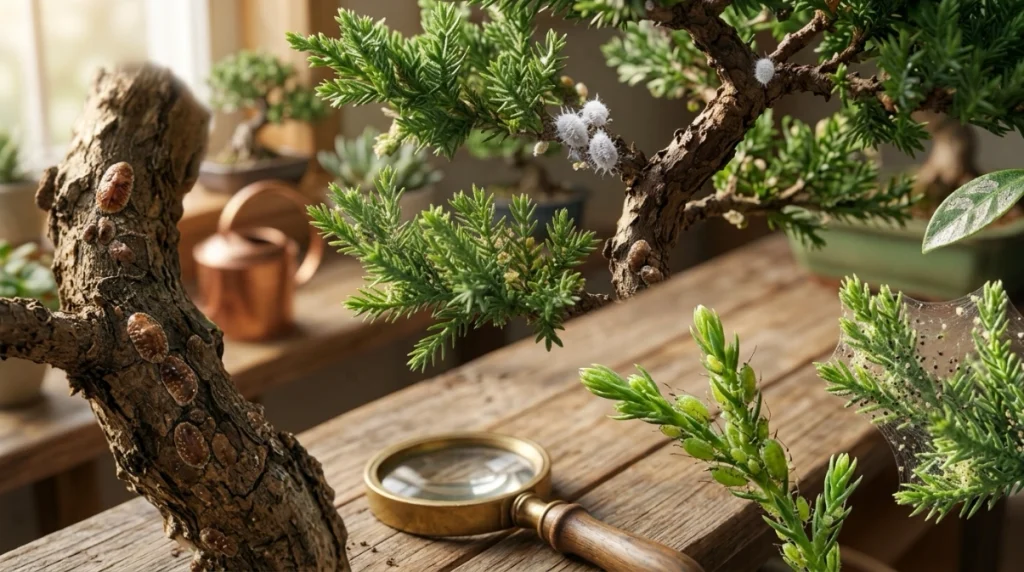
| Pest | Common Warning Signs | How It Spreads | Risk to Nearby Plants |
|---|---|---|---|
| Aphids | Clusters on new shoots, curled leaves, sticky honeydew, white shed skins | Crawling, flying adults, plant contact | High when susceptible plants are close together |
| Spider mites | Fine webbing, pale stippling, dusty-looking leaves, leaf drop | Crawling, air currents, tools and clothing | High in warm, dry, crowded conditions |
| Scale insects | Brown or white bumps, sticky foliage, weak shoots, yellow leaves | Mobile young called crawlers, plant contact, tools | Moderate to high because early stages are difficult to see |
| Mealybugs | White cotton-like material, honeydew, black sooty growth | Crawling, hidden eggs, pots and tools | High among indoor tropical plants |
| Thrips | Silvery scars, black specks, distorted leaves and flowers | Flying, jumping, crawling | High because adults are mobile and small |
| Whiteflies | Tiny white adults fly up when leaves are disturbed | Flying between plants | High in indoor collections and greenhouses |
| Fungus gnats | Small dark flies near soil, larvae in wet organic material | Flying adults and shared potting material | Moderate; greatest where soil remains consistently damp |
Aphids
Aphids prefer tender growth and often gather around shoot tips and young leaves. They remove plant sap and produce sticky waste called honeydew. Black sooty mold may grow on this residue, making the foliage look dirty.
Wingless aphids crawl between touching plants, while winged forms can reach plants farther away. Ant activity around a bonsai may also indicate aphids or another honeydew-producing pest.
Spider Mites
Spider mites are not insects; they are tiny relatives of spiders. They pierce individual plant cells, creating fine pale or bronze speckles across the foliage. Severe infestations cause webbing, discoloration, weakness, and premature leaf loss.
They are especially troublesome on indoor bonsai kept near heaters, sunny windows, or dry ventilation systems. Their small size lets them move unnoticed on hands, sleeves, and equipment.
Scale Insects and Mealybugs
Adult scale insects may remain fixed in one place, but newly hatched scale insects—called crawlers—are mobile. They can move along a branch, cross touching foliage, or be transferred on tools.
Mealybugs are more visibly mobile. Look for cotton-like deposits in branch forks, under leaves, around roots, and beneath the lip of the bonsai pot.
Thrips and Whiteflies
Thrips are slender insects that can fly, jump, or crawl. Their feeding often leaves silvery or streaked damage rather than clean holes. Whiteflies hide under leaves and fly upward in a small cloud when disturbed.
Both pests can move quickly through an indoor plant collection. Sticky monitoring cards may help reveal adult activity, but they do not eliminate eggs or immature pests already on the plant.
Are All Nearby Plants Equally Vulnerable?
No. A pest may spread physically to another plant without being able to establish a successful population there. Risk depends on the pest species, plant type, temperature, humidity, and general plant health.
Plant Species Matters
Some pests feed on a broad range of plants, while others prefer particular plant families. Spider mites, aphids, thrips, and mealybugs often have a wide enough host range to threaten mixed collections.
A pest found on a juniper bonsai may not thrive on every tropical houseplant. However, you should not assume a nearby plant is safe without identifying the pest and inspecting the plant carefully.
Indoor and Outdoor Collections Face Different Risks
Indoor collections provide stable temperatures and shelter from rain, wind, and natural predators. Pest populations may reproduce throughout the year under these conditions.
Outdoor bonsai may benefit from rainfall and beneficial insects, but they are exposed to pests from surrounding vegetation. Flying insects can arrive from gardens, weeds, landscape trees, or neighboring properties.
Never move an infested indoor bonsai outdoors without considering the season and species. A tropical ficus may suffer serious cold damage, while an outdoor juniper can decline when kept indoors for extended periods.
Stressed Plants Are More Likely to Decline
Healthy plants can still become infested, but stressed plants often show damage sooner. Common stress factors include:
- Overwatering or compacted soil
- Root rot or poor drainage
- Insufficient light
- Excessive fertilizer
- Recent repotting or heavy pruning
- Heat or cold injury
- Incorrect indoor placement
- Poor airflow and crowded foliage
Pest treatment should therefore include correcting the care problem that is weakening the tree. Spraying repeatedly while the roots remain waterlogged will not restore good vigor.
What to Do Immediately When You Find Pests
Do not panic or discard the bonsai immediately. Most common infestations are manageable when detected early. Take deliberate steps to prevent accidental spread.
- Stop handling other plants. Finish inspecting the affected tree before moving through the rest of the collection.
- Move the bonsai into quarantine. Use a separate room or protected growing area suitable for that species.
- Inspect the entire tree. Check leaf undersides, shoots, branch forks, bark, trunk, soil surface, drainage holes, and pot rim.
- Identify the pest as closely as possible. Use a hand lens or a phone camera with macro capability.
- Remove heavily infested debris. Seal removed leaves and insects in a bag before disposal.
- Clean the work area and tools. Avoid carrying crawlers or eggs to another plant.
- Inspect every nearby plant. Pay particular attention to plants whose foliage touched the affected bonsai.
- Begin the least disruptive effective treatment. Match the method to the pest and tree species.
Do not repot automatically. Most foliage pests do not require root disturbance. Repotting an already stressed tree can add another major burden unless the infestation involves the soil or roots, drainage has failed, or root rot is also present.
Expert Tip: Place a white sheet of paper beneath a branch and tap the foliage gently. Moving dots on the paper can reveal spider mites, thrips, and other tiny pests that are difficult to see while they remain on the tree.
How to Quarantine an Infested Bonsai
Quarantine means separating a potentially infested plant so pests cannot reach healthy plants while you inspect and treat it. Good quarantine requires more than placing the bonsai on an adjacent shelf.
Choose a Suitable Isolation Area
The area should be far enough from other plants to prevent leaf contact and reduce flying movement. It must also meet the bonsai species’ basic needs for light, temperature, humidity, and airflow.
An indoor tropical bonsai may be isolated near a bright window or under a grow light. An outdoor species should normally remain outdoors in a separate protected area rather than being moved into a warm living room.
Use Separate Equipment
Keep a dedicated watering container, cleaning brush, and basic tools in the quarantine area if possible. If equipment must be shared, clean and disinfect it before returning it to general use.
Always care for healthy plants first and the quarantined plant last. This simple order reduces the chance of carrying insects into the collection.
Monitor for Several Pest Cycles
One treatment may kill exposed adults but miss eggs or insects protected beneath waxy coverings. Continue inspecting the bonsai every few days and repeat treatment only as directed.
As a practical approach, keep the plant isolated until:
- No live pests are visible.
- No fresh webbing, honeydew, or cottony material appears.
- New leaves are not developing fresh feeding damage.
- The required treatment course is complete.
- At least two careful follow-up inspections find no activity.
The exact period varies with the pest, product, temperature, and severity. A quarantine of several weeks is often more dependable than returning the tree immediately after the first clean inspection.
How to Treat the Bonsai Without Harming It
The best treatment depends on the pest, tree species, infestation level, and growing environment. Begin with identification rather than reaching for the strongest product available.
Start With Physical Removal
For a light infestation, physical controls may be enough to reduce pest numbers significantly:
- Rinse suitable foliage with a controlled stream of water.
- Wipe larger leaves gently with a damp cloth.
- Remove isolated, heavily infested leaves or shoots.
- Use a soft brush to dislodge visible insects.
- Remove dead leaves and organic debris from the soil surface.
Protect the soil from washing out and avoid harsh water pressure. Do not remove so much foliage that the tree loses its ability to photosynthesize, especially after repotting or during weak growth.
Use Insecticidal Soap or Horticultural Oil Carefully
Commercial insecticidal soaps and horticultural oils can control many soft-bodied pests when the spray directly covers them. Coverage beneath leaves and inside branch junctions is important.
However, these products are not harmless to every plant. Test a small section first, avoid application during extreme heat or intense sunlight, and follow the label. The [University of Minnesota’s guidance on managing indoor plant insects](https://extension.umn.edu/garden-and-home/yard-and-garden/yard-and-garden-insects/insects-indoor-plants) warns against substituting homemade dish-soap mixtures because they may burn plants.
Some delicate bonsai species, fresh growth, flowers, or trees under moisture stress may react badly to sprays. Water appropriately before treatment if the product directions recommend treating only adequately hydrated plants.
Reserve Stronger Products for Confirmed Problems
A systemic insecticide is absorbed and transported through the plant. It may be useful against certain sap-feeding pests, but it is not appropriate for every pest or situation. Some systemic products can also harm pollinators when treated plants are moved outdoors or allowed to flower.
Never apply a pesticide merely because a leaf looks unhealthy. Yellowing may result from overwatering, poor light, root damage, nutrient imbalance, seasonal change, or disease rather than insects.
The [EPA’s pesticide safety recommendations](https://www.epa.gov/pesticide-incidents/pesticide-safety-tips) emphasize using non-chemical controls where practical and following every label precaution. Keep children and pets away for the period specified on the label, wear required protective equipment, and never assume that doubling the dose will improve control.
Avoid Treating Every Plant Automatically
Preventively spraying an entire collection can damage sensitive foliage, kill beneficial insects, increase unnecessary exposure, and make future pest control more difficult.
Inspect nearby plants first. Treat plants that show evidence of the same pest or when the product label and professional guidance clearly support a coordinated treatment.
How to Inspect the Rest of Your Plant Collection
Begin with plants that were closest to the infested bonsai. Work outward and keep notes if you have a large collection.
For each plant, check:
- New shoots for aphids and distorted growth
- Leaf undersides for mites, whiteflies, eggs, and webbing
- Branch joints for mealybugs
- Woody stems for scale-like bumps
- Leaves for pale stippling, silver scarring, or black specks
- Soil surfaces for adult fungus gnats
- Foliage and pots for sticky honeydew
- Overall vigor, including unexplained yellowing or leaf drop
Use sticky cards as monitoring tools where appropriate, especially for whiteflies, thrips, and fungus gnats. Remember that traps catch only certain mobile adults. A clean trap does not prove there are no eggs, larvae, crawlers, or mites on the plant.
How to Prevent Future Pest Spread
Quarantine Every New Plant
Inspect new bonsai, houseplants, and accent plants before placing them near the collection. Keep them separate for several weeks and examine them repeatedly rather than relying on one quick inspection.
Remove decorative pot sleeves, check beneath the container, and examine the drainage holes. Pests sometimes remain hidden where normal watering and cleaning do not disturb them.
Give Plants Enough Space
A small gap between canopies limits direct transfer and improves airflow. It also lets you rotate, water, and inspect each bonsai without brushing against its neighbors.
Keep Tools and Benches Clean
Remove soil and plant material from tools before disinfecting them with an appropriate method. Clean benches, trays, and turntables regularly. Do not leave pruned infested foliage beside healthy plants.
Maintain Appropriate Bonsai Care
A properly placed and watered bonsai is better able to recover from minor feeding damage. Provide the light, seasonal conditions, watering pattern, soil drainage, and fertilizer strength required by the species.
Do not try to “boost” a weak, infested bonsai with excessive fertilizer. Damaged roots may be unable to use the nutrients, and salt accumulation can create additional stress.
Inspect on a Consistent Schedule
Check vulnerable areas whenever you water, then perform a closer inspection at least weekly during active growth or when pests are common. Early detection usually means fewer treatments, lower expense, and less damage.
Cost, Product Quality, and Species Suitability
Pest management does not need to be expensive. A hand lens, white paper, clean brush, and good inspection light can reveal problems before costly treatments are necessary.
Ready-to-use insecticidal products usually cost more per application than concentrates, but they reduce measuring errors and may suit beginners with only a few trees. Concentrates can be economical for a large collection, although accurate dilution and safe storage are essential.
Product quality matters less than correct pest identification, legal labeling, and species compatibility. An expensive pesticide used against the wrong pest is still a poor purchase.
Before buying any treatment, confirm:
- The target pest appears on the label.
- The intended plant or use site is permitted.
- The product can be used indoors or outdoors as required.
- The bonsai species is not known to be sensitive to it.
- You can follow the temperature, ventilation, and protective-equipment directions.
- The container size is appropriate for your collection.
The [EPA’s information about pesticides and indoor air quality](https://www.epa.gov/indoor-air-quality-iaq/pesticides-impact-indoor-air-quality) recommends using non-chemical options when possible, applying only recommended quantities, and increasing ventilation during indoor use.
Common Mistakes Bonsai Owners Should Avoid
- Waiting for severe damage: Webbing, major leaf drop, or widespread honeydew often indicates that the infestation is already established.
- Placing the tree only a few inches away: Flying pests and mites carried by air currents may still reach neighboring plants.
- Using homemade detergent mixtures: Household soaps may strip protective leaf coatings and cause chemical burns.
- Applying too much pesticide: A stronger mixture can injure the tree without improving pest control.
- Treating only once: Eggs or protected life stages may survive and restart the infestation.
- Spraying without identifying the cause: Root rot, poor lighting, and watering problems can resemble pest damage.
- Repotting a weak tree unnecessarily: Root disturbance can further reduce vigor when the pest lives only on foliage.
- Ignoring nearby plants: A clean-looking bonsai does not mean the infestation has not reached its neighbors.
- Returning the tree too soon: Continue quarantine until follow-up inspections show no new activity.
- Using the same tools without cleaning: Pest crawlers and contaminated debris can travel between trees.
- Changing the tree’s environment dramatically: Quarantine should not expose an outdoor bonsai to warm indoor conditions or an indoor tropical tree to cold weather.
When to Ask an Experienced Bonsai Grower or Arborist

Ask an experienced bonsai grower, local extension professional, or qualified arborist when you cannot identify the pest, several plants are affected, or the bonsai continues declining after careful treatment.
Expert help is especially valuable when:
- The tree is old, valuable, collected, or difficult to replace.
- The infestation involves extensive deadwood, bark cavities, or roots.
- Branches are dying despite visible pest removal.
- You suspect both root rot and insect damage.
- The tree recently underwent major root work or structural pruning.
- The treatment label does not clearly cover the species or intended location.
- You suspect a regulated or invasive pest.
- Children, pets, fish, or pollinators make chemical treatment risky.
An arborist is generally more relevant for larger landscape trees or serious woody-plant health problems. A knowledgeable bonsai grower may be better equipped to balance pest treatment with bonsai-specific concerns such as limited root volume, seasonal work, and preservation of valuable branches.
Do not perform major pruning, aggressive root washing, and chemical treatment at the same time on a weak bonsai unless an experienced professional recommends it. Combining several stressful procedures may cause more harm than the original infestation.
FAQs
Can spider mites spread from a bonsai to houseplants?
Yes. Spider mites can crawl between touching plants and travel on hands, clothing, tools, or air currents. Isolate the affected bonsai and inspect nearby houseplants for stippled leaves, fine webbing, and tiny moving dots.
How far should an infested bonsai be kept from other plants?
A separate room or enclosed growing area is best for indoor plants. Distance alone cannot completely stop flying pests. For outdoor bonsai, use a separate bench while maintaining the temperature, sunlight, and seasonal conditions the species needs.
Should I treat all my plants if one bonsai has pests?
Not automatically. Inspect every nearby plant and identify the pest first. Unnecessary treatment can injure sensitive plants and expose people, pets, and beneficial insects to pesticides without providing a meaningful benefit.
How long should a bonsai stay in quarantine?
Keep it isolated through the full treatment period and until repeated inspections reveal no live pests or fresh damage. This often requires several weeks because eggs and protected immature stages may survive the first treatment.
Can bonsai pests live in the soil?
Some can. Fungus gnat larvae live in moist organic material, while root mealybugs may infest the root zone. Many common pests, however, live mainly on leaves and branches, so soil replacement is not always necessary.
Can pests spread through bonsai tools?
Yes. Tiny insects, eggs, and plant debris may remain on cutters, brushes, chopsticks, or work surfaces. Clean equipment after handling an infested bonsai and work on healthy trees before treating quarantined ones.
Can a bonsai recover after a serious infestation?
Many bonsai recover if enough healthy roots, foliage, and living branches remain. Recovery depends on the tree species, season, pest severity, and underlying care. Avoid heavy pruning, repotting, or excessive fertilizer while the tree is weak.
Conclusion
Can bonsai pests spread to other plants? They certainly can. Aphids, spider mites, scale insects, mealybugs, thrips, whiteflies, and fungus gnats may travel through direct contact, flight, tools, clothing, debris, or newly introduced plants.
The safest response is to isolate the affected bonsai immediately, identify the pest, inspect every nearby plant, and use the least disruptive effective control. Maintain the correct environment for the tree during quarantine and continue monitoring after visible pests disappear.
Make close inspection part of your regular watering routine. Check beneath leaves, around new shoots, along branches, and near the soil surface. If you find a suspicious sign, separate the bonsai early and act before a small, manageable pest problem spreads through your entire collection.
