Why Are My Bonsai Leaves Dry and Crispy?

Dry, crispy bonsai leaves can be alarming, especially when a tree seemed healthy only a few days earlier. The damage may begin at the leaf tips, spread around the edges, or affect entire leaves until they become brittle and fall.
If you are wondering “Why are my bonsai leaves dry and crispy?”, the most common causes are improper watering, excessive sun or heat, damaged roots, low humidity, fertilizer burn, or pest problems such as spider mites.
The good news is that crispy leaves do not automatically mean your bonsai is dying. What matters most is identifying why the leaves are drying before changing your care routine. This guide will help you diagnose the symptoms, correct the underlying problem, and avoid making a stressed tree worse.
Quick Answer
Bonsai leaves usually become dry and crispy when the tree is losing water faster than its roots can replace it. Underwatering, excessive heat, sunburn, root damage, low humidity, fertilizer buildup, and spider mites are common causes. Check the soil, roots, recent environmental changes, and leaf undersides before treating the tree.
What Do Dry and Crispy Bonsai Leaves Mean?
A crispy leaf contains tissue that has dried enough to die. Once that section of a leaf becomes brown, brittle, and papery, it will not turn green again.
Your goal is therefore not to repair damaged leaves. It is to protect the healthy leaves, buds, branches, and roots so the bonsai can produce new growth.
Leaf drying commonly begins in one of three ways:
- Brown, crispy tips often indicate water stress, dry air, salt buildup, or root problems.
- Dry margins around the entire leaf can point to heat, intense sun, or insufficient water movement.
- Whole leaves becoming crisp may indicate severe dehydration, root failure, pest damage, or serious environmental stress.
University horticulture guidance notes that prolonged drought can cause leaf scorch, browning, leaf drop, and reduced growth. University of Maryland Extension guidance on drought stress
The Most Common Causes of Dry and Crispy Bonsai Leaves
1. The Bonsai Has Become Too Dry
Underwatering is one of the first things to investigate.
Bonsai pots hold relatively little soil, and many bonsai substrates are intentionally free-draining. During warm, windy, or sunny weather, a small bonsai can therefore dry much faster than an ordinary houseplant.
Signs of dehydration include:
- Dry or very light-colored substrate
- Soil pulling away from the pot
- Wilting before leaves become crispy
- Brown leaf tips and edges
- Brittle leaves
- Sudden leaf drop
- Thin twigs beginning to shrivel
Do not water according to a fixed schedule such as “every three days.” Check the substrate instead.
Push a finger slightly into the surface or use a wooden chopstick to assess moisture. When the upper layer is beginning to dry but the root mass is not completely dry, water thoroughly until water drains freely from the holes in the pot.
Do not compensate for previous underwatering by keeping the tree permanently soaked afterward. That can create a second problem: damaged, oxygen-starved roots.
2. Too Much Sun or Heat Is Scorching the Leaves
Bonsai trees need light, but the correct amount depends heavily on the species.
A juniper, pine, or many temperate outdoor species generally tolerates considerably stronger light than a shade-adapted tropical bonsai kept indoors.
Sun scorch is particularly likely after:
- Moving an indoor tree directly outdoors
- Moving a bonsai from shade into full afternoon sun
- A sudden heat wave
- Placing a tree close to hot glass
- Allowing the pot to become excessively hot
- Combining strong sunlight with dry soil
Sunburn often produces pale, faded, tan, or brown patches that later become dry and brittle. University of Maryland Extension notes that sudden increases in direct sunlight can cause leaf scorch and that damage becomes more severe when intense sun is combined with dry soil. University of Maryland Extension information on sunburn damage
If you recently changed the tree’s location, move it to bright but less intense light while it stabilizes. Do not move a sun-loving outdoor bonsai permanently into a dark room.
Could Overwatering Cause Crispy Bonsai Leaves?
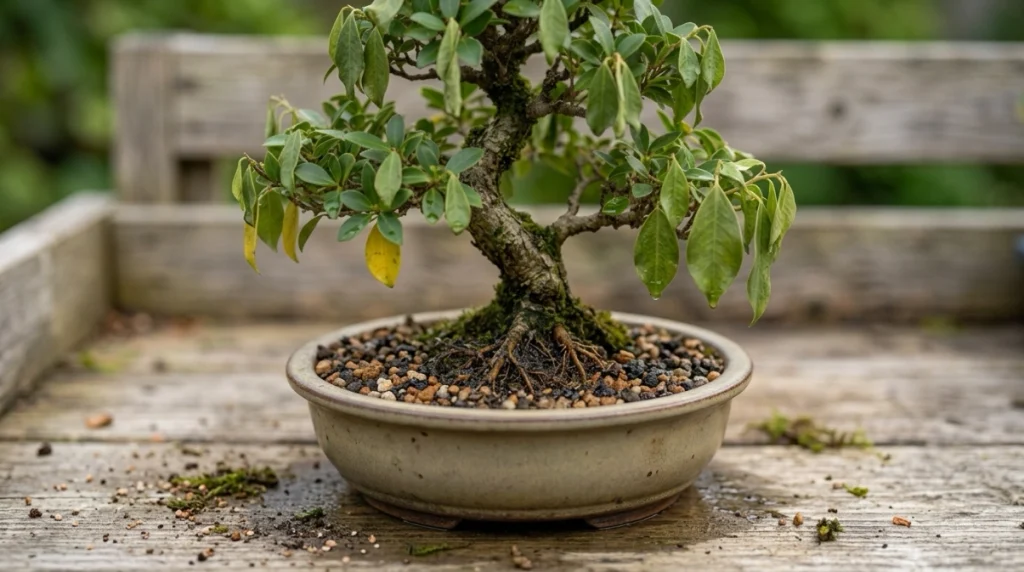
Yes. This seems contradictory, but a constantly wet bonsai can eventually show symptoms that resemble dehydration.
Roots need both moisture and oxygen. If the substrate remains saturated for too long, fine roots may deteriorate. Damaged roots cannot efficiently supply water to the foliage, even though the pot itself is wet.
Warning signs include:
- Soil remaining wet for unusually long periods
- Yellow leaves followed by browning
- Wilted foliage despite wet soil
- A sour or unpleasant smell from the root zone
- Soft or blackened roots
- Weak new growth
- Progressive branch dieback
Healthy roots are generally firm. Severely rotted roots commonly become dark, soft, or mushy. University of Maryland Extension guidance for diagnosing indoor plant problems
Do not immediately repot every bonsai with crispy leaves. Root work is stressful, and disturbing the roots of an already dehydrated tree can make recovery harder.
Repot only when there is good reason to suspect a serious drainage or root problem and when the species and season make root work reasonably safe.
Quick Diagnostic Table
| What You Notice | Possible Cause | Best First Step |
|---|---|---|
| Soil bone-dry and leaves brittle | Underwatering | Water thoroughly and monitor moisture more closely |
| Brown edges after hot weather | Heat or sun scorch | Reduce harsh afternoon exposure |
| Wet soil plus wilted or brown leaves | Root stress or root rot | Inspect drainage and root health |
| Fine speckling and webbing | Spider mites | Isolate and inspect leaf undersides |
| Crispy tips after fertilizing | Fertilizer salt burn | Stop feeding and flush appropriately |
| Damage mainly near a heater or vent | Dry air or hot airflow | Move the tree away from the airflow |
| Leaves dry after relocation | Environmental shock | Stabilize light, temperature, and watering |
| Only old leaves drying seasonally | Possibly normal leaf turnover | Check species and seasonal behavior |
Check Carefully for Spider Mites
Because this symptom is often blamed entirely on watering, bonsai owners sometimes miss pests.
Spider mites are especially important when leaves look dry, faded, speckled, bronze, or crispy. They are extremely small and often feed on the underside of leaves.
Look for:
- Fine webbing between leaves or twigs
- Tiny white or yellow dots on foliage
- Bronzed leaves
- Premature leaf drop
- Tiny moving specks beneath leaves
A simple test is to hold a sheet of white paper underneath a branch and gently tap the foliage. Tiny moving dots on the paper may indicate mites.
The University of Minnesota Extension spider mite guide explains that spider mites are especially troublesome in hot, dry conditions and that severe feeding can cause bronzing and leaf drop.
If mites are present, isolate the bonsai from nearby plants. This reduces the chance of pests spreading while you decide on treatment.
Do Not Spray Before Identifying the Pest
Avoid randomly applying insecticide because a leaf looks unhealthy.
Some sprays can burn sensitive foliage, and unnecessary treatment can add stress without solving the original problem.
Start with physical and cultural controls when practical. Depending on the species and infestation, this may include washing foliage, removing heavily affected leaves, improving growing conditions, or using an appropriate labeled product.
If you use a pesticide, follow the product label exactly. The EPA emphasizes that pesticide labels explain proper use, precautions, storage, and safety requirements. EPA guidance on reading pesticide labels
Keep pesticides away from children and pets and never assume that applying more product will provide better control.
Low Humidity and Dry Indoor Air
Low humidity usually does not kill a healthy bonsai by itself, but it can increase water loss from foliage.
Tropical bonsai such as many ficus varieties may struggle when placed directly beside:
- Heating vents
- Radiators
- Air conditioners
- Strong fans
- Very hot windows
- Constant dry airflow
Move the tree away from direct hot or cold airflow.
A humidity tray can provide a small amount of localized humidity, but it should not be treated as a substitute for correct watering or proper species care.
Also remember that many bonsai are not indoor plants. Junipers, maples, elms, pines, and many other temperate trees generally need outdoor seasonal conditions. Keeping an outdoor species permanently indoors can gradually weaken it even when watering seems correct.
Fertilizer Burn and Salt Buildup
More fertilizer does not mean faster bonsai growth.
Because a bonsai grows in a relatively small quantity of substrate, excessive fertilizer salts can damage fine roots and contribute to scorched leaf edges.
Suspect fertilizer burn when crispy leaves appear soon after:
- Increasing fertilizer concentration
- Feeding a severely dry bonsai
- Applying fertilizer too frequently
- Using several fertilizer products together
- Allowing salts to accumulate in poorly draining soil
If fertilizer burn seems likely, stop feeding temporarily and stabilize watering. Depending on the substrate and species, thorough watering may help remove excess soluble salts.
Do not fertilize a severely stressed bonsai simply because it looks weak. Fertilizer is useful when a tree is actively growing and capable of using nutrients. It does not repair dead foliage or rotten roots.
Has the Bonsai Recently Been Repotted?
Repotting temporarily reduces the tree’s ability to absorb water because some fine roots are normally disturbed or removed.
Crispy foliage after repotting may result from:
- Excessive root pruning
- Root exposure during the procedure
- Repotting at the wrong seasonal stage
- Strong sunlight immediately afterward
- Poor aftercare
- Removing too much foliage and root mass at once
A recently repotted bonsai usually benefits from stable conditions while new roots establish.
Avoid combining several stressful jobs at once. For example, major root pruning, heavy branch pruning, wiring, fertilizing, and pest treatment should rarely all be performed on an already weak tree at the same time.
Root work also requires species knowledge. A vigorous ficus and a stressed pine should not automatically receive identical treatment.
Is Your Bonsai in the Wrong Soil?
Poor substrate can create both extremes: too dry and too wet.
Very compact organic soil may remain saturated around the roots, while an extremely coarse mix can dry faster than a beginner expects.
Good bonsai substrate should balance:
- Drainage
- Water retention
- Air around the roots
- Structural stability
- Particle durability
Higher-quality bonsai soil components usually maintain useful structure longer than materials that quickly break down into fine particles. However, an expensive soil mix is not automatically better if it does not suit your climate, species, watering habits, and pot size.
A beginner who cannot water several times during a hot summer day may need slightly more moisture retention than an experienced grower who closely monitors trees throughout the day.
Expert Tip
Expert Tip: Before treating crispy foliage, check the soil moisture and leaf undersides on the same day. Underwatering and spider mites can look surprisingly similar, and treating the wrong problem may delay recovery.
How to Help a Bonsai With Dry and Crispy Leaves
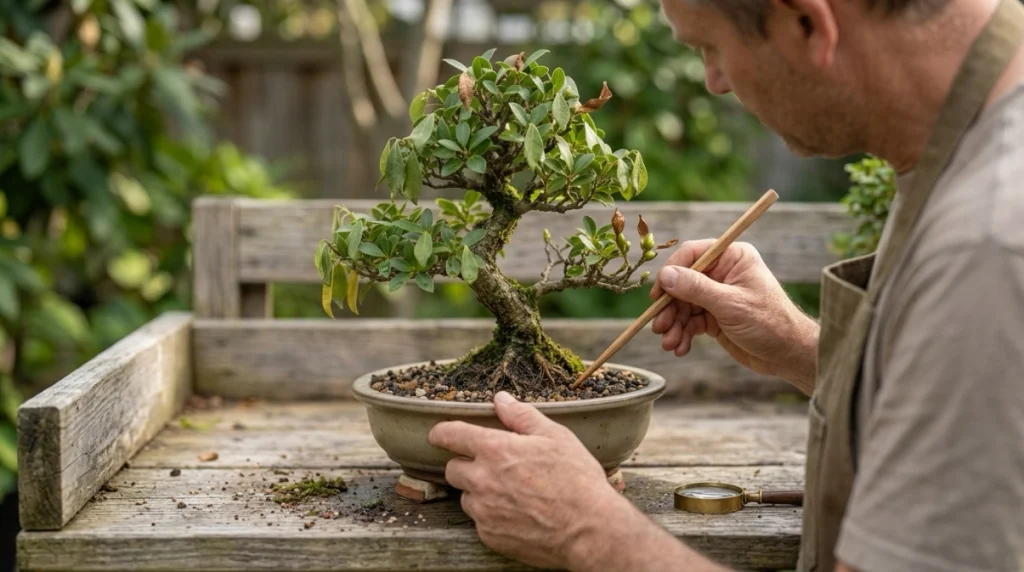
Avoid trying five treatments at once. Instead, work systematically.
- Check whether the tree is still alive.
Look for flexible twigs, living buds, or green tissue beneath a tiny scratch in the bark. Do not repeatedly scratch important branches. - Check the soil moisture.
Determine whether the root ball is dry, damp, or constantly saturated. - Review recent changes.
Consider whether you recently moved, repotted, fertilized, sprayed, pruned, or exposed the bonsai to stronger sunlight. - Inspect the foliage closely.
Look under leaves and around branch junctions for mites, scale insects, webbing, sticky residue, or unusual spots. - Correct the most likely cause.
Restore proper watering, reduce extreme exposure, isolate pests, or correct drainage as appropriate. - Give the tree time.
Once the underlying problem is corrected, avoid repeatedly moving or treating the bonsai.
Recovery should be judged by healthy buds and new growth, not by whether old crispy leaves improve.
Should You Remove Crispy Bonsai Leaves?
Completely dead leaves can usually be removed once you understand the cause, but there is rarely a need to strip every damaged leaf immediately.
A partially green leaf can still contribute to photosynthesis, which is the process the tree uses to convert light into energy.
On a severely stressed bonsai, preserving functioning foliage may be more helpful than making the tree look tidy.
Avoid heavy pruning until the tree shows clear signs of recovery.
Common Mistakes Bonsai Owners Should Avoid
- Watering on a fixed calendar instead of checking the soil.
- Assuming brown leaves always mean underwatering. Wet, damaged roots can produce similar symptoms.
- Moving a shaded bonsai directly into intense sunlight.
- Bringing outdoor species indoors permanently because they look delicate.
- Fertilizing heavily to “revive” a weak tree.
- Repotting immediately without confirming a root problem.
- Using pesticide before identifying the pest.
- Applying stronger-than-label pesticide concentrations.
- Removing every damaged leaf from a weak tree.
- Changing watering, soil, location, fertilizer, and pest treatment simultaneously.
The best recovery strategy is usually the least disruptive one that fixes the actual cause.
When to Ask an Experienced Bonsai Grower or Arborist
Many leaf problems can be corrected at home, but expert help is worthwhile when the cause remains unclear or valuable woody material is at risk.
Ask an experienced bonsai grower when:
- Most foliage becomes crispy within a few days.
- Important branches begin dying back.
- You suspect severe root rot.
- The tree needs emergency repotting outside its normal repotting season.
- A valuable or old bonsai is declining rapidly.
- You cannot identify a suspected pest or disease.
- The trunk or major branches show unusual lesions, cankers, or decay.
- You are considering aggressive root or structural work on an already stressed tree.
For a large landscape-grown tree being trained as bonsai or a tree with significant structural or disease concerns, a qualified arborist may be more appropriate.
Getting experienced help can cost more than DIY diagnosis, but for an old, expensive, collected, or irreplaceable bonsai, avoiding one serious mistake may be worth far more than the consultation.
FAQs
Can crispy bonsai leaves turn green again?
No. Once leaf tissue becomes brown, dry, and crispy, that tissue is dead. Focus on correcting the cause and watching for healthy buds or new leaves.
Should I water my bonsai immediately if its leaves are crispy?
Check the soil first. If the root ball is dry, water thoroughly. If the soil is already saturated, adding more water could worsen a root problem.
Can overwatering make bonsai leaves dry?
Yes. Prolonged saturation can damage roots, reducing their ability to transport water to the foliage. The leaves may eventually wilt, brown, or dry even though the soil remains wet.
Why are only the tips of my bonsai leaves crispy?
Crispy tips commonly result from inconsistent watering, excessive heat, dry airflow, fertilizer salts, or root stress. Review recent care changes before applying treatment.
Can spider mites cause crispy bonsai leaves?
Yes. Spider mites remove plant fluids from the foliage. Heavy infestations can cause stippling, bronzing, drying, webbing, and premature leaf drop.
Should I repot a bonsai with crispy leaves?
Not automatically. Repotting adds stress. Only consider immediate root work when serious drainage or root deterioration is strongly suspected and you understand the species’ tolerance and seasonal requirements.
How long does a bonsai take to recover from crispy leaves?
Recovery varies by species, season, and severity. A mildly stressed, actively growing bonsai may produce healthy new growth relatively quickly, while severe root damage can require much longer. Judge recovery by new buds, shoots, and stable branches rather than damaged old leaves.
Conclusion
If you have been asking “Why are my bonsai leaves dry and crispy?”, start with the basics: inspect the soil, check the roots indirectly through drainage and moisture behavior, review sunlight and temperature changes, and examine the foliage carefully for pests.
Underwatering is common, but it is not the only explanation. Excess water, root damage, intense sun, fertilizer salts, dry indoor conditions, unsuitable soil, repotting stress, and spider mites can all produce similar symptoms.
The safest approach is to diagnose first and treat second. Avoid panic watering, heavy fertilizing, unnecessary repotting, or spraying pesticides without evidence.
Once you identify the likely cause, correct it gently and give your bonsai stable growing conditions. Then watch the buds and new foliage—the tree’s next growth will tell you far more about its recovery than the old crispy leaves.
