
Aphid Eggs on Bonsai: What to Do

Quick Answer
If you find aphid eggs on a bonsai, first confirm that they are eggs rather than scale insects, mites, or debris. Some aphid species overwinter as tiny eggs on woody stems and near buds, then hatch as growth resumes in spring. For confirmed overwintering aphids, a correctly timed, labeled horticultural oil may help by coating the eggs before they hatch; Colorado State University Extension’s aphid guidance explains this dormant-season approach.
What to do first
- Confirm the pest: Aphid eggs are tiny and species-dependent, so don’t treat an unidentified bump simply because it looks like an egg.
- Inspect the buds: Check twig junctions, bark crevices, bud bases, and last season’s young growth with a hand lens.
- Check the season: Dormant eggs are most relevant before spring growth begins, not during every aphid infestation.
- Remove reachable eggs: Small confirmed deposits can often be wiped or brushed away carefully without damaging buds or bark.
- Use oil cautiously: Apply only a horticultural oil whose label permits use on your plant and at the correct seasonal stage.
Most important caution
- Don’t spray household detergent, cooking oil, or an improvised mixture onto a valuable bonsai. Small trees can show foliage or bark injury from unsuitable concentrations.
Finding what looks like aphid eggs on a bonsai can be confusing because growers usually notice the adults first. Eggs are smaller, less obvious, and easy to confuse with other pests.
I’ve found that the safest approach is identification first and treatment second. This guide covers what aphid eggs look like, where to search, when to remove them, and when horticultural oil makes sense.
In This Guide
What Are Aphid Eggs on a Bonsai?
Aphid eggs are the overwintering stage produced by some aphid species. They allow the insects to survive unfavorable seasons before hatching when conditions improve.
Many aphids reproduce rapidly without laying eggs during warm weather. Their life cycles can change with species, host plant, climate, and season.
Definition: An aphid egg is a dormant reproductive stage laid by certain aphids, commonly on woody host tissue. It later hatches into a young aphid called a nymph.
On woody plants, overwintering eggs may occur around buds, bark cracks, twig junctions, or other protected sites. Some are less than 1 mm long, making a hand lens useful.
Do all aphids lay winter eggs?
No. Aphid biology differs widely between species, and not every aphid affecting a bonsai uses eggs on that particular tree as its overwintering stage.
Some aphids alternate between different host plants. Others can survive differently in mild climates or protected environments.
- Woody-host aphids: Some deposit overwintering eggs directly on trees or shrubs.
- Host-alternating aphids: They may spend different life stages on different plant species.
- Warm-climate populations: Some continue producing live young when conditions remain suitable.
- Indoor populations: Heated conditions can allow active aphids to persist instead of following an outdoor seasonal cycle.
This is why finding aphids during summer doesn’t automatically mean eggs are also present. The tree species and time of year matter.
Why are aphid eggs important on bonsai?
A few surviving eggs can start a new colony near tender spring growth. That timing matters because fresh buds and shoots are exactly where many aphids prefer to feed.
On a bonsai, distorted spring growth can interfere with branch development and fine ramification, which means the network of increasingly fine twigs.
I’ve learned to inspect last year’s shoots before spring growth opens fully. It takes only a few minutes on a small tree and can reveal problems before curled foliage hides them.
How Can You Identify Aphid Eggs on a Bonsai?
Look for tiny oval structures attached firmly to woody tissue, but don’t rely on appearance alone. Aphid eggs vary by species and may darken as they mature.
Use a 10× hand lens if possible. Good side lighting also makes raised insects and eggs easier to distinguish from bark.
Where should you look?
- Bud bases: Inspect the area immediately surrounding dormant buds.
- Young twigs: Check growth produced during the previous season.
- Bark crevices: Look inside protected cracks and rough areas.
- Branch junctions: Examine tight crotches and sheltered intersections.
- Old aphid sites: Give extra attention to shoots that carried colonies last season.
A deciduous bonsai without leaves is often easier to examine. Bare branches expose areas that would disappear beneath foliage later.
Aphid eggs vs. common look-alikes
Misidentification is one of the easiest ways to apply an unnecessary treatment. Scale insects in particular can resemble small bumps or eggs attached to stems.
| What You See | Typical Clue | What to Check Next |
|---|---|---|
| Possible aphid eggs | Tiny, oval, firmly attached near woody growth or buds | Season, host species, previous aphid activity |
| Scale insects | Raised shell-like or waxy bumps | Look for living tissue beneath the covering and honeydew from soft scale |
| Mite eggs | Often extremely small and associated with mites or webbing | Inspect closely with magnification |
| Bark texture | Repeating natural structures that match surrounding bark | Compare several branches before removing anything |
| Debris or soil particles | Irregular shapes that brush away easily | Check whether the material is truly attached |
Bonsai Empire’s pest and disease guide is also useful when comparing aphids with scale, mites, mealybugs, and other common bonsai pests.
Section Takeaway: Don’t treat every dark dot as an aphid egg. Location, season, host plant, magnification, and signs of previous aphid activity provide a much stronger diagnosis.
Should You Remove Aphid Eggs From a Bonsai?
Yes, confirmed aphid eggs that you can safely reach can usually be removed before they hatch. Physical removal is especially practical on bonsai because the canopy is small.
Work carefully around buds and thin bark. Preventing damage to the tree matters more than removing every questionable speck.
How I handle a small number of suspected eggs
- Photograph them first. A close picture helps with identification before you disturb the evidence.
- Examine them with magnification. Check several areas rather than assuming the first object represents the entire problem.
- Separate the bonsai. Move it away from nearby trees if you also find active pests.
- Remove confirmed deposits gently. Use a soft brush, cotton swab, or careful wiping where the bark permits.
- Reinspect the tree. Check buds and twig junctions from several directions.
- Watch spring growth. Look for newly hatched aphids as buds begin opening.
Avoid scraping thin young bark with a knife or other hard tool. A tiny pest problem isn’t worth creating a permanent wound.
Pro tip: If removing a suspected egg mass means cutting live wood or an important bud, ask an experienced grower or local bonsai club first. Irreversible pruning deserves more caution than pest wiping.
Should you prune an infested twig?
Usually not for a few eggs. Manual cleaning makes more sense when the branch is part of the design.
Pruning becomes reasonable when an expendable shoot is heavily infested, already damaged, or scheduled for removal anyway.
Section Takeaway: Manual removal is ideal for a few confirmed aphid eggs because bonsai gives you direct access to most branches. Preserve valuable buds and bark while you work.
Can Horticultural Oil Kill Aphid Eggs?
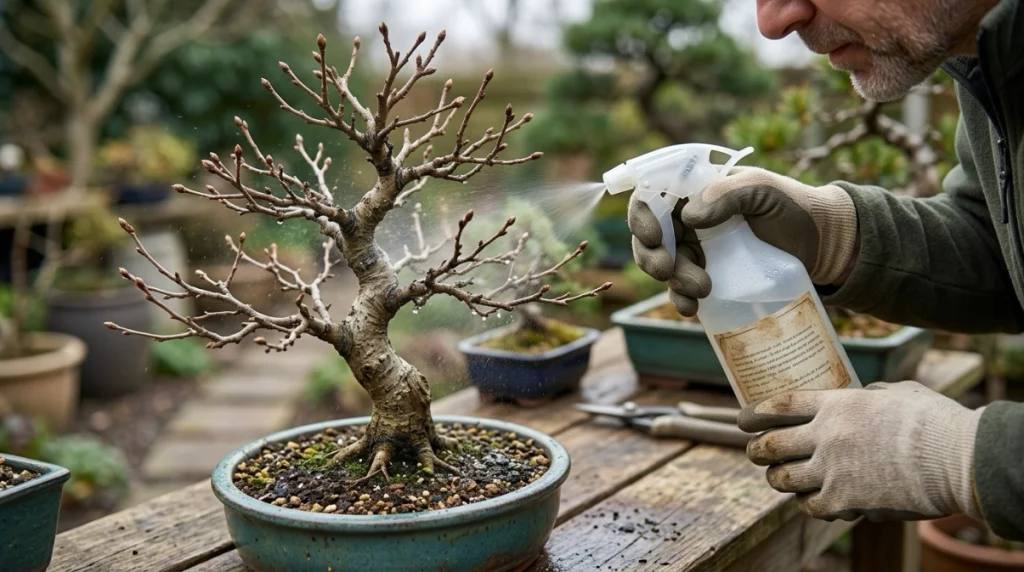
Horticultural oil can suppress overwintering eggs of certain aphid species when it reaches and coats them. Timing and complete coverage are important because oils largely work through direct contact.
Colorado State University Extension’s horticultural oil guidance describes dormant-season oil use against aphids and other overwintering pests on woody plants.
What does dormant oil mean?
Dormant oil refers mainly to when an appropriate horticultural oil is applied. It is generally used while woody plants are dormant or around the delayed-dormant period specified by the product label.
Modern horticultural oils vary. Never assume a product is suitable for your bonsai just because another oil worked on a different tree.
When should you consider oil?
- Eggs are confirmed: You have reasonable evidence that the structures are aphid eggs.
- The species tolerates it: The product label permits application to that plant or relevant ornamental category.
- Timing is appropriate: The tree is at a permitted dormant or growth stage.
- The bonsai isn’t stressed: Avoid adding treatment stress to a severely dehydrated or otherwise compromised tree.
- Weather fits the label: Temperature, moisture, and application conditions meet product directions.
Coverage matters more than drowning the tree. The spray needs to contact the target while remaining within the labeled rate.
Never increase concentration because a bonsai is valuable. Stronger isn’t automatically better and can raise the risk of phytotoxicity, which means plant injury caused by a chemical treatment.
Can you use homemade oil or dish soap?
I don’t recommend experimenting with household oil or detergent on bonsai. Household products aren’t formulated or labeled for predictable plant-pest control.
Commercial horticultural oils and insecticidal soaps provide directions for concentration, plant compatibility, and application. Those instructions matter on small, carefully developed trees.
Section Takeaway: A labeled horticultural oil can be useful against overwintering aphid eggs, but only when identification, tree species, timing, weather, and label directions all line up.
What Should You Do if Aphid Eggs Hatch?
Young aphids are usually easier to confirm than eggs. Look for clusters on opening buds, tender shoots, young leaves, and leaf undersides.
Aphids are soft-bodied sap feeders. Their feeding may distort tender growth and produce sticky honeydew.
Use the least disruptive control first
- Isolate the affected bonsai: Keep it away from nearby plants while you determine how widespread the infestation is.
- Inspect every growing tip: Young aphids can hide among unfolding leaves.
- Remove light colonies: Crush isolated insects or rinse sturdy foliage with controlled water pressure.
- Recheck after several days: Aphids reproduce quickly, so one inspection isn’t enough.
- Escalate only when needed: Use a labeled insecticidal soap, horticultural oil, or other registered treatment when physical removal isn’t controlling them.
The University of Minnesota Extension aphid guide notes that natural enemies such as lady beetles, lacewings, hover flies, and parasitic wasps can help reduce aphid populations.
Don’t confuse shed skins with eggs
After an infestation begins, pale white specks around a colony may be shed aphid skins rather than eggs. Aphids molt as they develop.
These empty skins don’t move or feed. Look for living insects nearby before deciding whether treatment is still needed.
Watch for honeydew and ants
Sticky leaves often indicate honeydew from aphids or another sap-feeding pest. Ants may visit these colonies for the sugary material.
Honeydew can also support dark sooty mold on plant surfaces. Control the sap-feeding pest rather than treating the dark coating as the primary problem.
How Can You Prevent Another Aphid Outbreak?
Regular inspection is more useful than routine preventive spraying. Catching a few aphids early is easier than treating a colony hidden inside curled leaves.
As of 2026, an integrated pest management approach remains sensible: identify the problem, monitor it, protect beneficial insects, and use targeted controls only when needed.
Inspect during the highest-risk periods
- Late dormancy: Examine woody twigs and bud bases for overwintering pests.
- Bud break: Watch closely as new leaves begin unfolding.
- Spring extension: Inspect tender shoots several times during rapid growth.
- After adding a new plant: Check both the newcomer and neighboring bonsai carefully.
- After a previous infestation: Give the same tree extra attention the following growing cycle.
Avoid forcing excessively soft growth
Healthy growth is desirable, but excessive nitrogen can produce lush tissue attractive to some aphids. Follow a feeding program suited to the species and development stage.
Utah State University Extension also notes an association between excessive fertilization and higher aphid densities in its aphid management guidance.
Protect beneficial insects outdoors
Lady beetles, lacewing larvae, hoverfly larvae, and parasitoid wasps naturally attack aphids. Broad-spectrum pesticide use can harm these useful insects.
Choose the narrowest effective treatment when intervention becomes necessary. Avoid spraying simply because one insect appears.
Section Takeaway: The best prevention is a repeatable inspection routine. Check buds before spring, tender shoots during active growth, and any new bonsai before mixing it into your collection.
Frequently Asked Questions About Aphid Eggs on Bonsai
What color are aphid eggs?
Aphid egg color varies by species and maturity. Some eggs become dark brown or black as they mature, so color alone isn’t enough for identification. Consider their shape, location, host plant, season, and previous aphid activity.
How small are aphid eggs?
Aphid eggs can be well under 1 mm long depending on the species. That makes a 10× hand lens useful when inspecting bonsai twigs, bud bases, and bark crevices.
Where do aphids lay eggs on bonsai trees?
Species that overwinter as eggs may place them on woody host tissue, including twigs, bark crevices, or areas around buds. The exact location depends on the aphid species and host plant.
Will aphid eggs survive winter?
Yes, overwintering eggs are specifically adapted to survive unfavorable seasonal conditions in aphid species that use this life cycle. They can hatch as temperatures rise and host growth becomes suitable.
Can I scrape aphid eggs off my bonsai?
You can gently remove confirmed eggs when doing so won’t damage buds or bark. A soft brush or careful wiping is safer than aggressive scraping, especially on young branches with thin bark.
Does neem oil kill aphid eggs?
Some neem-derived products have insecticidal properties, but results and permitted uses depend on the formulation. Don’t assume every neem product works as an ovicide. Use only a labeled product and follow its directions for the target pest and plant.
Should I spray my bonsai if I only see one suspected egg?
Usually not. Confirm the object first and inspect the entire tree. If there’s only one removable suspect and no other pest evidence, physical removal and monitoring can avoid an unnecessary pesticide application.
Final Takeaway: Deal With Aphid Eggs Before They Become a Colony
Aphid eggs on bonsai aren’t automatically an emergency. They are an opportunity to catch a potential infestation before vulnerable spring growth becomes covered with feeding insects.
Confirm what you’re seeing, inspect the entire tree, and manually remove small confirmed deposits when practical. Consider a labeled horticultural oil only when the aphid life cycle, tree species, season, and product directions support its use.
Then keep watching the buds. A five-minute inspection during spring growth can save far more work later.