How to Get Rid of Scale on Bonsai
Quick Answer
To get rid of scale on bonsai, isolate the tree, identify whether the bumps are scale insects, physically remove manageable populations, then treat remaining crawlers with an appropriate horticultural oil or insecticidal soap labeled for the plant. Timing matters because young scale crawlers are easier to control than protected adults; general bonsai pest care guidance also emphasizes correct identification before treatment.
What to do first
- Isolate the tree: Move it away from healthy bonsai and houseplants.
- Confirm scale: Look for fixed brown, tan, gray, white, or shell-like bumps.
- Check for honeydew: Sticky residue often points toward soft scale rather than armored scale.
- Remove visible insects: Gently lift manageable scale from bark, twigs, and leaves without damaging living tissue.
- Treat crawlers: Use a labeled horticultural oil or insecticidal soap when young mobile stages are present.
- Inspect again: Recheck the bonsai weekly and repeat treatment only as the product label allows.
Before spraying
- Test any treatment on a small section first, especially on delicate foliage or unfamiliar species.
Scale on a bonsai can be frustrating because the insects often resemble bark, buds, or harmless bumps. By the time leaves become sticky or growth weakens, the colony may already be established.
I treat scale as an identification and timing problem first. Spraying blindly is rarely the best starting point, especially on a small tree with limited foliage.
In This Guide
What Does Scale Look Like on a Bonsai?
Scale insects usually look like small stationary bumps attached to leaves, twigs, branches, or bark. Depending on the species, they may appear brown, tan, gray, white, reddish, or almost black.
Definition: Scale insects are sap-feeding insects whose females or immature stages often develop a waxy, shell-like, or shield-like covering. The newly hatched mobile stage is commonly called a crawler.
Soft scale vs. armored scale
The distinction matters because the two groups behave differently. Soft scales often produce sticky honeydew, while armored scales generally do not.
- Soft scale: Usually rounded or dome-shaped and often associated with sticky honeydew.
- Armored scale: Usually flatter with a separate protective cover over the insect.
- Crawlers: Tiny mobile young that move before settling and beginning to feed.
Common signs of a scale infestation
Do not judge the problem from bumps alone. Check the entire tree for secondary symptoms.
- Sticky leaves, branches, pots, or benches
- Black sooty mold growing on honeydew
- Yellow or pale foliage
- Weak or shortened new growth
- Premature leaf or needle drop
- Small bumps concentrated along veins or twigs
- Ants repeatedly visiting the bonsai
- Twig decline during a heavy infestation
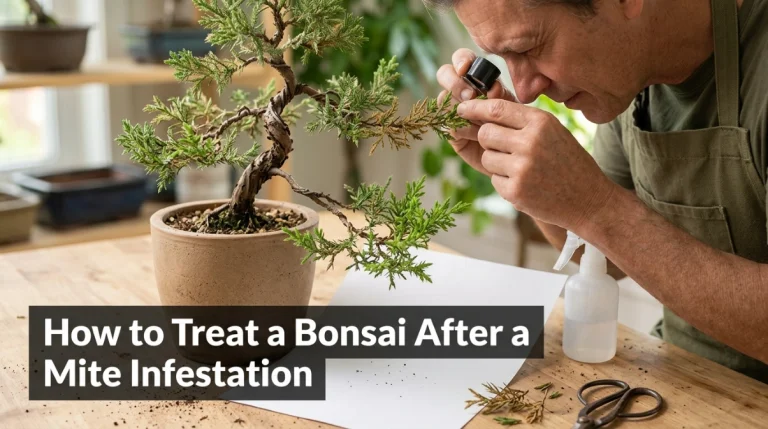
A 10× hand lens is useful on small bonsai. It can reveal crawlers and help separate scale from normal bark texture.
Scale can also be confused with buds, lenticels, old pruning scars, and natural bark features. If you are uncertain, photograph the suspect area before treating it.
Section Takeaway: Scale is more than a brown bump. Identify its shape, location, mobility, honeydew, and associated plant damage before choosing a treatment.
How Do You Get Rid of Scale on Bonsai Step by Step?
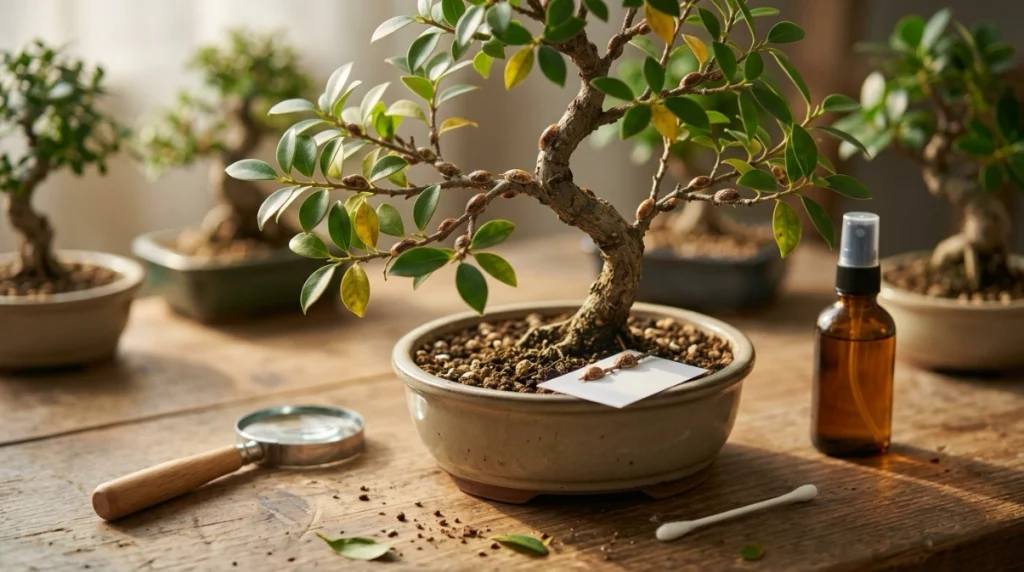
For a small or moderate infestation, combine isolation, physical removal, monitoring, and a targeted treatment. Avoid jumping straight to the strongest pesticide available.
- Move the bonsai away from other plants. Do this before brushing, rinsing, or spraying so crawlers do not spread.
- Inspect every surface. Check leaf undersides, petioles, branch forks, twigs, trunk crevices, pot rims, and exposed roots.
- Remove reachable adult scale. Gently lift or wipe individual insects without scraping through living bark.
- Dispose of badly infested debris. Seal removed leaves or twigs rather than dropping them beside your collection.
- Look for crawlers. Tap a branch over white paper or inspect new growth with magnification.
- Apply an appropriate labeled treatment. Horticultural oils and insecticidal soaps can work well against exposed immature stages when coverage is thorough.
- Inspect the tree again each week. New crawlers may emerge after the first treatment.
Should you prune scale-infested branches?
Removing one heavily infested twig can make sense when the colony is localized. Aggressive pruning of a weak bonsai is different.
Keep enough healthy foliage for the tree to recover. Do not remove a major structural branch simply because several scale insects are attached to it.
Pro tip: Any pruning that permanently changes the bonsai’s structure deserves caution. If an important branch is involved, ask an experienced grower or local bonsai club before cutting it off.
Can you wash scale off with water?
A firm but gentle stream of water can dislodge crawlers and some loose insects. It usually will not remove every established adult scale.
Water works best as part of a larger control plan. Protect loose bonsai soil from washing out of the pot.
Section Takeaway: The safest sequence is isolate, identify, physically reduce the colony, target vulnerable crawlers, and monitor for another generation.
What Is the Best Treatment for Bonsai Scale?
There is no single best treatment for every scale infestation. The right choice depends on population size, scale type, life stage, bonsai species, and growing conditions.
| Method | Best Use | Main Advantage | Main Limitation |
|---|---|---|---|
| Manual removal | Small, visible populations | Immediate reduction without spraying the whole tree | Easy to miss crawlers and hidden insects |
| Water rinse | Exposed crawlers and loose pests | Simple and low impact | Established scale may remain attached |
| Insecticidal soap | Exposed immature scale | Contact treatment with limited residual action | Must contact the pest and may need repeated labeled applications |
| Horticultural oil | Crawlers and susceptible overwintering stages | Useful against many scale species when timed correctly | Poor timing or unsuitable conditions can injure sensitive foliage |
Horticultural oil
Horticultural oil works mainly by coating susceptible insects. Thorough contact and correct timing are important.
Use only a product labeled for ornamental plants and appropriate for your bonsai species. Follow the label instead of inventing a stronger mixture.
Insecticidal soap
Insecticidal soap can help against exposed crawlers. It has little value if spray never reaches the insect.
Coverage matters around leaf undersides and branch junctions. Again, follow the label and test a small area first.
What about systemic insecticides?
Systemic products are not a universal solution. Some active ingredients work on certain soft scales yet perform poorly against some armored scales.
They can also have environmental and pollinator considerations. For home bonsai, I would first exhaust identification, physical removal, and lower-impact labeled options unless the infestation justifies more aggressive control.
When Should You Treat Scale Insects?
The crawler stage is often the easiest time to control scale. Crawlers have not yet developed the protective covering that makes older stages harder to reach.
How to find scale crawlers
You do not need complicated equipment. Simple monitoring can show whether young scale is moving.
- Inspect fresh growth with a 10× hand lens.
- Tap affected branches over white paper.
- Place double-sided tape near active colonies and inspect it regularly.
- Look for tiny yellowish, reddish, or pale moving specks.
Check at least weekly while an infestation is active. Scale species can hatch at different times, so calendar dates alone are unreliable.
This is one reason I prefer watching the tree instead of spraying on an arbitrary schedule. The insect’s life stage tells you more than the date.
Can dormant oil be used?
Dormant-season horticultural oil can suppress overwintering stages of some scale species on suitable woody plants. It is not appropriate for every species or every scale.
Read the product label carefully. Some plants may be sensitive to oil treatments at particular temperatures or growth stages.
Section Takeaway: Treating vulnerable crawlers is usually more efficient than repeatedly spraying protected adults. Monitor first, then time treatment around what you actually find.
How Do You Treat Scale Without Damaging the Bonsai?
Bonsai foliage can be sensitive because the tree has limited reserves compared with a large landscape plant. A treatment that kills insects but badly burns foliage is not a successful treatment.
Test sprays on a small area
Apply a small test to a few leaves or a minor branch before treating the whole canopy. Watch for discoloration, spotting, curling, or scorch.
Avoid improvising stronger concentrations. More product does not automatically mean better control.
Keep normal bonsai care stable
A scale infestation is not a reason to change every part of the care routine. Keep light, watering, airflow, and temperature suitable for the species.
- Water according to soil moisture, not a fixed calendar.
- Avoid keeping stressed roots permanently wet.
- Do not heavily fertilize a declining tree to force new growth.
- Keep outdoor species outdoors when their seasonal requirements demand it.
- Give tropical indoor bonsai adequate light and airflow.
The U.S. National Arboretum maintains major living bonsai collections, which is a useful reminder that pest treatment always sits inside broader year-round horticultural care.
Should you repot a bonsai with scale?
Ordinary foliage scale does not automatically require repotting. Unnecessary root disturbance can add another source of stress.
Repot only when the root system, soil condition, root pests, or normal repotting cycle provides a separate reason.
Pro tip: Root pruning is irreversible. If a badly weakened bonsai seems to need both pest treatment and major root work, get species-specific advice from an experienced grower or bonsai club first.
How Do You Stop Scale From Coming Back?
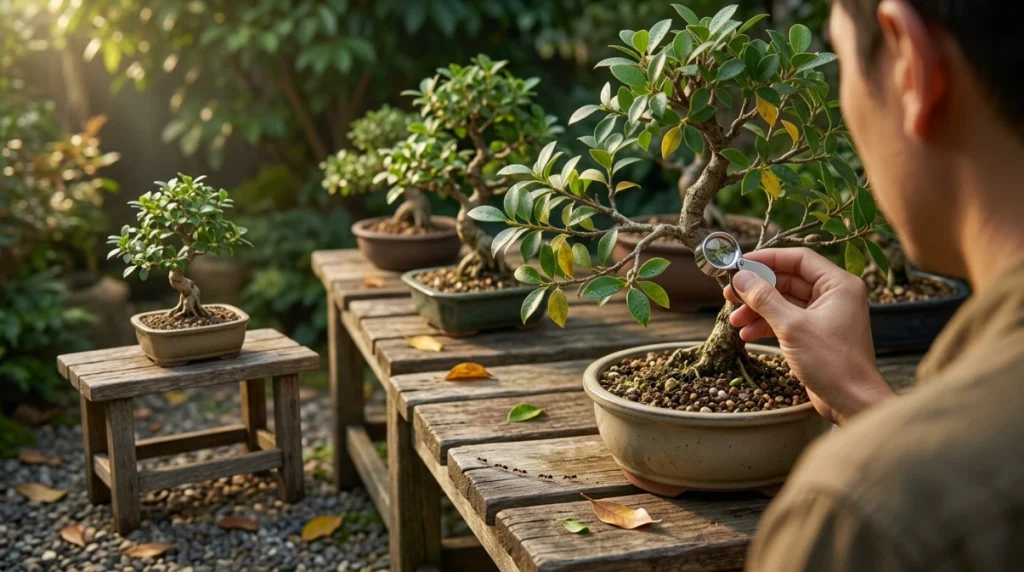
Scale prevention depends on regular inspection and preventing hidden introductions. A clean-looking tree can still carry small crawlers or scale tucked into bark crevices.
Quarantine new plants
Keep newly acquired bonsai separate from an established collection while you inspect them. Also isolate any tree with confirmed scale.
During quarantine, check both the bonsai and its pot. Crawlers can move, and plant-to-plant contact makes movement easier.
Inspect the collection every week
I like to make pest inspection part of watering rather than a separate job. Turning the pot exposes areas that are easy to overlook from the front.
- Check tender shoots.
- Look under leaves and needles.
- Inspect branch junctions.
- Examine rough bark and old scars.
- Watch for sticky honeydew.
- Investigate unusual ant activity.
Control conditions that favor repeated problems
Healthy care does not make a bonsai immune to scale, but chronic stress makes recovery harder. Correct watering, drainage, light, and seasonal care remain essential.
Avoid routine broad-spectrum pesticide use without a confirmed target. Preserving beneficial insects can help outdoor plants maintain better natural pest balance.
For continuing education, the American Bonsai Society and local bonsai clubs can be useful when pest identification becomes difficult.
Section Takeaway: Prevention is mainly inspection, quarantine, correct care, and early action. Catching ten scale insects is much easier than treating hundreds.
Frequently Asked Questions
Can scale insects kill a bonsai?
Yes, a severe or persistent scale infestation can weaken a bonsai by removing plant sap. Heavy feeding may cause yellowing, reduced growth, leaf drop, twig decline, and greater stress, especially when the tree is already unhealthy.
Can I scrape scale off my bonsai?
You can gently remove individual scale insects when the population is small. Avoid aggressive scraping because bonsai bark and young twigs are easy to damage, and manual removal will not eliminate hidden crawlers or eggs by itself.
Does neem oil kill scale on bonsai?
Some neem or botanical-oil products are labeled for scale insects, but effectiveness depends on direct coverage, scale stage, product formulation, and tree sensitivity. Use only a labeled product, follow its directions, and test delicate bonsai foliage before full treatment.
Why does scale keep coming back?
Scale often seems to return because eggs or hidden immature insects survive the first cleanup. Crawlers may also hatch over an extended period, which is why repeated inspection and correctly timed follow-up treatment can be necessary.
Are the brown bumps on my bonsai definitely scale?
No. Buds, lenticels, bark texture, scars, and other natural structures can resemble scale. Look for repeated insect-like shapes, crawlers, honeydew, sooty mold, yellowing, or weakening growth before deciding the tree has an infestation.
Should I isolate a bonsai with scale?
Yes. Keep an infested bonsai away from healthy plants while you identify and treat the problem. Mobile crawler stages can move onto nearby suitable hosts, especially where foliage touches or plants share a crowded growing space.
How long does it take to eliminate scale?
There is no universal number of days. A small infestation may respond quickly, while a larger colony can require several inspection and treatment cycles because different life stages may be present at the same time.
As of 2026, the core approach remains simple: identify the scale, isolate the bonsai, reduce the population manually, target vulnerable crawlers, and keep monitoring. Avoid treating the tree harder than the pest problem requires.
If scale persists despite careful treatment, take clear close-up photographs and ask a local extension service, bonsai club, or experienced grower to confirm the insect. Correct identification can save both the tree and a lot of unnecessary spraying.