
Why Do My Bonsai Leaves Have Yellow Spots?

Quick Answer
Yellow spots on bonsai leaves usually come from spider mites or other sap-feeding pests, leaf-spot disease, watering or root stress, nutrient problems, or environmental damage. The pattern matters more than the color alone, so inspect both sides of each leaf before changing your care routine. This bonsai pest and disease overview is also useful when symptoms are difficult to identify.
Common clues to check
- Tiny yellow dots: Fine stippling across the leaf often points toward spider mite feeding.
- Brown-centered spots: Dark lesions with yellow halos may indicate fungal or bacterial leaf spot.
- Green leaf veins: Yellow tissue between green veins can suggest chlorosis or a nutrient-availability problem.
- Wet soil: Persistent moisture, weak growth, and widespread yellowing can indicate root stress.
- Webbing or residue: Fine webs, sticky honeydew, scale-like bumps, or insects strengthen the case for pests.
Best first move
- Inspect the leaf undersides with a hand lens, check soil moisture, and compare affected leaves before spraying, fertilizing, or repotting.
Yellow spots on bonsai leaves can look alarming because a small tree has little foliage to hide the damage. The good news is that the spot pattern often gives you useful clues before the problem becomes severe.
I approach yellow spotting as a diagnosis problem rather than a reason to immediately spray or fertilize. Once you separate pest stippling from leaf lesions and general chlorosis, the next step becomes much clearer.
In This Guide
- What Do Yellow Spots on Bonsai Leaves Usually Mean?
- How Can I Tell What Is Causing the Yellow Spots?
- Which Bonsai Pests Cause Yellow Spots?
- Can Leaf Spot Disease Cause Yellow Spots?
- Can Watering, Light, or Nutrients Cause Yellow Spots?
- How Do I Fix Yellow Spots Without Harming My Bonsai?
- Frequently Asked Questions
What Do Yellow Spots on Bonsai Leaves Usually Mean?
Yellow spots mean part of the leaf has lost its normal green color. That localized discoloration is different from an entire leaf gradually turning yellow.
Definition: Chlorosis is yellowing caused by reduced chlorophyll in leaf tissue. It can appear across a whole leaf, between veins, or in small localized patches depending on the cause.
With bonsai, localized spots deserve close inspection because pests can create hundreds of tiny feeding marks. Diseases can create larger lesions with yellow tissue around their edges.
Care problems usually produce a broader pattern. However, species, season, recent weather, and the age of affected leaves can change how symptoms appear.
- Fine yellow speckles: Check first for spider mites.
- Yellow halo around a dark center: Consider leaf-spot disease.
- Yellow between green veins: Investigate nutrient availability and root-zone conditions.
- Bleached patches on exposed leaves: Consider sudden sun or heat stress.
- General yellowing plus wet soil: Check drainage and root health.
A deciduous bonsai may also develop normal yellowing before leaf drop. Normal seasonal color usually affects leaves more uniformly than active pest stippling.
How Can I Tell What Is Causing the Yellow Spots?

Start with the shape, location, and distribution of the spots. Then check the leaf undersides, stems, soil, and recent changes in the tree’s environment.
A 10× hand lens is one of the most useful diagnostic tools for this job. Tiny mites, eggs, crawlers, and feeding damage become much easier to distinguish.
| Leaf Pattern | Likely Cause | Extra Clues | Next Check |
|---|---|---|---|
| Many pin-sized yellow dots | Spider mites | Webbing, bronzing, dry conditions | Inspect undersides and shake over white paper |
| Brown or black spots with yellow halos | Leaf-spot disease | Wet foliage, spreading lesions | Check airflow and affected leaves |
| Yellow tissue between green veins | Chlorosis | Often clearer on young or older leaves | Review fertilizer, pH, and root health |
| Large pale or scorched patches | Sun or heat stress | Damage concentrated on exposed foliage | Review recent placement changes |
| Widespread yellowing | Water or root stress | Wet or extremely dry soil, weak growth | Check moisture and drainage |
Check which leaves are affected
New leaves showing symptoms can point toward different problems than old interior foliage. Record whether the damage starts at the top, bottom, outside, or shaded interior of the canopy.
Also compare healthy and affected branches. A problem limited to one branch may suggest localized pests, disease, or physical damage rather than a whole-tree watering issue.
Use the white-paper test
Hold clean white paper beneath suspicious foliage and gently tap the branch. Tiny moving dots on the paper can help reveal mites that were nearly invisible on the tree.
Do not diagnose spider mites from webbing alone. Ordinary spiders can also live around bonsai without feeding on the plant.
Which Bonsai Pests Cause Yellow Spots?
Spider mites are one of the strongest suspects when the spots are tiny, numerous, and pale yellow. Their feeding removes contents from individual plant cells, producing a stippled appearance.
The University of Minnesota Extension describes spider mite injury as tiny white or yellow spots that can progress to bronzing, bleaching, and leaf drop. Their spider mite guidance also recommends checking leaf undersides and using white paper to detect mites.
Spider mites
- Typical damage: Fine yellow or white stippling.
- Where to look: Leaf undersides and protected foliage.
- Other clues: Bronzing, fine webbing, premature leaf drop.
- Favorable conditions: Hot, dry conditions often support rapid population growth.
Aphids, scale, and mealybugs
These sap-feeding pests can also weaken foliage and cause yellowing. Their damage is often less evenly stippled than classic spider mite injury.
- Aphids: Look around tender shoots and new leaves.
- Scale: Check stems and veins for attached shell-like bumps.
- Mealybugs: Look for white cotton-like material around joints.
- Honeydew: Sticky leaves can accompany several sap-feeding insects.
If you confirm an infestation, separate the bonsai from nearby plants while identifying the pest. Avoid spraying every tree with an unconfirmed treatment.
Section Takeaway: Fine yellow stippling plus mites or webbing is strong evidence of pest feeding. Confirm the pest before choosing a control.
Can Leaf Spot Disease Cause Yellow Spots?
Yes, but disease spots often look different from mite stippling. A fungal or bacterial lesion commonly develops a darker center surrounded by yellow tissue.
Penn State Extension notes that several indoor-plant leaf-spot problems produce brown or black lesions with yellow halos. Its indoor plant pest and disease guidance also emphasizes sanitation, airflow, and keeping foliage dry where appropriate.
What disease-related spotting looks like
- Distinct lesions: Spots may have a brown, black, tan, or water-soaked center.
- Yellow halos: Yellow tissue can form around an expanding lesion.
- Irregular spread: Spots may enlarge or merge instead of staying pin-sized.
- Wet-weather association: Some leaf diseases become more troublesome with prolonged moisture.
- Dieback: Severe infections can involve shoots as well as leaves.
Some woody species can also be affected by bacterial pathogens such as Pseudomonas syringae. Penn State documents leaf spotting, yellow halos, and shoot damage on several woody hosts in its woody-plant disease guidance.
Do not assume every spotted leaf needs fungicide. Chemical treatment will not correct mite feeding, sun stress, fertilizer injury, or poor root conditions.
Remove badly damaged fallen foliage from the growing area and keep tools clean. If spots spread rapidly despite better conditions, seek a species-specific diagnosis.
Can Watering, Light, or Nutrients Cause Yellow Spots?
Yes, although these problems often cause broader discoloration instead of hundreds of pin-sized spots. Always check basic care before assuming disease.
Watering and root stress
Bonsai roots need both water and oxygen. Constantly saturated growing media can reduce root function and eventually affect leaf color and vigor.
Severe drying can also damage foliage. Never diagnose either problem from the leaves alone; check the soil first.
- Constantly wet mix: Investigate drainage, watering frequency, and compacted soil.
- Bone-dry mix: Check whether the root ball has dried more deeply than expected.
- Weak new growth: Consider root health as part of the diagnosis.
- Foul or sour soil smell: Treat it as a warning sign that deserves closer inspection.
Nutrient-related chlorosis
Nutrient problems can create pale or yellow foliage, particularly when roots cannot access an element efficiently. Interveinal chlorosis leaves the veins greener than the tissue between them.
Do not add fertilizer just because a leaf looks yellow. Excess fertilizer can create its own root and foliage problems.
Light and heat stress
A bonsai moved suddenly from protected light into intense sun may develop bleached or scorched areas. Damage is usually strongest on the most exposed leaves.
Low light can also weaken color and growth over time. Indoor tropical bonsai deserve particular attention because a bright-looking room may still provide limited usable light.
As of 2026, the basic diagnostic principle has not changed: identify the pattern first, then correct the specific cause. The American Bonsai Society is also a useful starting point for educational resources and finding experienced local growers.
Section Takeaway: Care problems usually create broader yellowing than pest stippling. Check moisture, drainage, roots, light, and feeding before making several changes at once.
How Do I Fix Yellow Spots Without Harming My Bonsai?
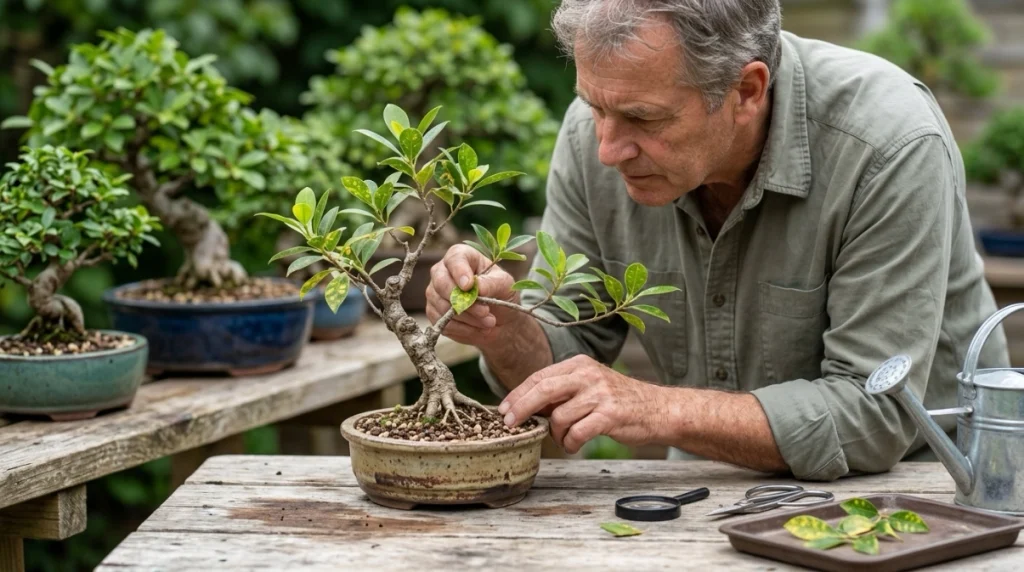
The safest approach is to change one thing only after you have evidence for it. Stacking pesticide, fertilizer, repotting, and relocation together can make a stressed tree harder to diagnose.
- Isolate the tree if pests are possible. Keep it away from nearby bonsai until you know what caused the damage.
- Inspect both leaf surfaces. Use a hand lens and check new shoots, branch junctions, and stems.
- Check the soil before watering. Determine whether the root zone is wet, dry, or draining poorly.
- Compare the spot pattern. Separate stippling, dark-centered lesions, interveinal chlorosis, and sun-exposed bleaching.
- Remove badly damaged debris. Keep fallen diseased-looking leaves away from the pot and benches.
- Choose a cause-specific response. Treat mites as mites and cultural stress as cultural stress.
- Monitor new foliage. Existing spots may not disappear even after you solve the problem.
If spider mites are confirmed
Begin by physically reducing the population where the species tolerates gentle rinsing. Then use a product labeled for the plant and pest, following its directions exactly.
Coverage matters because mites often remain on leaf undersides. Reinspect instead of assuming one treatment ended the infestation.
If leaf disease is suspected
Improve air movement and reduce unnecessary leaf wetness. Remove heavily affected foliage only when doing so will not excessively weaken the tree.
Get a more specific diagnosis before applying a fungicide or bactericide. Different pathogens respond to different management methods.
If root problems are suspected
Correct routine watering and drainage first unless the tree faces an urgent root emergency. Major root work is stressful and should match the species and proper repotting season.
Pro tip: If you think damaged roots must be cut away, consult an experienced grower or local bonsai club before doing irreversible root pruning on a weak tree.
How to prevent another outbreak
- Inspect foliage regularly during active growth.
- Check leaf undersides instead of viewing only the canopy.
- Keep fallen leaves and plant debris off benches.
- Clean tools after working on suspicious plants.
- Give each species suitable light, airflow, and moisture.
- Avoid unnecessary fertilizer on stressed roots.
- Quarantine newly acquired or infested plants.
The goal is not perfectly spotless foliage at every moment. The goal is catching unusual patterns early enough to protect the tree’s next flush of healthy growth.
Section Takeaway: Diagnose before treating. The newest leaves are often your best measure of whether the correction is working.
Frequently Asked Questions
Why does my bonsai have tiny yellow dots on its leaves?
Tiny yellow dots or stippling are commonly associated with spider mite feeding, especially when the pattern covers many small areas of a leaf. Check the undersides with a hand lens and perform a white-paper test before applying treatment.
Are yellow spots on bonsai leaves always caused by pests?
No. Leaf-spot diseases, nutrient-related chlorosis, watering problems, root stress, heat, and sudden sun exposure can also discolor foliage. The shape and distribution of the yellow areas help separate these causes.
What do spider mites look like on a bonsai?
Spider mites are extremely small and can appear as moving specks rather than obvious insects. Look for fine stippling, bronzed foliage, mites beneath leaves, and fine webbing when populations become larger.
Should I remove bonsai leaves with yellow spots?
Do not automatically remove every spotted leaf. Remove badly diseased or dead foliage when appropriate, but keep enough healthy leaf area for photosynthesis and avoid heavy defoliation on a weak tree.
Can overwatering cause yellow spots?
Overwatering more often causes broader yellowing, weak growth, and root stress than fine isolated spots. However, persistently wet conditions can weaken the tree and may also create an environment favorable to some plant diseases.
Will yellow spots turn green again?
Established damaged areas often remain discolored even after you correct the cause. Watch new leaves instead; clean, healthy new growth is a better sign that pest pressure or environmental stress has been controlled.
When should I get expert help?
Seek help when spotting spreads quickly, branches begin dying, roots appear damaged, or you cannot identify the cause. Clear photos of both leaf surfaces, the whole tree, soil, and affected branches will make diagnosis easier.
Final takeaway: Yellow spots on bonsai leaves are a symptom, not a diagnosis. Inspect the pattern closely, confirm pests or disease when possible, and make targeted corrections rather than changing several parts of your care routine at once.
If you catch the problem early, the next flush of foliage can tell you far more than the damaged leaves already on the tree. Keep checking new growth, soil moisture, and leaf undersides as the bonsai recovers.
