
Why Are My Bonsai Leaves Speckled?

Quick Answer
Speckled bonsai leaves usually point to spider mites, thrips, other sap-feeding pests, fungal or bacterial leaf spots, mineral residue, spray injury, or environmental stress. Fine pale dots across otherwise intact leaves are called leaf stippling and often deserve a close pest inspection before you change watering or fertilizer; reviewing bonsai care basics can also help you compare the symptom with the tree’s wider growing conditions.
What the speckles may be telling you
- Pale pinpricks: Check leaf undersides for spider mites or other piercing pests.
- Silvery patches: Thrips feeding can create pale, silvery stippling and distorted new growth.
- Brown lesions: Defined spots that enlarge may indicate fungal or bacterial disease rather than insect feeding.
- White powder: A coating that looks dusty or flour-like can indicate powdery mildew.
- Wipeable marks: Hard-water minerals, dried sprays, or dust can resemble leaf damage.
- Scorched flecks: Sudden strong sun, heat, or chemical injury may bleach or burn leaf tissue.
Best first check
- Inspect both sides of several damaged leaves with bright light and a hand lens, then test whether the speckles wipe away before treating the bonsai.
Speckled bonsai leaves can look alarming because several unrelated problems create almost the same pattern. The safest approach is to identify the pattern before reaching for fertilizer, fungicide, or insecticide.
I start underneath the leaf, not at the fertilizer shelf. Tiny clues there often tell you more than the color of the speckles alone.
In This Guide
- What Do Speckles on Bonsai Leaves Mean?
- How Can You Identify the Speckle Pattern?
- Are Spider Mites or Thrips Causing the Speckles?
- Can Disease or Environmental Stress Cause Speckled Leaves?
- How Do You Diagnose Speckled Bonsai Leaves Step by Step?
- How Do You Fix and Prevent Speckled Bonsai Leaves?
- Frequently Asked Questions
What Do Speckles on Bonsai Leaves Mean?
Speckles are small areas of discoloration that differ from the healthy surrounding leaf tissue. They may be white, cream, yellow, silver, tan, brown, or almost black.
Definition: Leaf stippling is a pattern of many tiny pale dots caused when small areas of leaf tissue lose their normal color, often after feeding by mites or other piercing pests.
Stippling differs from a classic leaf spot. A disease lesion usually has clearer boundaries and may enlarge, darken, develop a halo, or merge with nearby lesions.
- Fine pale stippling: Often associated with spider mites, thrips, leafhoppers, or similar feeding damage.
- Silvery speckling: Often worth checking for thrips, particularly on tender leaves.
- Brown or black spots: May point toward fungal or bacterial leaf disease, physical injury, or dead tissue.
- Powdery white marks: May indicate powdery mildew if they have a fungal, dusty appearance.
- Raised bumps: Could be scale insects rather than damaged leaf tissue.
- Surface residue: Water minerals, fertilizer spray, pesticides, or dust may sit on top of the leaf.
The distribution matters too. Damage concentrated on the newest shoots suggests a different problem from speckles evenly covering old and new foliage.
Species also changes the diagnosis. A ficus, Japanese maple, Chinese elm, azalea, or juniper can react differently to the same environmental stress.
How Can You Identify the Speckle Pattern?
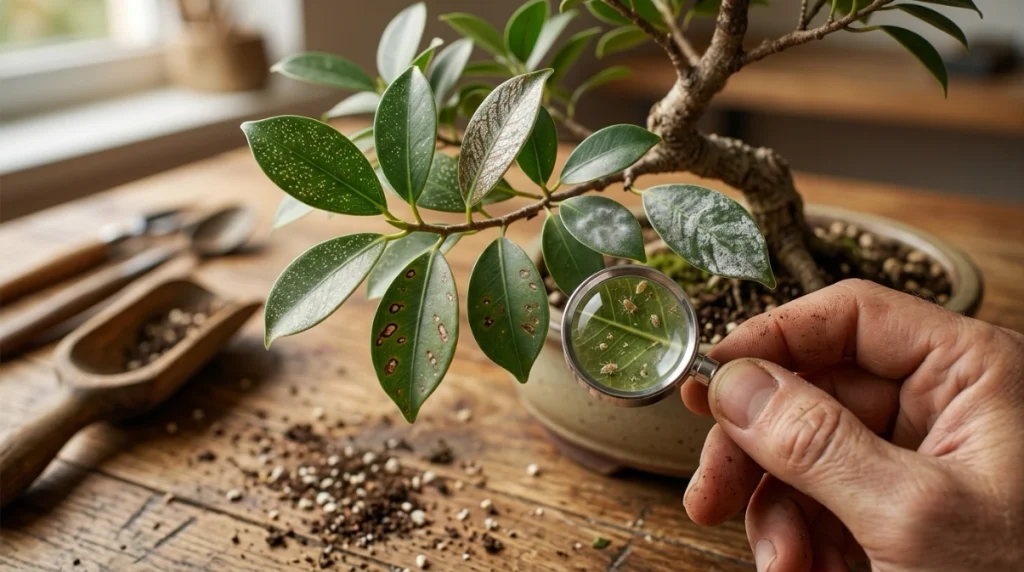
Start with appearance, location, and texture. Then look for a second clue that confirms or weakens your first suspicion.
| What You See | Likely Possibility | What to Check Next |
|---|---|---|
| Hundreds of tiny pale dots | Spider mites or another sap-feeding pest | Undersides, fine webbing, white-paper test |
| Silvery or bronze flecks | Thrips or mite injury | Young leaves, dark frass, moving insects |
| Brown defined lesions | Leaf-spot disease or tissue injury | Yellow halos, wet-looking margins, spreading lesions |
| White powdery patches | Powdery mildew | Powder-like fungal growth on either leaf surface |
| Firm attached bumps | Scale insects | Stems, veins, sticky honeydew, sooty growth |
| Chalky marks that wipe away | Mineral or spray residue | Test gently with a damp cloth |
| Bleached dry patches | Sun, heat, or chemical injury | Recent changes in sun exposure or sprays |
Do not diagnose from one damaged leaf. Compare at least several leaves from different parts of the canopy.
A 10× hand lens is useful when mites are suspected. Bright side lighting can also make webbing, cast skins, insects, and surface texture easier to see.
Are Spider Mites or Thrips Causing the Speckles?
Spider mites are one of the first problems I would rule out when a bonsai develops widespread pale stippling. Their feeding removes contents from individual leaf cells and creates tiny light-colored dots.
What does spider mite damage look like?
Early damage may appear as scattered cream or yellow pinpricks. As feeding increases, the dots can merge and give foliage a faded or bronzed appearance.
- Inspect the undersides of leaves.
- Look along major veins and protected leaf areas.
- Watch for extremely fine webbing.
- Check for tiny moving specks.
- Look for pale shed skins trapped in webbing.
The University of Maryland Extension’s mite guidance describes a simple white-paper test that works well for suspicious foliage.
Hold clean white paper beneath a branch and tap the foliage sharply. Tiny moving dots on the paper strengthen the case for mites, although magnification helps with confirmation.
Could thrips cause similar damage?
Yes. Thrips can create pale stippling that becomes silvery, yellow, bronze, or scarred as the damage accumulates.
New leaves may also become crinkled or distorted when feeding occurs while they are expanding.
- Silvery tissue: Look for thin, pale areas rather than clean round lesions.
- Dark specks: Small deposits of frass may accompany feeding.
- Tender growth: Check new leaves, buds, and protected crevices.
- Distortion: Young foliage may remain curled after the original injury.
You can compare these signs with the University of Maryland Extension thrips guide before choosing a control.
What about scale, aphids, and other pests?
Scale insects can look like small raised speckles, especially when immature insects are difficult to see. Soft scale may also produce sticky honeydew.
Aphids usually gather around soft shoots rather than creating uniform classic stippling. Still, their feeding can distort and discolor tender foliage.
Section Takeaway: Fine stippling becomes much more suspicious for pests when you also find moving mites, webbing, thrips, frass, scale-like bumps, honeydew, or distorted new growth.
Can Disease or Environmental Stress Cause Speckled Leaves?
Yes. Speckling is not automatically an insect problem, and spraying blindly can make diagnosis harder.
Fungal and bacterial leaf spots
Leaf-spot diseases tend to create discrete lesions rather than hundreds of evenly distributed pinpricks. Those lesions may begin pale or water-soaked before becoming tan, brown, or black.
Some develop yellow margins. Others enlarge and merge into broader areas of damaged tissue.
- Look for spots that become larger over several days.
- Check whether lesions have clear borders.
- Notice yellow halos around brown centers.
- Watch for damage spreading during humid or wet conditions.
- Check whether nearby leaves develop similar lesions.
Powdery mildew
Powdery mildew is easier to distinguish when it develops obvious white or gray fungal growth. Early patches, however, can resemble scattered white marks.
The UC Integrated Pest Management powdery mildew guide notes that powdery spots can occur on either leaf surface and expand as infection develops.
Mineral deposits and spray residue
A harmless surface deposit is one of the easiest problems to overlook. Hard-water droplets can dry into pale rings or spots.
Foliar fertilizer, pesticide residue, or other sprays can leave a similar pattern.
Gently wipe one affected area with a damp soft cloth. Residue may disappear, while damaged leaf tissue normally remains discolored.
Sun and heat injury
A bonsai moved suddenly into stronger light can develop bleached or scorched tissue. Tender foliage is usually more vulnerable than established leaves.
Heat, drying wind, and a dry root zone can increase stress. Look for crispy margins or damage concentrated on the most exposed side of the canopy.
Watering and root stress
Overwatering and underwatering usually cause broader symptoms than fine stippling. They may produce wilting, yellowing, dry margins, weak growth, or leaf drop.
Still, stressed foliage can develop irregular discoloration. Always check soil moisture and drainage as part of the diagnosis.
How Do You Diagnose Speckled Bonsai Leaves Step by Step?
The goal is to collect evidence before changing the tree’s care. Work through these checks in order.
- Check whether the spots wipe off. Use a damp soft cloth on a small area to separate residue from permanent tissue damage.
- Inspect the upper leaf surface. Note the color, shape, size, and distribution of the speckles.
- Turn every sample leaf over. Many mites, thrips, scale insects, eggs, and other clues remain hidden underneath.
- Use magnification. A hand lens can reveal mites, webbing, cast skins, insects, or fungal texture that is difficult to see unaided.
- Try the white-paper test. Tap suspicious foliage over clean paper and watch for moving specks.
- Check new growth. Distorted young leaves may point toward thrips, aphids, mites, chemical injury, or root stress.
- Check the soil. Determine whether the root zone is dry, appropriately moist, constantly wet, or slow to drain.
- Review recent changes. Think about new fertilizer, pesticides, relocation, stronger sunlight, heat, repotting, or changes in watering.
- Inspect neighboring plants. Similar symptoms on nearby trees make a mobile pest or spreading disease more suspicious.
- Photograph the damage. Take clear pictures now so you can judge whether new lesions are appearing later.
Look for progression, not just old damage
An injured leaf may remain speckled even after the original problem has stopped. Old damaged tissue usually cannot turn healthy green again.
Mark or photograph several leaves and inspect fresh growth over the following days. New damage is more informative than the appearance of old scars.
Do not change five things at once
A common mistake is watering more, moving the tree, adding fertilizer, and spraying pesticide on the same day. That creates new stress and makes it harder to tell what was wrong.
Correct the factor supported by your evidence first. Then monitor the tree’s response.
Section Takeaway: Diagnosis becomes much easier when you combine the speckle pattern with leaf-underside inspection, moisture conditions, recent care changes, and whether new damage continues to appear.
How Do You Fix and Prevent Speckled Bonsai Leaves?
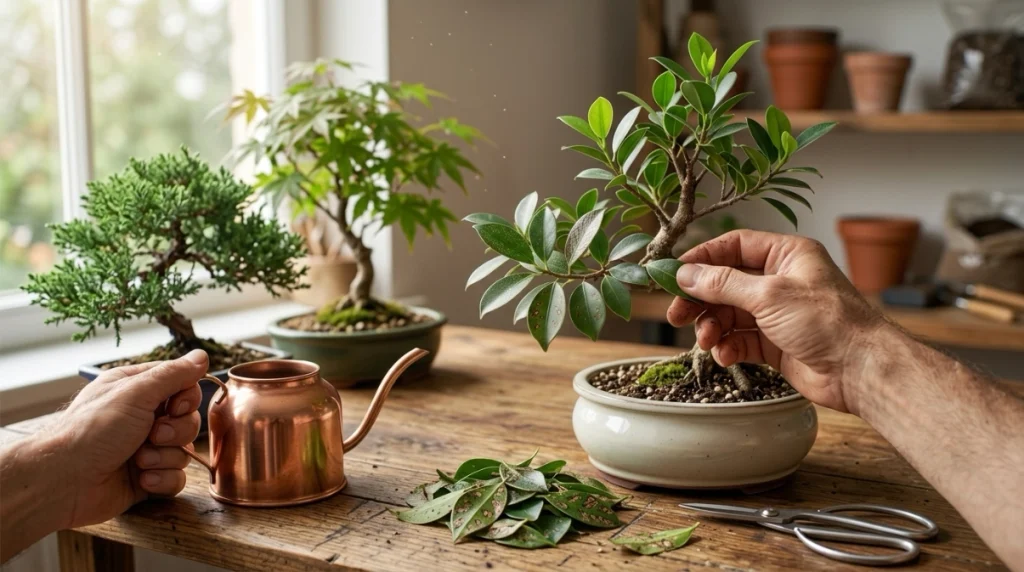
Treatment depends entirely on the cause. There is no single spray that safely fixes every type of speckled bonsai leaf.
If spider mites are confirmed
Separate the affected bonsai from nearby plants while you assess the infestation. Pay particular attention to leaf undersides during cleaning or treatment.
- Remove heavily damaged dead material when appropriate.
- Use a controlled stream of water where the species and growing conditions allow it.
- Keep the tree appropriately watered without leaving the root zone saturated.
- Inspect neighboring plants for similar stippling.
- If using a pesticide, choose one labeled for the pest, plant, and growing location.
- Follow the product label exactly.
Avoid assuming that stronger pesticide concentrations provide better control. Excessive or inappropriate sprays can injure foliage.
If thrips are confirmed
Focus inspections on tender growth and protected leaf areas. Monitor repeatedly because the youngest foliage may show damage first.
Use only control methods appropriate for the identified pest and plant. Keep heavily affected bonsai separated from healthy trees during treatment.
If leaf disease is suspected
Remove clearly dead or badly infected fallen material and improve sanitation around the tree. Avoid repeatedly wetting foliage late in the day when a moisture-favored leaf disease is suspected.
Do not apply fungicide simply because the spots are brown. A fungicide will not correct mites, mineral deposits, sunburn, or damaged roots.
If the spots are residue
Correct the source instead of treating the tree for disease. Consider your water quality and anything recently sprayed onto the leaves.
Do not scrub delicate foliage aggressively. A gentle test on a small section is enough to determine whether the material is superficial.
If light or heat caused the damage
Adjust exposure gradually rather than moving the tree between extreme conditions. Keep watering matched to the species, season, soil mix, pot size, and actual moisture level.
Existing bleached tissue may remain damaged. Judge recovery by healthy new foliage.
How can you prevent the problem from returning?
- Inspect weekly: Look under leaves before populations become obvious.
- Quarantine newcomers: Keep newly acquired trees away from an established collection while you inspect them.
- Maintain species-appropriate light: Avoid abrupt exposure changes.
- Water by need: Check the root zone rather than relying on a fixed calendar.
- Keep tools clean: Sanitation becomes especially important when disease is suspected.
- Avoid unnecessary sprays: Every chemical application should have a clear reason.
- Watch new growth: Healthy fresh leaves are one of the clearest signs that conditions have improved.
Pro tip: If diagnosis would require major root work, heavy pruning, or another irreversible procedure on a weak tree, consult an experienced grower or local bonsai club first.
When should you seek expert help?
Ask for experienced help when speckling spreads rapidly despite corrected care, branches begin dying, or you cannot distinguish a pest from a disease. A local horticulture extension service can also help identify unusual foliage symptoms.
Bring clear photographs of both leaf surfaces, the entire tree, the soil surface, and any visible pests. Include the tree species and a short history of recent care changes.
Frequently Asked Questions
Why does my bonsai have tiny white speckles on its leaves?
Tiny white speckles often come from spider mite or other piercing-pest feeding, but mineral deposits and spray residue can look similar. Check whether the marks wipe off, then inspect leaf undersides with bright light and magnification for mites, webbing, insects, or cast skins.
What does spider mite damage look like on bonsai?
Spider mite damage often begins as many tiny pale or yellowish dots called stippling. Heavy feeding can make foliage look faded, bronzed, or bleached, while larger infestations may produce extremely fine webbing around leaves and twigs.
Can overwatering cause speckled bonsai leaves?
Overwatering more commonly causes yellowing, weak growth, wilting, root stress, and leaf drop than classic fine stippling. However, poor root health can create irregular discoloration, so soil moisture and drainage should still be checked during diagnosis.
Should I remove speckled bonsai leaves?
Do not remove every speckled leaf automatically. Leaves that remain green may still photosynthesize, while unnecessary defoliation can add stress to a weak tree. Remove clearly dead or badly diseased material when sanitation requires it.
Will speckled bonsai leaves turn green again?
Permanent feeding scars, burns, and dead leaf lesions usually remain visible. Recovery is better judged by the next flush of healthy growth and by whether new speckles stop appearing after the underlying problem is corrected.
Should I spray neem oil on speckled bonsai leaves?
Do not spray simply because leaves are speckled. First identify the likely pest or disease, then confirm that the chosen product is labeled for that use and safe for the species and growing conditions. Follow the label rather than increasing the concentration.
Can speckled bonsai leaves spread the problem to my other trees?
The speckles themselves do not spread, but some causes can. Mobile pests and certain plant diseases may affect nearby trees, so isolate a suspicious bonsai when you find active insects, continuing unexplained damage, or signs of infectious disease.
The main takeaway: When your bonsai leaves become speckled, resist the urge to treat first and diagnose later. Check whether the marks wipe away, inspect both leaf surfaces, look for pests, review recent care changes, and watch the newest foliage.
Once you confirm the cause, correct that specific problem and give the tree time to respond. Healthy new growth matters more than making every old damaged leaf look perfect.
If the pattern remains unexplained or the tree continues declining, take detailed photographs and ask an experienced bonsai grower, bonsai club, or local horticulture extension service for identification help.
