Why Are My Bonsai Leaves Turning Red? Causes, Warning Signs, and Solutions
Seeing red leaves on a bonsai can be beautiful, but it can also leave you wondering whether something is wrong. If you are asking, “Why are my bonsai leaves turning red?”, the answer depends heavily on the bonsai species, the time of year, and what the leaves look like before and after they change color.
Red foliage is often completely natural, especially on deciduous bonsai such as Japanese maple. Some varieties naturally produce red or bronze new growth, while others develop brilliant red foliage as autumn approaches. For example, several Japanese maple cultivars are known to emerge red and later change color during the growing season.
However, unexpected red, reddish-purple, or bronze leaves can sometimes indicate sun stress, drought, root problems, nutrient imbalance, pests, disease, or general tree stress.
This guide explains how to tell the difference. You will learn why bonsai leaves turn red, which symptoms are harmless, which warning signs require action, and what you should do before changing your watering, fertilizer, light, or repotting routine.
Quick Answer
Why are my bonsai leaves turning red? Red bonsai leaves may be completely normal because of the species, new growth, or seasonal changes. In other cases, red or reddish leaves can signal stress from intense light, drought, root problems, pests, disease, or nutrient imbalance. Check the species, timing, leaf pattern, soil moisture, and overall tree health before treating the problem.
Why Bonsai Leaves Turn Red Naturally
The first thing to understand is that red leaves do not automatically mean your bonsai is unhealthy.
Leaves contain several pigments. Chlorophyll gives healthy leaves their familiar green color. As chlorophyll decreases, other pigments can become more visible. Red and purple colors are often associated with anthocyanins, natural pigments produced by many plants.
The Royal Horticultural Society explains that autumn red and purple colors are associated with anthocyanins, while changes in temperature, light, weather, and genetics can influence how strongly those colors appear.
For a bonsai grower, this means you should ask one simple question first:
Is the red color occurring at a normal time for this particular species?
If the answer is yes and the tree otherwise looks healthy, there may be no problem to fix.
Red New Growth Can Be Completely Normal
Some bonsai species naturally produce reddish young leaves.
Japanese maple is a common example. Certain cultivars emerge bright red in spring before becoming green or developing different colors later in the year. Other cultivars remain red or bronze for much longer.
Other woody bonsai species can also produce bronze, copper, red, or purple new growth.
Look at the newest leaves:
- Are they small, soft, and recently opened?
- Is the red color evenly distributed?
- Are the leaves otherwise healthy?
- Does the color match previous growth from the same tree?
- Is the tree producing normal new shoots?
If yes, do not automatically treat the foliage as a disease or nutrient deficiency.
Red Leaves During Autumn
For deciduous bonsai, seasonal color change is one of the most common reasons leaves turn red.
As days become shorter and temperatures change, chlorophyll production declines. Once the green pigment fades, yellow, orange, red, and purple pigments become easier to see.
The intensity of red autumn color varies with species, genetics, light, temperature, and weather. The RHS notes that bright light and cool temperatures can favor stronger anthocyanin development in many plants.
How to Tell Normal Autumn Color From Stress
Normal autumn color usually has a predictable pattern.
You may notice:
- Color developing gradually across older leaves
- Red, orange, yellow, or purple shades appearing seasonally
- Leaves remaining reasonably firm before dropping
- Normal-looking buds and branches
- No unusual pest activity
- No foul smell from the soil
- No sudden collapse of the entire tree
By contrast, stress-related color changes often happen too early, too suddenly, or together with other symptoms.
For example, red leaves combined with wilting, crispy edges, blackened tissue, severe spotting, or widespread leaf drop deserve closer inspection.
Red Leaves Caused by Too Much Sun or Heat
Strong sunlight is not necessarily bad for a bonsai. Many outdoor bonsai require substantial light to grow properly.
The problem occurs when the amount of light and heat exceeds what the species or current root condition can tolerate.
This is especially important for recently repotted trees, weakened bonsai, and species that prefer protection from intense afternoon heat.
Signs of Light or Heat Stress
Look for:
- Red or bronze coloration developing on exposed leaves
- Brown or crispy leaf margins
- Pale or bleached areas
- Curling leaves
- Wilting during hot periods
- Damage concentrated on the sun-facing side
- Rapid moisture loss from the pot
A bonsai can become stressed when its foliage loses water faster than its roots can replace it.
Do not respond by automatically moving every bonsai into deep shade. Too little light can create weak growth, long internodes, and poor development.
Instead, consider the species and gradually adjust exposure if heat or sun damage is clearly occurring.
Water Stress Can Cause Red or Reddish Foliage
Watering problems are among the first things beginners should investigate when foliage changes unexpectedly.
Both underwatering and overwatering can cause stress, but they create different patterns.
Underwatering
A bonsai that repeatedly becomes too dry may develop:
- Drooping leaves
- Dry or crispy leaf edges
- Premature leaf color
- Leaf drop
- Weak new growth
- A root ball that pulls away from the pot edge
A small bonsai pot contains limited soil, so it can dry surprisingly quickly during hot or windy weather.
Overwatering
Overwatering is different. The issue is not simply that the tree receives “too much water.” The bigger problem is often insufficient oxygen around the roots.
Constantly saturated soil can weaken roots and create conditions favorable to root problems.
Watch for:
- Soil that remains wet for unusually long periods
- Yellowing mixed with reddish or brown foliage
- Weak growth
- Wilting despite wet soil
- A sour or unpleasant smell
- Black or damaged roots when root inspection is appropriate
Never use a fixed watering schedule without checking the soil and environmental conditions.
Water when the tree actually needs it, then water thoroughly enough to wet the root ball.
Could Root Problems Be Causing Red Leaves?
Yes. Roots are the foundation of bonsai health.
A tree with damaged or unhealthy roots may struggle to supply water and nutrients to the canopy. The foliage can then show stress even when you are watering regularly.
This is why simply adding fertilizer is not always the right solution.
If a bonsai is declining and the soil remains excessively wet, investigate the root environment rather than repeatedly feeding the tree.
When Root Trouble Becomes More Likely
Root problems deserve greater attention when red foliage occurs alongside:
- Persistent wilting
- Very slow growth
- Yellowing
- Premature leaf drop
- Constantly wet soil
- Poor drainage
- A recently repotted tree that is deteriorating
- A potting mix that has collapsed or become compacted
For general tree health principles, the USDA Forest Service tree health resources provide useful background on how environmental stress and tree condition can interact.
Do not immediately repot a severely stressed bonsai just because the leaves changed color. Repotting itself can add stress. If the tree has a serious root problem, however, delaying necessary action may also make the situation worse.
Nutrient Problems and Red Leaves
Nutrient deficiencies can affect leaf color, but red leaves alone are not enough to diagnose a deficiency.
Many beginners see unusual foliage and immediately add fertilizer. This can be risky.
Too much fertilizer can damage roots, while fertilizing a badly stressed or unhealthy tree may not solve the underlying problem.
Low nutrient availability can sometimes influence leaf pigmentation. Research on trees has also found relationships between nutrient status and red leaf coloration, particularly during autumn senescence.
Instead of guessing, consider the entire picture:
| What you notice | Possible explanation | What to check |
|---|---|---|
| Red new leaves but vigorous growth | Normal species trait | Species and cultivar |
| Red leaves in autumn | Seasonal color change | Time of year |
| Red plus crispy edges | Heat or drought stress | Moisture and exposure |
| Red plus wet soil and wilting | Root stress | Drainage and roots |
| Red plus distorted leaves | Pest or disease | Undersides and new growth |
| Red plus weak growth | General stress or nutrition issue | Soil, roots, feeding history |
| Red spots or lesions | Possible disease | Spot pattern and spread |
| Sudden widespread red/bronze color | Acute stress | Water, heat, roots, pests |
Pests Can Sometimes Be Part of the Problem
Red leaves are not the most reliable sign of a pest infestation, but pests can damage foliage enough to cause unusual coloration.
Spider mites, aphids, scale insects, and other sap-feeding pests can weaken bonsai foliage.
Look carefully at both sides of the leaves.
Check for These Pest Warning Signs
- Fine webbing
- Tiny moving insects
- Sticky residue
- Distorted young leaves
- Speckled or stippled foliage
- Silvery or bronze discoloration
- Clusters of insects around tender shoots
- Unusual leaf drop
For example, University of Minnesota Extension notes that spider mite infestations can cause stippling, bronzing, and premature leaf drop, particularly during hot, dry conditions.
Inspect before spraying. Do not assume every red leaf requires an insecticide.
If treatment becomes necessary, identify the pest first and follow the pesticide label carefully. More product is not better, and spraying during extreme heat can create additional foliage damage.
Disease Can Cause Red or Purple Leaf Symptoms
Some fungal and bacterial problems can produce reddish, purple, brown, or dark lesions on leaves.
The key difference is that disease-related color usually has a pattern rather than appearing as an even, healthy-looking change.
Look for:
- Circular or irregular spots
- Dark margins
- Dead centers
- Spots merging together
- Premature leaf drop
- Damaged shoots
- Repeated symptoms during wet conditions
A useful example is leaf spot disease, where infected foliage can develop distinct lesions before yellowing, reddening, or dropping.
If you suspect disease, remove badly affected fallen leaves, improve airflow, avoid unnecessary overhead watering, and identify the problem before applying a fungicide.
Why Japanese Maple Bonsai Often Have Red Leaves
Japanese maple bonsai are particularly interesting because red foliage can be either normal or a warning sign, depending on the cultivar and season.
Some cultivars naturally produce red leaves in spring. Others develop red, orange, or crimson foliage in autumn.
For example, the RHS describes Japanese maple cultivars with red spring growth and others that develop intense crimson-red autumn foliage.
This makes cultivar identification important.
If your Japanese maple has always produced red young leaves and continues to grow strongly, the color is probably part of its normal characteristics.
If a normally green tree suddenly develops red or bronze leaves during an unusually hot period, especially with crispy margins or wilting, investigate environmental stress.
What to Do When Your Bonsai Leaves Turn Red
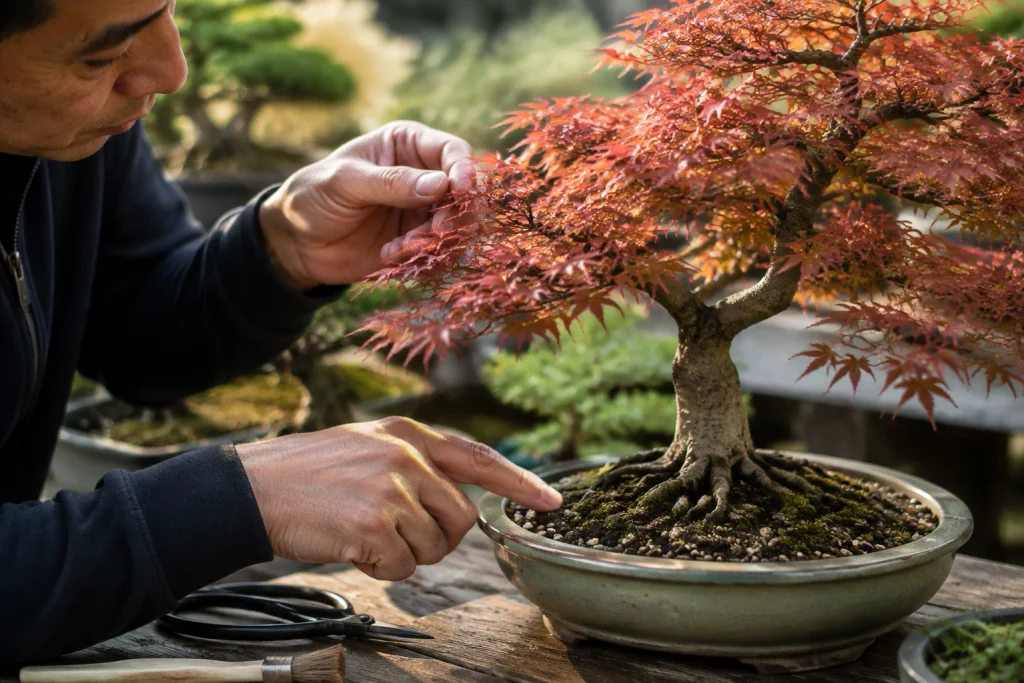
Instead of immediately changing everything, use a simple diagnostic process.
Step 1: Identify the Bonsai Species
Find out exactly what species or cultivar you have.
A Japanese maple, juniper, ficus, elm, bougainvillea, and pine do not respond to environmental conditions in exactly the same way.
Species determines what “normal” foliage color looks like.
Step 2: Check When the Color Appeared
Ask:
- Did it happen during spring growth?
- Is it occurring in autumn?
- Did it happen after moving the tree?
- Did it follow a heat wave?
- Did it appear shortly after repotting?
- Did it happen after a major pruning?
Timing can provide an important clue.
Step 3: Inspect the Leaves Closely
Look at both sides of several affected leaves.
Check for:
- Spots
- Holes
- Webbing
- Insects
- Curling
- Crispy edges
- Sticky residue
- Distortion
Do not diagnose the entire tree from one unusual leaf.
Step 4: Check the Soil Moisture
Push a finger carefully into the soil surface or use another appropriate moisture-checking method.
The goal is not to keep the soil permanently wet.
A bonsai needs both water and oxygen around its roots.
Step 5: Examine the Overall Tree
Healthy growth is often a better indicator than leaf color alone.
Look at:
- New shoots
- Bud development
- Branch flexibility
- Leaf density
- Root-zone drainage
- Overall vigor
A bonsai with red leaves but vigorous new growth may be perfectly healthy.
Step 6: Avoid Panic Treatments
Do not immediately:
- Repot the tree
- Remove most of the leaves
- Apply strong fertilizer
- Spray several pesticides
- Move it into complete shade
- Prune heavily
Changing several variables at once makes it difficult to determine what actually caused the problem.
Expert Tip: Before treating red leaves, photograph the foliage and record the species, recent weather, watering, feeding, pruning, and repotting history. Patterns become much easier to recognize when you compare symptoms over several days.
When Red Leaves Are a Warning Sign

Red foliage deserves more attention when several symptoms appear together.
Watch for These Combinations
Red leaves + crispy edges + dry soil
Likely environmental or drought stress.
Red leaves + wet soil + wilting
Investigate root-zone problems and drainage.
Red leaves + spots or lesions
Consider disease or another foliage problem.
Red leaves + webbing or stippling
Inspect carefully for mites.
Red leaves + distorted new growth
Check for insects, disease, or environmental damage.
Red leaves + sudden leaf drop
Investigate quickly, especially if the timing is abnormal for the species.
One symptom rarely tells the whole story. Bonsai diagnosis works best when you consider species, timing, environment, roots, foliage, and recent care together.
Should You Remove Red Bonsai Leaves?
Usually, no.
If the leaves are naturally changing color in autumn or the tree naturally produces red foliage, removing them is unnecessary.
If leaves are damaged by disease, pests, or severe stress, selective removal may sometimes be useful, but avoid stripping healthy foliage simply because it looks unusual.
Leaves are still part of the tree’s energy-producing system while they are functional.
Do not perform heavy defoliation on a bonsai that is already stressed.
Should You Fertilize a Bonsai With Red Leaves?
Not automatically.
Fertilizer is useful when the tree needs nutrients and is actively growing, but fertilizer is not a universal treatment for abnormal foliage.
Before feeding, consider:
- Species
- Season
- Current growth
- Previous fertilizer applications
- Soil condition
- Root health
- Severity of stress
If the tree is suffering from drought, root damage, disease, or severe heat stress, correcting the underlying problem is more important than simply adding fertilizer.
Should You Repot a Bonsai With Red Leaves?
Red leaves by themselves are not a reason to repot.
Repotting can be appropriate when the root system, soil structure, drainage, or timing indicates that it is needed. But unnecessary root disturbance can add stress.
Be especially cautious if the tree is already weak.
Repotting Becomes More Reasonable When You Also See:
- Severely compacted soil
- Very poor drainage
- Roots circling excessively
- A declining root system
- Soil that stays saturated for too long
- A potting mix that has broken down significantly
Major root work should be matched to the species, season, and condition of the tree.
Common Mistakes Bonsai Owners Should Avoid
- Assuming every red leaf is a disease. Some bonsai naturally produce red foliage.
- Watering on a fixed calendar. Bonsai watering needs change with weather, pot size, soil, and species.
- Adding fertilizer immediately. Nutritional problems cannot be diagnosed from red leaves alone.
- Moving the tree into deep shade without evidence of sun stress. Reduced light can create its own problems.
- Repotting a stressed bonsai unnecessarily. Root disturbance can increase stress.
- Spraying pesticides without identifying the pest. Incorrect treatment can damage foliage and beneficial organisms.
- Ignoring the roots. A healthy-looking watering routine cannot compensate for chronically poor drainage.
- Pruning heavily when the tree is struggling. A stressed bonsai needs recovery, not unnecessary loss of foliage.
- Ignoring seasonal behavior. Deciduous bonsai naturally change leaf color before leaf fall.
- Judging tree health from color alone. Buds, new growth, root condition, and overall vigor are equally important.
When to Ask an Experienced Bonsai Grower or Arborist
Most minor foliage-color changes can be investigated at home. However, experienced help is worthwhile when the diagnosis is unclear or the tree is declining rapidly.
Consider asking an experienced bonsai grower or qualified arborist when:
- A large portion of the canopy changes color suddenly
- Leaves are dropping rapidly outside the normal season
- The tree is repeatedly wilting despite appropriate watering
- You suspect serious root rot
- Large branches are dying back
- You cannot identify an insect or disease
- A valuable or old bonsai is deteriorating
- Major root work or structural pruning is being considered
- The tree has been severely damaged by heat, frost, storm, or drought
Do not attempt major root surgery or structural pruning on a severely stressed tree unless you understand the species and the risks involved.
A local bonsai club or experienced grower can often provide useful species-specific advice, while an arborist is more appropriate for larger trees or serious structural and health concerns.
FAQs
Why are my bonsai leaves turning red suddenly?
Sudden red foliage can result from normal species characteristics, seasonal change, intense light, heat, drought, root stress, pests, or disease. Check the timing and inspect the leaves and soil before treating the tree.
Are red leaves on a bonsai always a sign of stress?
No. Many bonsai naturally produce red young leaves or develop red foliage during autumn. Japanese maple cultivars are particularly well known for this behavior.
Why are my bonsai leaves turning red and falling off?
If the timing matches the natural seasonal cycle of a deciduous species, this may be normal. Outside the normal season, investigate watering, heat, root health, pests, and disease.
Can overwatering cause bonsai leaves to turn red?
Overwatering can contribute to root stress, which may lead to abnormal foliage color, yellowing, wilting, or leaf drop. The important issue is usually poor root oxygen caused by persistently saturated soil.
Should I cut off red bonsai leaves?
Not simply because they are red. If the color is natural, leave the foliage alone. Remove leaves selectively only when there is a clear reason, such as significant disease or severe damage.
Should I fertilize my bonsai when the leaves turn red?
Not automatically. First determine whether the red color is normal or caused by stress. Fertilizing a tree with root damage or severe environmental stress may not solve the problem.
Can pests make bonsai leaves turn red?
Yes, pest feeding can damage foliage and sometimes cause stippling, bronzing, discoloration, and premature leaf drop. Inspect both sides of leaves and young shoots before choosing a treatment.
Conclusion
If you are wondering why your bonsai leaves are turning red, start by resisting the urge to treat the tree immediately. Red foliage can be completely natural, particularly on deciduous bonsai and Japanese maple cultivars, but abnormal red or bronze foliage can also accompany environmental stress, root problems, pests, disease, or nutritional issues.
The best approach is to look at the species, season, leaf pattern, soil moisture, recent weather, and overall tree vigor together.
Healthy new growth, normal seasonal timing, and evenly colored leaves are generally reassuring. Red foliage combined with wilting, crispy edges, spots, pests, poor drainage, or sudden leaf drop deserves closer investigation.
Your next step is simple: identify the species, inspect the affected leaves, check the soil, and compare the color change with the tree’s normal seasonal behavior. Avoid unnecessary pruning, fertilizer, pesticide, or repotting until you have a reasonable idea of what is actually happening.
With careful observation, you can usually determine whether your red bonsai leaves are a beautiful part of the tree’s natural cycle or an early warning that your bonsai needs better care.