
Whiteflies on Bonsai Leaves: Causes and Solutions

Quick Answer
Whiteflies on bonsai leaves are tiny sap-feeding insects that usually gather underneath foliage. Adults often fly up when the tree is disturbed, while immature whiteflies remain attached to leaves. Confirm the pest using a reliable whitefly identification guide before treating your bonsai.
Signs that point to whiteflies
- Flying white adults: Tiny white insects flutter upward when you gently disturb the foliage.
- Leaf-underside colonies: Eggs, nymphs, and adults commonly gather beneath leaves.
- Sticky foliage: Feeding whiteflies produce sugary honeydew that can coat leaves.
- Black surface growth: Sooty mold may develop on accumulated honeydew.
- Yellowing leaves: Heavy feeding can reduce vigor and contribute to premature leaf drop.
What to do first
- Isolate the bonsai, inspect leaf undersides, rinse removable insects away, and treat remaining pests with a product labeled for both the plant and whiteflies.
Whiteflies are easy to miss until a tiny cloud rises from your bonsai. By that point, several life stages may already be hiding underneath the leaves.
I approach these infestations by identifying the insect first, then reducing the population in stages. That protects the tree from both pest damage and unnecessary treatments.
In This Guide
How Can You Identify Whiteflies on Bonsai Leaves?
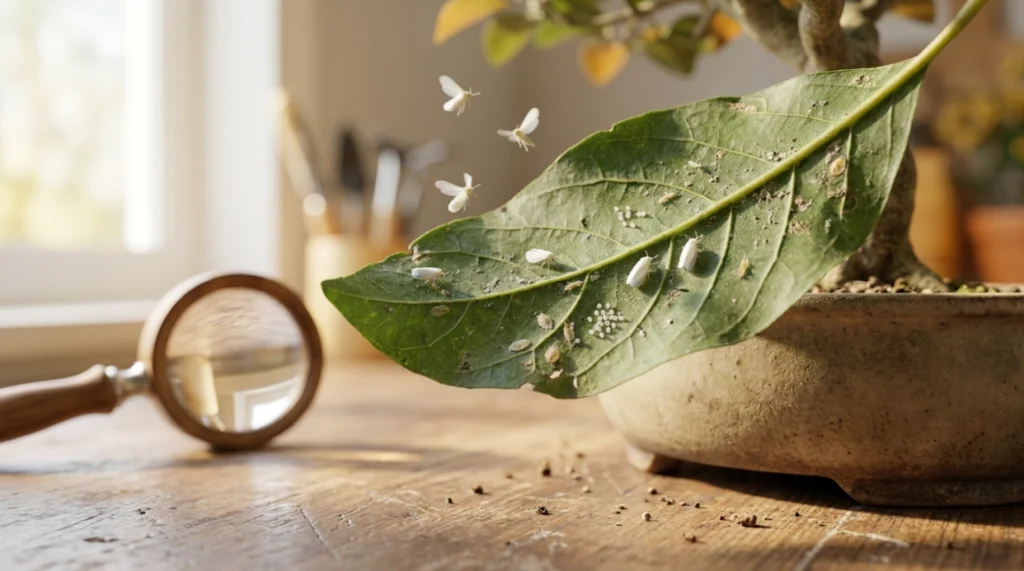
Whiteflies are tiny sap-feeding insects in the family Aleyrodidae. Despite their name, they aren’t true flies and are more closely related to aphids, scales, and mealybugs.
Definition: A whitefly is a small Hemipteran insect whose adults have powdery, whitish wings and whose immature stages feed while attached to leaf surfaces.
Adult whiteflies are commonly around 1/16 inch, or roughly 1.5 mm, long. Their small size makes a close inspection important.
The easiest field test is movement. Gently tap or turn the foliage and watch for tiny white insects fluttering away.
Check the underside of the leaves
Don’t stop after finding adults. Turn several affected leaves over and use a hand lens if you have one.
- Eggs: Usually occur on leaf undersides and can be difficult to see without magnification.
- Crawlers: Newly hatched first-stage nymphs can move before choosing a feeding location.
- Older nymphs: These become largely immobile and can resemble tiny flat scales.
- Adults: Powdery white insects with wings that readily move when disturbed.
Whiteflies pass through four nymphal instars before adulthood. That matters because one inspection rarely reveals every stage.
Whiteflies vs. other white bonsai pests
| What You See | Likely Problem | Best Clue |
|---|---|---|
| Tiny white adults | Whiteflies | Adults fly when foliage is disturbed |
| Cotton-like clusters | Mealybugs | Waxy masses around joints and crevices |
| Fixed white or brown bumps | Scale insects | Bumps remain attached rather than flying |
| Fine pale stippling | Spider mites | Tiny mites or fine webbing may appear |
The University of Maryland Extension’s whitefly guidance also highlights adults fluttering from disturbed foliage as a useful identification clue.
Why Do Whiteflies Appear on Bonsai Trees?
Whiteflies don’t appear because you watered your bonsai incorrectly. An infestation begins when insects reach a suitable host and reproduce.
This distinction matters. Correcting care can strengthen a stressed bonsai, but watering changes alone won’t eliminate an established colony.
Common ways an infestation starts
- New plants: An infested bonsai, houseplant, or nursery plant can introduce eggs, nymphs, or adults.
- Nearby plants: Winged adults can move between suitable plants growing close together.
- Warm protected areas: Greenhouses and indoor growing spaces can support continuing pest activity.
- Hidden immature stages: Eggs and flat nymphs beneath leaves can survive an incomplete inspection.
- Interrupted natural control: Outdoor predators and parasitoids sometimes help suppress whitefly populations.
Ficus and other broadleaf ornamentals can host certain whitefly species. The exact host range varies considerably between whitefly species.
Does poor bonsai care cause whiteflies?
No. Stress doesn’t create insects.
However, a weak bonsai may tolerate feeding less successfully. Poor light, damaged roots, incorrect watering, or other stress can make recovery harder.
I therefore treat the infestation and review the growing conditions separately. Fixing one problem shouldn’t distract from the other.
What Damage Do Whiteflies Cause to Bonsai?
Whiteflies pierce plant tissue and remove phloem sap. Small populations may cause little visible damage, while large colonies can weaken foliage.
The symptoms often develop gradually. Look at the pattern across several leaves rather than judging one damaged leaf.
- Yellow foliage: Feeding can contribute to chlorosis and declining leaf quality.
- Premature leaf drop: Heavily affected leaves may fall before their normal seasonal time.
- Weak growth: Persistent feeding can reduce the tree’s vigor.
- Sticky honeydew: Whiteflies excrete sugary liquid onto leaves and nearby surfaces.
- Sooty mold: Dark fungal growth can develop on honeydew-coated surfaces.
Honeydew is one of my most useful clues. Sticky foliage tells me to look closely for sap-feeding pests, even when the insects aren’t obvious.
Is sooty mold attacking the bonsai?
Sooty mold usually grows on honeydew rather than directly feeding on the bonsai. Treating the insect source is therefore more important than cleaning the black coating alone.
Once pest pressure drops, you can gently clean affected foliage where practical. Avoid harsh scrubbing that damages delicate leaves.
Bonsai Empire’s pest and disease overview also emphasizes identifying visible insect signs before choosing a treatment.
How Do You Get Rid of Whiteflies on a Bonsai?
Start with the least disruptive methods and work upward. The goal is to reduce adults and immature stages without adding unnecessary stress.
Step 1: Isolate the affected tree
Move the bonsai away from other susceptible plants. Leave enough separation that foliage doesn’t touch neighboring plants.
Inspect nearby plants too. Treating one bonsai won’t solve the problem if another plant remains infested.
Step 2: Inspect every part of the foliage
Check young leaves, mature leaves, branch tips, and especially leaf undersides. A hand lens can make flat nymphs much easier to detect.
Look for honeydew and sooty mold as well. These signs can reveal areas where insects have been feeding.
Step 3: Physically reduce the population
For a manageable infestation, rinse the foliage with water where the species and growing setup allow it. Concentrate on the undersides.
Support branches while rinsing. A bonsai’s fine ramification can be easier to damage than a full-sized nursery shrub.
Step 4: Use yellow sticky traps for adults
Yellow sticky cards can capture flying adults. They also help you see whether adult numbers are declining.
Sticky traps don’t remove eggs or attached nymphs. Think of them as a monitoring and population-reduction tool, not a complete cure.
Step 5: Treat immature stages when necessary
Insecticidal soap or horticultural oil can help control susceptible whitefly stages when the product label permits use on your plant. Thorough coverage matters because these treatments primarily work through contact.
Test sensitive foliage first when appropriate. Always follow the product label for concentration, application intervals, temperature limits, and safety precautions.
Step 6: Keep monitoring
One treatment may leave protected life stages behind. Check new and older leaves repeatedly as the remaining whiteflies develop.
Repeat treatment only according to the product’s directions. Don’t increase the concentration because adults are still visible.
Section Takeaway: Treat whiteflies as a multi-stage infestation. Remove what you can, target remaining insects appropriately, and continue inspecting until new activity stops.
Which Whitefly Treatments Work Best?
No single treatment targets every whitefly stage equally well. A combination of monitoring, physical removal, and carefully selected contact treatments is usually more practical.
As of 2026, I still favor an integrated approach instead of immediately reaching for the strongest pesticide available.
| Method | Main Target | Useful For | Main Limitation |
|---|---|---|---|
| Water rinse | Removable insects | Early population reduction | May not remove attached stages |
| Yellow sticky trap | Flying adults | Monitoring and trapping | Doesn’t control eggs or attached nymphs |
| Insecticidal soap | Susceptible exposed stages | Direct-contact treatment | Coverage is critical; some plants are sensitive |
| Horticultural oil | Eggs and immature stages | Contact-based suppression | Plant and temperature restrictions vary |
Colorado State University Extension notes that whitefly control can require repeated treatment because eggs and some developmental stages respond differently to insecticides. Its greenhouse whitefly guidance also discusses soaps and horticultural oils.
What about homemade dish-soap sprays?
I prefer a product specifically formulated and labeled as insecticidal soap. Household detergents vary in formulation and may injure foliage.
Bonsai leaves can also respond differently between species. A treatment tolerated by one tree isn’t automatically safe for another.
Should you use a systemic insecticide?
Systemic insecticides exist for some ornamental whitefly situations, but they aren’t my automatic first step. Registration, environmental effects, plant suitability, and local rules all matter.
If simpler measures fail, use only a pesticide legally labeled for the plant, pest, and application site. Follow its directions rather than improvising a dose.
How Can You Stop Whiteflies From Coming Back?
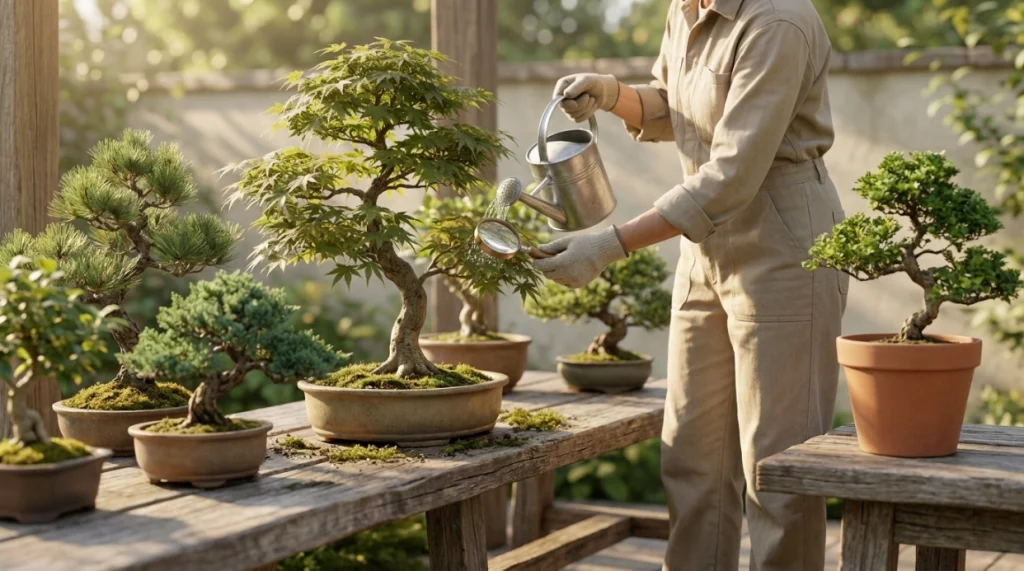
Prevention starts with inspection and isolation. You can’t make a bonsai immune, but you can catch new infestations before they become difficult.
Quarantine new plants
Keep newly purchased bonsai and companion plants away from your established collection at first. Inspect both sides of their leaves repeatedly.
A plant that looks clean on purchase can still carry difficult-to-see eggs or nymphs. Continue checking during the isolation period.
Inspect while watering
I use watering time as a pest check. It only takes seconds to turn over a few leaves and examine new growth.
- Look for tiny flying insects.
- Check for sticky leaf surfaces.
- Inspect new growth for yellowing.
- Look underneath mature leaves.
- Watch for black sooty deposits.
Give the tree species-appropriate care
Healthy care doesn’t repel whiteflies. It does give your bonsai a better foundation for recovering from feeding damage.
Provide the light, watering, soil drainage, fertilizer, temperature, and seasonal conditions required by the species. Don’t change several care factors at once unless they are clearly wrong.
Don’t overcrowd your collection
Closely packed foliage makes inspection harder and allows pests to move between neighboring plants. Leave practical space for airflow and access.
Outdoor conditions may also provide natural whitefly predators and parasitoids. Avoid unnecessary broad-spectrum pesticide use that can disrupt beneficial insects.
Keep monitoring after the adults disappear
This is where many infestations rebound. The visible white cloud can disappear while immature whiteflies remain underneath the leaves.
Continue checking the tree through the next development cycle. Fresh adults are a warning that surviving immature stages have matured.
Section Takeaway: Isolation, frequent leaf checks, sensible spacing, and species-appropriate care are your best defenses against a repeat infestation.
Frequently Asked Questions
Are whiteflies harmful to bonsai trees?
Yes, especially when populations become large. Whiteflies remove sap from leaves and can cause yellowing, reduced vigor, sticky honeydew, sooty mold, and premature leaf drop.
Why do whiteflies fly out when I touch my bonsai?
Adult whiteflies readily leave the foliage when disturbed and often settle again nearby. This fluttering response is one of the quickest ways to distinguish them from scale insects or mealybugs.
Can whiteflies spread from my bonsai to houseplants?
Yes. Adult whiteflies can move between suitable host plants, so isolate an infested bonsai and inspect nearby plants for adults, eggs, and nymphs.
Will yellow sticky traps eliminate whiteflies?
No. Sticky traps mainly catch flying adults and help monitor activity. Eggs and immature whiteflies remain on leaves, so traps work best as one part of a broader control plan.
Can I use insecticidal soap on a bonsai?
Potentially, but the product must be suitable for the plant and labeled for the intended use. Cover pest-infested surfaces carefully, test sensitive foliage when appropriate, and follow every label instruction.
Why do whiteflies keep returning after I spray?
Different whitefly life stages can be present at the same time, and some stages are harder to control. Eggs or surviving nymphs may later produce new adults, which is why follow-up inspection matters.
Should I repot a bonsai because it has whiteflies?
Usually not. Whiteflies primarily colonize foliage, so repotting doesn’t address the main infestation and can add stress. Repot only when the roots, soil, drainage, season, or normal bonsai maintenance schedule provides a separate reason.
Final takeaway: When white insects rise from your bonsai leaves, don’t treat blindly. Isolate the tree, confirm whiteflies underneath the foliage, reduce the population, and monitor every life stage until activity stops.
A small infestation is much easier to manage than a neglected one. Make leaf inspection part of your normal bonsai routine, especially when adding new plants to your collection.