
Bonsai Leaf Spot Disease: Causes and Treatment

Quick Answer
Bonsai leaf spot disease usually appears as brown, black, tan, or yellow-edged spots caused by fungal or bacterial pathogens. Start by keeping the foliage dry, improving airflow, removing badly affected leaves, cleaning fallen debris, and checking the tree for pests or watering stress before considering a treatment. The University of Minnesota Extension leaf spot guide is a useful reference for identifying common patterns.
Signs to check first
- Brown or black spots: Often consistent with fungal or bacterial leaf disease, especially when spots continue spreading.
- Yellow halos: Dark spots surrounded by yellow tissue can occur with some bacterial infections.
- Wet foliage: Long periods of leaf wetness create favorable conditions for many pathogens.
- Early leaf drop: Heavy infection can cause damaged leaves to yellow and fall prematurely.
- Rapid spreading: New spots appearing after wet weather suggest an active disease rather than old physical damage.
What to do immediately
- Move the bonsai away from nearby trees, stop routine foliage misting, remove fallen leaves, and photograph the symptoms so you can track whether the problem is still spreading.
Leaf spots on a bonsai can look alarming because every damaged leaf is easy to see on a small canopy. I treat spotting as a diagnosis problem first, not a reason to immediately reach for a spray.
In this guide, I’ll show you how I separate true bonsai leaf spot disease from watering stress, insects, scorch, and normal leaf damage. I’ll also explain what to change so the problem is less likely to return.
In This Guide
What Is Bonsai Leaf Spot Disease?
Bonsai leaf spot disease is a group of plant disorders that produce localized dead or discolored areas on leaves. Fungi cause many leaf spot diseases, although bacteria and other pathogens can produce similar symptoms.
Definition: A leaf spot is a limited area of injured or dead leaf tissue that develops a different color, texture, or shape from the surrounding healthy foliage.
Typical spots may be tan, reddish, brown, dark purple, or nearly black. Some stay as tiny dots, while others enlarge and merge into irregular dead patches.
The disease can also behave differently depending on the bonsai species. A thin Japanese maple leaf may show damage much faster than a thick, waxy tropical leaf.
Does every brown spot mean disease?
No. A single dry patch can come from sun scorch, wind, fertilizer residue, insects, bruising, or physical damage.
True disease becomes more likely when new lesions continue appearing, especially on previously clean leaves. Repeated spotting after humid or rainy periods is another useful clue.
- Old physical damage usually stays localized.
- Active disease tends to produce additional lesions.
- Sun or wind injury often follows exposed edges or leaf tips.
- Pest feeding may produce stippling, webbing, residue, or visible insects.
That distinction matters. Spraying a fungicide on a tree suffering from sun scorch or mites wastes time and may add another layer of stress.
The Bonsai Empire pests and diseases guide also emphasizes diagnosis alongside basic tree health, watering, soil, and placement.
What Causes Leaf Spot Disease on Bonsai?
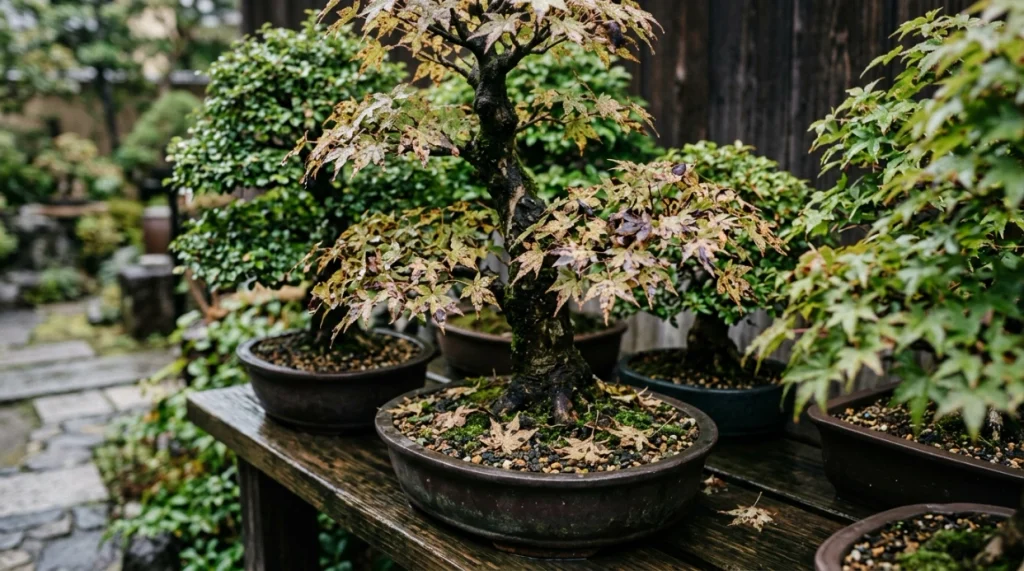
Fungal pathogens are the most common cause, but bacteria can also cause leaf spots. Disease becomes easier to establish when susceptible foliage stays wet and airflow is poor.
According to established horticultural guidance, many leaf-spot pathogens depend on prolonged moisture or high humidity. Some can infect after roughly 12 to 24 hours of favorable leaf-wetness conditions.
Fungal leaf spot
Fungi associated with foliar spotting include groups such as Cercospora, Pseudocercospora, Phyllosticta, and anthracnose-causing fungi. The exact pathogen depends heavily on the host species.
Fungal spores can move through splashing water and wind-driven moisture. Infected leaves and debris may also provide material where some pathogens survive between growing seasons.
Bacterial leaf spot
Bacterial diseases can create dark lesions, sometimes with a yellow halo. The center may eventually dry and drop out, producing a small “shot-hole” appearance.
Bacteria also spread readily through splashing water and wet plant surfaces. That is one reason I avoid unnecessary overhead watering when a tree is already showing suspicious spots.
Why bonsai growing conditions can encourage spotting
Bonsai culture creates a few special situations that ordinary landscape trees do not face. Trees may sit closely together on benches, making humidity and cross-contamination easier to manage poorly.
- Frequent misting: Repeatedly wet foliage can extend the time leaves remain damp.
- Tight spacing: Crowded canopies dry more slowly after rain or watering.
- Poor airflow: Trees against walls or inside enclosed spaces can remain humid longer.
- Contaminated debris: Fallen infected leaves left on the soil surface may remain close to new foliage.
- Plant stress: Incorrect watering, weak light, root problems, or unsuitable soil can reduce overall vigor.
Overwatering deserves special attention because it can confuse the diagnosis. Constantly wet soil can damage roots and cause yellowing or leaf loss without causing a true foliar leaf-spot infection.
For bonsai, I check both sides of the problem. I inspect the lesions themselves, then inspect drainage, soil moisture, light, airflow, and recent weather.
How Can You Tell Leaf Spot From Other Bonsai Problems?
Look at the shape, location, texture, and progression of the damage. One photograph is less useful than observing what happens over several days.
I like to photograph a few marked leaves and check them again later. If lesions expand or fresh spots appear elsewhere, I treat the issue as active until proven otherwise.
| Problem | Typical Clues | What to Check |
|---|---|---|
| Fungal leaf spot | Tan, brown, red, or black lesions that may enlarge or merge | Recent humidity, rain, wet foliage, fallen infected leaves |
| Bacterial spot | Dark lesions, possible yellow halos or shot-hole damage | Splashing water, rapidly spreading wet-looking lesions |
| Spider mites | Fine pale stippling, dull foliage, sometimes delicate webbing | Undersides of leaves and branch junctions |
| Sun or heat scorch | Bleached, crispy, or brown exposed areas and margins | Recent move into stronger sun or extreme heat |
| Root or watering stress | General yellowing, wilt, weak growth, or broad leaf drop | Soil moisture, drainage, roots, watering habits |
Inspect both sides of every affected leaf
Turn leaves over instead of examining only the upper surface. Pests, fungal structures, and subtle discoloration may be easier to see underneath.
A small magnifying lens helps. I also check neighboring leaves that still look healthy because early symptoms can be easy to miss.
Check whether the pattern follows exposure
Environmental damage usually has a pattern. Scorch often affects the side facing intense sun, while wind damage tends to hit exposed foliage first.
Disease lesions often appear more randomly because water, spores, or bacteria reach leaves in irregular patterns. Lower or shaded inner foliage may sometimes show symptoms first where humidity remains higher.
Do not diagnose by color alone
Black spots are not automatically fungal, and yellow spots are not automatically a nutrient problem. Several unrelated problems can create similar colors.
If the entire tree is declining rather than developing distinct lesions, broaden the diagnosis. Check roots, watering, light, temperature, and pests before deciding leaf spot is the primary problem.
How Do You Treat Bonsai Leaf Spot Disease?
Treatment starts by slowing spread and correcting the environment. Existing dead leaf tissue will not turn green again, so the goal is to protect healthy foliage and support new growth.
- Separate the affected bonsai. Give it space from the rest of your collection while you determine whether the problem is infectious.
- Remove badly infected leaves. Take off leaves with substantial spotting, but avoid stripping a weak tree of most of its functioning foliage.
- Clean the soil surface. Remove fallen leaves and other infected-looking debris rather than letting it accumulate beneath the canopy.
- Keep foliage drier. Water the substrate rather than repeatedly soaking leaves, especially late in the day.
- Improve airflow. Give the tree enough open space for leaves to dry after rain or watering.
- Check overall care. Confirm appropriate light, soil drainage, watering, and species-specific conditions.
- Monitor new growth. Healthy new leaves are a better recovery signal than the appearance of old damaged foliage.
Should you cut off every spotted leaf?
No. Removing a few heavily infected leaves can reduce diseased material, but aggressive defoliation can weaken an already stressed bonsai.
A practical limit is to preserve enough healthy foliage for photosynthesis. If most leaves are affected, focus more heavily on diagnosis, sanitation, airflow, and professional guidance.
Pro tip: Removing live foliage or diseased twigs is irreversible. If the tree is valuable, old, or already weak, ask an experienced grower or local bonsai club before making major cuts.
Do fungicides cure bonsai leaf spot?
Fungicides generally protect healthy tissue better than they repair existing lesions. Product selection also depends on the disease organism and the tree species.
That timing is important. The Penn State Extension disease-control schedule emphasizes preventive treatment around vulnerable growth periods for plants with histories of severe leaf disease.
Never assume a product labeled for one ornamental tree is automatically safe for every bonsai. Read the label for the host plant, pathogen, application timing, temperature restrictions, and required intervals.
What about bacterial leaf spot?
Standard fungal disease treatments may not control bacterial pathogens. Accurate identification becomes more important if lesions spread despite good sanitation and dry foliage.
Copper-based products are labeled for some bacterial plant diseases, but they can also injure sensitive foliage under unsuitable conditions. I would not use one blindly on an unidentified bonsai problem.
The University of Minnesota plant disease management guide recommends early identification, moisture management, and removing affected material as core disease-management practices.
How Do You Prevent Leaf Spot From Returning?
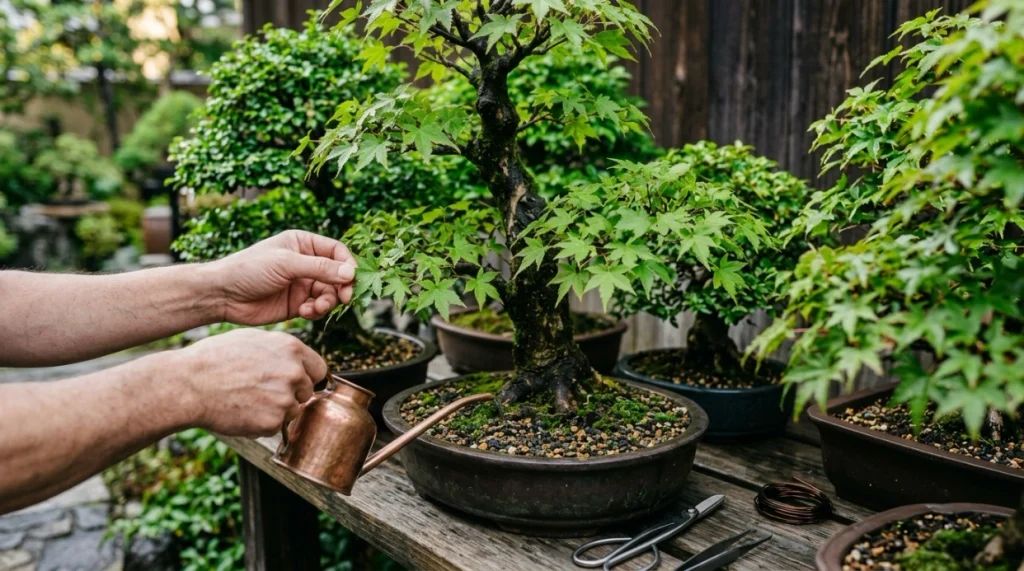
The most reliable prevention strategy is keeping leaves from staying wet unnecessarily while maintaining a healthy, well-spaced tree. Sanitation is especially important after an outbreak.
I pay more attention to prevention after several rainy days. That is when closely packed bonsai can remain damp much longer than expected.
- Water the root zone: Aim water at the substrate instead of making foliage wet every time.
- Water early when possible: Leaves accidentally wetted during the day can dry sooner.
- Space trees properly: Avoid allowing several dense canopies to overlap.
- Remove fallen leaves: Keep old infected foliage off the pot surface and bench.
- Clean tools: Sanitize cutting tools when moving between suspect or diseased plants.
- Inspect weekly: Check upper and lower leaf surfaces during active growth.
- Avoid unnecessary misting: Do not use routine foliage misting as a substitute for proper root watering.
Should you repot a bonsai with leaf spot?
Not automatically. Leaf spot is primarily a foliage problem, so repotting an already stressed tree may create more stress without solving the disease.
Repot only when the root system or substrate has its own clear problem, such as severe compaction, drainage failure, or root deterioration. Follow the proper repotting season for the species whenever possible.
Pro tip: Root pruning is permanent and can weaken a sick tree. If leaf disease and root problems occur together, consult an experienced bonsai grower before carrying out a major repot.
Does species matter?
Yes. Broadleaf bonsai can develop fungal and bacterial leaf diseases, while conifers may show needle spots, needle casts, or blights instead of classic broadleaf lesions.
Species-specific diagnosis is always more accurate than treating “bonsai” as a single plant type. A ficus, Chinese elm, Japanese maple, azalea, pine, and juniper have different foliage and environmental needs.
As of 2026, I still consider basic prevention more useful than routine preventive spraying for most hobby collections. Healthy placement, sensible watering, airflow, sanitation, and early observation solve many problems before they become severe.
If you want experienced local help with an unusual or valuable tree, the American Bonsai Society maintains bonsai resources and information about clubs where growers can find regional guidance.
Frequently Asked Questions
Can bonsai leaf spot disease kill the tree?
Mild leaf spot usually causes limited damage, but repeated heavy defoliation can weaken a tree by reducing photosynthesis. A bonsai that loses substantial foliage season after season deserves closer diagnosis because ongoing stress can make other pest, root, and disease problems harder to manage.
Should I isolate a bonsai with black spots?
Yes, temporary separation is sensible when you suspect an infectious disease. Give the tree good airflow and avoid splashing water between plants while you monitor whether new spots develop on affected or neighboring bonsai.
Can overwatering cause brown spots on bonsai leaves?
Overwatering can cause root stress, yellowing, browning, weak growth, and leaf drop, but those symptoms do not necessarily mean true leaf spot disease. Check whether the damage forms distinct lesions and whether the substrate remains saturated for unusually long periods.
Should I mist a bonsai that has leaf spot?
I would avoid unnecessary foliage misting while suspicious spots are spreading. Many fungal and bacterial pathogens benefit from moisture on leaf surfaces, so direct routine watering toward the soil and let the canopy dry efficiently.
Will damaged bonsai leaves become green again?
No. Tissue that has turned brown or black from necrosis is dead and will not recover. Judge improvement by whether spotting stops spreading and whether the bonsai produces healthy new foliage under corrected growing conditions.
When should I use fungicide on bonsai leaf spot?
Consider a fungicide only after fungal disease is reasonably likely and cultural changes alone are insufficient. Use a product specifically labeled for the plant and disease, follow its directions exactly, and remember that preventive timing often works better than spraying badly damaged leaves.
When should I ask an expert for help?
Seek experienced help if spotting spreads rapidly, branches begin dying, most foliage is affected, or the tree continues declining after environmental corrections. Valuable or old bonsai also justify earlier professional diagnosis because trial-and-error treatments can cause additional damage.
Final takeaway: When I see bonsai leaf spots, I start with diagnosis, dry foliage, airflow, sanitation, and careful observation. Treat the cause rather than the color of the spot, and your tree has a much better chance of producing clean, healthy growth again.
Check your bonsai regularly during the growing season. Catching the first few suspicious leaves is far easier than managing an infection after it has spread across the canopy.
