Bonsai Not Growing? 9 Reasons and How to Fix Them

A bonsai not growing is one of the most common worries for new owners. You water it, it looks alive, but week after week nothing new appears. Sometimes this is completely normal: the tree is dormant, recovering from repotting, or simply a slow species. Other times it means something in its care is holding it back, most often light, roots or nutrients. The key is to work out which one you are dealing with before you change anything.
In this guide
This guide covers the nine most common reasons a bonsai stops growing, how to check each one and what to do. If your tree is also losing leaves or changing color, it is likely stressed rather than just slow, and the fixes below still apply.
Is my bonsai not growing, or just resting?
Bonsai do not grow all year. Outdoor species such as maples, elms, junipers and pines go dormant from autumn until spring. During dormancy, no new shoots appear even on a perfectly healthy tree. You can read more about this natural rest period in the Wikipedia article on plant dormancy.
Tropical indoor trees like ficus and jade grow more slowly in winter too, because the days are short and light is weak. So before you worry, check the calendar. A tree that shows no growth between November and March is probably just resting. A tree that shows no growth in May or June has a problem.
9 reasons for a bonsai not growing
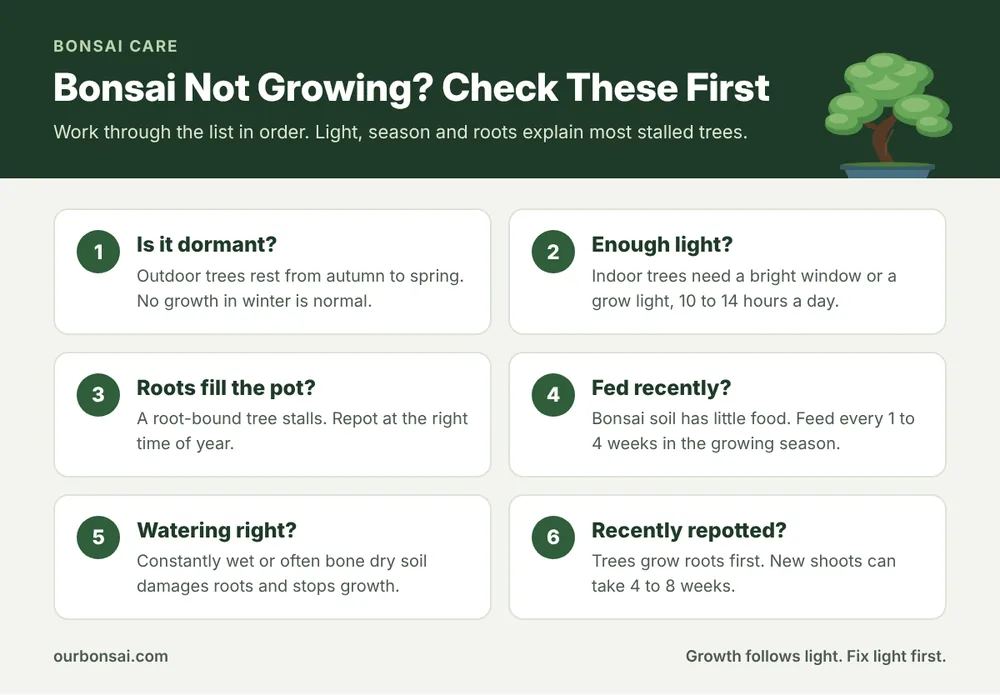
1. Not enough light
This is the number one reason indoor bonsai stop growing. A tree needs light to make energy, and most homes are much darker than they look to our eyes. A spot a meter or two away from a window can have a fraction of the light right at the glass.
Fix: move the tree right next to the brightest window, ideally south or west facing. In winter or in dark rooms, add a full spectrum grow light for 10 to 14 hours a day. Our guide on how much light a bonsai tree needs explains the details, and our review of the best indoor grow lights for bonsai helps you choose one.
2. An outdoor tree kept indoors
Junipers, maples, elms and pines need outdoor light and a winter rest. Indoors they slowly weaken, grow weak pale shoots or stop growing completely, and often die within a year.
Fix: move outdoor species outside. Our guide to types of outdoor bonsai trees helps you identify what you have.
3. Root-bound in the pot
After a few years, roots fill the pot completely. Water runs straight through, nutrients run out and growth stops.
Fix: lift the tree out of the pot. If roots circle the inside of the pot in a solid mat, repot in early spring (for most species) into fresh bonsai soil and trim the circling roots.
4. No fertilizer
Bonsai soil is designed to drain well, which means it holds very few nutrients. A tree that has not been fed for months will grow very little.
Fix: feed every one to four weeks during the growing season, depending on the product. Our guide to bonsai fertilizer pellets or liquid compares the two main types.
5. Watering problems
Soil that is always wet suffocates the roots. Soil that keeps drying out completely kills the fine root tips. Either way, the tree spends its energy on survival, not growth.
Fix: check the soil daily and water thoroughly when the topsoil is just dry. If the roots are rotting, see our guide to root rot in bonsai.
6. Wrong soil
Many store-bought bonsai come in compact, peaty soil or even with glued rocks on top. These stay wet, block air and slow root growth.
Fix: remove any glued stones from the soil surface right away. At the next repotting time, switch to a gritty bonsai mix. Our comparison of bonsai soil vs regular soil explains why it matters.
7. Recently repotted
After repotting, a tree focuses on growing new roots. Above the soil, nothing much happens for four to eight weeks. This is normal.
Fix: be patient. Keep the tree in bright, indirect light, keep the soil evenly moist and wait for new buds before you feed.
8. Pruned too hard
Removing most of the leaves or branches at once cuts the tree’s energy supply. It may sit still for weeks while it recovers.
Fix: never remove more than about a third of the foliage at once. Let the tree grow freely for a season to rebuild strength. Our guide on when to start pruning bonsai covers timing.
9. Pests or disease
Sap-sucking pests like scale, mealybugs and spider mites slowly drain a tree’s energy. Check stems and leaf undersides for bumps, white fluff or fine webbing.
Fix: treat early. See our guide to bonsai pests and diseases for an overview.
How fast should a bonsai grow?
It depends on the species and the season. In good conditions, a healthy ficus or Chinese elm puts out new shoots every few weeks during spring and summer. Junipers and pines grow more slowly and in clear flushes. A jade grows steadily but slowly. Our guide on how long it takes bonsai trees to grow gives realistic expectations by species.
| Species | Normal growth in the growing season |
|---|---|
| Ficus | New shoots every 3 to 6 weeks |
| Chinese elm | Several flushes from spring to autumn |
| Juniper | Steady new tips, slower than broadleaf trees |
| Pine | One main flush of candles in spring |
| Jade | Slow and steady, a few new leaf pairs a month |
| Japanese maple | Strong flush in spring, slower in summer |
Restarting growth: a 4-week plan
If you are not sure which cause applies, this plan covers the most likely ones without stressing the tree further:
- Week 1: move the tree to the brightest spot you have, or add a grow light. Check the soil daily and water only when the topsoil is just dry. Remove any glued stones from the soil surface.
- Week 2: look closely at stems and leaf undersides for pests and treat if you find any. Check the drainage holes are open.
- Week 3: if it is spring or summer and the tree has not been repotted recently, start feeding with a balanced fertilizer at half strength.
- Week 4: look for swelling buds at branch tips. If nothing is happening and it is the growing season, lift the tree from the pot to check the roots. Plan a repot if the pot is full of roots or the soil is muddy.
Most trees show new buds within this time once light and watering are right. Slow species like junipers and pines can take longer, so give them a full growing season before making big changes.
Common mistakes when a bonsai is not growing
- Fertilizing a sick tree heavily. Strong fertilizer burns weak roots. Fix light and watering first.
- Repotting in the wrong season. Repotting a stalled tree in midsummer adds stress. Wait for the right time.
- Moving it around constantly. Every move forces the tree to adjust. Pick a bright spot and keep it there.
- Expecting growth in winter. Most bonsai rest in winter. Wait for spring.
FAQ: bonsai not growing
Why is my indoor bonsai not growing?
Almost always light. Put it right next to the brightest window or under a grow light, then add regular feeding in spring and summer.
Why is my bonsai alive but not growing?
It may be dormant, recovering from repotting, root-bound or short on light and food. Check the season first, then the light and roots.
How do I make my bonsai grow faster?
Give it more light, feed regularly in the growing season, use fast-draining soil and let it grow without pruning for a while. Growing in a larger training pot also speeds up growth.
Will a bonsai grow back after it stops growing?
Yes, if it is still alive. Scratch a twig: green under the bark means the tree can grow again once you fix the cause.
Final thoughts
A bonsai not growing is either resting or stuck. Check the season first, because winter dormancy is normal. If it should be growing, look at light, roots and fertilizer in that order. Most stalled bonsai start growing again within a few weeks once they get enough light and food. For the full routine, see our main bonsai care guide.