How Often to Water Olive Bonsai (Indoor & Outdoor Guide)

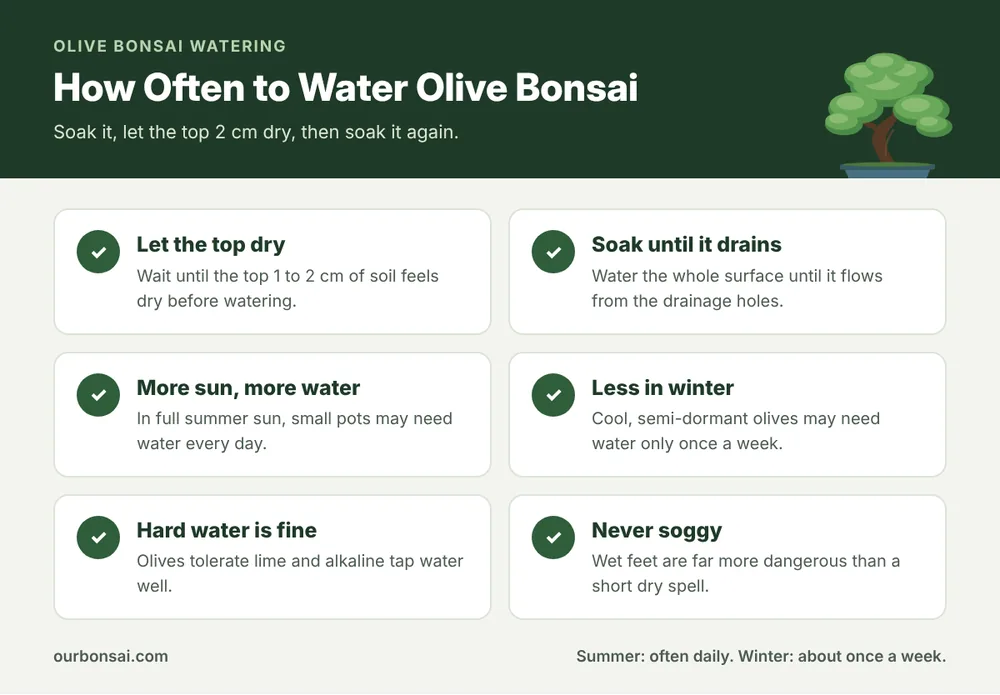
If you are wondering how often to water olive bonsai, the rule is simple: let the top 1 to 2 cm of soil dry out, then water thoroughly until it drains from the pot. For an outdoor olive in full summer sun that often means daily. In spring and autumn it is usually every two to three days, and in a cool winter it can be once a week or less. Indoors, every three to five days is typical. Olives handle a short dry spell far better than soggy soil, so when in doubt, check again tomorrow rather than watering today.
In this guide
- Why olive bonsai like to dry out a little
- How often to water olive bonsai by season
- How to tell when your olive needs water
- How to water an olive bonsai
- Watering olive bonsai indoors
- Signs of over and underwatering in olive bonsai
- Watering after repotting or pruning
- Watering olives in very hot or very wet weather
- Common mistakes when watering olive bonsai
- FAQ: how often to water olive bonsai
- Final thoughts
This guide explains why olives are different from most bonsai, how to judge when they need water, and how the routine changes through the year.
Why olive bonsai like to dry out a little
The European olive (Olea europaea) evolved on hot, rocky Mediterranean slopes with long dry summers. Its small, leathery, silvery leaves are built to save water, with a waxy coating and fine hairs underneath that reduce moisture loss. The Wikipedia article on the olive describes how well the tree survives drought.
Those adaptations make olive bonsai forgiving if you forget a watering, but unforgiving if the roots sit wet. Root rot in olives often starts quietly and shows up as yellowing, then sudden leaf drop. That is why soil matters as much as watering frequency. A gritty, fast-draining mix lets you water deeply without risk. Our guide to bonsai soil vs regular soil explains the difference, and the bonsai soil mix ratio guide shows how to blend a suitable mix.
How often to water olive bonsai by season
| Season | Outdoors | Indoors | What is happening |
|---|---|---|---|
| Spring | Every 2 to 3 days | Every 3 to 5 days | New shoots appear, water use increases |
| Summer | Daily in full sun | Every 2 to 4 days | Peak growth and heat |
| Autumn | Every 2 to 4 days | Every 4 to 6 days | Growth slows, cooler nights |
| Winter | Every 5 to 10 days | Every 5 to 7 days | Olive rests, uses little water |
These are starting points. Always check the soil before you water.
How to tell when your olive needs water
The finger test
Push your finger into the soil about 2 cm (an inch). If it feels dry, water. If it feels cool and damp, wait. With olives you can let it get a little drier than with most species.
Soil color
If your mix contains akadama, it turns from dark brown to a light, dusty tan as it dries. When most of the surface is light, it is time to water.
Leaf signals
Olive leaves curl slightly inward and look duller when the tree is short of water. That is an early warning, not an emergency, but water soon. Don’t wait for this every time, since repeated drought stress slows growth.
A chopstick or moisture meter
Push a wooden chopstick deep into the soil and leave it for ten minutes. If it comes out dry, water. A soil moisture meter works too, especially for indoor olives.
How to water an olive bonsai
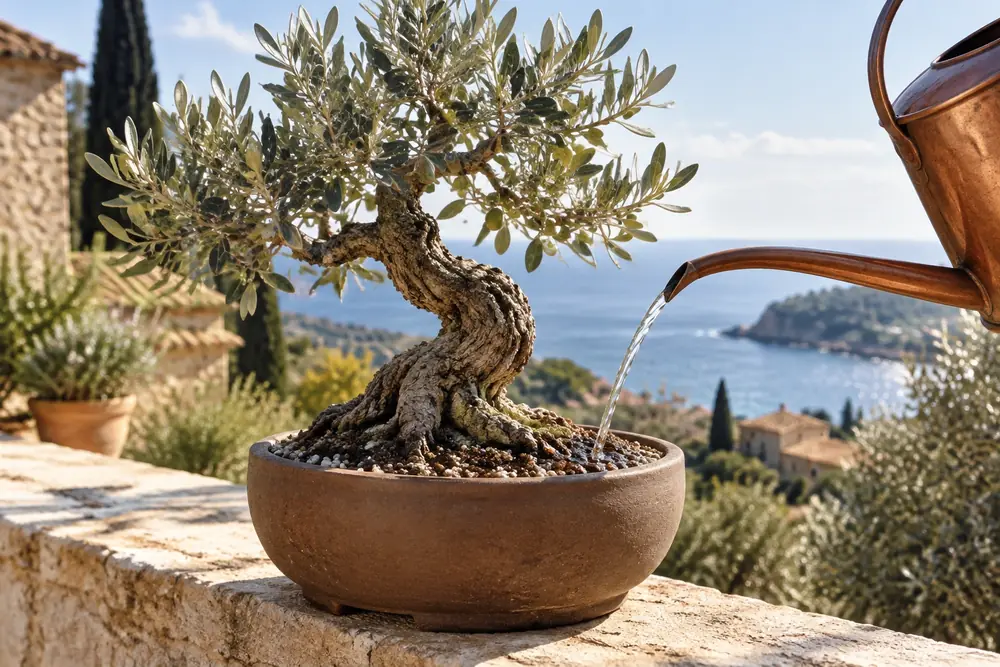
- Water slowly over the whole soil surface with a fine-rose can, such as a Japanese bonsai watering can.
- Keep going until water runs out of the drainage holes.
- Wait a minute, then water again so the whole root ball is wet.
- Let the pot drain completely. Never leave an olive standing in a saucer.
- Water in the morning where possible, so the tree has water for the hot part of the day.
Olives are not fussy about water quality. Hard, alkaline tap water is fine, which makes them easier than lime-hating species like azaleas.
Watering olive bonsai indoors
Olives are happiest outdoors in full sun, but many people keep them indoors in winter, especially in cold climates. Indoors:
- Place the tree in your sunniest window, or add a grow light. Without enough light, olives drop leaves no matter how carefully you water. Our guide to how much light a bonsai tree needs helps.
- Water less often than outdoors, but check every day. Heated rooms dry the soil faster than you might expect.
- Keep the tree away from radiators and heaters.
- A cool, bright room of around 10 to 15 °C (50 to 60 °F) is ideal for a winter rest.
Our guide to watering indoor bonsai in winter has more tips.
Signs of over and underwatering in olive bonsai
| Sign | Likely cause | What to do |
|---|---|---|
| Leaves curl and look dull | Underwatering | Water thoroughly and check more often |
| Crispy brown leaf edges | Repeated drying out | Soak the pot, keep a steady routine |
| Yellow leaves dropping, soil wet | Overwatering | Let the soil dry more, check drainage |
| Sudden heavy leaf drop, sour smell | Root rot | Repot into gritty soil, trim dead roots |
| White crust on soil and pot | Hard water mineral build-up | Flush with rain water occasionally |
If you suspect rot, our guide to root rot in bonsai walks through what to look for and how to treat it.
Watering after repotting or pruning
After repotting, water thoroughly once, then let the top of the new soil dry before the next watering. The root system is smaller for a few weeks, so the tree uses less water. After a heavy pruning, the same applies: fewer leaves mean less water use, so check before watering out of habit.
Watering olives in very hot or very wet weather
Heat waves. In temperatures above about 32 °C (90 °F), small olive bonsai can dry out by early afternoon. Water in the early morning and check again in the late afternoon. Moving the pot out of the hottest afternoon sun, or shading the pot itself, keeps the roots cooler.
Long rainy spells. Olives dislike constantly wet roots. In a week of rain, tilt the pot slightly so excess water drains away, or move the tree under cover. Skip watering until the soil starts to dry again.
Common mistakes when watering olive bonsai
- Watering on a fixed schedule. Olives use water at very different rates depending on sun and season.
- Keeping the soil constantly moist. That suits azaleas, not olives.
- Using dense potting soil. It keeps the roots too wet.
- Leaving the pot in a saucer of water. Always drain.
- Underestimating summer. A small olive in full sun can need water every day.
FAQ: how often to water olive bonsai
Can olive bonsai survive drought?
Better than most bonsai. A short dry spell is fine, but repeated drying out slows growth and can cause leaf drop. Water when the top soil is dry.
Should I mist my olive bonsai?
It is not necessary. Olives are adapted to dry air. Focus on watering the soil properly.
How often should I water an olive bonsai in winter?
Usually about once a week, sometimes less in a cool spot. Check the soil and water only when the top is dry.
Why is my olive bonsai dropping leaves after watering?
Often the soil has been too wet for too long, or it dried out completely before you watered. Check the roots and adjust your routine.
Final thoughts
So, how often to water olive bonsai? Water deeply, then let the top of the soil dry before the next watering. Expect daily watering in a hot summer and much less in winter. Combine that with gritty soil, full sun and good drainage, and your olive will stay healthy and grow into a beautiful, gnarled little tree. For more drought-tolerant species, see our guide to types of outdoor bonsai trees.