Underwatered Bonsai: Signs and How to Revive a Dry Tree

This post contains affiliate links. As an Amazon Associate, OurBonsai earns from qualifying purchases at no extra cost to you. Read our disclosure.
In this guide
- Signs of an underwatered bonsai
- Underwatered or overwatered?
- How to revive an underwatered bonsai
- What not to do after a tree has dried out
- Can an underwatered bonsai die?
- Why bonsai dry out
- How to prevent underwatering
- How plants lose water
- Building a watering habit that sticks
- FAQ: underwatered bonsai
- Final thoughts
An underwatered bonsai can go downhill surprisingly fast. Bonsai live in small, shallow pots with very little soil, so they have almost no reserve. On a hot, windy day a small tree can go from healthy to wilting in a few hours. The fine feeder roots that take up water are the first to die, and once they are gone the tree struggles even after you water it again.
The good news is that a tree caught early usually recovers. This guide shows you how to recognize underwatering, how to rescue a dried-out tree, and how to set up a routine so it does not happen again.
Signs of an underwatered bonsai
| Sign | What it looks like |
|---|---|
| Wilting | Soft shoots and leaves droop, often in the afternoon |
| Crispy leaves | Edges or whole leaves turn brown and dry |
| Leaf drop | Green or yellow leaves fall suddenly |
| Dry soil | Soil is light colored, hard or dusty |
| Light pot | The pot feels much lighter than usual |
| Shrinking soil | Soil pulls away from the sides of the pot |
| Water runs off | Water pools on top or runs straight down the sides |
On conifers such as junipers and pines, the signs are slower. Foliage turns dull, then yellowish or brown, sometimes weeks after the drought happened.
Underwatered or overwatered?
Both can cause wilting and yellow leaves, so it is easy to confuse them. The key difference is the soil.
- Underwatered: soil is dry, pot is light, leaves are crispy and brittle.
- Overwatered: soil is wet for days, may smell sour, leaves are soft and yellow, roots may be dark and mushy. See our guide to bonsai root rot.
If you are unsure, push a chopstick deep into the soil and leave it for ten minutes. A dry chopstick means the tree needs water. Our guide to why bonsai leaves wilt covers other causes too.
How to revive an underwatered bonsai
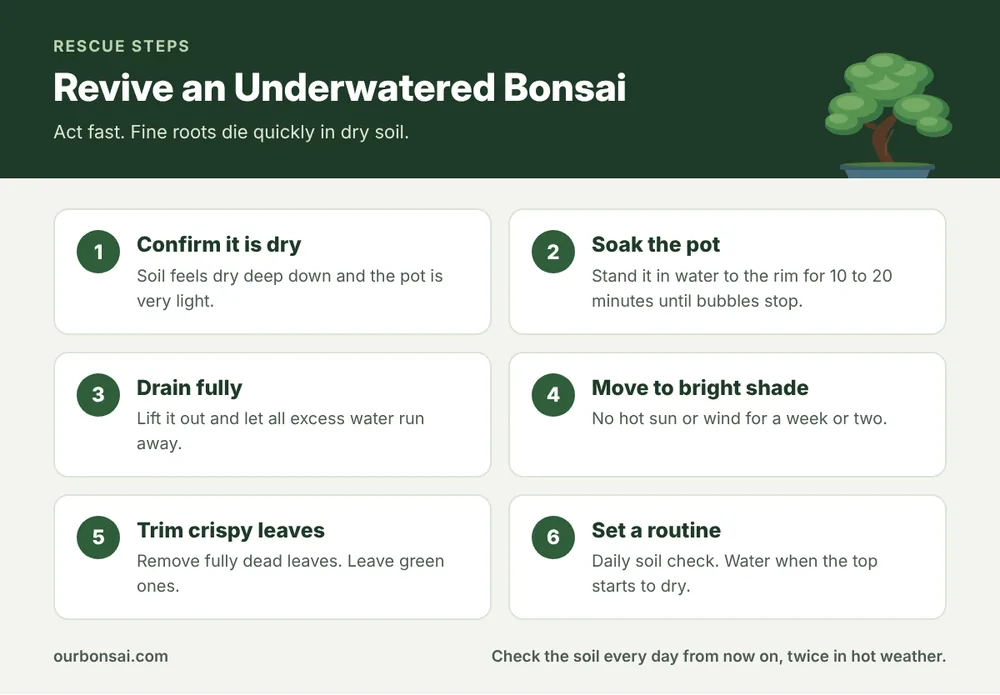
Step 1: Confirm the soil is really dry
Check deep in the pot, not just the surface. Lift the pot to feel its weight.
Step 2: Soak the whole pot
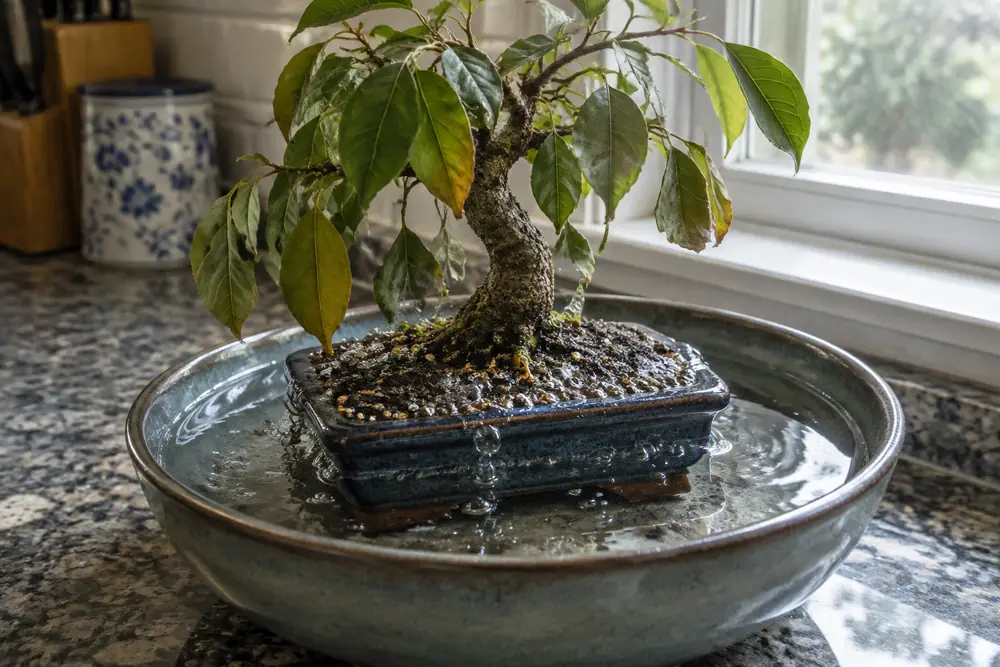
When bonsai soil dries out completely, it can repel water. Water just runs down the sides and out of the drainage holes without wetting the root ball. The fix is to soak it. Fill a bowl or basin with water and stand the pot in it so the water reaches the rim. Air bubbles will rise from the soil. Leave it for 10 to 20 minutes, until the bubbles stop.
Step 3: Drain it fully
Lift the pot out and let all the excess water drain away. Never leave it standing in water afterwards.
Step 4: Give it bright shade
For one to two weeks, keep the tree out of hot afternoon sun and wind. Its damaged roots cannot keep up with heavy water loss yet. Indoors, keep it away from heaters.
Step 5: Remove dead leaves
Leaves that have turned fully crispy will not recover. Trim them off. Leave any that are still green, even if they are drooping.
Step 6: Watch and wait
Check the soil daily. Water when the surface starts to dry. Do not overcompensate by keeping the soil constantly soaked, because roots damaged by drought can rot in soggy soil. New buds usually appear within two to six weeks.
What not to do after a tree has dried out
- Do not fertilize. Damaged roots burn easily. Wait until new growth appears.
- Do not repot unless the soil is completely unsuitable. Repotting adds more root stress.
- Do not prune green growth. The tree needs every leaf it has to recover.
- Do not move it into full sun to “speed things up”.
Can an underwatered bonsai die?
Yes, if the roots dry out completely for long enough. How quickly depends on the species:
- Azaleas, maples, elms and other fine-rooted trees: very sensitive. A single day bone dry in summer can kill many roots.
- Junipers and pines: more drought tolerant, but damage shows late, so they can look fine for weeks before turning brown.
- Jade and other succulents: very tolerant. They store water in their leaves and stems.
Use the scratch test to check: scrape a little bark on a twig with your fingernail. Green underneath means that part is alive.
Why bonsai dry out
- Small, shallow pots hold very little water.
- Root-bound trees have more roots than soil, so they drink the pot dry quickly.
- Hot, sunny and windy weather. Our guide to watering bonsai in summer has heat-wave tips.
- Indoor heating in winter dries both air and soil.
- Soil that is too coarse for your climate.
- Watering on a fixed schedule instead of when the tree needs it.
How to prevent underwatering
- Check the soil every day, twice a day in summer heat.
- Water thoroughly each time until water runs from the drainage holes.
- Use a moisture meter while you learn. Our guide to the best soil moisture meters has good options.
- Group trees together and use shade cloth in hot climates.
- Set up automatic watering if you are often away. See our guide to the best automatic watering system for bonsai.
- Repot root-bound trees in the right season so there is more soil to hold water.
- Use a humidity tray for indoor trees. Our pick of humidity trays explains how they help.
A simple watering can with a fine rose makes it easier to water slowly and evenly so the whole root ball gets wet.
How plants lose water
Leaves lose water constantly through tiny pores, especially in heat, sun and wind. When roots cannot replace it fast enough, cells lose pressure and the plant wilts. Mild wilting is reversible. Prolonged wilting damages cells permanently, which is why the leaves go crispy and drop. That is also why bonsai in small pots need such regular attention compared with garden plants.
Building a watering habit that sticks
Most underwatering happens on busy days, not because owners do not care. A few habits make it far less likely:
- Tie the soil check to something you already do, such as your morning coffee or getting home from work.
- Keep the watering can or hose next to the trees, filled and ready.
- Group thirsty trees together so you check them at the same time.
- Put a reminder on your phone for hot days, when a second check in the afternoon is needed.
- Arrange help before trips. Show a neighbor exactly how to water, or move trees into shade and set pots in trays of damp sand for short absences.
After a few weeks, checking becomes automatic and you learn how fast each tree dries in different weather.
FAQ: underwatered bonsai
How long can a bonsai go without water?
In summer heat, small trees can be in trouble within a day. In cool weather, a few days. It depends on pot size, species and conditions, so check daily.
Will crispy leaves grow back?
The crispy leaves will not recover, but new ones will grow if the roots and branches survived.
Should I mist an underwatered bonsai?
Misting helps a little by reducing leaf water loss, but it does not replace watering the roots. Soak the pot first.
Is bottom watering good for bonsai?
Soaking is great for rescuing a dry tree. For daily watering, top watering until it drains is better because it flushes the soil.
Final thoughts
An underwatered bonsai needs fast, calm action: soak the pot until the bubbles stop, drain it, give it bright shade and then return to careful, regular watering. Most trees recover if the roots were not dry for too long. Above all, build the habit of checking the soil every day; it is the simplest way to keep your trees healthy. For more on daily care, see our bonsai care guide.