When Does Bonsai Need Water? 5 Easy Ways to Tell

This post contains affiliate links. As an Amazon Associate, OurBonsai earns from qualifying purchases at no extra cost to you. Read our disclosure.
In this guide
- Why there is no fixed watering schedule
- 5 ways to tell when your bonsai needs water
- Signs from the tree itself
- How season changes watering
- How to water once you know it is time
- Best time of day to water
- Watering mistakes to avoid
- Learning your trees
- Watering several trees with different needs
- Species that drink fast and species that sip
- FAQ: when does bonsai need water
- Final thoughts
When does bonsai need water? It is the most common question beginners ask, and the honest answer is: when the soil says so, not when the calendar does. A bonsai in a small pot can need water twice a day in a summer heat wave and only once a week in a cool winter. The trick is learning to read the soil and the tree, so you water at the right moment every time.
This guide gives you five easy ways to check, explains what changes the timing, and shows you how to water properly once you know it is time.
Why there is no fixed watering schedule
How quickly a bonsai uses water depends on many things:
- Weather: heat, sun and wind dry pots much faster.
- Season: trees use far more water in spring and summer than in winter.
- Pot size: small and shallow pots dry fastest.
- Soil mix: coarse, inorganic mixes dry faster than mixes with organic material.
- Species: thirsty trees such as trident maple and azalea dry faster than junipers or jade.
- Root mass: a root-bound tree drinks the pot dry quickly.
A schedule like “every Sunday” ignores all of these. That is why the best growers check every day and water only when needed.
5 ways to tell when your bonsai needs water
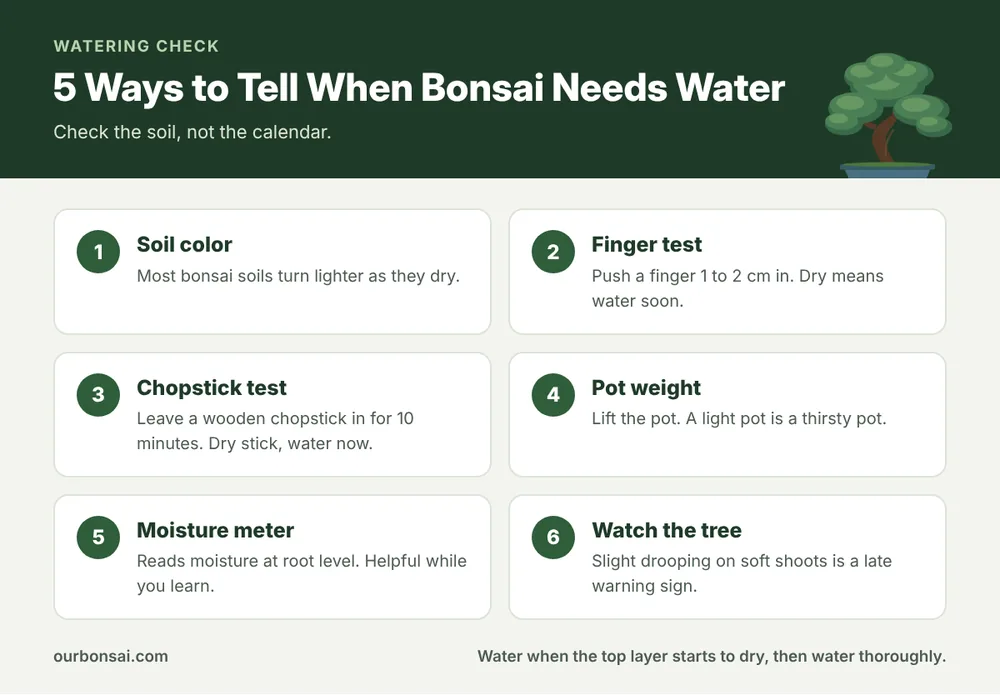
1. Look at the soil color
Most bonsai soils, especially akadama and other clay granules, are darker when wet and lighter when dry. When the surface has turned noticeably lighter, it is getting close to watering time. This is the quickest daily check.
2. The finger test
Push a fingertip 1 to 2 cm into the soil. If it feels dry at that depth, water soon. If it feels cool and damp, wait. This works well for most pots, though it can be hard in very coarse soil.
3. The chopstick test
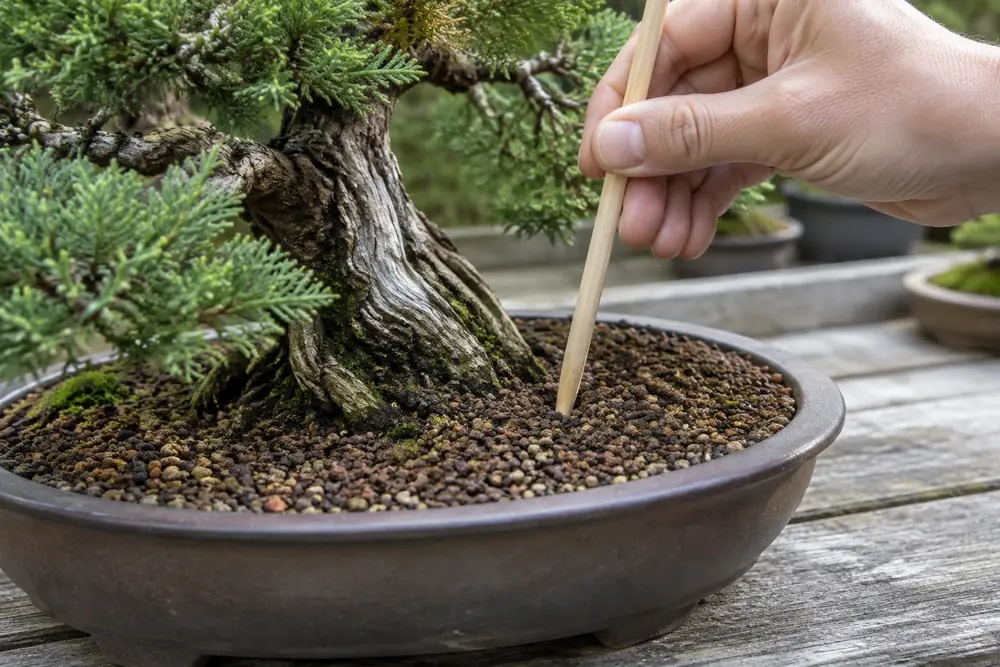
Push a plain wooden chopstick into the soil, near the middle of the pot, and leave it for ten minutes. Pull it out. A dark, damp chopstick means there is still moisture at the roots. A dry, clean chopstick means it is time to water. Some growers leave a chopstick in each pot permanently.
4. Lift the pot
With small and medium trees, lift the pot just after watering to feel how heavy it is when wet. Then lift it each day. When it feels clearly lighter, it needs water. After a few weeks you can judge this by feel alone.
5. Use a moisture meter
A soil moisture meter measures moisture at root level and removes the guesswork, especially for indoor trees. It is a great training tool while you learn how your trees behave.
Signs from the tree itself
The tree also gives signals, though they come later than soil checks:
- Slight drooping of soft new shoots, often in the afternoon.
- Dull, slightly soft leaves on broadleaf trees.
- Wrinkled leaves on succulents such as jade.
If you see these, water straight away. Do not wait for leaves to turn crispy. If they do, our guide to why bonsai leaves wilt helps you work out what went wrong.
How season changes watering
| Season | Typical outdoor tree | Typical indoor tree |
|---|---|---|
| Spring | Every 1 to 3 days | Every 3 to 5 days |
| Summer | Daily, sometimes twice | Every 2 to 4 days |
| Autumn | Every 2 to 4 days | Every 3 to 6 days |
| Winter | Weekly or less, never frozen | Every 4 to 10 days |
These ranges are only a rough guide. Always check first. Our seasonal guides on watering bonsai in summer and watering indoor bonsai in winter go into more detail.
How to water once you know it is time
- Water the whole surface slowly with a fine-rose can or wand.
- Keep going until water runs from the drainage holes.
- Wait a minute and water again to make sure the whole root ball is wet.
- Let it drain fully. Never leave a bonsai standing in water.
The RHS guidance on watering also recommends thorough, less frequent watering over frequent light sprinkles for container plants. You can find a bonsai watering can on Amazon if you do not have one.
Best time of day to water
Morning is best for most trees. They start the day fully hydrated, and leaves dry off before evening, which reduces fungal problems. In hot summers, a second check in late afternoon is often needed. Watering in full midday sun is fine if the tree is dry; the old idea that water droplets burn leaves is a myth.
Watering mistakes to avoid
- Little and often: small sips wet only the top layer and leave the roots dry.
- Watering on a schedule regardless of the soil.
- Keeping the soil constantly wet, which can lead to bonsai root rot.
- Using dense potting soil that never dries. A proper free-draining mix helps; see our guide to the best bonsai soil.
- Forgetting indoor trees near heaters, which dry much faster than expected.
Learning your trees
After a few weeks of checking daily, you will notice patterns. The small maple in full sun dries by lunchtime. The juniper in a deep pot lasts two days. The jade indoors needs water every couple of weeks. Each tree has its own rhythm, and learning it is part of the pleasure of bonsai.
Watering several trees with different needs
Once you have more than a few bonsai, it helps to arrange them by thirst. Put fast-drying trees, such as maples, azaleas and small shohin pots, together where you pass them every day. Group slow-drying trees, such as junipers in deep pots or succulents, in another area. That way, one quick walk past the bench tells you who needs water, and you do not drown the slow drinkers while caring for the thirsty ones. Labels with each tree’s name and typical watering interval can help family members or neighbors who water while you are away.
Species that drink fast and species that sip
- Fast drinkers: Trident maple, Japanese maple, azalea, Chinese elm, willow and most fruiting or flowering trees. Check these first every day.
- Medium: Ficus, Fukien tea, boxwood, hornbeam and most tropical broadleaf trees.
- Slow: Junipers and pines in coarse soil, and succulents such as jade and portulacaria, which store water in their leaves.
FAQ: when does bonsai need water
Should I water my bonsai every day?
Only if it needs it. In summer, many outdoor bonsai do need daily water. In winter, daily watering usually drowns them.
Is it better to underwater or overwater a bonsai?
Neither is good. Underwatering damages roots quickly; overwatering slowly rots them. Checking the soil avoids both.
Can I mist instead of watering?
No. Misting raises humidity briefly but does not water the roots. Always water the soil.
How do I water bonsai while on vacation?
Ask someone to water, use an automatic system, or move trees into shade and set the pots in trays of damp sand for a few days.
Final thoughts
So, when does bonsai need water? When the soil surface turns lighter, feels dry a centimeter or two down, a chopstick comes out dry, or the pot feels light. Check every day, water thoroughly when it is time, and adjust for season and species. Once checking becomes a habit, watering stops being a worry and becomes a quick daily moment with your trees. For more on daily routines, see our bonsai care guide.