Serissa Bonsai Winter Care: Keep Your Snow Rose Happy

This post contains affiliate links. As an Amazon Associate, OurBonsai earns from qualifying purchases at no extra cost to you. Read our disclosure.
In this guide
- How cold can a serissa handle?
- Serissa bonsai winter care checklist
- Light: the key to a full serissa
- Watering in winter
- Humidity
- Expect some yellow leaves
- Bringing serissa indoors in autumn
- Pests in winter
- Fertilizer and pruning in winter
- Flowering in winter
- Choosing the right winter spot
- A simple weekly serissa routine for winter
- Signs your serissa is happy in its winter spot
- Common serissa winter mistakes
- FAQ: serissa bonsai winter care
- Final thoughts
Serissa bonsai winter care is mostly about stability. Serissa (Serissa japonica), also called snow rose or tree of a thousand stars, is a subtropical shrub with tiny leaves and small white flowers. It is a lovely indoor bonsai, but it is famous for reacting to any change by dropping leaves. Winter brings several changes at once: less light, dry heated air, colder windows and, often, a move indoors from the garden. Plan for these, and your serissa will stay full and green.
This guide covers temperature, light, watering, humidity and how to avoid the classic winter leaf drop.
How cold can a serissa handle?
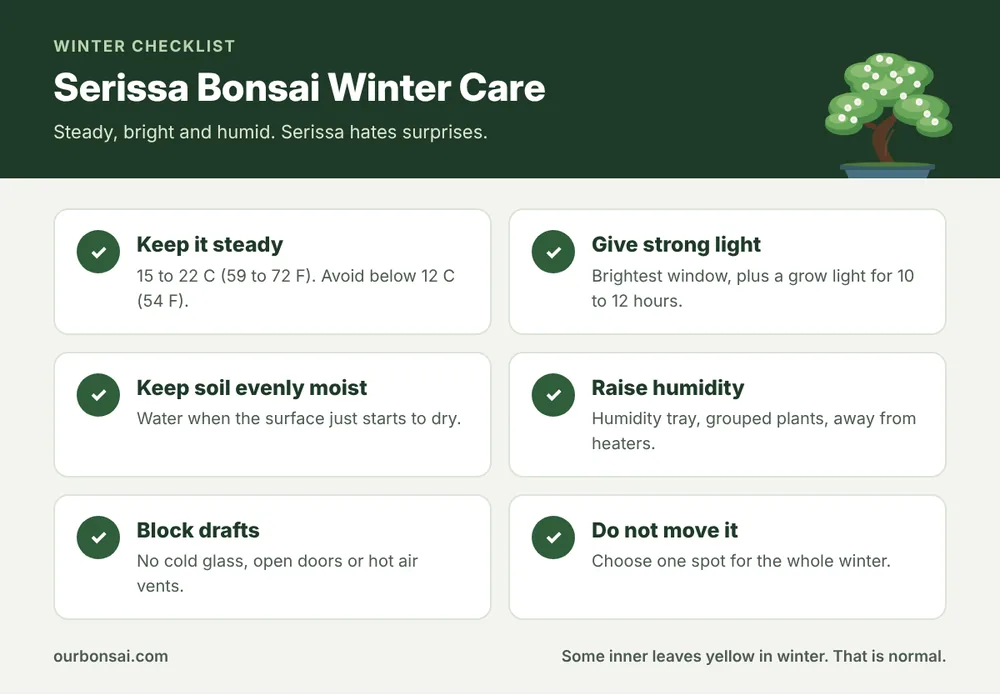
Serissa is not frost hardy. It prefers steady, moderate warmth.
| Temperature | Effect |
|---|---|
| 18 to 22°C (64 to 72°F) | Ideal |
| 15 to 18°C (59 to 64°F) | Fine, slower growth |
| 12 to 15°C (54 to 59°F) | Tolerated, leaf drop likely |
| Below 12°C (54°F) | Stress, avoid |
If your tree spends summer outdoors, bring it in before nights drop below about 13 to 15°C (55 to 59°F). Moving it earlier, while conditions inside and outside are similar, reduces leaf drop.
Serissa bonsai winter care checklist
Light: the key to a full serissa
In winter, light is usually the biggest limit. Serissa needs a lot of light to keep its leaves and stay compact.
- Brightest window you have, ideally south or east facing.
- Close to the glass, but with leaves not touching cold glass at night.
- Add a grow light for 10 to 12 hours a day in dark months. Our guide to the best grow lights for bonsai explains setup.
A serissa in low light drops inner leaves first and then grows thin, weak shoots. If it still flowers in winter, that is a good sign it has enough light.
Watering in winter
Serissa likes steady moisture. It dislikes both soggy soil and drying out.
- Check every day or two. Heated rooms can dry a small pot quickly.
- Water thoroughly when the surface starts to dry, until water runs from the drainage holes.
- Empty the drip tray so the roots never sit in water.
- Use room-temperature water. Cold water can shock the roots.
If you are unsure, a soil moisture meter helps. Our general tips on watering indoor bonsai in winter also apply.
Humidity
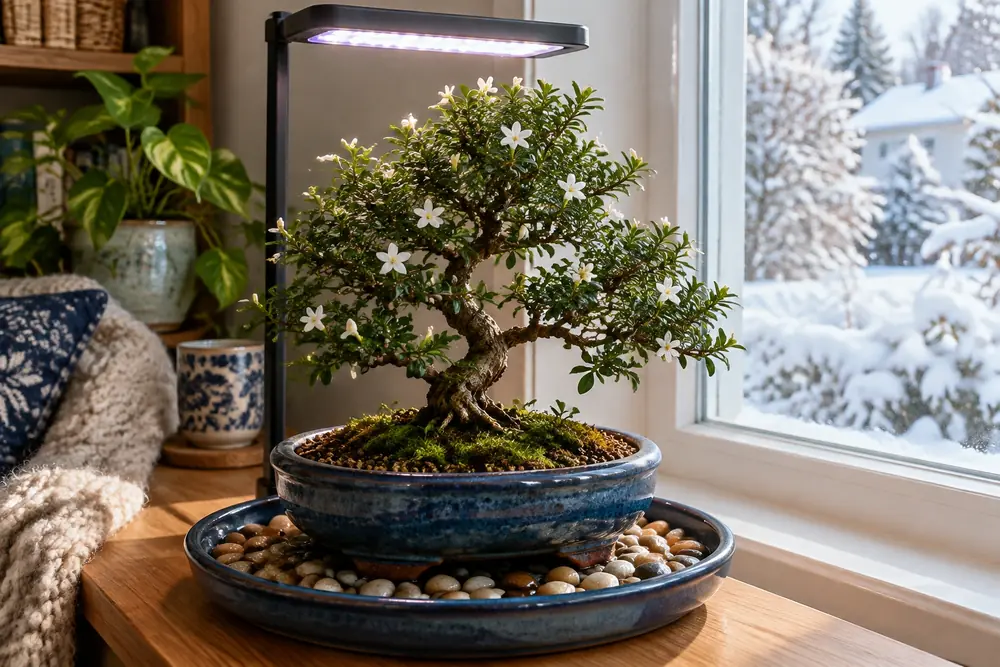
Serissa comes from humid regions and suffers in dry indoor air. A humidity tray under the pot is the simplest fix. Grouping it with other plants helps, and a small humidifier is ideal in very dry homes. Keep it well away from radiators and heat vents.
Expect some yellow leaves
Even in perfect conditions, serissa sheds some older inner leaves in autumn and winter. A few yellow leaves while the shoot tips stay green is normal. Heavy leaf drop is not, and usually comes from:
- A move to a new spot.
- Cold drafts.
- Soil that dried out completely.
- Soggy soil in a cool room.
- Too little light.
Our article on serissa bonsai yellow leaves goes deeper into the causes.
Bringing serissa indoors in autumn
The move indoors is the riskiest moment of the serissa year. Make it easier:
- Move it while nights are still mild, not after the first cold snap.
- Check for pests first, especially spider mites and aphids.
- Set up its indoor spot in advance with a humidity tray and light.
- Keep watering steady through the move.
- Expect a little leaf drop in the first two weeks.
Pests in winter
Dry indoor air encourages spider mites on serissa. Look for fine webbing and pale speckles on the leaves. Our guide to spider mites on bonsai trees explains how to treat them. Wiping or rinsing the foliage gently every couple of weeks helps prevent problems.
Fertilizer and pruning in winter
- Fertilizer: If the tree keeps growing under good light, feed at half strength once a month. Otherwise, wait until spring.
- Pruning: Light trimming of long shoots is fine. Leave harder pruning for spring and summer. Serissa roots and cut stems have an unpleasant smell when cut; that is normal.
- Repotting: Late spring, when it is warm and growing.
Flowering in winter
Serissa can flower on and off throughout the year, including winter, if it gets enough light. Flowers are usually lighter in winter. If your serissa does not flower indoors in winter, that is normal; more light usually brings the blooms back. It is a good choice among flowering indoor bonsai trees.
Choosing the right winter spot
The perfect winter spot for a serissa has four things: bright light, steady warmth, decent humidity and no drafts. A wide windowsill in a room that stays warm day and night, with a humidity tray and a grow light, is ideal. A shelf in the middle of a dim room is not. If you need a stand to raise the tree closer to the window light, look for a small indoor plant stand on Amazon.
A simple weekly serissa routine for winter
- Every day or two: Look at the soil surface and feel it with a fingertip. Water when it is just starting to dry.
- Weekly: Refill the humidity tray, turn the pot a quarter turn and look under the leaves for pests.
- Every two weeks: Rinse or gently wipe the foliage to remove dust and discourage spider mites.
- Monthly: Feed at half strength if you see new shoots, and trim any shoot that has grown far beyond the outline.
Keeping the same rhythm all winter suits serissa perfectly. It is a tree that rewards routine and punishes surprises.
Signs your serissa is happy in its winter spot
- New shoots appear at the tips, even if slowly.
- Leaves stay small, dark green and glossy.
- Only a few inner leaves yellow each week.
- The odd white flower opens.
If you see these signs, do not change anything. The setup is working.
Common serissa winter mistakes
- Moving the tree around the house looking for a “better” spot.
- Letting the soil dry out completely near a heater.
- Keeping it on a cold windowsill behind a curtain at night.
- Watering on a fixed schedule.
- Repotting or hard pruning in midwinter.
FAQ: serissa bonsai winter care
Can serissa stay outside in winter?
Only in warm, frost-free climates where nights stay above about 12°C (54°F).
How often should I water a serissa in winter?
Check every day or two and water when the surface starts to dry. That is often every two to four days indoors.
Why is my serissa losing leaves in winter?
Usually a move, low light, drafts or watering problems. A few yellow inner leaves are normal.
Should I mist my serissa?
Misting helps a little, but a humidity tray is more effective. The Wikipedia page on Serissa japonica describes its humid native habitat.
Final thoughts
Serissa bonsai winter care comes down to stable warmth, strong light, steady moisture and good humidity. Choose one bright spot, set up a humidity tray and a grow light, check the soil often and resist the urge to move the tree. Your snow rose will reward you with tiny green leaves and, often, a few white flowers through the darkest months. For more indoor care tips, read how to take care of a bonsai tree indoors.