Why Do Bonsai Trees Die? The 9 Most Common Causes

This post contains affiliate links. As an Amazon Associate, OurBonsai earns from qualifying purchases at no extra cost to you. Read our disclosure.
In this guide
- 1. Overwatering
- 2. Underwatering
- 3. Keeping an outdoor tree indoors
- 4. Too little light
- 5. Poor soil
- 6. Frost damage to the roots
- 7. Pests and diseases left unchecked
- 8. Doing too much at once
- 9. Starvation
- A simple routine that prevents most deaths
- How to tell if your bonsai is dying
- FAQ: why do bonsai trees die
- Final thoughts
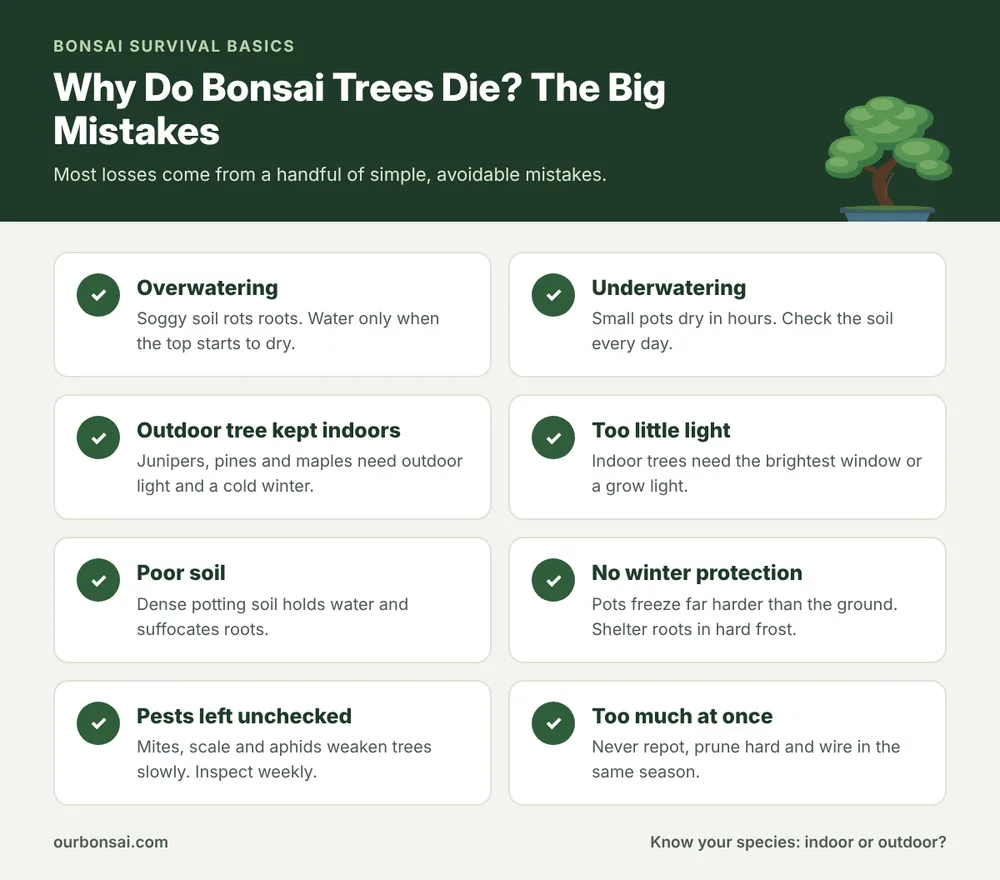
Why do bonsai trees die? In most cases, it comes down to a few avoidable mistakes rather than bad luck. A bonsai is a normal tree living in a very small amount of soil, so it depends completely on you for water, light, food and protection. The most common causes of death are watering problems (both too much and too little), keeping an outdoor species indoors, too little light, poor soil and frost damage to roots in winter. Pests, over-styling and starvation finish off many weakened trees. The good news is that once you know these causes, almost all of them are easy to prevent.
This guide walks through the nine most common reasons bonsai die, how to recognize each one, and what to do instead.
1. Overwatering
Overwatering is the top killer of indoor bonsai. Roots need air as well as water. When soil stays wet for days, roots suffocate and begin to rot, and the tree shows it with yellow, drooping leaves and weak growth. By the time you see the symptoms above ground, a lot of root damage has often happened.
Avoid it: water when the top of the soil begins to dry, not on a fixed schedule. Use a free-draining soil and empty the drip tray. Our guide to root rot in bonsai shows what to do if it has already started.
2. Underwatering
The opposite mistake kills just as many trees, especially outdoors in summer. A small bonsai pot can dry out in a few hours on a hot, windy day, and the fine roots die quickly. Leaves crisp and drop, and conifers turn brown weeks later.
Avoid it: check the soil every day in the growing season, twice on very hot days. Our article on watering bonsai in summer has practical routines.
3. Keeping an outdoor tree indoors
Many bonsai sold as gifts are junipers, pines or maples, which are outdoor trees. They need full outdoor light and a cold winter dormancy. Indoors, they slowly decline over a few months and then die, often with no obvious single cause. The Wikipedia article on bonsai cultivation and care points out that most traditional bonsai species are hardy outdoor trees.
Avoid it: find out what species you have. Junipers, pines, maples, elms (most), azaleas and other temperate trees live outside. Ficus, Fukien tea, jade, Hawaiian umbrella and other tropicals can live indoors. Our guide to most popular indoor bonsai trees lists suitable species.
4. Too little light
Even true indoor species need far more light than most rooms provide. In a dim spot, they drop leaves, grow long, weak shoots and become easy targets for pests.
Avoid it: put indoor trees right next to the brightest window, ideally south or west facing, or add a grow light. See our guide on how much light a bonsai tree needs.
5. Poor soil
Many bonsai are sold in dense, peaty soil or even compacted mud. It holds water for days, drains poorly and gets worse over time. This sets the stage for root rot and makes watering much harder to get right.
Avoid it: repot into a proper gritty bonsai mix at the right season. Our bonsai soil vs regular soil guide explains the difference.
6. Frost damage to the roots
Outdoor bonsai are hardy, but their roots are in a small pot above ground, where they freeze far harder than roots in the earth. A long, hard freeze can kill the roots while the tree looks fine, and the damage only shows when it fails to leaf out in spring.
Avoid it: in cold climates, protect pots during hard frosts by placing them on the ground in a sheltered spot, mulching around them, or moving them into an unheated shed or cold frame.
7. Pests and diseases left unchecked
Spider mites, scale, aphids and mealybugs rarely kill a healthy tree quickly, but they drain a weak one steadily. Fungal problems spread in damp, still air.
Avoid it: look closely at your tree every time you water, especially under leaves and along stems. Our guide to bonsai pests and diseases helps you identify and treat the common ones.
8. Doing too much at once
Repotting, hard pruning, wiring and defoliation each take energy from a tree. Doing several in the same season, or working on a tree that is already weak, can push it past the point of recovery.
Avoid it: one major job per season, and only on a strong, healthy tree. Let it recover in between.
9. Starvation
Bonsai soil holds very few nutrients, and every watering washes some out. A tree that is never fed slowly weakens, turns pale and grows less each year.
Avoid it: feed regularly through the growing season. Our guide to the best bonsai plant food covers options, or browse balanced bonsai fertilizer.
A simple routine that prevents most deaths
You do not need to be an expert to keep a bonsai alive. A short routine covers almost every cause above:
- Every day: check the soil with a finger and water if the top is drying. Glance at the leaves.
- Every week: turn indoor trees a quarter turn, look under the leaves for pests, and remove dead leaves.
- Every two weeks in the growing season: feed with a balanced fertilizer.
- Every season: do at most one big job, such as repotting in spring or structural pruning in late winter.
- Before winter: bring tropical trees indoors before nights get cold, and plan frost protection for outdoor trees.
Most bonsai that live for decades are cared for by people who simply do these few things consistently.
How to tell if your bonsai is dying
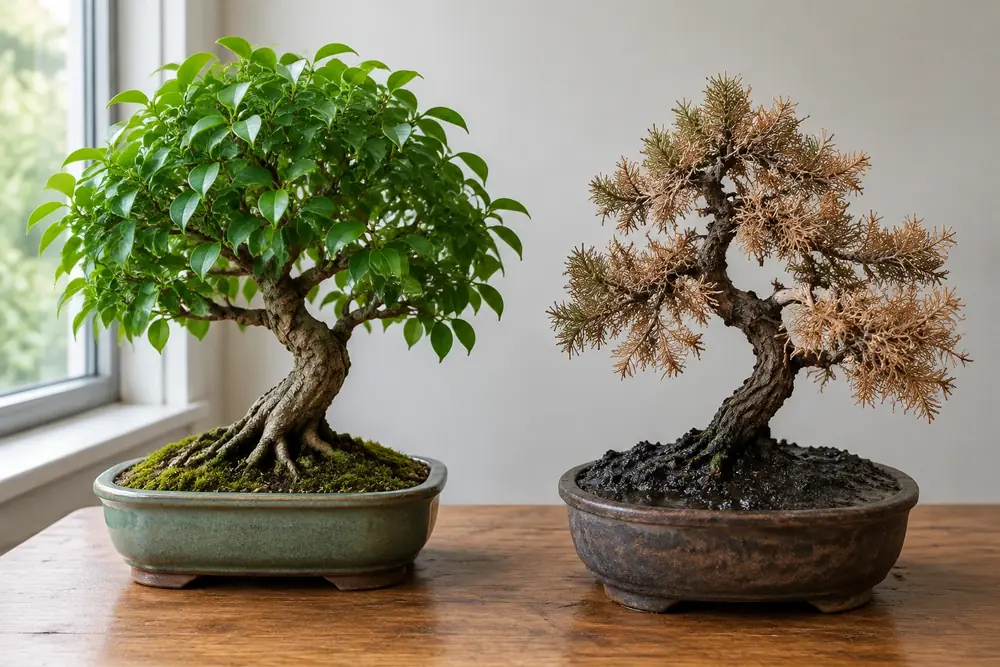
- Leaves yellowing, browning or dropping in large numbers.
- Branches that snap dry rather than bending.
- Wrinkled bark or a soft trunk base.
- Soil that smells sour, or roots that are black and mushy.
- No new growth in the growing season.
The scratch test is a useful check: scrape a tiny area of bark on a branch. Green underneath means that part is alive. Our guide to why bonsai branches are dying covers dieback in more detail.
FAQ: why do bonsai trees die
What is the most common reason bonsai die?
Watering problems, especially overwatering indoors and underwatering outdoors in summer, followed by keeping outdoor species indoors.
Do bonsai die easily?
Not if you choose the right species for your conditions and learn to water by checking the soil. Many bonsai live for decades, some for centuries.
Can a dying bonsai be saved?
Often, if there is still green tissue under the bark and some healthy roots. Fix the cause quickly and give the tree time.
Why did my bonsai die after I bought it?
Common reasons are an outdoor species kept indoors, poor soil from the store, or a big change in light and watering after moving it home.
Final thoughts
So, why do bonsai trees die? Mostly because of watering mistakes, the wrong place for the species, too little light, poor soil and winter cold, with pests and over-styling finishing off weakened trees. Learn your species, check the soil daily, give it the right light and protect it in winter, and your bonsai has every chance of living a very long life. Our bonsai care guide brings all of these basics together.