How Often to Water Japanese Maple Bonsai (Season-by-Season Guide)

This post contains affiliate links. As an Amazon Associate, OurBonsai earns from qualifying purchases at no extra cost to you. Read our disclosure.
In this guide
- Why Japanese maples need careful watering
- How often to water Japanese maple bonsai by season
- How to check if your maple needs water
- How to water a Japanese maple bonsai
- Preventing leaf scorch in summer
- Soil and watering go together
- Watering after repotting
- Winter watering
- Signs of overwatering and underwatering
- FAQ: how often to water japanese maple bonsai
- Final thoughts
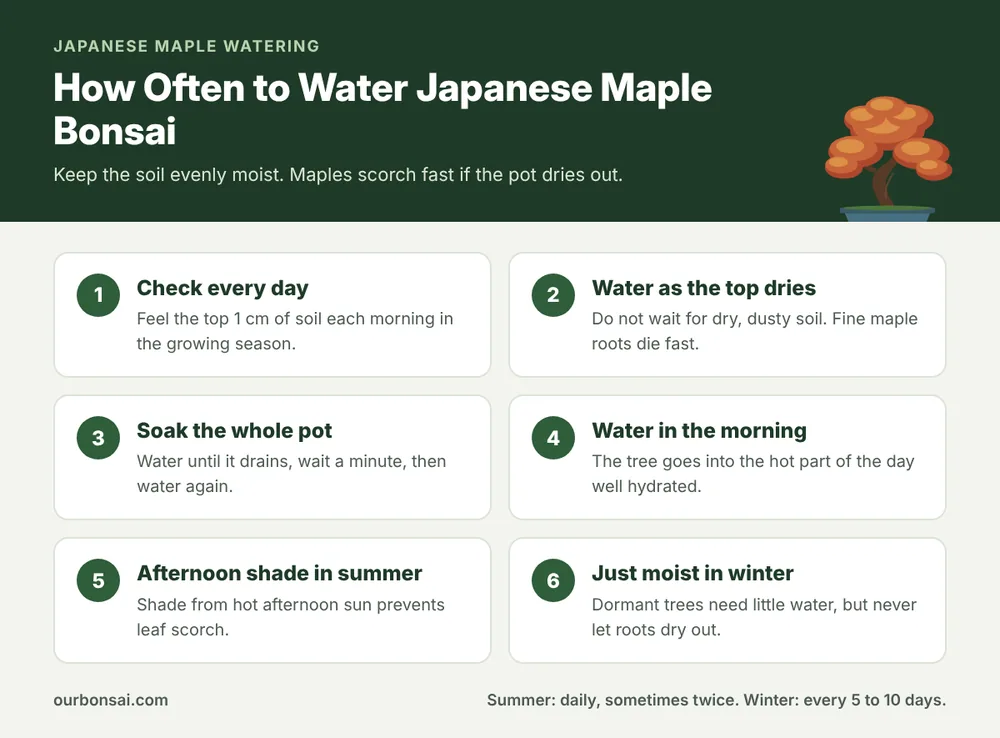
If you are asking how often to water japanese maple bonsai, the short answer is: check it every day and water as soon as the top centimeter of soil starts to dry. In summer that usually means daily, and on hot or windy days twice. In spring and autumn it is often every two to three days, and in winter, while the tree is dormant, every five to ten days, just enough to keep the roots from drying out. Japanese maples (Acer palmatum) have fine roots and thin, delicate leaves, so they are less forgiving of dry soil than most outdoor bonsai.
This guide covers seasonal watering, how to check the soil, how to water, how to prevent leaf scorch, and the signs of over and underwatering.
Why Japanese maples need careful watering
In the wild, Japanese maples grow in the shade of taller trees in cool, moist mountain forests. The Wikipedia page on Acer palmatum describes its preference for partial shade and moist, well-drained soil. A bonsai pot is the opposite of a shady forest floor: a small volume of soil that heats up and dries fast in the sun.
Two things make Japanese maple bonsai sensitive:
- Thin leaves. They lose water quickly and scorch at the edges when the roots cannot keep up.
- Fine, fibrous roots. They are great for absorbing water but die quickly if the soil dries out completely, and suffocate if it stays soggy.
The goal is steady, even moisture in a free-draining soil.
How often to water Japanese maple bonsai by season
| Season | Typical frequency | Notes |
|---|---|---|
| Early spring (buds opening) | Every 2 to 3 days | Increase as leaves expand |
| Late spring and summer | Daily, often twice in heat | Check morning and late afternoon |
| Autumn (color change) | Every 2 to 3 days | Water use drops as leaves age |
| Winter (leafless) | Every 5 to 10 days | Only when dry and not frozen |
These are typical figures for an outdoor Japanese maple in a temperate climate. Pot size, soil, sun and wind all change the timing. Always check before watering.
How to check if your maple needs water
- Finger test. Push a finger about 1 cm into the soil. If it feels dry, water. If cool and damp, wait.
- Akadama color. In akadama-based soil, the surface turns from dark to light brown as it dries.
- Pot weight. A dry pot is noticeably lighter.
- Leaves. Leaves drooping slightly in the afternoon heat mean the tree needs water immediately. Try not to let it get to this point.
How to water a Japanese maple bonsai
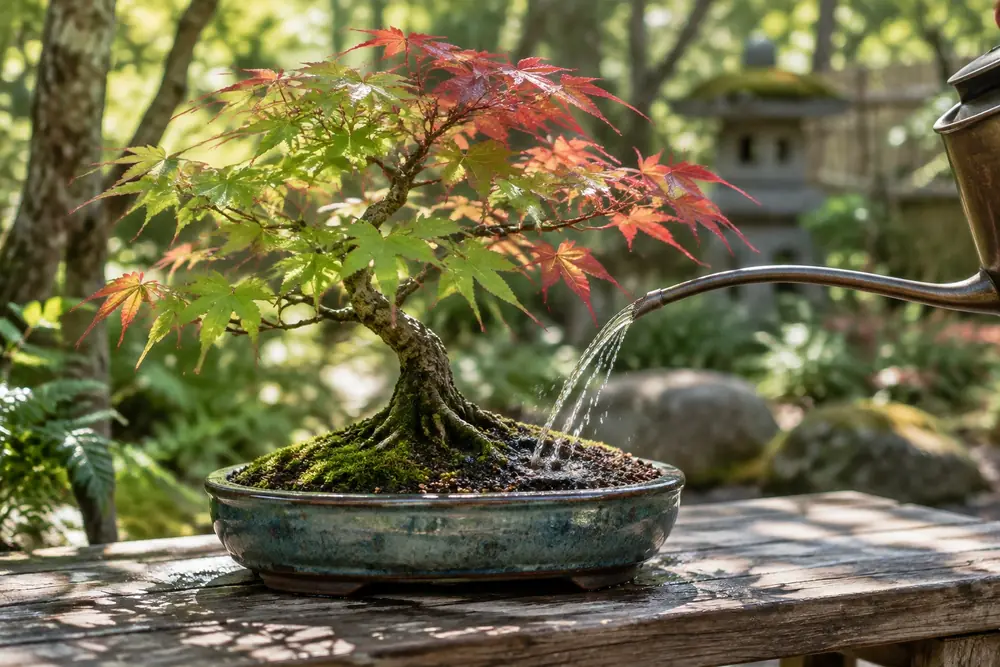
- Water gently over the whole soil surface with a fine-rose watering can or a soft hose spray. Our guide to the best Japanese watering can for bonsai covers good options, or browse fine rose bonsai watering cans.
- Water until it drains from the holes, wait a minute and water again so the whole root ball is wet.
- Water in the morning. The tree enters the hottest part of the day fully hydrated.
- Check again in the late afternoon during hot spells, and water if the surface is dry.
- Avoid wetting the leaves in strong midday sun. Water droplets themselves do not burn leaves, but wet leaves in hot, still air can encourage fungal problems.
Preventing leaf scorch in summer
Brown, crispy leaf edges are the most common summer problem on Japanese maple bonsai. The cause is usually the roots drying out or overheating for a few hours, especially in small pots in full afternoon sun. To prevent it:
- Give afternoon shade. Morning sun and shade from about midday is ideal in summer. A shade cloth of 30 to 50 percent works well.
- Shade the pot. Dark pots in direct sun heat up fast. Group pots, stand them on gravel or shield the pot itself from sun.
- Water twice on hot days. Check in the morning and again in the late afternoon.
- Shelter from wind. Hot, dry wind strips moisture from the thin leaves.
Our article on watering bonsai in summer has more heat wave tips. Leaves that scorch will not recover, but the tree will grow new ones, and a healthy tree recovers fully by next spring.
Soil and watering go together
A good soil makes watering much easier. An akadama-rich mix, for example 2 parts akadama to 1 part pumice and 1 part lava, holds moisture evenly while draining freely. Dense potting soil stays wet in the center and dry on top, making it hard to judge. Our bonsai soil mix ratio guide explains how to adjust a mix, and our kanuma bonsai soil review covers a moisture-holding component that also suits maples.
Watering after repotting
Japanese maples are repotted in early spring, just as the buds swell. After repotting, water thoroughly to settle the new soil around the roots, then keep it evenly moist while the roots recover. A tree that lost some roots cannot draw water as fast, so new leaves can wilt more easily on the first warm, sunny days. Keep a freshly repotted maple in light shade and out of wind for two to three weeks, and check the soil every day. Do not fertilize for about a month, until new roots are growing.
Winter watering
Japanese maples need a cold winter rest outdoors. A leafless maple uses very little water, but its fine roots must not dry out. Check every week or so and water lightly on mild mornings when the soil is dry and not frozen. Protect the pot from hard freezes by placing it in a sheltered spot, sinking it in mulch, or moving it to an unheated shed or garage during the coldest spells. Our guide to Japanese maple bonsai indoors explains why long periods inside are risky.
Signs of overwatering and underwatering
| Too much water | Too little water |
|---|---|
| Leaves yellowing and dropping in summer | Brown, crispy leaf edges |
| Soil green with algae and always wet | Leaves drooping in the afternoon |
| Weak, small spring growth | Soil pulling away from the pot edge |
| Sour smell, dark roots | Early leaf drop in late summer |
FAQ: how often to water japanese maple bonsai
Should I water my Japanese maple bonsai every day?
In late spring and summer, usually yes, and twice on hot days. In spring, autumn and winter, check daily but water only when the surface is drying.
Can Japanese maple bonsai be overwatered?
Yes. If the soil stays soggy for days, fine roots rot. Use a free-draining mix and water only when the top starts to dry.
Why are my maple bonsai leaves crispy at the edges?
Usually the soil dried out or the roots overheated. Water more consistently and give afternoon shade in summer.
Should I mist my Japanese maple bonsai?
Not necessary. Focus on watering the soil and providing shade in hot weather.
Final thoughts
Now you know how often to water japanese maple bonsai: check daily, water as soon as the top starts to dry, soak the pot fully, and in summer water in the morning with a second check in the afternoon. Add afternoon shade and an akadama-rich soil, and your maple will keep its delicate leaves fresh all summer before its autumn color show.