How to Overwinter Bonsai Trees Outdoors

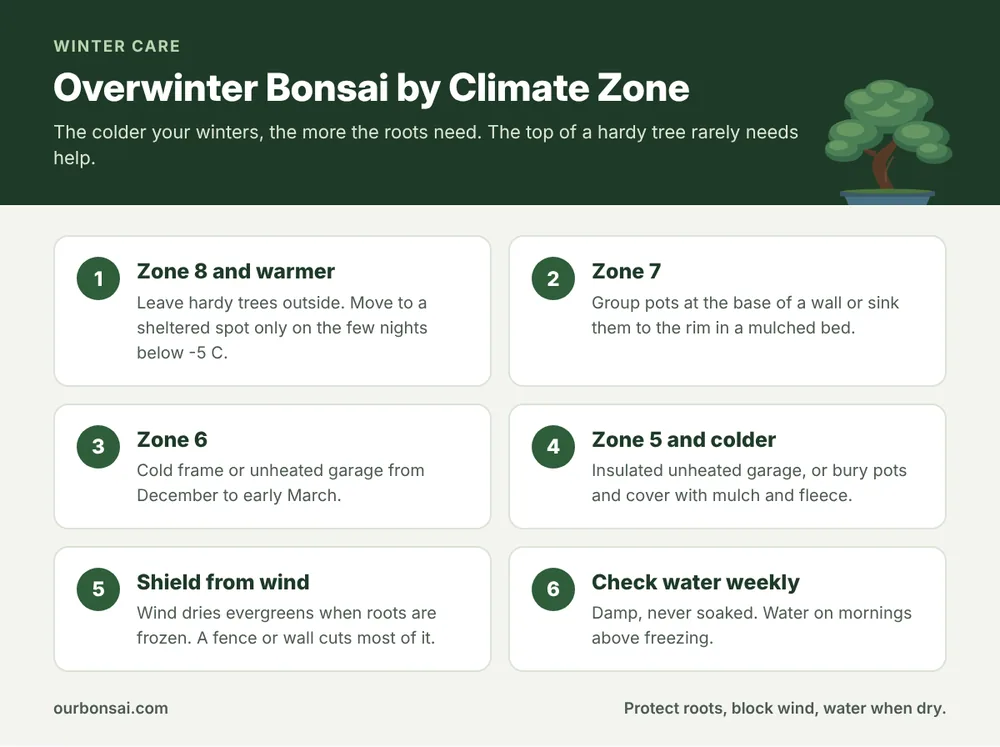
To overwinter bonsai outdoors, keep the root ball above roughly -5 C (23 F), keep evergreen foliage out of drying wind, and water only when the soil starts to dry, which is often every 7 to 14 days. The tree itself should stay cold and dormant. How much protection you need depends mostly on your climate zone: in USDA zone 8 a hardy juniper can sit on its bench most of winter, while in zone 5 the same tree needs an unheated garage or a buried pot from December to March.
In this guide
Why roots are the weak point
A bonsai pot holds a few liters of soil at most. In the ground, roots are buffered by tons of earth that changes temperature slowly. In a pot, the root ball cools almost as fast as the air. That matters because roots are much less cold hardy than branches. A Japanese maple whose twigs survive -25 C may lose roots at about -10 C, and some growers report damage on trident maple roots from around -5 C.
You will not see root damage in January. It shows in April or May, when the tree pushes leaves using stored energy and then collapses because there are no working roots to supply water. So if a tree “died in spring,” winter is often the real cause.
Find your zone first
Look up your area on the USDA Plant Hardiness Zone Map (or the equivalent for your country). The zone tells you the average coldest night of the year, which is the number that decides your method. Then subtract one or two zones for the tree, because a pot is colder than the ground. A species rated to zone 5 in the landscape is safer treated as zone 6 or 7 in a bonsai pot.
Five ways to overwinter bonsai outside
1. Ground bed burial
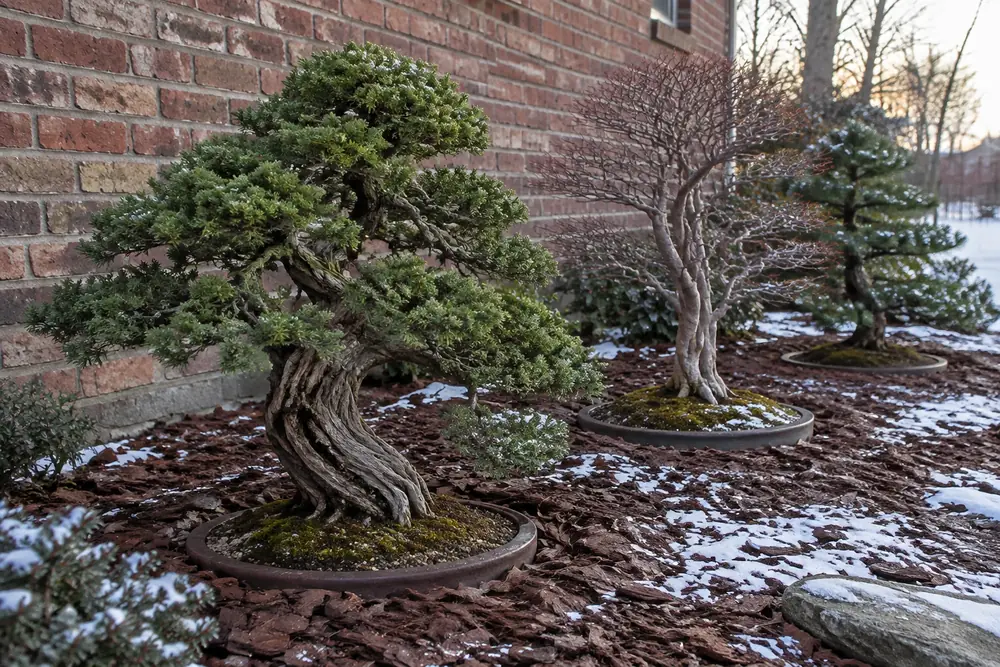
Dig a trench in a sheltered bed, set the pots in up to the rim, and fill around them with soil or bark. Then spread 5 to 10 cm of bark mulch over the soil surface. This is the method many experienced growers prefer for deciduous trees in zones 6 and 7. It costs nothing, and the surrounding earth keeps the root ball close to ground temperature.
Downsides: you cannot easily check drainage, and slugs or mice may move in. Lift a pot every few weeks to see that water is not sitting in it.
2. At the base of a house wall
A north-facing wall stays cold but steady, which is good for dormancy. A south-facing wall warms up on sunny days, which is risky for maples because it can wake them early. Group the pots tightly, pack bark between them, and wrap the outside of the group in burlap or bubble wrap.
3. Cold frame
A clear-lidded box that keeps out wind and the hardest frost while letting light reach conifers. It is the most controllable method if you vent it on sunny days, and a basic one takes an afternoon to build from timber and a twin-wall polycarbonate sheet. The seasonal routines around it are covered in our bonsai care hub.
4. Unheated garage or shed
Good for zone 5 and colder. Aim for an inside range of about -5 to 5 C. Deciduous trees without leaves can stay in near darkness for two to three months. Junipers and pines need a window, or a cheap LED shop light on a timer for 8 to 10 hours a day.
5. Under the bench, with fleece
In mild areas (zone 8), slide pots under the display bench on the coldest nights and throw horticultural fleece over the bench. It is a short-term fix, not a whole-winter plan.
What hardy species can take in a pot
| Species | Approximate safe root low | Best method |
|---|---|---|
| Trident maple | -2 to -5 C | Cold frame or garage |
| Japanese maple | -5 to -8 C | Ground bed or cold frame |
| Chinese elm | -5 to -8 C | Ground bed, wall group |
| Juniper | -10 C | Ground bed with light, cold frame |
| Japanese black pine | -8 C | Cold frame with light |
| Larch, hawthorn, native oak | -10 to -15 C | Ground bed or wall group |
Treat these as guidelines, not guarantees. Pot size, soil moisture and how long the cold lasts all change the result. A wet root ball freezes harder than one that is just damp. For more on which trees suit outdoor life, see our list of types of outdoor bonsai trees.
Watering while you overwinter bonsai
Rain and snow do some of the work, but trees under eaves, in garages or in cold frames get none of it. Every week, push a chopstick into the soil of a few pots. Water when it comes out dry, in the morning, and only when the air is above freezing so the excess can drain before night. Snow on top of a pot is fine and even insulates a little.
Overwatering in winter is a quiet killer. Cold, waterlogged soil is where root rot in bonsai starts, and the damage only shows in spring.
Winter mistakes to avoid
- Moving hardy trees into the living room. A juniper or maple kept warm indoors misses dormancy and usually fails. Only tropical species belong inside.
- Plastic sheeting directly on foliage. It traps moisture and can cook the tree on sunny days. Use breathable fleece.
- Bringing trees out too early. A warm week in February is not spring. Keep protection ready until your last frost date.
- Forgetting rodents. Voles and mice strip bark at soil level in sheds and mulch beds. A ring of fine mesh around the trunk base helps.
- Feeding in winter. Cold roots cannot use fertilizer; it just builds up salts.
Frequently asked questions
Can I leave my bonsai outside in snow?
Yes, for hardy species. Snow on branches and soil is harmless and even insulates. The danger is a long hard freeze that turns the whole root ball to ice, or wet heavy snow snapping thin wired branches.
What temperature is too cold for bonsai outside?
For the roots of most hardy species in small pots, sustained temperatures below about -5 to -10 C (14 to 23 F) call for protection. Tropical species like ficus should come inside before nights drop below about 10 C (50 F).
Should I wrap my bonsai pot in winter?
Wrapping the pot (not the tree) in bubble wrap, burlap or a foam sleeve helps if you have only a few trees and no cold frame. Leave the soil surface open so you can check moisture.
When do bonsai come out of winter protection?
When nights stay above about 0 C and buds are swelling, usually March to April in temperate climates. Bring trees out gradually and keep fleece handy for late frosts. If yours look rough after winter, our guide to why bonsai branches die helps you work out what went wrong.
Final thoughts
Overwintering is mostly about roots, wind and water, and very little about warmth. Pick a method that suits your zone, put a thermometer where the trees are, and resist the urge to fuss over them. For a wider view of the winter rest itself, the Wikipedia article on bonsai cultivation and care covers how growers in different climates handle it.