How to Wire Azalea Bonsai Without Damaging It

This post contains affiliate links. As an Amazon Associate, OurBonsai earns from qualifying purchases at no extra cost to you. Read our disclosure.
In this guide
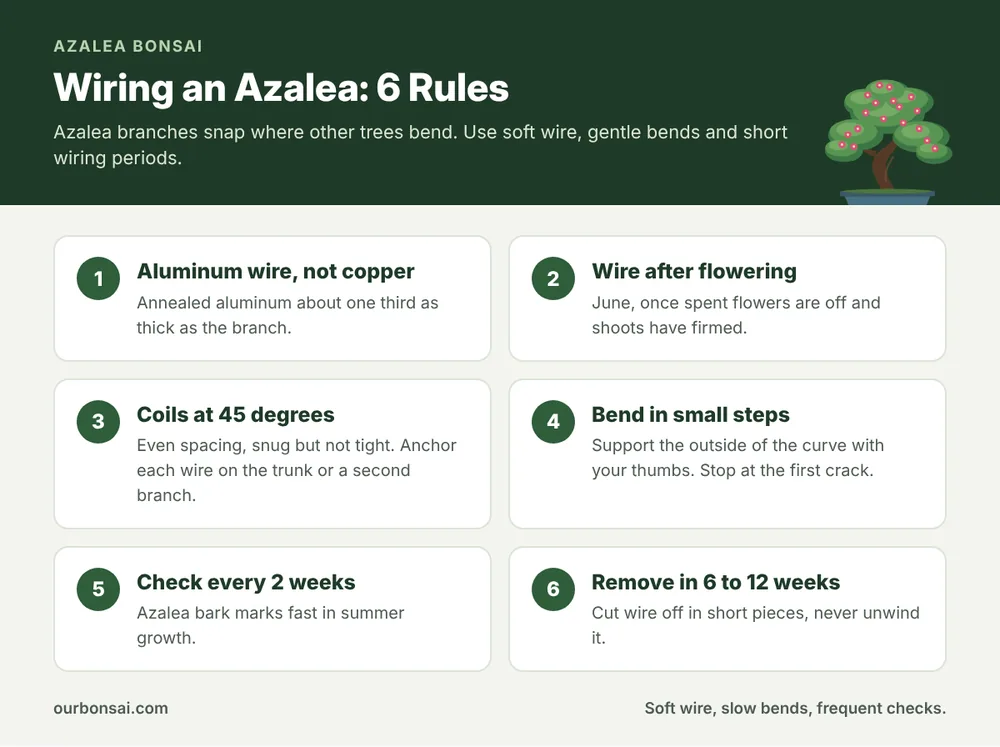
Learning how to wire azalea bonsai comes down to three adjustments to normal wiring: use soft annealed aluminum wire about one third as thick as the branch, wire in early summer right after the flowers are finished, and bend in small steps while supporting the outside of the curve with your thumbs. Satsuki and Kurume azalea wood is brittle and the bark is thin, so the wire also has to come off sooner than on a pine or juniper, often within 6 to 12 weeks. Check for wire bite every two weeks.
Why azaleas are tricky to wire
Compared to elms or junipers, azalea branches are short-grained and snap rather than flex once they reach pencil thickness. Branch junctions are a weak point: a bend placed right at a fork can split the branch down the middle. The bark on young shoots is thin and smooth, so wire marks it quickly during the fast growth of early summer.
There is good news too. Azaleas back-bud well from old wood, so if a branch does snap, you can usually cut it back and grow a replacement. And because many azalea designs rely on a dense canopy of flowers, you often need less wiring than with a conifer.
When to wire an azalea bonsai
| Time | Wire? | Reason |
|---|---|---|
| Late winter to early spring | Light work only | Flower buds are on the tips; you can knock them off |
| During flowering | No | Wire damages flowers and the tree is busy |
| Right after flowering (June) | Best time | Prune first, then wire the new structure |
| Mid to late summer | Light only | Flower buds forming; avoid moving tips |
| Autumn | Possible on thick branches | Growth slows, so wire marks less |
Most growers combine wiring with the main post-flowering prune: remove spent flowers, cut back unwanted shoots, then wire the branches you are keeping.
Tools and wire
- Annealed aluminum wire in a few sizes, roughly 1.0, 1.5, 2.0 and 2.5 mm. It is softer than copper and gentler on thin bark.
- Wire cutters with a rounded head, so you can cut close to the bark without nicking it.
- Raffia or florist tape to wrap thick branches before bending.
- Guy wires and small hooks for big moves on old branches.
- Tie-in wire for the pot, if you are combining wiring with a repot. Our guide to bonsai repotting wire explains the sizes used for that job.
If you are building a kit, a search for aluminum bonsai wire shows multi-size packs, and our roundup of the best Japanese bonsai tool kit covers cutters.
How to wire azalea bonsai step by step
- Water the day before. A well-hydrated branch is more flexible than a dry one.
- Choose the wire size. Hold the wire against the branch. It should be about one third the branch thickness and stiff enough to hold the branch when bent.
- Anchor the wire. Wire two branches with one piece where you can, crossing the trunk once. Or anchor into the soil or around the trunk for the first branch.
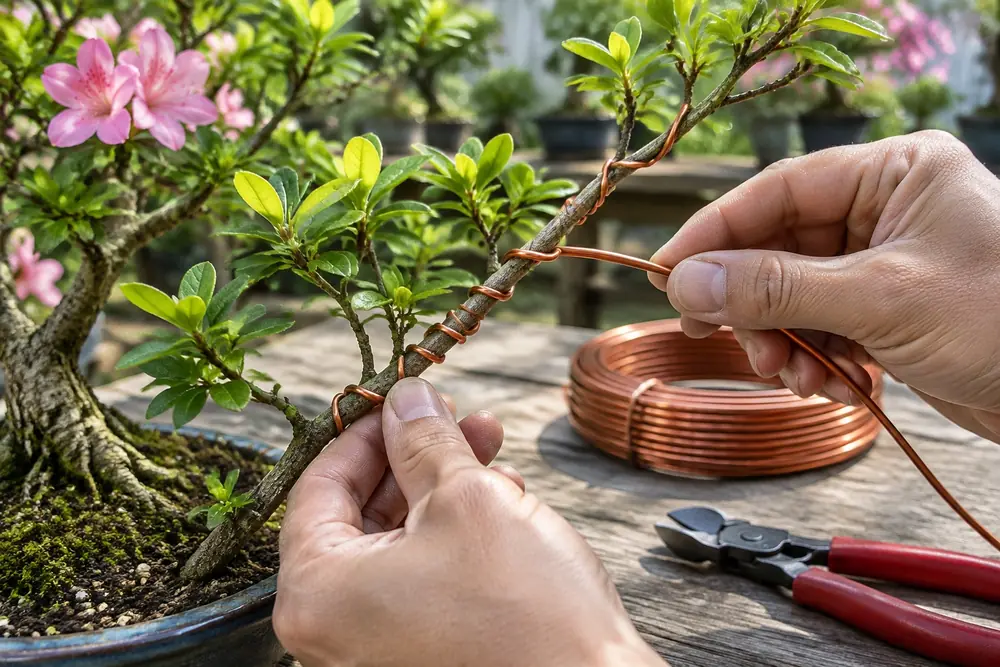
- Coil at about 45 degrees. Keep the coils even. Too tight crushes bark; too loose does nothing.
- Wire on the outside of the planned bend. When you bend, the wire then supports the stretched side, which is the side that breaks.
- Bend slowly. Place both thumbs on the outside of the curve and bend in two or three small pushes, pausing between them. Listen and feel for a soft crack. If you hear one, stop and hold the branch where it is.
- Avoid bending at forks. Bend between junctions, not at them.
- Position the tips. Leave the last few centimeters of each shoot pointing slightly up so the branch keeps growing strongly.
Moving thick branches safely
On branches thicker than a pencil, coiled wire alone is risky. Two safer options:
- Raffia wrap plus wire. Soak raffia, wrap the branch tightly, then wire over it. The raffia holds the fibers together if they start to split.
- Guy wires. Tie a soft loop around the branch (cushioned with rubber tubing), run a wire down to a hook or the pot rim, and tighten over several weeks. This pulls the branch down gradually, which azaleas tolerate far better than a sudden bend.
How long to leave wire on an azalea
Check every two weeks, especially from June to August when shoots thicken fast. As soon as the wire starts to press into the bark, remove it. On young shoots, that can be 6 weeks. On older branches, it can be 3 months or more.
Always cut the wire off in short pieces with wire cutters. Unwinding it can rip bark and snap the branch you just shaped. If the branch springs back after removal, rewire it in the opposite direction from the old marks.
What to do if a branch cracks
A partly cracked branch often heals if you hold it in place. Wrap the crack firmly with grafting tape or raffia and leave it for the season. If the branch broke right through, cut it cleanly back to a bud or a side shoot. Azaleas usually sprout new buds near the cut within a few weeks in summer.
Frequently asked questions
Can I use copper wire on azalea bonsai?
You can, but annealed copper is stiffer and harder on thin bark. Most growers use aluminum for azaleas and keep copper for conifers.
Should I wire flower buds?
Avoid it. Wire on the very tips where flower buds sit in late summer and winter can knock them off. Wire the branch, stop short of the tip.
Do I need to wire an azalea at all?
Not always. Many azaleas are shaped mostly by pruning: cutting back to a bud facing the direction you want. Wire is for placing branches that will not get there by pruning alone.
Can I wire a newly repotted azalea?
Wait about 4 weeks so the tree can start new roots. Light wiring of a few shoots is fine, but avoid heavy bending in the same season as a hard root prune.
Final thoughts
Wiring an azalea is about patience more than force: soft wire, slow bends, and frequent checks. Pair it with pruning right after flowering and you will rarely need heavy bends at all. For general styling guidance see our page on types of bonsai, check our notes on satsuki azalea care, and read the Wikipedia article on bonsai cultivation and care for the broader history of wiring.