When and How to Repot Azalea Bonsai

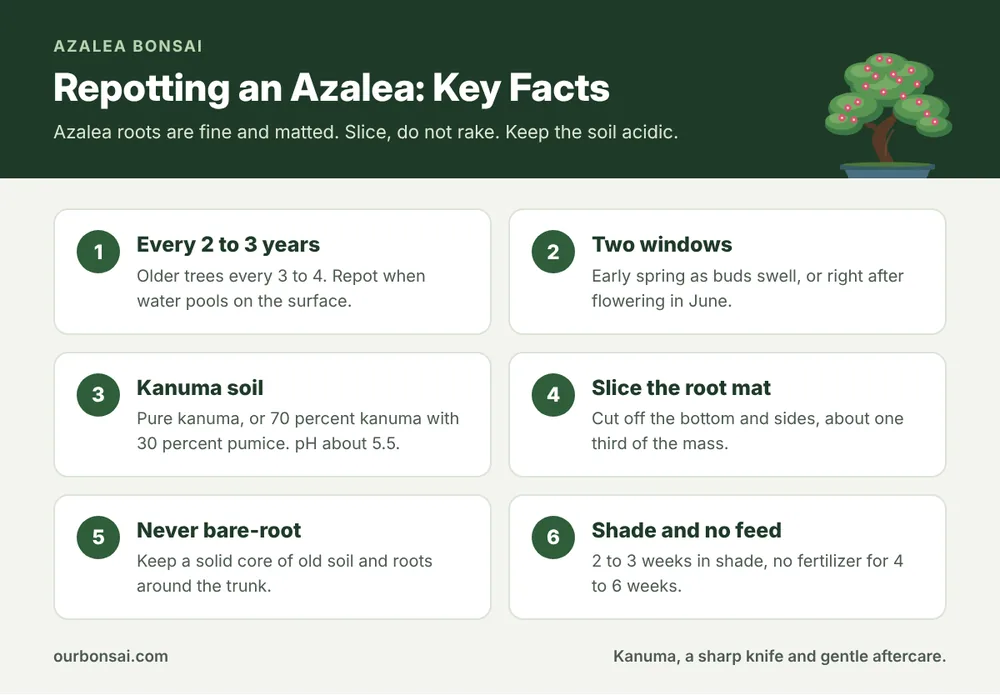
Here is how to repot azalea bonsai in short: repot every 2 to 3 years, either in early spring as the buds begin to swell or right after flowering in June, into kanuma soil. Because azalea roots form a dense, felt-like mat, you slice off roughly the bottom and outer third of the root mass with a knife or saw instead of combing the roots out. Keep a solid core around the trunk, never bare-root it, then give the tree 2 to 3 weeks in bright shade and no fertilizer for 4 to 6 weeks.
In this guide
How to know your azalea needs repotting
Calendar rules are a guide. The tree tells you more:
- Water sits on the soil surface for several seconds before it drains.
- Kanuma looks muddy and dark and no longer has visible grains.
- Roots circle the inside of the pot or push the tree up.
- The tree dries out very fast in summer because the pot is mostly roots.
- Leaves are smaller and paler than last year even with regular feeding.
Young azaleas in development may need repotting every 2 years. Mature trees in their final pots usually go 3 to 4 years.
Best time: spring or after flowering?
Both work, and growers argue about which is better.
Early spring, as buds swell. Roots are about to grow, so they recover fast. The downside is that you are disturbing a tree just before it flowers. Many growers remove most flower buds when repotting in spring, so the tree puts its energy into roots.
Right after flowering, usually June. You enjoy the flowers first, then repot alongside the main post-bloom prune. Roots grow strongly in early summer warmth. This is the traditional timing for satsuki in Japan. The downside is summer heat during recovery, so shade is essential.
Avoid repotting in late summer, when flower buds for next year are forming, and in winter, when roots are cold and slow.
Why kanuma?
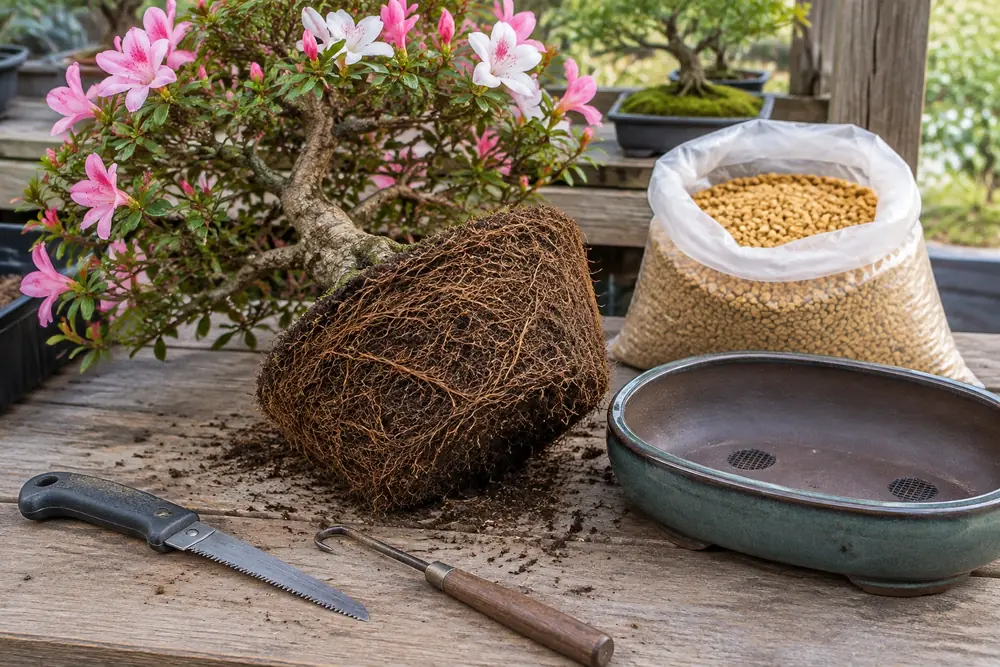
Kanuma is a soft, light yellow volcanic soil mined near Kanuma in Japan. It has an acidic pH around 5.5, holds plenty of water inside each grain, and still leaves air spaces between grains. Azaleas evolved in acidic, airy forest soils, and kanuma copies that closely. It also changes color, dark when wet and pale yellow when dry, which makes watering easier.
Its weakness is that it breaks down faster than akadama, which is one reason azaleas need repotting more often. Our Kanuma bonsai soil review covers grades and brands, and our list of the best soil for azalea bonsai compares kanuma with mixes.
| Soil option | Good for | Notes |
|---|---|---|
| 100 percent kanuma | Most azaleas | The standard; repot every 2 to 3 years |
| 70 kanuma, 30 pumice | Wet climates | Drains faster, lasts a little longer |
| 50 kanuma, 50 akadama | Where kanuma is costly | Slightly less acidic; acid feed helps |
| Peat-based potting mix | Avoid | Stays soggy, leads to root rot |
How to repot azalea bonsai, step by step
- Prepare. Sieve kanuma to remove dust. Soak it for a few minutes and let it drain; dry kanuma is dusty and can repel water at first. Fit mesh over the pot holes and thread tie-in wire.
- Water the tree a day ahead so the root ball is moist but not dripping.
- Remove the tree. Cut tie wires, run a knife around the inside of the pot, and lift the tree out.
- Cut the bottom. With a root saw or sharp knife, slice off the bottom 1 to 2 cm of the root mat, more on an overgrown tree.
- Cut the sides. Shave off about 1 to 2 cm all around. On very dense trees, cut a few vertical wedges into the remaining mass so new soil can get inside.
- Tease the surface. Use a chopstick or root hook gently on the top and outer edge only, to loosen fine roots. Do not rake into the core.
- Check the core. Leave the central third around the trunk undisturbed. If it is solid old soil that never drains, you can work some of it out over two or three repots, not all at once.
- Pot up. Add a thin layer of kanuma, set the tree slightly higher than before, tie it in firmly, and fill with kanuma, working it in with a chopstick.
- Water thoroughly until it runs clear.
Our list of the best bonsai repotting tools covers saws and root hooks if your kit needs updating.
Aftercare
- Bright shade for 2 to 3 weeks, out of wind and heavy rain.
- Water when the surface lightens, not before. Kanuma’s color helps.
- No fertilizer for 4 to 6 weeks, then start at half strength with an acid feed.
- No hard pruning or heavy wiring until new growth appears, unless you are combining the post-flower prune with the repot (then go lighter on both).
- Protect from frost if you repotted in early spring.
Mistakes to avoid
- Bare-rooting an azalea. Their fine roots tear easily and the tree may not recover.
- Using garden soil or peat. It holds too much water and drives up the risk of root rot.
- Repotting in late summer. You lose next year’s flowers and stress the tree in heat.
- Hard tap water right after repotting. It raises the pH of fresh kanuma. Use rainwater if you can.
If a repotted azalea wilts in wet soil after a few weeks, check for rot. Our guide to root rot in bonsai explains what to look for.
Frequently asked questions
Can I repot an azalea bonsai while it is flowering?
Better not. Wait until the flowers fade, or remove the flower buds and repot in early spring. Repotting during bloom stresses the tree.
How much root can I remove from an azalea?
On a healthy tree, about a third of the root mass is a safe amount. Weak trees should lose less.
Does an azalea bonsai need a deep pot?
No. Azalea roots are shallow, so a medium or shallow pot works well. Deeper pots hold more water and can stay soggy.
What if I cannot find kanuma?
A mix of akadama and pumice works, along with an acid fertilizer and rainwater to keep pH low. Avoid regular potting mix.
Final thoughts
Repotting an azalea is less about technique than restraint: slice the mat, keep the core, use kanuma, and keep the tree cool and shaded while it recovers. For background on the species, see the Wikipedia entry for Rhododendron indicum.