Can You Use Sand in Bonsai Soil? Coarse Grit vs Fine Sand

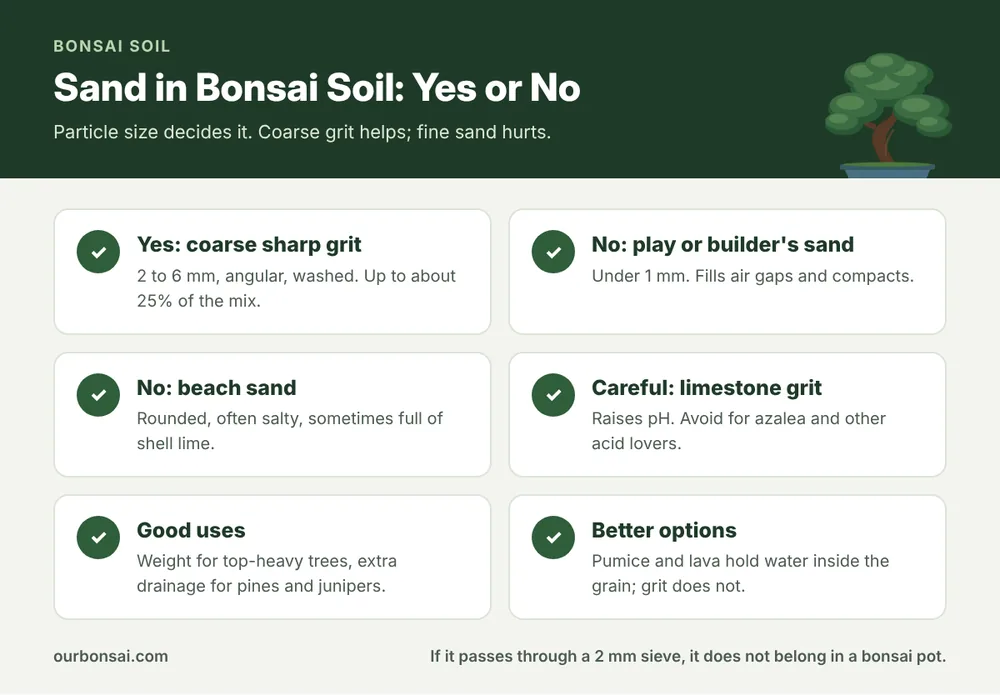
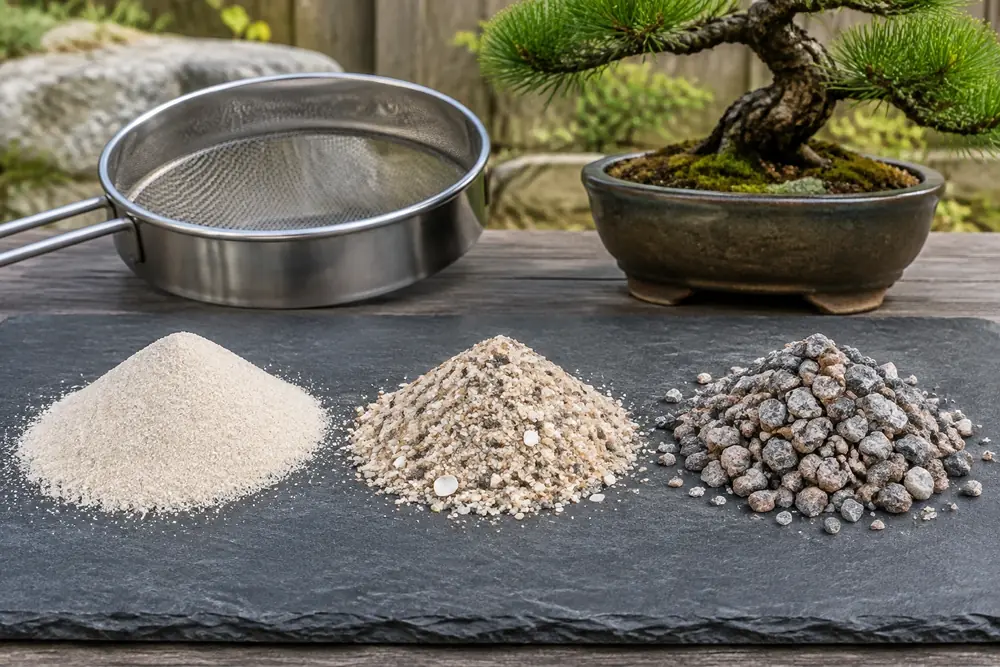
Can you use sand in bonsai soil? Only the right kind. Coarse, sharp, washed grit with particles of about 2 to 6 mm, such as crushed granite or quartz grit, can make up to roughly 25 percent of a bonsai mix and adds drainage and weight. Fine sand, meaning play sand, builder’s sand or anything that passes through a 2 mm sieve, should not be used: it fills the air gaps between the larger particles and turns the soil into a dense, waterlogged layer in a shallow pot. Beach sand is a poor choice too, because it is rounded, often salty, and can contain shell fragments that raise the pH.
In this guide
Can you use sand in bonsai soil? Particle size decides
A bonsai pot is shallow. After watering, a layer of water hangs at the bottom of the soil, held there by capillary action. With coarse particles, that layer is thin and the rest of the pot drains and fills with air. With fine particles, the wet layer is thick, and the roots in it run short of oxygen.
Sand grains are small. Most play sand and builder’s sand are well under 1 mm. Added to a granular bonsai mix, those tiny grains slip into the gaps between the larger pieces and block them. The result is a mix that looks gritty but drains like mud. Our article on bonsai soil versus regular soil explains the same principle with potting soil.
The shape of the grain matters too. Angular, sharp-edged grit locks together loosely and leaves irregular gaps that stay open. Rounded grains, like beach sand or tumbled river pebbles of the same size, settle more tightly. That is why bonsai growers ask for “sharp” grit and why the same weight of rounded sand drains noticeably worse.
Coarse grit behaves differently. Its particles are similar in size to the akadama, pumice and lava around them, so the air spaces stay open.
Types of sand and grit compared
| Material | Typical particle size | Use in bonsai soil? | Notes |
|---|---|---|---|
| Play sand | Under 0.5 mm | No | Clogs air gaps |
| Builder’s or masonry sand | 0.1 to 2 mm | No | Same problem, sometimes contains lime |
| Beach sand | 0.1 to 1 mm, rounded | No | Salt, shells, rounded grains pack tightly |
| Horticultural sand | 0.5 to 2 mm | Rarely | Too fine for most bonsai pots |
| Crushed granite grit | 2 to 6 mm | Yes, up to about 25% | Sharp, stable, heavy, neutral pH |
| Quartz or flint grit | 2 to 6 mm | Yes, up to about 25% | Sharp and inert |
| Limestone grit | 2 to 6 mm | Only for lime-tolerant trees | Raises pH over time |
| River gravel, washed | 3 to 8 mm | Yes, as a drainage layer | Rounded; better at the bottom of the pot |
Look for products sold as poultry grit (the insoluble granite type, not oyster shell), horticultural grit, or crushed granite for paths, then sift to size.
Where coarse grit helps
Pines and junipers. These prefer a lean, fast-draining mix. Replacing part of the akadama with grit speeds drainage and adds weight. Our juniper bonsai soil recipe and our guide to the best soil for Japanese black pine bonsai both show where grit fits.
Top-heavy trees. Pumice is light. A tall tree or a heavy cascade in a pumice mix can tip in wind. Adding 15 to 25 percent granite grit lowers the center of gravity.
Top dressing. A thin layer of fine grit on the surface looks neat, discourages fungus gnats and stops akadama splashing when you water.
Drainage layer. A thin layer of coarse grit or gravel at the bottom of a deep pot helps water leave quickly.
Where it does not help
Water retention. Grit holds water only on its surface. Pumice, lava and akadama hold water inside each grain as well. Too much grit makes a mix that dries out very quickly and holds few nutrients.
Acid-loving trees. Azalea and other ericaceous plants need acidic soil. Avoid limestone grit or any sand that fizzes when you drop vinegar on it.
Seedlings and cuttings. Very young plants need more even moisture. A fine, sifted mix of akadama and pumice suits them better; see our guide to soil for bonsai seedlings.
A simple recipe with grit
For a general outdoor mix suitable for pines, junipers and many deciduous trees:
- 40 percent akadama
- 30 percent pumice
- 15 percent lava rock
- 15 percent crushed granite grit
Sift every component to 2 to 6 mm and discard the dust. If your climate is hot and dry, raise the akadama and lower the grit. If it is very wet, do the opposite. Our page on bonsai soil mix ratios shows how to adjust.
How to test sand or grit before using it
- Sieve test. Shake a sample through a 2 mm screen. If most of it falls through, it is too fine.
- Vinegar test. Drop a little vinegar on a sample. Fizzing means it contains lime, which raises pH.
- Rinse test. Rinse a handful in a jar of water. If the water stays cloudy for a long time, the sand contains clay or silt and should be washed thoroughly or avoided.
- Salt check. Never use sand from a beach or a road verge treated with salt in winter.
Frequently asked questions
Is sand good for bonsai drainage?
Only coarse grit improves drainage. Fine sand reduces it, which surprises many people.
Can I use aquarium gravel?
Plain, uncoated aquarium gravel in the 2 to 6 mm range works as a grit. Avoid colored or coated gravel and anything with crushed coral, which raises pH.
Why do older bonsai books recommend sand?
Older recipes often used coarse river sand, which was closer to what we now call grit. Fine modern play and builder’s sand is a different material.
Can I use sand instead of akadama?
Not as a direct replacement. Akadama holds water inside the grain; grit does not. Calcined clay or pumice is a better substitute.
Final thoughts
The question is less “sand or no sand” and more “what size”. Coarse, sharp grit of 2 to 6 mm is a useful part of many bonsai mixes, adding drainage and weight. Fine sand of any kind clogs the pot and should stay out. For background on how sand is classified by grain size, the Wikipedia article on sand has a useful table, and for an all-round look at substrates, our guide to good potting soil for bonsai.