How to Prune Beech Bonsai and Wire It Without Scars

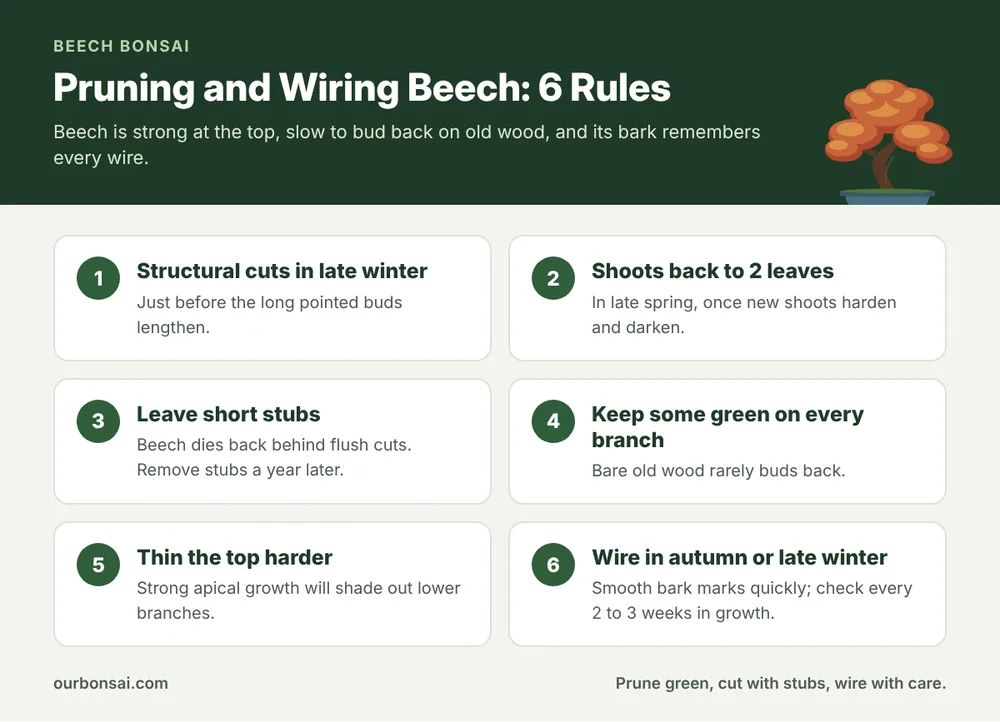
To prune beech bonsai well, follow three rules: do structural cuts in late winter just before the long, pointed buds start to lengthen; cut new shoots back to about two leaves in late spring once they have hardened and darkened; and always leave a short stub on larger cuts, because beech tends to die back behind flush cuts. European beech (Fagus sylvatica) and Japanese beech (Fagus crenata) do not bud back reliably from bare old wood, so keep some green on every branch you want to keep. For wiring, work in autumn after leaf fall or in late winter, and check often: smooth gray beech bark shows wire marks for years.
In this guide
How beech grows, and why it matters for pruning
Beech buds are long and slender, up to 2 cm, and each one holds a whole shoot already formed for the coming year. In spring the shoot pushes out in one flush, the leaves unfold from pleats, and growth then stops for most of the summer. Strong trees may push a second, smaller flush in early summer.
Three habits shape the pruning approach:
- Strong apical dominance. The top and the outer tips get most of the energy. Left alone, the crown thickens while lower and inner branches weaken.
- Weak back-budding on old wood. Cut a branch back to bare bark with no buds, and it often dies back instead of sprouting.
- Dieback behind cuts. A flush cut on beech commonly dies back a little into the trunk or branch, leaving a sunken scar.
Pruning calendar
| When | What to do | Why |
|---|---|---|
| Late winter (before buds lengthen) | Structural cuts, remove unwanted branches | Wounds seal fastest as growth starts |
| Spring flush | Let shoots extend | Leaves need to harden to feed the tree |
| Late spring (shoots darken, firm) | Cut shoots back to 2 leaves | Keeps growth short and pushes buds inward |
| Early summer | Thin dense areas, trim second flush | Lets light into the inner canopy |
| Autumn and winter | Remove stubs from last year, plan | No heavy cuts while dormant |
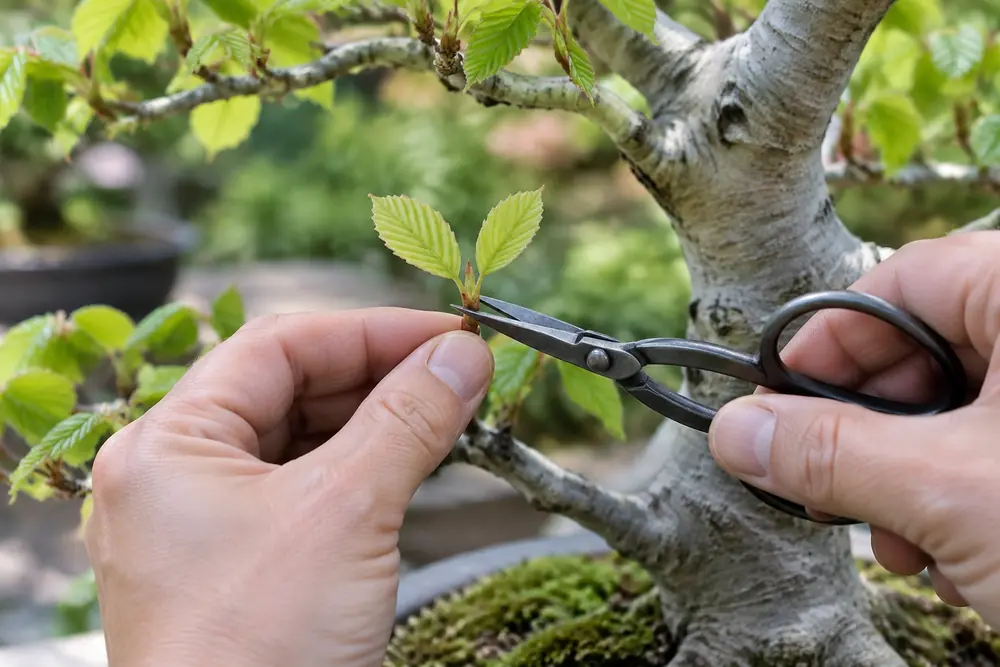
How to prune beech bonsai shoots in late spring
- Wait for the flush to finish. The new leaves should be fully open, slightly darker and firmer to the touch. On many trees this is late May or June.
- Count leaves on each new shoot. Cut back to two leaves, just beyond the second leaf, with sharp scissors.
- Be harder at the top. In the apex and on the outer tips, cut back to one or two leaves, or remove some shoots entirely.
- Be gentler low down and inside. Let weak inner shoots keep three or four leaves so they gain strength.
- Thin crowded spots. Where several shoots grow from one point, keep two.
Japanese growers working on refined Fagus crenata sometimes pinch the soft shoot as it emerges, or partially defoliate strong trees in early summer to get smaller leaves. These are advanced methods. They only work on healthy, vigorous trees, and the cut-back method above is safer for most growers.
Structural pruning in late winter
When you remove a branch, cut it so a stub of about 1 cm, or a little more on thick branches, remains. Over the following season, the stub may die back, but it protects the trunk. The next winter, cut the dead stub off neatly with a concave cutter and seal the wound with cut paste. Our concave cutter review and guide to cut paste alternatives cover the tools.
Never cut a branch back to a section with no buds or leaves unless you are prepared to lose it.
Wiring beech bonsai
Beech branches are reasonably flexible when young but the bark is thin, smooth and pale gray, so wire marks stand out and take years to fade.
- When: autumn after the leaves color, or late winter before buds lengthen. Some growers also wire in early summer after the shoots harden, but bark swells fast then.
- Wire: annealed aluminum or copper, about one third the branch thickness, coiled at 45 degrees.
- Protect buds. Beech buds are long and stick out. Coil the wire beside them, not over them.
- Check every 2 to 3 weeks in the growing season, every month in winter.
- Remove early. Cut wire off in pieces as soon as it starts to press into the bark. Rewire if the branch springs back.
- Use guy wires for heavy branches, to avoid marks altogether.
European vs Japanese beech: small differences
Both species follow the same rules, but they behave a little differently in a pot. Japanese beech (Fagus crenata) tends to have smaller leaves, whiter bark and finer twigs, and it is the species most often seen in high-end Japanese collections. European beech (Fagus sylvatica) has slightly larger, glossier leaves and is usually more vigorous, which makes it easier to grow on but harder to keep compact. On European beech, be a little stricter with the late spring cut-back, and expect to reduce leaf size mainly through years of ramification rather than leaf-cutting. Copper beech and other colored forms of F. sylvatica follow the same pruning timing.
Common mistakes
- Pruning the whole tree hard in one year. Beech recovers slowly. Spread big changes over several seasons.
- Flush cuts. Leave stubs.
- Ignoring the apex. It will outgrow the rest of the tree in two summers.
- Pulling off the dry winter leaves. Beech often holds dead leaves through winter; they protect buds. Let them drop on their own or snip them carefully, never pull.
For general timing across deciduous species, see when to prune deciduous bonsai.
Frequently asked questions
When is the best time to prune a beech bonsai?
Structural cuts in late winter, and shoot pruning in late spring once the first flush has hardened.
Does beech back-bud after pruning?
On young wood with buds and leaves, yes. On bare old wood, rarely. Always keep some green on a branch you want to keep.
Can I defoliate a beech bonsai?
Partial defoliation is used on vigorous Japanese beech by experienced growers. It is risky on weak trees and on European beech. Most growers should stick to cutting shoots back.
How do I avoid wire scars on beech?
Wire in autumn or late winter, check every few weeks, remove wire as soon as it presses into the bark, and use guy wires for big moves.
Final thoughts
Beech rewards patience: let the shoots harden, cut them back to two leaves, keep the top in check, and leave stubs on big cuts. It is slower than maple, but its silver bark and fine twigs are worth the wait. For more on soil and repotting, see our bonsai soil mix ratio guide, and for the species, the Wikipedia article on Fagus crenata.