Best Soil for Dawn Redwood Bonsai: Mix and Repotting Tips

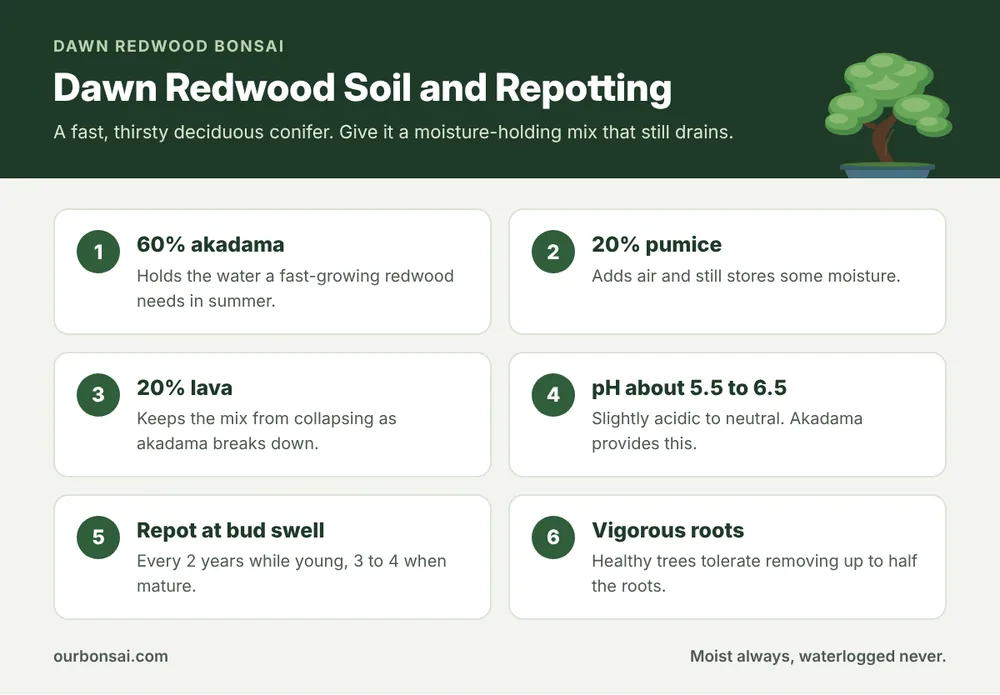
The best soil for dawn redwood bonsai is a moisture-holding but airy mix of about 60 percent akadama, 20 percent pumice and 20 percent lava rock, sieved to 2 to 6 mm, with a slightly acidic to neutral pH. Dawn redwood (Metasequoia glyptostroboides) is one of the fastest-growing bonsai and uses a lot of water in summer, so its mix leans more toward water retention than a standard deciduous recipe. Repot every 2 years while the tree is young and every 3 to 4 years once mature, at bud swell in spring. Vigorous trees tolerate losing up to half their roots.
In this guide
A thirsty tree from wet valleys
Dawn redwood was known only from fossils until living trees were found in central China in the 1940s, in the region of Hubei and Chongqing. It grows there in moist valleys and along streams. Like bald cypress, it is a deciduous conifer: its soft needles turn orange-brown in autumn and fall with the small side shoots that carry them.
In a pot, dawn redwood grows fast. A young tree can add 30 cm or more of shoot growth in a season in good conditions, and every one of those needles loses water on a sunny day. A soil that drains quickly but holds little water leaves the tree short of moisture by afternoon, which shows up as brown, crispy needle tips.
How it differs from bald cypress
People often grow dawn redwood and bald cypress side by side, and their soil needs are similar. Two differences matter:
| Trait | Dawn redwood | Bald cypress |
|---|---|---|
| Needle arrangement | Opposite pairs | Alternate |
| Tolerance of standing water | Moderate; likes moist, not flooded | High in summer; can sit in a water tray |
| Suggested mix | 60 akadama, 20 pumice, 20 lava | About equal parts |
| Winter wetness | Keep well drained | Keep well drained |
Dawn redwood likes consistently moist soil but is less suited to standing in water than bald cypress. A water-retentive mix plus regular watering is the safer approach. Our guide to Brussels dawn redwood bonsai shows a typical young tree.
Best soil for dawn redwood bonsai: adjusting the mix
| Situation | Akadama | Pumice | Lava |
|---|---|---|---|
| Standard temperate | 60% | 20% | 20% |
| Hot, dry summers | 70% | 15% | 15% |
| Cool, wet climate | 50% | 25% | 25% |
| Large tree, deep pot | 50% | 25% | 25%, coarser grains |
Sieve every component to remove dust. Fine particles turn into mud at the bottom of the pot. Our bonsai soil mix ratio guide explains the role of each ingredient, and bonsai soil vs regular soil explains why garden soil does not work in a shallow pot.
When and how to repot
Timing: at bud swell in early spring, when the buds fatten and show green. Dawn redwood also tolerates repotting a little later in spring, thanks to its vigor.
Frequency: every 2 years while young and growing fast, every 3 to 4 years once refined.
Steps:
- Prepare the pot, mesh, tie-in wire and sieved soil.
- Remove the tree and comb out the roots from the outside in.
- Remove up to half the root mass on a vigorous, healthy tree. Cut thick downward roots under the trunk.
- Spread the remaining roots outward to encourage a wide, flared base, which suits the formal upright style most dawn redwoods are grown in.
- Pot up, tie in firmly, and work soil around the roots.
- Water thoroughly, keep in light shade for about a week, then back to full sun.
- Start feeding after 3 to 4 weeks.
The best bonsai repotting tools list covers the root hooks and scissors you will need.
Fertilizer and soil work together
A fast tree in a mostly inorganic soil depends on you for nutrients. Akadama holds some nutrients, but pumice and lava hold very little. From the moment buds open until late summer, feed dawn redwood regularly: a balanced liquid fertilizer every 1 to 2 weeks, or organic pellets on the surface once a month. Young trees in development can take full-strength feeding; refined trees where you want short shoots get less. Stop feeding in early autumn so the tree hardens before winter. Flush the pot with plenty of plain water every few weeks to stop salts building up, especially if you use hard tap water. Our comparison of pellet and liquid bonsai fertilizer helps you pick a method that suits your schedule.
Watering dawn redwood in this mix
In summer, check every morning and again in the afternoon during heat. Water when the top centimeter is dry, until water runs from the holes. In winter, the tree is leafless and dormant. Let the soil dry slightly between waterings and keep it well drained; dormant roots in cold, soggy soil can rot. Our article on watering bonsai in summer covers hot-weather routines.
Soil-related problems
- Brown needle tips in summer: soil dried out. Water more often or increase akadama.
- Pale, yellowish needles: often hard water raising the pH, or old soil. Use rainwater and repot on schedule.
- Weak spring growth: roots damaged by a wet winter or frozen pot.
- Algae and moss spreading quickly: surface staying too wet in cool weather. Make sure the mix is not too fine.
- Water running straight through without soaking in: the root ball has dried out and shrunk, or roots have filled the pot. Soak the pot in a bucket for 10 minutes and plan a repot.
Frequently asked questions
Can I use pure akadama for dawn redwood?
Yes, in hot climates many growers do. Repot more often, because pure akadama breaks down faster and can become soggy after 2 years.
Does dawn redwood like wet soil?
It likes consistently moist soil, especially in summer. It is less tolerant of standing water than bald cypress, and winter waterlogging should be avoided.
How often should I repot a dawn redwood bonsai?
Every 2 years when young, every 3 to 4 years when mature, at bud swell in spring.
Is dawn redwood an indoor bonsai?
No. It is a hardy outdoor tree that needs full sun and a cold winter. See our types of outdoor bonsai trees for winter care basics.
Final thoughts
Feed dawn redwood’s thirst with a mostly akadama mix, keep the drainage sharp, and repot often while it is young and racing upward. For the remarkable history of this species, read the Wikipedia article on Metasequoia glyptostroboides.