When and How to Repot Japanese Black Pine Bonsai

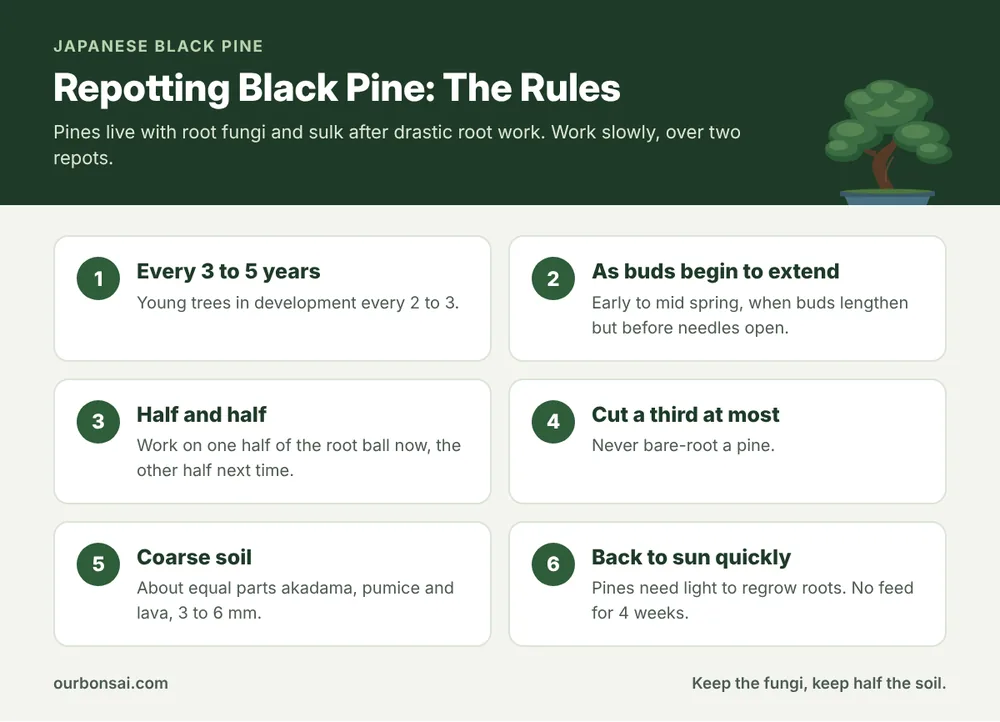
Here is how to repot japanese black pine bonsai: repot every 3 to 5 years (every 2 to 3 while young), in early to mid spring as the buds begin to extend; work on only half of the root ball at a time and leave the rest of the old soil for the next repot; cut no more than about a third of the roots; and use a coarse, fast-draining mix of roughly equal parts akadama, pumice and lava. Japanese black pine (Pinus thunbergii) lives in partnership with beneficial root fungi, and drastic root work weakens it for a year or more. Never bare-root a pine.
In this guide
Why pines are repotted conservatively
Pines in the wild grow in poor, sandy or rocky soils where nutrients are scarce. They rely on mycorrhizal fungi that coat the root tips and extend into the soil, gathering water and nutrients far beyond the reach of the roots themselves. In a healthy pine pot you often see white threads and patches in the soil and on the roots. That is the fungus, and it is a good sign.
Washing all the old soil away removes most of this partner. A pine can survive it, but it often sulks with weak candles and short needles for one or two seasons. The standard solution is to repot gradually and always carry old soil into the new pot.
Japanese black pine is native to the coasts of Japan and Korea, where it grows on sand dunes and rocky shores in full sun and wind. It handles salt spray, poor soil and drought far better than wet roots.
When to repot
| Tree | Interval | Timing |
|---|---|---|
| Young pine growing on | Every 2 to 3 years | As buds begin to extend in spring |
| Mature pine in display pot | Every 3 to 5 years | Same |
| Collected or nursery pine in field soil | Over 2 or more repots | Spring, half the soil each time |
The bud signal matters more than the date. When the buds at the shoot tips begin to lengthen but before the new needles open, the tree is about to push new roots. In mild climates, some growers also repot in early autumn; spring is the safer choice for most.
Soil
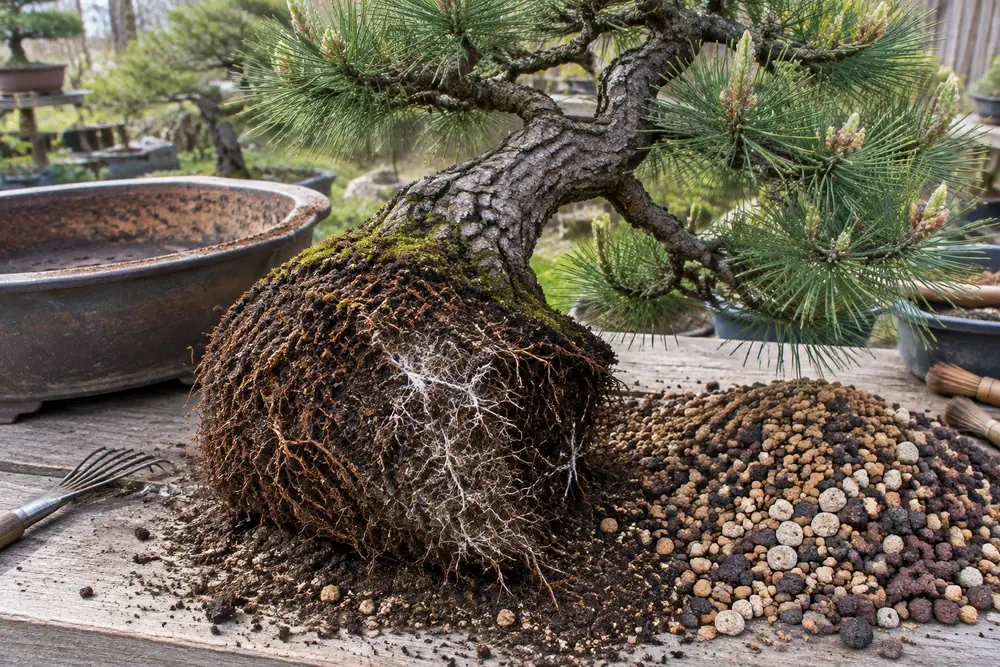
Black pine wants a coarse, fast-draining mix. Equal parts akadama, pumice and lava sieved to 3 to 6 mm is a common starting point. In wet climates, increase lava and pumice; in very hot, dry climates, a little more akadama. Our guide to the best soil for Japanese black pine bonsai covers the options in detail.
How to repot japanese black pine bonsai, step by step
- Prepare everything first: pot with mesh and tie-in wires, sieved soil, root hook, sharp scissors and a sharp saw for thick roots.
- Remove the tree. Cut old wires and loosen the edge with a knife.
- Pick a half. Divide the root ball mentally into two halves, for example front and back, or left and right.
- Work on that half only. Comb out old soil from the outer edge and bottom on that side, trim long and circling roots, and cut thick downward roots under that half.
- Leave the other half alone, apart from shaving off any roots circling the pot.
- Keep the total cut to about a third of the root mass.
- Mix a handful of the old soil, with its white fungal threads, into the new soil.
- Pot up, tie in firmly, and work soil into the gaps with a chopstick. A pine that rocks in its pot tears new roots.
- Water thoroughly until it runs clear.
At the next repot, a few years later, work on the other half. Our list of the best bonsai repotting tools covers the saw and root hook.
Aftercare
- Shelter from wind and frost for 2 to 3 weeks.
- Return to full sun soon. Pines need strong light to make the sugars that drive new root growth. A few days of light shade is plenty.
- Water carefully. Let the surface dry slightly between waterings. Pines dislike constantly wet soil.
- No fertilizer for about 4 weeks.
- Skip strong candle pruning this year if you did a heavy repot. Let the tree rebuild.
Signs the repot worked
You will know within the season. A pine that recovered well extends its candles normally in late spring, opens needles of good length and dark green color, and sets strong buds by late summer. In the following year’s repot, you should see plenty of new fine roots and white fungal threads in the soil you added.
Signs of a struggling tree are candles that stall at a few centimeters, needles that stay short and yellowish, or older needles dropping early in summer. If you see these, do not feed heavily or repot again. Keep the tree in full sun, water carefully and let it rebuild for a full year before any more root or styling work.
Repotting collected or nursery pines
Pines dug from the ground or bought in nursery containers often sit in heavy field soil or bark-based compost. Do not try to replace all of it in one session. Use the half-and-half method over two repots, two or three years apart, and keep the tree in a slightly larger training pot until most of the old soil is gone.
Common mistakes
- Bare-rooting. The fastest way to set a pine back by a year.
- Repotting too early, while buds are still tight and the soil is cold.
- Fine, water-holding soil. Leads to weak roots and needle yellowing.
- Leaving the tree in shade to “recover.” Pines recover in sun.
- Combining a hard repot with heavy styling. Do one big job per year.
For broader context on evergreen species, see our guide to types of evergreen bonsai trees, and if you grow other pines, our loblolly pine bonsai care guide covers a North American relative.
Frequently asked questions
How often should I repot a Japanese black pine bonsai?
Every 3 to 5 years for mature trees, every 2 to 3 for young trees in development.
Can I bare-root a black pine?
It is not recommended. Pines depend on root fungi and recover slowly from full bare-rooting. Work on half the root ball at a time.
What is the white stuff in my pine’s soil?
Usually mycorrhizal fungus, which is beneficial. Keep some of that old soil when you repot.
When is the best time to repot a black pine?
Early to mid spring, as the buds begin to extend but before new needles open.
Final thoughts
Repot black pine slowly and kindly: half the root ball at a time, old soil carried over, coarse fresh soil, and sun right after. For the species background, see the Wikipedia article on Pinus thunbergii.