Best Soil for Hinoki Cypress Bonsai: Mix and Repotting Tips

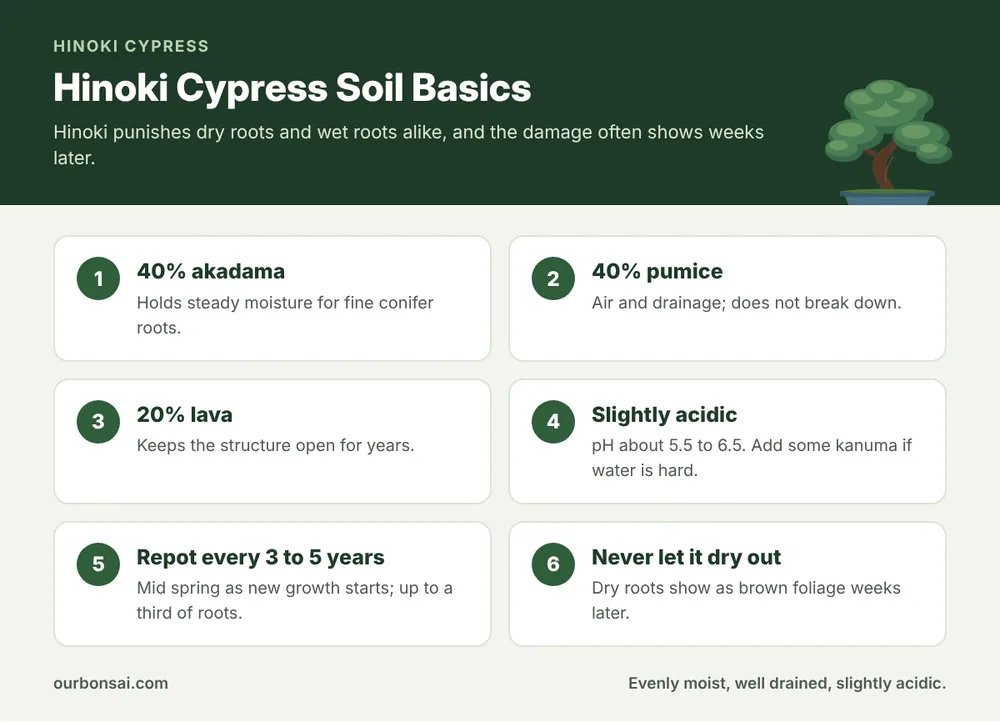
The best soil for hinoki cypress bonsai drains quickly yet stays evenly moist: about 40 percent akadama, 40 percent pumice and 20 percent lava rock, sieved to 2 to 6 mm, with a slightly acidic pH around 5.5 to 6.5. Hinoki cypress (Chamaecyparis obtusa) has fine roots that are damaged both by drying out and by sitting in wet soil, and the damage often only shows as browning foliage weeks later. Repot every 3 to 5 years in mid spring, remove no more than a third of the roots, and water as soon as the surface begins to dry.
In this guide
What hinoki needs from its soil
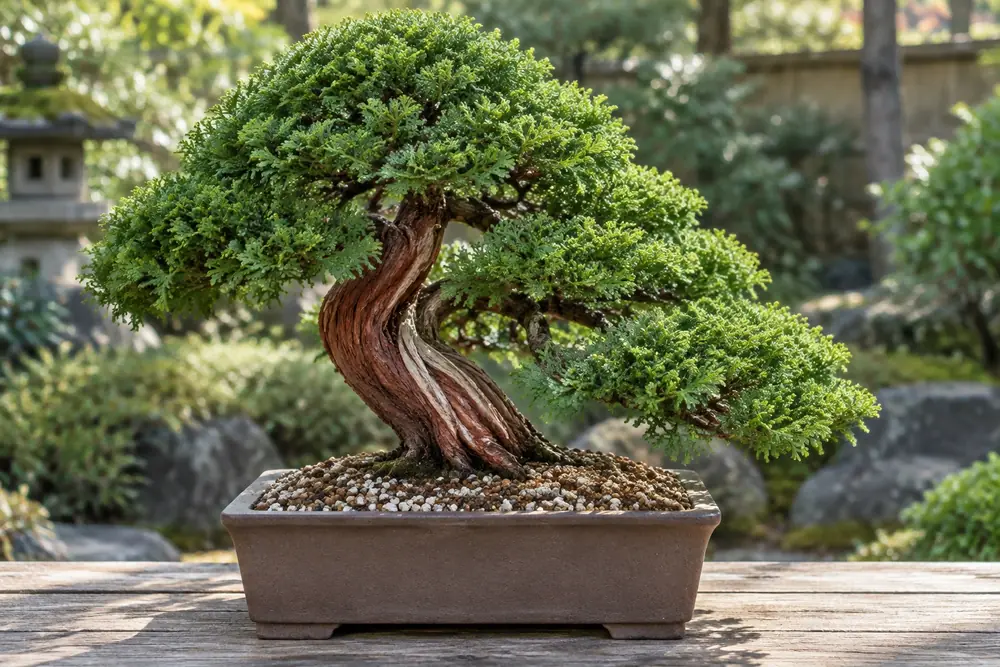
Hinoki grows wild in the mountains of central and southern Japan, in cool, moist forests with high rainfall and well-drained, slightly acidic soils. It is one of Japan’s most valued timber trees, used for temples and shrines. As a bonsai, it is grown both as the species and as dwarf cultivars such as ‘Nana Gracilis’ and ‘Kosteri’, which have dense, fan-shaped sprays of foliage.
Two traits shape soil choice:
- Fine, shallow roots that dry out quickly in a coarse, fast mix.
- Low tolerance for waterlogging, like most conifers. Wet, airless soil leads to root rot.
A balanced, mostly mineral mix with plenty of akadama gives steady moisture and good air. Peat-based potting soil, on the other hand, either stays wet in cool weather or dries into a hard, water-repelling block in summer, and hinoki suffers in both cases. Our bonsai soil mix ratio guide explains how akadama, pumice and lava each behave.
Best soil for hinoki cypress bonsai: recipe and adjustments
| Situation | Akadama | Pumice | Lava | Notes |
|---|---|---|---|---|
| Standard | 40% | 40% | 20% | Good for most climates |
| Hot, dry summers | 50% | 30% | 20% | Holds more water |
| Cool, wet climate | 30% | 40% | 30% | Drains faster |
| Hard tap water | 30% akadama + 10% kanuma | 40% | 20% | Kanuma helps keep pH low |
Sieve all ingredients to remove dust. For small trees, use 1 to 4 mm grains; for large trees, up to 6 or 8 mm.
Why pH matters a little
Hinoki prefers slightly acidic soil. In most cases, akadama keeps the pH in the right range. If your tap water is very hard, minerals build up over months, the pH creeps up, and foliage can turn pale or yellowish. Rainwater, monthly flushing and a small share of kanuma all help. Our Kanuma bonsai soil review covers that ingredient.
Repotting hinoki cypress
- When: mid spring, as new growth begins. Conifers generally wake a little later than deciduous trees.
- How often: every 2 to 3 years for young trees, every 3 to 5 years for mature trees.
- How much root: up to about a third. Never bare-root.
Steps:
- Prepare the pot, mesh, tie-in wire and sieved soil.
- Remove the tree and comb out the outer and bottom roots with a root hook.
- Leave a core of old soil around the trunk. This keeps beneficial fungi and protects fine roots.
- Trim long, circling and dead roots. Look for dark, soft roots, which indicate rot.
- Pot up, tie in firmly, and work soil in with a chopstick.
- Water thoroughly and keep the tree out of wind and strong sun for 2 to 3 weeks.
- Do not feed for about 4 weeks.
The best bonsai repotting tools list covers what you need.
Watering habits for hinoki
Water as soon as the top of the soil starts to dry, before it is dry right through. In summer, that usually means every day. A fine-rose watering can soaks the soil evenly without washing it out. Misting the foliage on hot, dry evenings also helps, because hinoki comes from humid forests.
The trap with hinoki is delayed damage. If the root ball dries out once in July, the foliage may look fine for days, then inner sprays turn brown in August. Many owners blame pests or disease when the real cause was a dry afternoon weeks earlier.
Placement affects how the soil behaves
Hinoki is often grown in more shade than junipers or pines, especially dwarf cultivars, which can scorch in strong afternoon sun in hot climates. A tree in morning sun and afternoon shade dries its soil more slowly, so the standard mix is usually right. A tree in full sun all day dries much faster, so lean toward the higher akadama version and check twice a day in summer. Wind matters too: an exposed balcony can dry a small pot in hours. Grouping pots together and placing them out of the prevailing wind helps keep the root zone evenly moist.
In winter, hinoki is hardy outdoors in most temperate climates but its roots need protection in a pot below about -10 C (14 F). Keep it in a cold frame, against a sheltered wall, or with the pot buried in mulch. Winter sun and wind on frozen roots can cause the same delayed browning as summer drought, because the foliage loses water the roots cannot replace.
Soil-related problems
- Brown inner foliage: often normal shedding of old foliage in autumn. Browning of outer, young sprays points to dry roots or root damage.
- Overall yellowing: soil too wet, or pH too high from hard water.
- Weak spring growth: compacted, old soil, or roots lost over winter.
For other conifers with similar needs, see our guide to lemon cypress bonsai care, and for winter care, our list of types of evergreen bonsai trees.
Frequently asked questions
Can I use juniper soil for hinoki cypress?
Many juniper mixes are coarser and drier. They work if you water more often, but a mix with a bit more akadama suits hinoki better.
Does hinoki cypress need acidic soil?
Slightly acidic soil, around pH 5.5 to 6.5, is ideal. Akadama provides it.
How often should I repot hinoki cypress bonsai?
Every 3 to 5 years for mature trees, every 2 to 3 for young ones, in mid spring.
Why is my hinoki turning brown after repotting?
Root loss or dry roots during the repot. Keep it shaded, sheltered and evenly moist. Browning may continue for a few weeks before new growth appears.
Final thoughts
Hinoki rewards consistency: a balanced akadama, pumice and lava mix, moderate repotting, and watering before the soil dries. For background on the species, see the Wikipedia article on Chamaecyparis obtusa.