When and How to Repot Ginkgo Bonsai

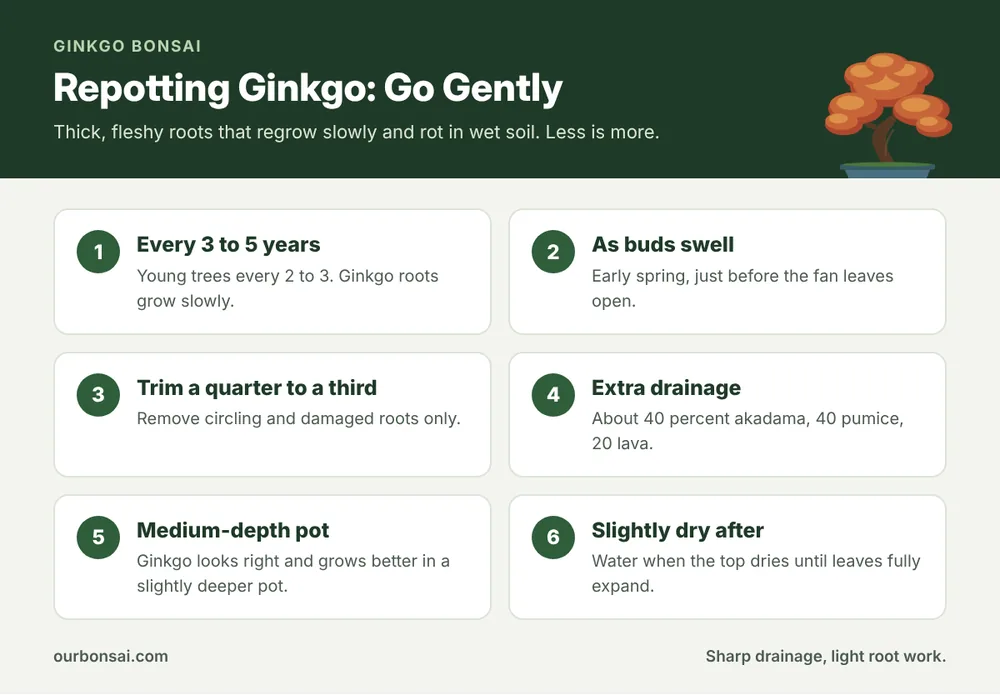
Here is how to repot ginkgo bonsai: repot every 3 to 5 years (every 2 to 3 while young), in early spring as the buds swell; remove only about a quarter to a third of the roots; and use a soil that drains faster than a standard mix, such as 40 percent akadama, 40 percent pumice and 20 percent lava. Ginkgo (Ginkgo biloba) has thick, fleshy roots with relatively few fine feeder roots. They rot in wet soil and grow back slowly, so ginkgo needs a gentler repot than maple or elm, and it should be kept slightly on the dry side until its new leaves have fully expanded.
In this guide
Why ginkgo roots are different
Ginkgo is the only living species of an ancient plant lineage, unchanged in its basic form for many millions of years. It grows wild in only a few places in China but is planted in cities worldwide for its toughness.
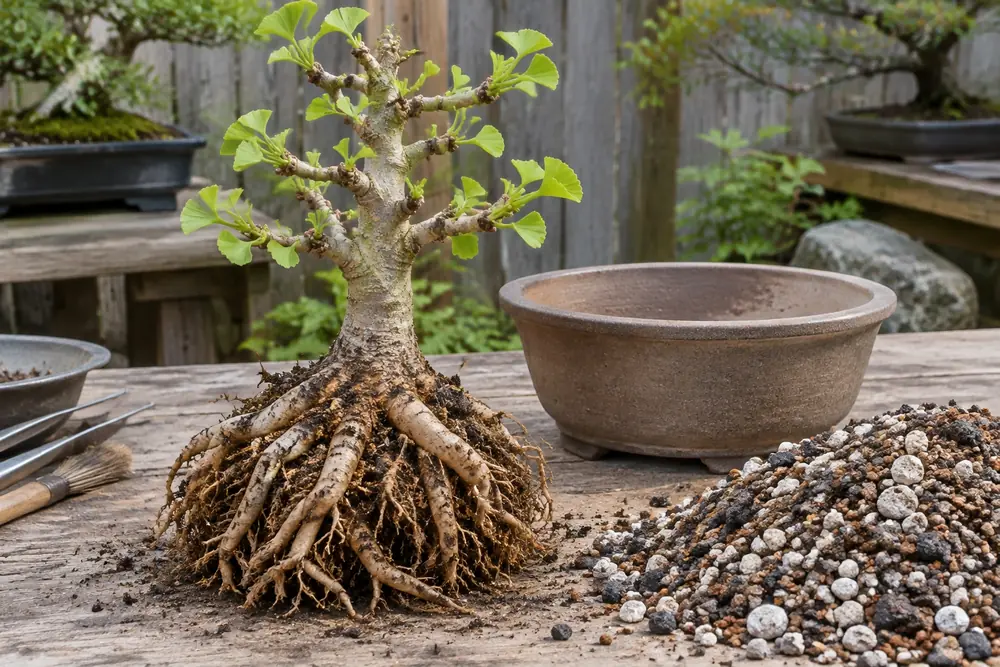
Its roots reflect that ancient design. Instead of a dense mat of fine roots, ginkgo grows thick, pale, fleshy roots that store food and branch sparingly. In the ground, that is fine. In a bonsai pot, it means:
- Fewer fine roots to lose. Cutting half the roots, as you might on an elm, can remove most of the feeding capacity.
- Slow recovery. New roots form gradually, so a hard repot can stall the tree for a whole season.
- Rot risk. Fleshy roots in cold, wet soil decay easily, especially before the leaves are out to draw water up.
When to repot
| Tree | Interval | Timing |
|---|---|---|
| Young tree growing on | Every 2 to 3 years | As buds swell in early spring |
| Mature tree in display pot | Every 3 to 5 years | As buds swell |
| Tree in poor, soggy soil | This spring | Change the soil, trim lightly |
Signs it is time: water drains slowly or pools, roots circle the pot, or growth has weakened for two seasons. Ginkgo grows slowly above ground too, so do not judge it by the vigor of other deciduous trees.
Soil for ginkgo
Choose a mix that drains a little faster than standard:
- Standard ginkgo mix: 40 percent akadama, 40 percent pumice, 20 percent lava.
- Hot, dry climate: 50 percent akadama, 30 pumice, 20 lava.
- Cool, wet climate: 30 percent akadama, 40 pumice, 30 lava.
Sieve out the dust. Our bonsai soil mix ratio guide explains each component, and bonsai soil vs regular soil shows why garden soil causes problems.
Pot choice
Ginkgo is usually grown as an upright, flame-shaped tree that copies old street and temple ginkgos. A medium-depth pot suits that look better than a very shallow tray, and it gives the thick roots a little more room and a more even moisture level. Unglazed or subtly glazed pots in earth tones work well, especially for showing the golden autumn color.
How to repot ginkgo bonsai, step by step
- Prepare everything first: pot with mesh and tie-in wire, sieved soil, root hook and sharp scissors.
- Remove the tree by cutting old wires and loosening the pot edge with a knife.
- Comb out gently from the outside and bottom. Ginkgo roots can snap; use your fingers and a chopstick more than a hook.
- Trim lightly. Remove circling roots, damaged roots and any soft, dark rotten ones. Keep the total cut to about a quarter to a third.
- Keep fine roots. Any fine roots you find are valuable; protect them.
- Pot up and tie in firmly. Work soil around the roots with a chopstick.
- Water once thoroughly until it runs clear.
Our list of the best bonsai repotting tools covers the root hooks and scissors you need.
Aftercare
- Light shade and shelter from wind for 2 weeks, and protection from late frost.
- Keep it slightly dry until the leaves have fully expanded. Water when the top 1 to 2 cm has dried.
- No fertilizer for 4 to 6 weeks. Then feed lightly through the season.
- No heavy pruning the same spring.
- Full sun once established. Ginkgo needs plenty of sun and a cold winter outdoors. Our list of types of outdoor bonsai trees covers winter protection.
Using repotting to build a better base
Ginkgo often has a weak root flare, with one or two thick roots running in the same direction and few surface roots elsewhere. You cannot fix that in one session without risking the tree, but each repot can move it forward. Choose one thick root that dives straight down and cut it back to a side root, so energy shifts outward. Spread the remaining surface roots evenly. Some growers also make shallow nicks in the bark at the base where they want new roots and cover the area with soil; ginkgo can root from these wounds over a season or two. Over three or four repots, the base usually broadens noticeably.
Ginkgo in a training box
If your ginkgo is young and you want a thicker trunk, a larger wooden box or deep training pot with the same free-draining soil speeds things up. Ginkgo grows faster with more root room, and the fleshy roots are less likely to circle and choke each other. Move it into a bonsai pot once the trunk is close to the size you want.
Signs of trouble
- Leaves stay small and yellowish after a repot: roots are slow to recover; keep the soil airy and avoid overwatering.
- Branches die back: roots lost too much at once, or rot set in.
- Dark, soft roots at the next repot: soil too wet. Increase pumice and lava. See our guide to root rot in bonsai.
Frequently asked questions
How much root can I remove from a ginkgo bonsai?
About a quarter to a third. Ginkgo recovers slowly from heavy root pruning.
When is the best time to repot ginkgo?
Early spring, as the buds swell and just before the leaves open.
Can ginkgo be bare-rooted?
It is not recommended. The fleshy roots break easily, and the tree may stall.
Why is my ginkgo slow to leaf out after repotting?
Ginkgo is slow to recover from root disturbance. As long as buds are firm and the bark is green underneath, give it time and keep the soil from staying wet.
Final thoughts
Ginkgo is a patient tree, and it needs a patient repot: early spring timing, sharp drainage, modest root cuts and slightly dry aftercare. For a look at a typical young tree, see our Brussels ginkgo bonsai review, and for the remarkable history of the species, the Wikipedia article on Ginkgo biloba.