Best Soil for Hornbeam Bonsai: Mix and Repotting Tips

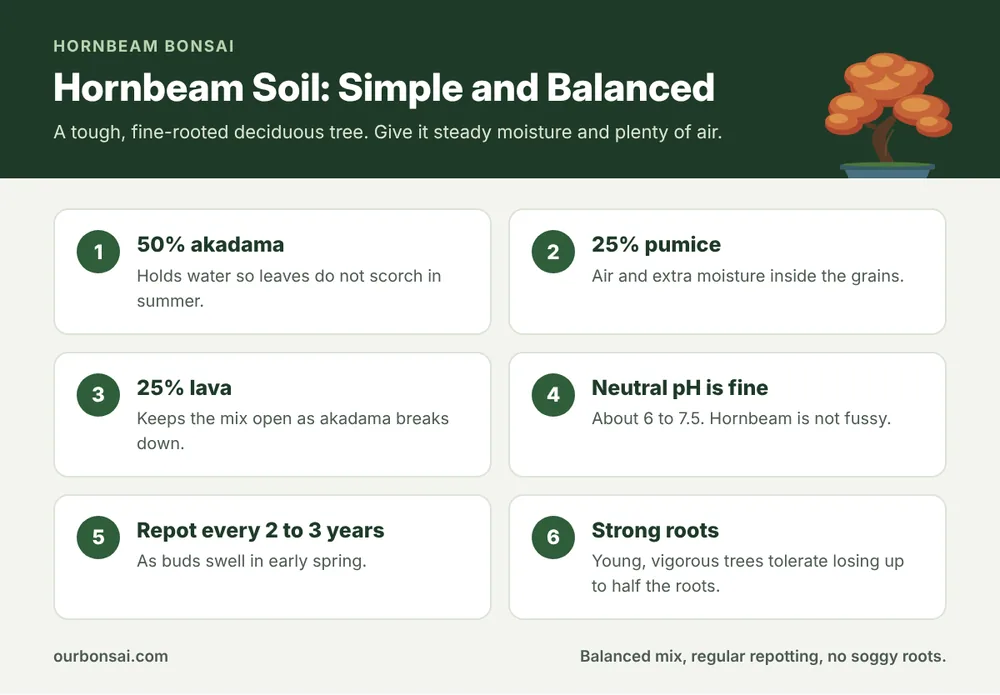
The best soil for hornbeam bonsai is a balanced mix of about 50 percent akadama, 25 percent pumice and 25 percent lava rock, sieved to 2 to 6 mm. Hornbeams have fine, vigorous roots that like steady moisture and plenty of air. They are not fussy about pH, growing well anywhere from slightly acidic to slightly alkaline, roughly 6 to 7.5. In hot summers, increase the akadama to stop leaf scorch. Repot every 2 to 3 years as the buds swell in early spring; young, vigorous trees tolerate losing up to half their roots.
In this guide
Which hornbeam do you have?
Four hornbeams are common in bonsai, and all do well in the same soil:
| Species | Botanical name | Leaves | Notes |
|---|---|---|---|
| Korean hornbeam | Carpinus turczaninowii | Small, 2 to 5 cm | Most popular for bonsai; orange-red autumn color |
| Japanese hornbeam | Carpinus japonica | Longer, strongly ribbed | Elegant; slightly less vigorous |
| European hornbeam | Carpinus betulus | Medium, 5 to 10 cm | Very hardy; leaves reduce with ramification |
| American hornbeam | Carpinus caroliniana | Medium | Native to eastern North America; muscular trunk |
All of them are hardy outdoor trees that need a cold winter dormancy. European hornbeam often holds dry brown leaves through winter, like beech. That is normal. Korean hornbeam is the most forgiving of the four and the easiest to find as bonsai stock, which is why most hornbeam soil advice is written with it in mind.
Why this mix works
Hornbeams grow wild in woods and hedgerows, often on heavier soils than many bonsai species prefer. In a shallow pot, though, heavy soil compacts and stays wet. A granular mix keeps the advantages hornbeams like, steady moisture and nutrients, while adding the air their fine roots need.
- Akadama holds water and nutrients and lets fine roots branch.
- Pumice adds air and holds some moisture inside each grain.
- Lava rock gives lasting structure.
Our bonsai soil mix ratio guide covers each ingredient in more depth.
Best soil for hornbeam bonsai in your climate
- Hot, dry summers (above 30 C often): 60 percent akadama, 20 pumice, 20 lava. Hornbeam leaves scorch at the edges if the pot dries out on hot afternoons.
- Mild, temperate climate: the standard 50/25/25.
- Cool, wet climate: 40 percent akadama, 30 pumice, 30 lava, so the pot drains faster through long rainy spells.
- Young trees in development: a slightly coarser version in a larger pot speeds up growth.
Sieve out all dust. If you are buying rather than mixing, see our reviews of premium bonsai soil and Heron’s bonsai soil mix.
Repotting hornbeam
Timing: early spring, as the buds swell and begin to lengthen.
Frequency: every 2 years for young trees, every 3 years for mature trees.
Steps:
- Prepare the pot, mesh, tie-in wire and sieved soil.
- Remove the tree and comb out the roots with a root hook, working from the outside in.
- Cut thick downward roots and shorten long ones. On a vigorous young tree you can remove up to half the root mass; on older trees, about a third.
- Spread surface roots outward. Hornbeam develops a good flared base with this treatment over a few repots.
- Pot up, tie in firmly and work soil around the roots.
- Water thoroughly. Keep in light shade and out of wind for about 2 weeks.
- Feed after about 4 weeks.
The best bonsai repotting tools list shows useful root hooks and scissors.
Pot choice and soil depth
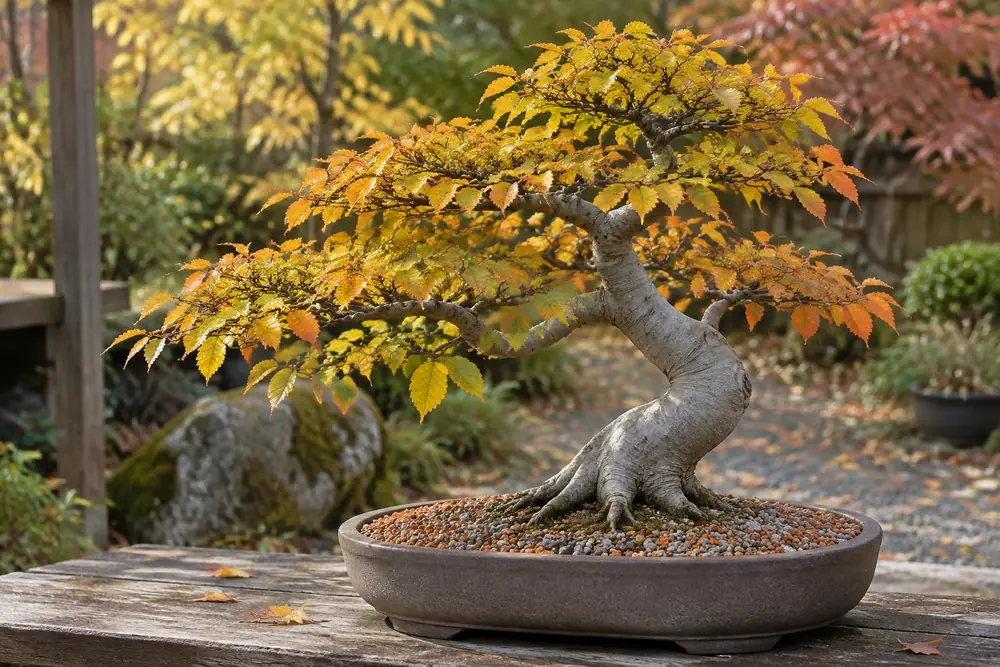
Hornbeams are usually styled as upright trees with a broad, rounded crown, a smooth gray trunk and a strong root flare. Medium-depth oval or rectangular pots suit that look. The shallower the pot, the less water it holds, so trees in very shallow display pots need the higher akadama mix and more frequent watering. During development, many growers keep hornbeams in larger training pots or wooden boxes, because a bigger soil volume speeds up trunk thickening and makes summer watering less stressful. Move the tree into its final pot once the trunk and main branches are close to the size you want, and switch to a slightly finer grain size at that point.
Feeding a hornbeam in a mineral mix
Because pumice and lava hold almost no nutrients, a hornbeam in this mix depends on regular feeding. From bud break to late summer, give a balanced fertilizer every 2 weeks if liquid, or monthly if you use organic pellets on the surface. Reduce nitrogen once the tree reaches the size you want, to keep leaves small and internodes short. Stop feeding in early autumn. Our comparison of pellet and liquid bonsai fertilizer helps you choose.
Watering in this mix
Water when the top centimeter dries. In summer, that is usually daily, and twice a day for small pots in heat. In spring and autumn, every 2 to 3 days is typical. In winter, dormant trees need water only every week or two. A fine-rose watering can soaks the soil evenly. For a hot-weather routine, see our guide to watering bonsai in summer.
Soil-related problems
- Brown, crispy leaf edges in summer: the pot dried out. Water more often, give afternoon shade in heat waves, or add akadama.
- Yellow leaves and weak growth: soil compacted or too wet. Repot and add pumice or lava.
- Poor ramification: often a sign of weak roots. Healthy roots in airy soil drive fine twig growth.
For more on deciduous species and timing, see our guide on when to prune deciduous bonsai.
Frequently asked questions
Does hornbeam need acidic soil?
No. Hornbeam grows well in neutral and even slightly alkaline soil.
How often should I repot a hornbeam bonsai?
Every 2 years when young, every 3 years when mature, as buds swell in spring.
Can I use pure akadama for hornbeam?
Yes, especially in hot climates. It holds more water, so watch for soggy soil in wet weather and repot when it starts to break down.
Why are my hornbeam leaves scorching?
Usually the soil dried out on a hot day. Add more akadama to the mix, water more often in summer, and give afternoon shade during heat waves.
Final thoughts
Hornbeam is easy to please below ground: a balanced akadama, pumice and lava mix, a repot every few years, and steady moisture in summer. For background on the genus, see the Wikipedia article on Carpinus betulus.