When and How to Repot Jade Bonsai

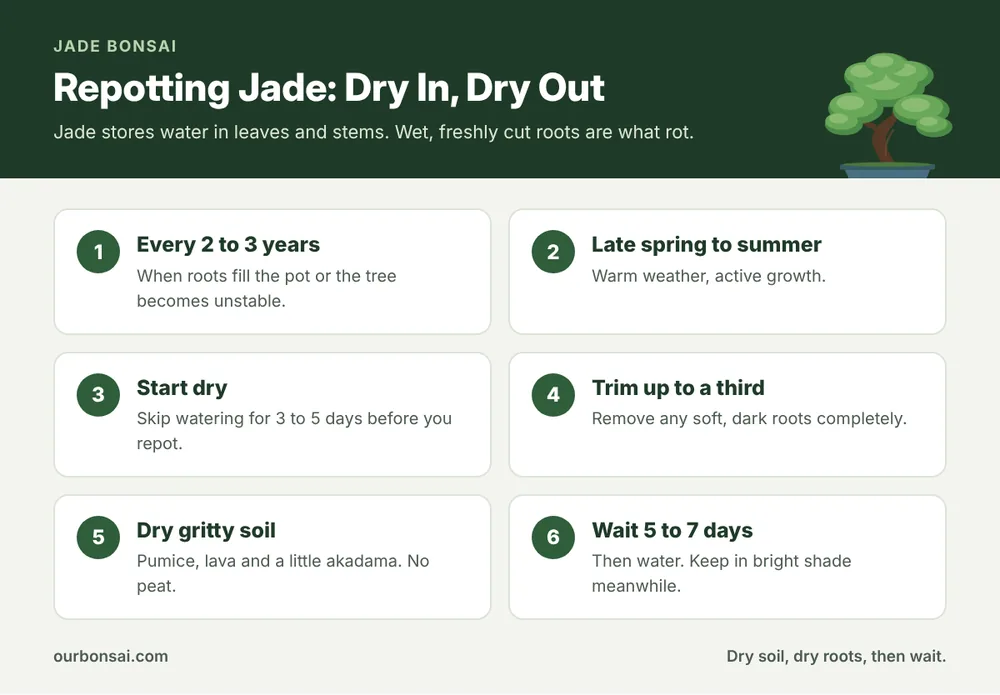
Here is how to repot jade bonsai: repot every 2 to 3 years in late spring or summer, starting with dry soil and dry roots; trim up to a third of the roots and remove any that are soft or dark; pot into dry, gritty soil; and then wait about 5 to 7 days before the first watering. Jade (Crassula ovata) is a succulent from South Africa that stores water in its thick leaves and stems. Freshly cut roots in wet soil are the main cause of rot after repotting, so jade breaks the usual bonsai rule of watering in right away.
In this guide
Why jade is repotted differently
Most bonsai are repotted with moist roots and watered straight after, so the fine roots never dry. Jade is the opposite. Its roots are shallow and fairly thick, and the plant can go weeks without water thanks to the store in its leaves. When roots are cut, the wounds need a few days to dry and seal. Water them too soon, especially in cool weather, and rot can enter through the cuts.
Jade is also heavy for its size. A thick trunk and fleshy leaves make it top-heavy, and branches snap at the joints. That makes careful handling and firm tying-in important.
Note that dwarf jade (Portulacaria afra) is a different plant with smaller leaves. It is repotted in a similar way.
When to repot
| Sign | What to do |
|---|---|
| Roots fill the pot or push out of the holes | Repot this summer |
| Tree rocks or tips over | Repot and tie in firmly |
| Soil stays wet for more than a week after watering | Repot into grittier soil |
| Soft, wrinkled lower leaves while soil is wet | Check for root rot now |
Late spring to summer is best, when the tree is warm and growing. Our jade bonsai tree live plant review shows a typical nursery tree and its starting soil.
Soil for jade
Use a very fast-draining, mostly mineral mix:
- Standard: 40 percent pumice, 40 percent lava, 20 percent akadama.
- Outdoors in hot summers: 30 percent pumice, 40 lava, 30 akadama, for a little more water.
- Indoors in low light: 50 percent pumice, 50 percent lava.
Avoid peat-based potting soils and most bagged cactus mixes that are high in peat. Our review of Bonsai Jack succulent soil covers a ready-made option.
How to repot jade bonsai, step by step
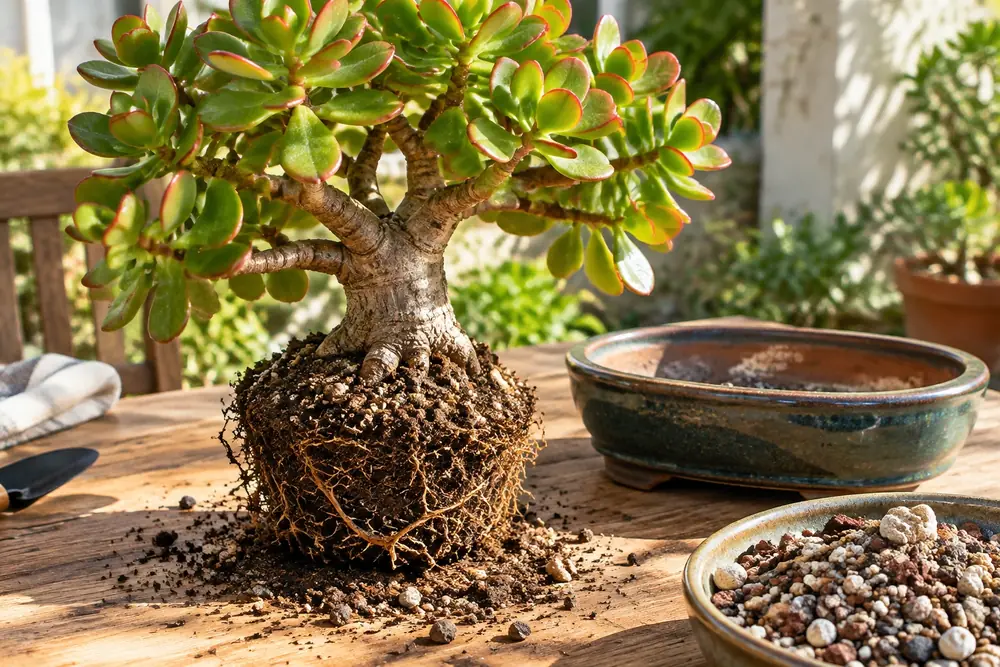
- Stop watering 3 to 5 days before. Dry soil falls away from the roots and dry roots are less likely to tear.
- Prepare a pot with large drainage holes, mesh and tie-in wire, and dry, sieved soil.
- Remove the tree by the base of the trunk, not the branches. Jade branches snap at the joints.
- Shake and comb out the old soil. A chopstick works better than a root hook on jade’s fleshy roots.
- Inspect the roots. Healthy roots are firm and light colored. Cut away soft, dark or hollow ones completely.
- Trim long and circling roots, removing up to about a third.
- Let the roots air for a few hours if you made many cuts, in the shade.
- Pot into dry soil. Set the tree, tie it in firmly so it cannot rock, and fill with soil.
- Do not water. Place it in bright shade.
- After 5 to 7 days, water thoroughly, then return the tree to full sun over a week.
Aftercare
- Bright light, not harsh sun for the first week, then full sun or the brightest window. Jade needs strong light to stay compact.
- Water deeply but rarely. After the first watering, let the soil dry almost completely each time.
- No fertilizer for 4 weeks, then a half-strength balanced feed monthly through the growing season.
- Leave pruning until it is clearly growing again.
Slightly wrinkled leaves in the first week are normal; the tree is using its stored water. They should plump up within a few days of the first watering.
Choosing the pot
Jade’s weight is the main factor. A thick trunk and a full head of fleshy leaves can easily tip over a light, shallow pot, especially on a windowsill where someone brushes past. Choose a pot that is heavy enough to balance the tree, with wide, flat feet and at least one large drainage hole. Unglazed or partly glazed pots dry a little faster, which suits a succulent. A medium-depth pot gives stability while still drying out reasonably fast in gritty soil. If you are moving up in size, go only a few centimeters wider than the root spread; a much larger pot holds water for too long.
Using the repot to fix a top-heavy tree
Many jade bonsai have grown tall and leggy indoors, with a small root system holding up a lot of weight. The repot is a good moment to deal with that. Prune the top back by a third or so a few weeks before repotting, so the tree is lighter and easier to stabilize. Jade roots readily from cuttings, so you can pot up the pruned pieces to grow new trees. Over the following summer in strong light, the pruned tree will branch lower down and become more compact.
Common mistakes
- Watering right after repotting. The most common cause of post-repot rot.
- Repotting in winter indoors. Growth is slow and cut roots heal poorly.
- Using regular potting soil. It stays wet far too long.
- Lifting the tree by its branches.
- A pot without drainage. Many decorative pots sold with jade have none.
For other jade problems, see our guide to jade bonsai pests and diseases, and for shaping ideas, traditional jade bonsai styles.
Frequently asked questions
Should I water jade bonsai after repotting?
Not immediately. Wait about 5 to 7 days so the cut roots can seal, then water deeply.
How often should I repot a jade bonsai?
Every 2 to 3 years, or when it becomes root-bound or unstable.
Can I repot jade in winter?
Avoid it unless the tree has root rot. Warm weather gives the best recovery.
How much root can I cut from a jade?
Up to about a third of healthy roots, plus any rotten roots.
Final thoughts
Repot jade like a succulent: dry in, dry soil, then wait before watering. Give it gritty soil, strong light and a firm tie-in, and it will grow on steadily. Clemson Extension’s jade plant factsheet covers its general care, and the Wikipedia article on Crassula ovata explains its origins.