Aphids on Bonsai Leaves: Causes and Treatment

Quick Answer
Aphids on bonsai leaves are tiny sap-feeding insects that gather around tender shoots, buds, stems, and leaf undersides. They can cause curled growth, sticky honeydew, yellowing, and sooty mold. For a light infestation, isolate the tree and remove aphids with a controlled stream of water. If they return, use a plant-safe insecticidal soap or horticultural oil according to its label and established aphid management guidance.
Signs and causes to check
- Tender growth: Aphids prefer soft new shoots, young leaves, buds, and expanding stems.
- Visible colonies: Look for small, soft-bodied insects clustered together rather than scattered individually.
- Sticky residue: Aphids excrete sugary honeydew that can coat leaves, branches, pots, and benches.
- Leaf distortion: Sustained feeding may curl or twist developing bonsai leaves and shoots.
- Ant activity: Ants visiting new growth repeatedly may be feeding on aphid honeydew.
- Soft growth: Excess nitrogen can encourage lush foliage that is especially attractive to aphids.
Best first move
- Confirm that the insects are aphids before spraying, then start with the least disruptive treatment that will control them.
Aphids can appear on a bonsai almost overnight, especially during a strong spring or summer growth flush. I usually spot them first near tender shoot tips, where the newest leaves are still soft.
The good news is that an aphid infestation is usually manageable when you catch it early. This guide explains what causes aphids on bonsai leaves, how to identify them, which treatments work, and how to prevent another outbreak.
In This Guide
What Are Aphids on Bonsai Leaves?
Aphids are small, soft-bodied insects that use piercing-sucking mouthparts to feed on plant fluids. They commonly gather on new leaves, buds, petioles, and young stems.
Definition: An aphid is a sap-feeding insect, often pear-shaped, with a pair of small tube-like structures called cornicles near the rear of its body.
Many aphids measure only a few millimeters long. Their small size makes a 10× hand lens useful when you need to confirm an infestation.
- Green aphids: Common and easy to overlook against fresh foliage.
- Black aphids: More visible on pale leaves and young stems.
- Yellow or brown aphids: Color varies with species and life stage.
- Winged aphids: Adults may develop wings when colonies disperse to new plants.
- Wingless aphids: These often make up most of an established colony.
Color alone isn’t a reliable identification method. Body shape, colony behavior, feeding location, honeydew, and cornicles are stronger clues.
Bonsai Empire’s pest and disease guidance also includes aphids among the insects bonsai growers may encounter.
Why Do Aphids Attack Bonsai Trees?
Aphids attack bonsai because tender plant growth provides accessible feeding sites. Fresh leaves and rapidly extending shoots are particularly attractive.
The bonsai pot itself doesn’t create aphids. Instead, seasonal growth, nearby host plants, excessive soft growth, and new plant introductions can increase exposure.
Fresh shoots provide ideal feeding sites
I watch my deciduous trees most closely when buds open and shoots begin extending. That’s when a small colony can hide between expanding leaves before the damage becomes obvious.
- Young leaves: Soft tissue is easier for aphids to feed on.
- Developing buds: Tight growth gives colonies sheltered feeding sites.
- Shoot tips: Rapidly growing stems often support concentrated colonies.
- Leaf undersides: Protected surfaces make insects harder to notice.
Too much nitrogen can encourage soft growth
Heavy nitrogen feeding can promote fast, lush foliage. That does not directly create aphids, but it can produce the tender growth they prefer.
Keep fertilizer appropriate for the species, season, and development goal. More fertilizer isn’t automatically better bonsai care.
Aphids can arrive from other plants
Winged adults can move between suitable host plants. Aphids can also arrive on recently purchased bonsai, nursery plants, accent plants, or nearby garden vegetation.
As of 2026, I still consider routine inspection more useful than preventive spraying. Finding a small colony early is easier on the tree than repeatedly treating foliage without evidence of pests.
Section Takeaway: Aphids are drawn to vulnerable feeding sites, not to bonsai pots themselves. Tender growth, nearby host plants, and unchecked new arrivals create the most useful conditions to monitor.
How Can You Tell if Your Bonsai Has Aphids?
Confirm aphids by combining visible insects with their feeding signs. Start at the newest growth, then inspect leaf undersides and branch junctions.
Bright side lighting makes shiny honeydew and pale shed skins easier to see. A hand lens helps when your bonsai has tiny foliage.
Common signs of aphids on bonsai leaves
- Visible clusters: Several small insects gather around the same shoot or leaf.
- Curled leaves: Feeding on developing tissue can distort new foliage.
- Sticky honeydew: Leaves, branches, pots, or surfaces underneath may feel tacky.
- Sooty mold: Dark fungal growth can develop on accumulated honeydew.
- White skins: Aphids shed pale exoskeletons as they grow.
- Ant trails: Ants may repeatedly visit colonies for their sugary honeydew.
- Slow new growth: Heavily affected shoots may become weak or distorted.
Honeydew is a sugar-rich waste produced by several sap-feeding pests. Aphids are common producers, but sticky foliage alone doesn’t prove you have aphids.
Aphids vs. other common bonsai pests
| Pest | Typical Appearance | Main Clue | Where to Check |
|---|---|---|---|
| Aphids | Soft, pear-shaped insects | Colonies, honeydew, curled growth | New shoots and leaf undersides |
| Soft scale | Rounded or flattened bumps | Often appears fixed in place | Stems, branches, leaf veins |
| Mealybugs | White, waxy or cotton-like insects | Cottony deposits | Leaf joints and protected crevices |
| Spider mites | Tiny moving specks | Stippling and fine webbing | Leaf undersides and fine twigs |
| Whiteflies | Tiny pale flying insects | Adults fly when leaves are disturbed | Leaf undersides |
The UC Integrated Pest Management houseplant guide also describes aphids on new growth and leaf undersides, along with honeydew and distorted foliage.
Section Takeaway: Don’t diagnose from leaf curl or stickiness alone. Confirm the insect’s appearance and feeding location before choosing a treatment.
How Much Damage Can Aphids Cause?
A few aphids on a vigorous bonsai usually aren’t an emergency. A growing colony can become more important when it covers multiple active shoots.
Bonsai deserves close monitoring because every developing shoot may contribute to future branch structure and ramification. Ramification means the fine branching that creates a mature-looking canopy.
Minor vs. serious aphid infestations
- Minor infestation: A few insects appear on one or two shoots without obvious distortion.
- Moderate infestation: Several colonies are present and honeydew becomes noticeable.
- Heavy infestation: Aphids cover many shoots and new leaves begin curling or yellowing.
- Higher-risk situation: The bonsai is already weak from drought, root trouble, heat, recent repotting, or heavy styling.
Aphid feeding can reduce the quality of new growth. The cosmetic damage matters more when you’re developing fine shoots on a display-quality tree.
Honeydew can also encourage black sooty mold. The mold usually grows on the sugary residue rather than attacking the plant tissue directly.
Can aphids kill a bonsai?
Aphids alone rarely kill a healthy established plant when controlled early. The risk increases when a large infestation combines with another source of stress.
I pay closer attention to recently worked trees for that reason. A bonsai recovering from root work or drought has less margin for another problem.
Section Takeaway: Aphid severity depends on population size and tree condition. A few insects may need monitoring, while distorted growth across multiple shoots deserves prompt action.
How Do You Treat Aphids on Bonsai Leaves?
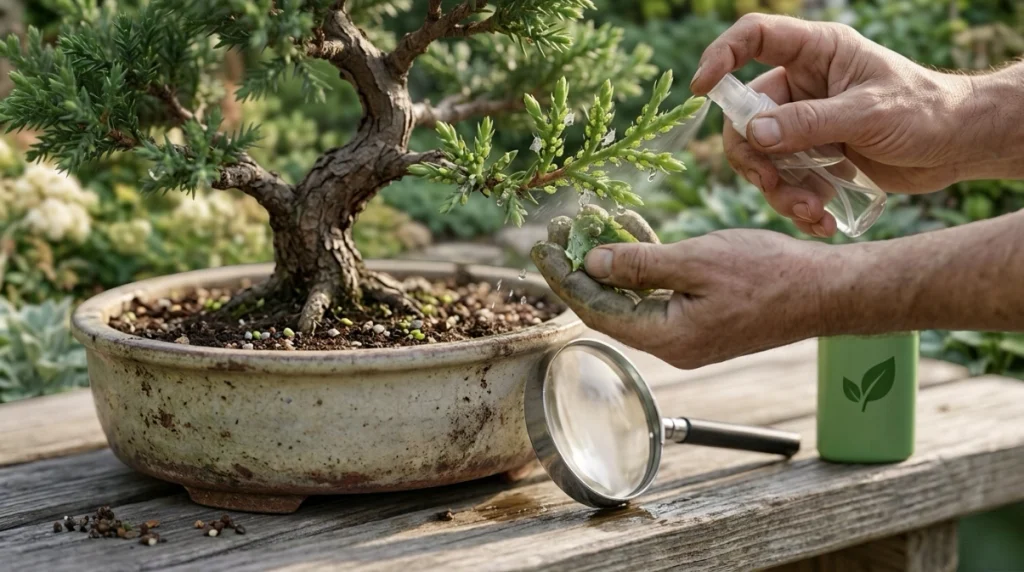
Start with physical removal and escalate only when necessary. This approach limits unnecessary chemical exposure and makes it easier to judge whether the infestation is declining.
1. Isolate the affected bonsai
Move the bonsai away from other trees and houseplants when practical. Keep its light, temperature, and watering conditions suitable while it is isolated.
Don’t place an outdoor species indoors for weeks simply because it has aphids. Quarantine should reduce pest spread without creating a new horticultural problem.
2. Remove visible aphids with water
A controlled stream of water can knock aphids from sturdy foliage. Support delicate branches and avoid blasting fine twigs, flowers, or freshly wired shoots.
UC IPM recommends water removal as a useful nonchemical approach on sturdy plants.
3. Reinspect the entire canopy
Check the tree again after physical removal. Pay special attention to curled leaves because hidden aphids may remain protected inside them.
- Inspect both sides of leaves.
- Check developing buds.
- Look along young stems.
- Examine branch junctions.
- Check nearby plants for similar insects.
4. Use insecticidal soap when needed
Commercial insecticidal soap can control soft-bodied insects when the spray contacts them. Use only a product labeled for the plant and pest situation.
Coverage matters because these treatments work primarily through direct contact. Follow the product directions rather than creating a stronger homemade mixture.
I avoid substituting ordinary dish detergent for a formulated insecticidal soap. Household detergents vary in ingredients and may injure sensitive foliage.
5. Consider horticultural or neem oil carefully
Horticultural oils can also suppress aphids when the insects receive thorough coverage. Some products contain petroleum-derived oils, while others use plant-derived oils such as neem.
The UC IPM guide to less-toxic insecticides lists pesticidal soaps and insecticidal oils among lower-impact options for soft-bodied insects.
Do not spray a drought-stressed bonsai. Avoid treating during extreme heat, and always follow the label’s restrictions for plant sensitivity and application conditions.
6. Repeat inspection instead of assuming one treatment worked
Contact treatments affect insects reached during application. Aphids hidden inside curled foliage or missed during spraying can survive.
Recheck the bonsai every few days during an active infestation. Follow the product label if another application becomes necessary.
Section Takeaway: Remove aphids physically first when practical. If treatment is needed, use a labeled insecticidal soap or horticultural oil correctly and keep monitoring afterward.
How Do You Prevent Aphids From Coming Back?
You cannot guarantee that aphids will never visit a bonsai. You can make outbreaks easier to detect and less likely to spread through your collection.
Inspect new growth regularly
During active growth, look at shoot tips while you water. That simple habit often catches aphids before curled leaves and honeydew become widespread.
Turn several leaves over instead of viewing the canopy only from above. Hidden colonies can otherwise grow unnoticed.
Quarantine new plants
Inspect newly acquired bonsai and companion plants before placing them beside established trees. Look for insects, honeydew, scale-like bumps, webbing, and distorted growth.
A short period of separation also gives hidden pests time to reveal themselves. Keep the plant under conditions appropriate for its species while monitoring.
Avoid excessive fertilizer
Feed for healthy, controlled development rather than maximum speed. Excessive nitrogen can produce lush shoots that attract sap-feeding pests.
Fertilizer needs vary with species, season, soil, health, and development stage. Follow an appropriate bonsai feeding plan instead of increasing fertilizer whenever growth slows.
Protect beneficial insects outdoors
Lady beetles, lacewing larvae, hoverfly larvae, and parasitic wasps can feed on or parasitize aphids. Broad-spectrum insecticides may kill these beneficial insects along with pests.
When an outdoor bonsai has only a small aphid population, natural enemies may help suppress it. That is another reason I avoid automatic spraying.
Control ant access where appropriate
Ants often collect aphid honeydew. In some situations, they also interfere with predators that would otherwise feed on the aphid colony.
Follow ant trails before treating anything. Their destination may reveal an aphid colony hidden inside dense foliage.
Section Takeaway: Prevention is mainly inspection, quarantine, balanced growth, and restrained pesticide use. Catching the first colony is much easier than controlling aphids across an entire collection.
Frequently Asked Questions
Why are there aphids on my bonsai leaves?
Aphids are attracted to tender plant tissue such as new leaves, shoots, and buds. Winged adults may arrive from nearby plants, while infestations can also enter a collection on newly purchased plants.
What do aphids look like on a bonsai?
Aphids are small, soft-bodied insects that often look pear-shaped. They may be green, black, yellow, gray, brown, or reddish and commonly gather in groups around new shoots or leaf undersides.
Will soapy water kill aphids on bonsai?
A commercial insecticidal soap labeled for the plant and pest can control aphids through direct contact. Avoid assuming household dish detergent is equivalent because formulations vary and may damage sensitive bonsai foliage.
Can neem oil get rid of aphids on bonsai?
Neem-based horticultural oils can suppress aphids when a product is labeled for that use and thoroughly covers the pests. Never guess the concentration, and avoid applying oil to stressed plants or under unsuitable temperature conditions.
Do aphids cause sticky bonsai leaves?
Yes. Aphids produce sugary honeydew while feeding, which can leave leaves and nearby surfaces sticky. However, soft scale, whiteflies, and mealybugs also produce honeydew, so sticky foliage alone doesn’t confirm aphids.
Should I remove leaves damaged by aphids?
You don’t need to remove every marked leaf. Severely curled foliage may shelter aphids, but unnecessary defoliation can add stress. Remove tissue only when it is badly damaged or pest management requires it.
Pro tip: Before cutting significant live growth from a valuable or weak bonsai, consider asking an experienced grower or local bonsai club for guidance. Irreversible pruning should serve the tree’s health or design, not just remove cosmetic damage.
How long does it take to get rid of aphids on bonsai?
Light infestations may decline quickly after physical removal. Established colonies can require repeated inspections and label-directed treatment because hidden aphids or newly emerging individuals may remain after the first control attempt.
Final Takeaway: Treat the Aphids, Not Just the Symptoms
Aphids on bonsai leaves are easiest to manage when you identify them early. Look for colonies on tender growth, curled leaves, honeydew, pale shed skins, and repeated ant activity.
Start with isolation, careful inspection, and physical removal. Move to a labeled insecticidal soap or horticultural oil only when the infestation requires it.
Your best long-term defense is regular observation. Check new shoots whenever your bonsai enters a strong growth period, and a small aphid problem is far less likely to become a serious one.
