Best Soil for Boxwood Bonsai: Recipe and Ratios

This post contains affiliate links. As an Amazon Associate, OurBonsai earns from qualifying purchases at no extra cost to you. Read our disclosure.
In this guide
- What boxwood roots need
- Best soil for boxwood bonsai: 3 recipes
- What each ingredient does
- Particle size and sifting
- Soil pH for boxwood bonsai
- When and how to repot a boxwood bonsai
- How soil affects watering boxwood
- Soil and winter care
- Common soil mistakes with boxwood
- FAQ: best soil for boxwood bonsai
- Final thoughts
The best soil for boxwood bonsai is a gritty, fast-draining mix with a near-neutral pH, such as equal parts akadama, pumice and lava rock, sifted to remove dust. Boxwood (Buxus) has fine, shallow roots that need plenty of air and rot easily in wet, compact soil. Unlike azaleas and some other popular bonsai, it does not want acidic soil. It grows best close to neutral, around pH 6.5 to 7.2.
Boxwood is a tough evergreen shrub with small, glossy leaves, popular for bonsai because it tolerates hard pruning and develops dense foliage. The species most used are Japanese and Korean boxwood (Buxus microphylla), common boxwood (Buxus sempervirens) and the subtropical Harland boxwood (Buxus harlandii), often sold as an indoor bonsai. This guide gives simple soil recipes for each situation and explains how to repot.
What boxwood roots need
Boxwood roots are dense and fibrous, staying near the surface. In a bonsai pot, they need:
- Free drainage. Boxwood is very prone to root rot, including Phytophthora, in waterlogged soil.
- Air. The fine roots need oxygen to grow and absorb nutrients.
- Moderate moisture. It likes soil that stays slightly damp, not dry and not soggy.
- Near-neutral pH. Very acidic soil can lead to poor nutrient uptake.
The Clemson University boxwood fact sheet stresses good drainage as the single most important factor for healthy boxwood in the garden, and it matters even more in a small pot.
Best soil for boxwood bonsai: 3 recipes
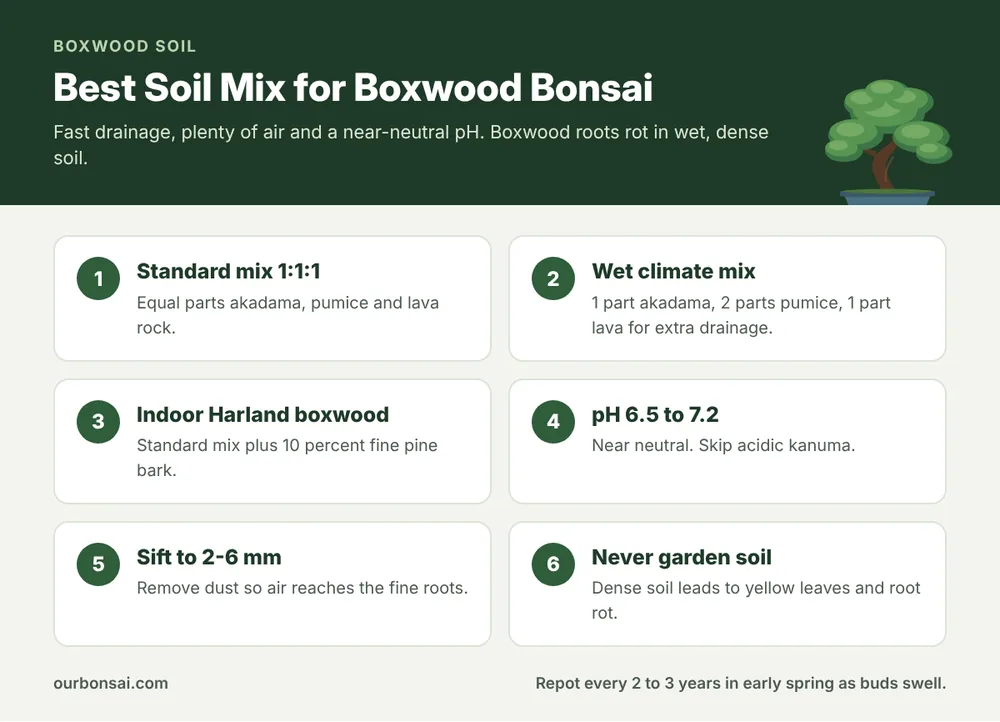
Standard mix
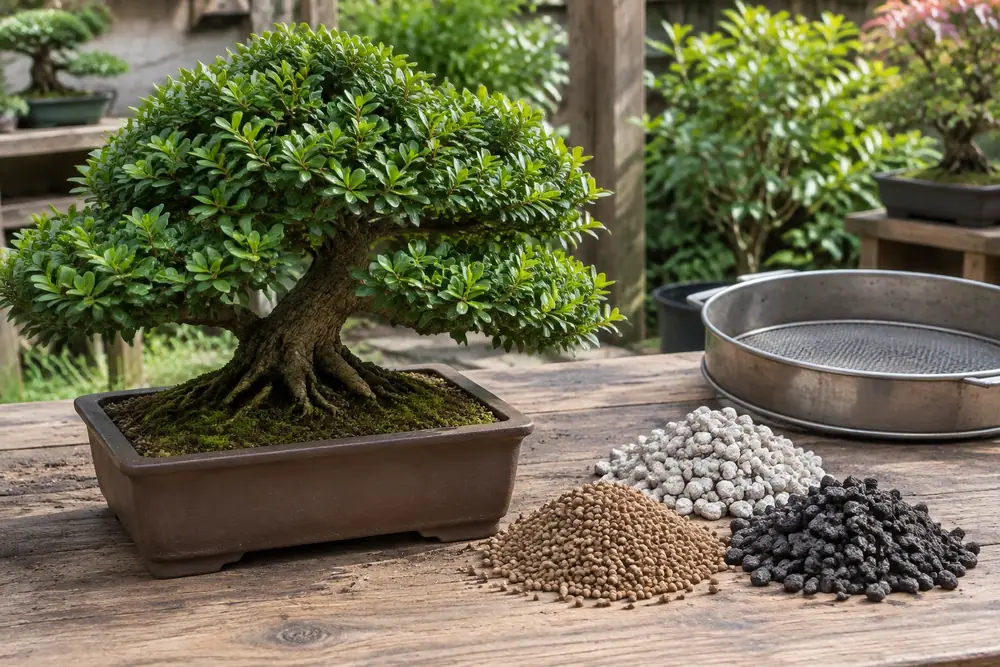
- 1 part akadama
- 1 part pumice
- 1 part lava rock
A balanced, open mix that drains quickly while holding enough moisture. It suits outdoor Japanese, Korean and common boxwood in most climates.
Wet or cool climate mix
- 1 part akadama
- 2 parts pumice
- 1 part lava rock
If your weather is rainy for long periods, extra pumice keeps the mix airy and helps prevent root rot.
Indoor Harland boxwood mix
- 1 part akadama
- 1 part pumice
- 1 part lava rock
- About 10 percent fine composted pine bark
Indoors, especially near heating, the soil surface can dry fast while the inside stays damp. A little bark evens out moisture. Keep it to a small amount, because too much organic matter holds water around the roots.
What each ingredient does
| Ingredient | Role | Notes for boxwood |
|---|---|---|
| Akadama | Holds water and nutrients, soft for fine roots | Breaks down after 2 to 3 years |
| Pumice | Air pockets, holds water inside its pores | Light, keeps the mix open |
| Lava rock | Open structure, fast drainage | Encourages fine branching roots |
| Pine bark (optional) | Extra moisture retention | Small amounts only |
| Kanuma | Very acidic | Avoid for boxwood |
If you prefer ready-made soil, our reviews of premium bonsai soil and Heron’s bonsai soil mix cover two well-draining options. Our bonsai soil mix ratio guide explains how to adjust any recipe. A pre-mixed akadama, pumice and lava bonsai soil saves time if you only have one or two trees.
Particle size and sifting
Use particles of about 2 to 6 mm. Smaller particles (2 to 4 mm) suit small trees in shallow pots, while larger ones (4 to 6 mm) suit bigger trees. Always sift out the dust. Fine particles fill the gaps in the mix and turn it into a dense, wet mass, which is exactly what boxwood roots cannot handle.
Soil pH for boxwood bonsai
Boxwood prefers soil close to neutral, about pH 6.5 to 7.2. A standard akadama, pumice and lava mix is slightly acidic to neutral and works well. You do not need to add lime in most cases. Avoid kanuma and peat-heavy mixes, which are acidic. If your tap water is very soft and slightly acidic and your boxwood shows pale growth over several years, a light dusting of garden lime on the soil surface once a year is sometimes used by growers, but test before you adjust.
When and how to repot a boxwood bonsai
Repot young boxwood every two years and older trees every three to five years, in early spring as the buds begin to swell. Boxwood has a dense root mass and tolerates root pruning well.
- Water the tree the day before.
- Remove it from the pot and comb out the old soil from the outside and bottom of the root ball.
- Trim long and thick roots, removing up to about a third of the root mass on healthy trees.
- Check for rot: healthy roots are light colored and firm. Cut away dark, mushy sections.
- Add a thin drainage layer of larger particles, then fresh mix.
- Position the tree, tie it in with wire through the drainage holes, and work the soil into the roots with a chopstick.
- Water thoroughly and keep the tree sheltered from strong sun and wind for two to three weeks.
Our guide to the best bonsai repotting tools covers the basics you need.
How soil affects watering boxwood
The right soil makes boxwood much easier to water. In a gritty mix, you can water thoroughly every time without worrying about drowning the roots, because excess water drains out within seconds. Check the soil daily and water when the top centimeter is just dry. In summer outdoors that may be daily, in spring and autumn every two to three days, and in winter much less.
In dense soil the opposite happens. The surface dries and looks thirsty, but the middle of the root ball is still wet. You water again, the center never dries, and the roots slowly rot. This is the most common way boxwood bonsai are lost, and it is almost always a soil problem rather than a watering problem. Switching to a proper bonsai mix at the next repotting usually solves it.
Soil and winter care
Outdoor boxwood stays outside in winter. Wet soil that freezes and thaws repeatedly can damage roots, so a free-draining mix is especially important in cold, wet winters. Place the pot on the ground in a sheltered spot or mulch around it. Harland boxwood is less hardy and should be kept above about 40 to 50 °F (5 to 10 °C), usually indoors.
Common soil mistakes with boxwood
- Using garden or potting soil. It stays wet and causes root rot.
- Using acidic azalea mixes. Boxwood prefers near-neutral soil.
- Not sifting. Dust clogs the mix.
- Repotting into a much bigger pot. Extra soil stays wet longer.
- Never repotting. Akadama breaks down and roots fill the pot, blocking drainage.
If your boxwood already has yellow leaves and wet soil, see our guide to bonsai leaves turning yellow or brown and our article on root rot in bonsai.
FAQ: best soil for boxwood bonsai
Can I use regular potting soil for a boxwood bonsai?
It is not recommended. Potting soil holds too much water in a bonsai pot, and boxwood roots rot easily.
Does boxwood need acidic soil?
No. Boxwood prefers near-neutral soil, around pH 6.5 to 7.2. Avoid kanuma and peat-heavy mixes.
How often should I repot a boxwood bonsai?
Every two years for young trees and every three to five years for older ones, in early spring.
What is the best soil for an indoor Harland boxwood?
A standard akadama, pumice and lava mix with a small amount of fine bark to even out moisture indoors.
Final thoughts
The best soil for boxwood bonsai is a sifted, gritty, near-neutral mix of akadama, pumice and lava rock, adjusted to be more open in wet climates or slightly more moisture-retentive indoors. Combined with careful watering and regular repotting, it keeps boxwood roots healthy and the foliage dense and dark green. For styling ideas, see our boxwood bonsai styles guide.