How to Prune Japanese Maple Bonsai: Step-by-Step Guide

This post contains affiliate links. As an Amazon Associate, OurBonsai earns from qualifying purchases at no extra cost to you. Read our disclosure.
In this guide
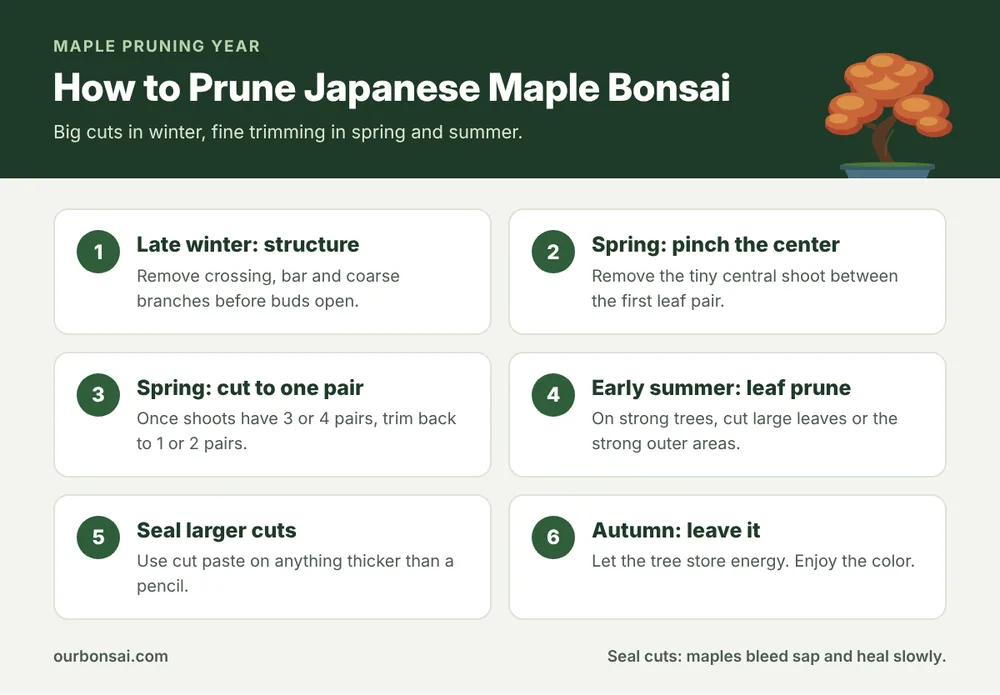
Learning how to prune japanese maple bonsai is mostly about timing. Japanese maples (Acer palmatum) are pruned in two distinct ways: structural pruning in late winter, when the tree is bare and you can see every branch, and fine trimming in spring and summer to keep new growth short and the branching dense. Maples grow in opposite pairs of leaves and buds, which makes them easy to shape once you understand the pattern, but their cuts bleed sap and heal slowly, so larger wounds need sealing.
This guide covers the yearly pruning cycle step by step, the tools you need, how to handle the tricky strong apex, and the mistakes to avoid.
How Japanese maples grow
Maple shoots grow in pairs: two leaves opposite each other at each node, with a bud in each leaf axil. A new spring shoot pushes out a first pair of leaves, then extends to a second, third and fourth pair with longer gaps (internodes) between them. For bonsai, you want short internodes and many fine branches, so you stop shoots early and let buds at the base develop.
Japanese maples also tend to be strongest at the top and outer tips (apical dominance). Left alone, the top grows thick and coarse while the lower branches weaken. Good pruning shifts energy back down the tree. The Wikipedia article on apical dominance explains why the top of a tree grows strongest.
The yearly pruning cycle
| Time | Task |
|---|---|
| Late winter | Structural pruning and wiring of the bare tree |
| Early spring | Leave buds alone as they open |
| Mid to late spring | Pinch central shoots, trim back to 1 or 2 pairs |
| Early summer | Partial leaf pruning on strong trees |
| Summer | Trim second flush shoots, remove misplaced growth |
| Autumn | No pruning. Let the tree store energy |
Our guide to when to prune deciduous bonsai covers the general deciduous calendar that maples follow.
How to prune Japanese maple bonsai step by step
Step 1: Late winter structural pruning
Before the buds start to swell, look at the bare tree from the front and remove:
- Branches that cross or rub.
- Bar branches, two branches at the same height on opposite sides. Keep one.
- Shoots growing straight up or down from branches.
- Thick, coarse branches near the top. Cut them back to a smaller side shoot to improve taper.
- Long, straight sections with no side branches; cut back to a pair of buds.
Always cut just above a pair of buds, or flush with a concave cutter when removing a branch at the trunk. Our concave cutter review explains why concave cuts heal better.
Step 2: Seal the cuts
Japanese maples bleed sap in late winter and spring, and their bark heals slowly. Seal any cut larger than a pencil with cut paste. Our guide to bonsai cut paste alternatives helps if you have none, or browse bonsai cut paste.
Step 3: Spring, pinch the central shoot
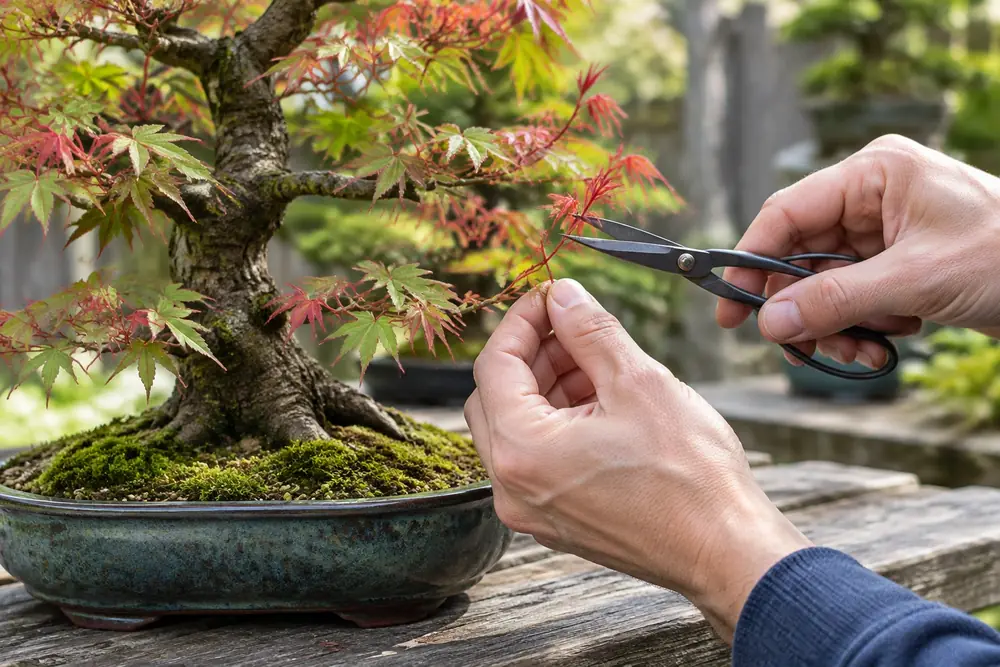
As new shoots emerge, a tiny central shoot appears between the first pair of leaves. On strong areas, carefully pinch or snip out that central shoot with fine tweezers or scissors. This stops the shoot extending and pushes energy into the buds at the base.
Step 4: Spring, trim shoots back to one or two pairs
On weaker areas, and anywhere you did not pinch, let shoots grow three or four pairs of leaves, then cut them back to the first or second pair. This keeps internodes short and builds fine ramification.
Step 5: Early summer, partial leaf pruning
On strong, healthy trees, cut off the largest leaves, or all leaves on the strong top and outer areas, once the spring leaves have hardened. This lets light into the interior, balances vigor and often produces smaller second-flush leaves. Do not fully defoliate a weak tree.
Step 6: Summer, tidy the second flush
Trim new shoots from the second flush back to one or two pairs, and remove shoots growing in the wrong direction. Stop trimming by late summer so the last growth can harden before autumn.
Pruning a young maple vs a refined one
The cycle above suits a maple whose trunk and main branches are already in place. A young maple you are still developing needs a different approach: let it grow freely for most of the season so the trunk and chosen branches thicken, and only cut back hard in late winter. Long, unpruned “sacrifice” shoots low on the trunk speed up thickening and can be removed once they have done their job. Pinching and leaf pruning slow growth down, so save them for when you want refinement rather than size.
A refined maple needs the opposite: frequent, light work through spring and early summer, very little structural cutting, and careful balancing of strong and weak areas. Most hobby trees sit somewhere in between, so adapt the intensity to what each branch needs.
Tools you need
- Fine, pointed bonsai scissors for shoots and leaves.
- Tweezers for pinching central shoots.
- A concave cutter for branches.
- Cut paste.
Our guide to the best bonsai pruning shears for beginners covers starter tools.
Balancing a strong apex
The most common Japanese maple problem is a thick, bushy top over thin, weak lower branches. To fix it:
- Prune the top harder and earlier than the lower branches.
- Pinch central shoots at the top, but let lower shoots extend more before trimming.
- Leaf prune the top in early summer and leave lower leaves on.
- Let a weak lower branch grow freely for a season to thicken.
Common Japanese maple pruning mistakes
- Big cuts in spring or autumn. Spring cuts bleed heavily; autumn cuts may die back over winter.
- Leaving cuts unsealed on larger wounds.
- Letting spring shoots run to four or five pairs before cutting, creating long internodes.
- Treating the whole tree the same, so the top keeps getting stronger.
- Full defoliation on a weak tree, or every year.
- Heavy pruning and repotting in the same spring.
FAQ: how to prune japanese maple bonsai
When is the best time to prune a Japanese maple bonsai?
Late winter for structural cuts, and spring through early summer for trimming new shoots.
Do Japanese maples bleed when pruned?
Yes, especially in late winter and spring. It does not usually harm a healthy tree, but seal larger cuts.
How do I get smaller leaves on my Japanese maple bonsai?
Keep internodes short by trimming early, feed lightly in spring, and use partial leaf pruning in early summer on strong trees.
Can I prune a Japanese maple in autumn?
Avoid it. Light tidying is fine, but larger cuts heal poorly before winter.
Final thoughts
Now you know how to prune japanese maple bonsai: make structural cuts in late winter and seal them, pinch and trim spring shoots back to one or two pairs, leaf prune strong areas in early summer, and leave the tree alone in autumn. Prune the strong top harder than the weaker lower branches, and over a few seasons your maple will develop the fine, balanced branching that makes it so beautiful. For a related species that responds even more strongly to pruning, see our Brussels trident maple bonsai review.