Bonsai Dormancy Explained: What Every Grower Should Know

Bonsai dormancy is the winter rest that maples, elms, junipers, pines, beech, larch and most other temperate trees go through every year. Growth stops in autumn, buds harden, and the tree waits out roughly 6 to 12 weeks of temperatures near 0 to 7 C (32 to 45 F) before it can grow normally again in spring. Skip that rest by keeping the tree warm indoors and it usually weakens over one or two years and then dies. Your job during dormancy is simple: keep the tree cold, keep the roots from freezing solid, and water only when the soil starts to dry.
In this guide
What actually happens inside a dormant tree
Dormancy is not one switch but a slow sequence. In late summer, shorter days tell the tree that winter is coming. Shoot growth slows, new buds form at the tips and in the leaf axils, and sugars and starches are moved down into the trunk and roots. On deciduous trees, chlorophyll breaks down, which is why trident maples turn orange and ginkgos turn yellow before the leaves fall.
Botanists split the rest into two phases. In the first, called endodormancy, the buds will not open even if you bring the tree into a warm room. They need a set amount of cold first, known as the chilling requirement. Once that cold has been counted, the tree enters ecodormancy: it is ready to grow and only waits for warm weather. That second phase is the reason a maple carried into a heated garage in February leafs out within two weeks, then struggles when it goes back outside into frost.
Which bonsai need dormancy and which do not
| Group | Examples | Needs a cold rest? | Winter spot |
|---|---|---|---|
| Hardy deciduous | Japanese maple, trident maple, Chinese elm (outdoor form), beech, hornbeam, larch, ginkgo | Yes, 6 to 12 weeks | Outside or cold frame |
| Hardy conifers | Juniper, Japanese black pine, hinoki cypress, yew | Yes, though they keep foliage | Outside with some light |
| Semi-hardy | Pomegranate, olive, bougainvillea (borderline) | Light rest, no hard frost | Cool bright room or frost-free greenhouse |
| Tropical | Ficus, Fukien tea, jade, schefflera, Brazilian rain tree | No | Indoors, above 12 C (54 F) |
If you are not sure which group your tree belongs to, look up its native range. A tree from Japan, Korea, northern China, Europe or North America almost always needs winter cold. A tree from the tropics or South Africa does not. Our list of deciduous bonsai tree types and the guide to tropical bonsai species cover the common ones.
How to manage bonsai dormancy, month by month
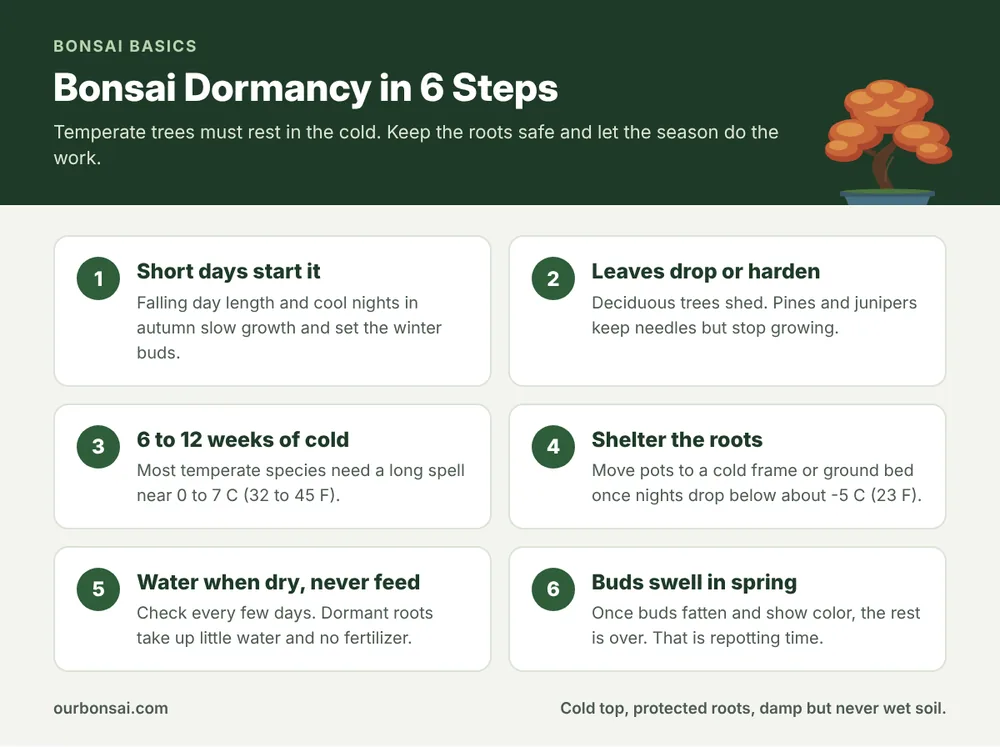
Autumn (September to November). Stop high-nitrogen feeding by late summer. Switch to a low-nitrogen feed or none at all once the leaves start to color. Let the tree feel the first light frosts; a couple of nights at -1 or -2 C (28 to 30 F) help harden it.
Early winter (December). When forecasts show nights below about -5 C (23 F), shelter the pots. The branches can handle far colder air, but roots in a shallow pot cannot. A cold frame, an unheated garage with a window, or burying the pot to its rim in a garden bed all work. Our guide to outdoor bonsai trees lists hardiness for the common species.
Mid winter (January). Very little to do. Check soil moisture every few days, look for mice chewing bark in sheds, and keep conifers where they get some daylight.
Late winter (February to March). Watch the buds. When they swell and begin to show green or red at the tips, the tree is waking. That window, often only two or three weeks long, is the best time to repot most deciduous species.
Watering a dormant tree
A leafless maple loses very little water, so a pot that needed water daily in July may stay damp for 10 days in January. Overwatering in winter is a common route to root rot in bonsai, because cold, wet soil starves roots of oxygen at the same time fungi stay active.
Push a chopstick 3 cm into the soil. If it comes out dark and damp, leave it. If it is dry and pale, water in the morning on a day above freezing until water runs from the holes. Evergreens in a sunny cold frame are the exception: on bright days they lose more water than you would guess, so check them more often.
How to tell a dormant bonsai from a dead one
New growers panic in January because a dormant tree and a dead tree can look identical at a glance. Three quick tests help:
- Scratch test. Gently scrape a small patch of bark on a thin twig with a fingernail. Green or creamy white tissue underneath means alive. Brown and dry means that twig is dead; test lower down before deciding the whole tree is lost.
- Bend test. Living twigs flex. Dead ones snap with a dry crack.
- Bud check. Healthy buds are plump and firm. Shriveled, hollow or easily crushed buds are a bad sign.
Conifers are harder to read. A dormant juniper may turn bronze or purple in hard cold, which is normal for some varieties. Needles that are brittle, gray and fall at a touch are not.
Mistakes that break dormancy
- Bringing a hardy tree indoors for winter. The warm room confuses the tree. It may push weak, pale shoots or simply decline. A juniper sold as an “indoor bonsai” is the classic case.
- Feeding in winter. Roots cannot use nitrogen when they are cold. The salts build up and can burn fine roots.
- Leaving pots exposed on a wall or balcony. Small pots freeze through in one hard night, and frozen roots cannot replace water lost from evergreen foliage.
- Wintering in total darkness for months. Leafless deciduous trees cope with a dark shed for a while, but pines and junipers need light.
- Moving a tree in and out repeatedly. Each warm spell can partly wake the tree, and the next frost damages soft tissue.
If you live in a mild climate where winter rarely drops below 5 C, temperate species such as Japanese maple may not get enough chilling. Growers in warm areas often choose subtropical species instead, or use a refrigerator for small trees, which is a specialist method best left until you have experience.
Frequently asked questions
How long does bonsai dormancy last?
For most temperate species, the deepest phase lasts about 6 to 12 weeks of cold, and the tree stays inactive until spring warmth arrives. In practice that means roughly November to March in much of the United States and Europe.
Can I keep a dormant bonsai in a garage?
Yes, if the garage is unheated and stays between about -5 and 5 C (23 to 41 F). Deciduous trees without leaves need little light. Conifers need a window or should go back outside on mild days.
Do indoor bonsai go dormant?
Tropical species like ficus and jade do not have a true dormancy. They slow down in low winter light, which can look similar, but they still need warmth and steady care. See our guide to watering indoor bonsai in winter for that side.
What if my bonsai never lost its leaves?
Some deciduous trees, especially beech and some hornbeams, keep dead brown leaves until spring. This is called marcescence and is normal. A Japanese maple kept indoors that stays green all winter, on the other hand, is not resting and needs to go outside.
Final thoughts
Dormancy feels like doing nothing, and that is mostly the point. Give hardy trees real cold, shelter the roots once nights get hard, keep the soil just damp, and leave the fertilizer on the shelf until the buds move. For the year-round basics, our bonsai care guide is the place to start. More background on the plant science sits in the Wikipedia entry on plant dormancy.