Why Are My Bonsai Leaves Turning Red?

Seeing red leaves on a bonsai can be surprising, especially when you expect healthy foliage to stay green. If you are asking, “Why are my bonsai leaves turning red?”, the answer depends heavily on the species, season, and other symptoms appearing at the same time.
Red, purple, bronze, or reddish-brown foliage can be completely normal in some bonsai, particularly during autumn or when new leaves naturally develop their seasonal color. In other cases, however, red leaves can signal heat stress, watering problems, root trouble, nutrient issues, pests, or disease.
The important point is not to treat the red color by itself. Look at when the color appeared, which leaves are affected, and whether the tree is showing other warning signs.
This guide explains the most common causes, how pests can contribute, what you should check first, and when your bonsai needs more serious attention.
Quick Answer
Why are my bonsai leaves turning red? Red leaves can result from normal seasonal color changes, natural pigmentation, heat or drought stress, root problems, nutrient issues, pests, or disease. Check the bonsai species, season, soil moisture, leaf pattern, and underside of the foliage before changing its care routine or applying treatment.
Is Red Foliage Normal for a Bonsai?
Before assuming something is wrong, identify your bonsai species.
Some deciduous bonsai naturally develop red, orange, yellow, bronze, or purple foliage as temperatures and daylight change. Japanese maple is a familiar example, but other species can also produce seasonal color.
Young leaves can also appear reddish when they first emerge. In many plants, pigments temporarily protect developing foliage from strong light and environmental stress. As the leaves mature, they may gradually become greener.
If the tree is otherwise healthy, producing normal new growth, and the red color matches its usual seasonal pattern, treatment may not be necessary.
The situation is different when red leaves appear unexpectedly during active growth.
For example, pay closer attention if:
- Green leaves suddenly become red or bronze during warm weather.
- Only one section of the canopy changes color.
- Red leaves are curling, wilting, or becoming crispy.
- Leaves have tiny spots, stippling, or holes.
- Fine webbing appears between leaves or branches.
- The soil remains wet for unusually long periods.
- Leaves are dropping much earlier than expected.
- New growth is weak or distorted.
- Branches are beginning to die back.
Early or unusual color changes can sometimes be a response to environmental stress. Extension guidance on trees notes that drought, excessive moisture, nutrient problems, and root stress can cause premature changes in foliage color.
7 Common Reasons Bonsai Leaves Turn Red
1. Natural Seasonal Color Change
For deciduous bonsai, seasonal color is often the simplest explanation.
As autumn approaches, chlorophyll production decreases. Chlorophyll is the green pigment responsible for much of the normal green appearance of leaves. As green pigmentation fades, other pigments become more visible.
Depending on the species and conditions, foliage may turn:
- Red
- Orange
- Yellow
- Purple
- Bronze
- Brown before falling
This is generally normal when it occurs at the expected time of year.
Do not fertilize aggressively simply because autumn foliage is changing color. Seasonal color is not automatically a sign of nutrient deficiency.
2. Heat or Drought Stress
A bonsai has a very small amount of soil compared with a full-sized landscape tree. That means its roots can lose access to usable moisture much faster.
Hot weather, dry wind, strong afternoon sun, or missed watering can cause the foliage to react quickly.
You may notice:
- Red or bronze coloration
- Curling leaves
- Crispy edges
- Wilting
- Premature leaf drop
- Slower growth
Heat stress can happen even when you watered the tree recently. If the root ball dried severely, water may run around the edges of the soil rather than soaking the entire root zone.
Check the soil before watering again. Do not follow a rigid calendar if the tree’s moisture needs have changed because of weather.
3. Overwatering and Root Stress
Overwatering is one of the most common bonsai-care mistakes.
It does not simply mean giving too much water at one time. The bigger problem is keeping the root zone continuously saturated.
Roots need both moisture and oxygen. If the bonsai soil stays waterlogged, roots can become stressed or damaged, reducing their ability to supply the canopy.
The foliage may respond with:
- Yellowing or reddening
- Wilting despite wet soil
- Premature leaf drop
- Weak new growth
- Brown or black roots
- A stagnant or unpleasant smell from the soil
A wilted bonsai does not always need more water. If the soil is already saturated, adding more can make the underlying problem worse.
4. Nutrient Imbalance
Nutrition can influence leaf color, but diagnosing a deficiency from red foliage alone is unreliable.
Nitrogen deficiency commonly produces pale or yellow foliage and weak growth. Phosphorus deficiency can be associated with purple or reddish coloration in some plants, but symptoms vary with species, growing conditions, and soil chemistry. Penn State Extension notes that phosphorus deficiency can produce purple coloring, particularly on lower leaves, but diagnosis should consider the broader plant condition.
Before adding a strong fertilizer, ask:
- Is the bonsai growing actively?
- When was it last fertilized?
- Is the fertilizer appropriate for the species?
- Is the soil draining properly?
- Are the roots healthy?
- Is the red coloration appearing on old or new leaves?
Avoid treating a suspected deficiency with excessive fertilizer. More fertilizer does not necessarily correct the problem faster and can damage roots if applied improperly.
5. Too Much Sun or Sudden Light Exposure
A bonsai moved suddenly from shade or indoor conditions into strong direct sunlight can experience leaf stress.
This is particularly important when a tree is moved outdoors, placed near a hot window, or exposed to intense afternoon sun after spending time in lower light.
Possible symptoms include:
- Reddish or bronze leaves
- Bleached patches
- Brown leaf margins
- Curling
- Crispy foliage
- Premature leaf drop
The solution is not always to move the bonsai into deep shade.
Instead, consider the species’ natural light requirements and make major light changes gradually when practical.
6. Pests Feeding on the Leaves
Pests are an important possibility when red or bronze foliage appears together with visible leaf damage.
Common bonsai pests include:
- Spider mites
- Aphids
- Scale insects
- Thrips
- Caterpillars
- Whiteflies, depending on the growing environment
Spider mites are particularly worth checking during hot, dry conditions. They are extremely small and may be difficult to see without magnification. Typical clues include fine webbing and tiny pale or yellow speckles across the leaves. Severe infestations can cause bronzing and leaf drop.
Aphids can cause curled or distorted foliage and weak growth, especially when populations become large.
Scale insects may appear as small bumps attached to stems or leaves. Some types produce honeydew, a sticky substance that can attract other insects and encourage sooty mold.
7. Disease or Leaf Damage
Fungal and other plant diseases can sometimes cause red, purple, brown, or reddish-brown areas on leaves.
The pattern matters.
A few red leaves without spots or decline may be normal. Red leaves covered with distinct lesions, surrounded by yellow tissue, or accompanied by premature leaf drop deserve closer inspection.
For example, some fungal diseases can cause reddish discoloration or leaf spots, while powdery mildew can sometimes be associated with reddened foliage.
Do not automatically assume every red leaf is a fungal infection. Treating the wrong problem can waste money and place unnecessary stress on the tree.
How to Tell Whether Red Leaves Are a Problem
Use the following checklist before changing your bonsai’s care.
| What you notice | Possible cause | What to check first |
|---|---|---|
| Red leaves during autumn | Natural seasonal change | Species and normal seasonal behavior |
| Red new leaves that later become green | Normal new growth | Leaf age and species |
| Red leaves with crispy edges | Heat or drought stress | Soil moisture and recent weather |
| Red/bronze leaves with webbing | Spider mites | Leaf undersides and branches |
| Red leaves with curling and insects | Aphids or other pests | New shoots and leaf undersides |
| Red leaves with spots or lesions | Disease or leaf damage | Spot pattern and spread |
| Red leaves plus wet soil and poor growth | Root stress | Drainage and root condition |
| Red foliage with weak growth | Nutritional or root problem | Fertilizer history and root health |
How to Check Your Bonsai for Pests
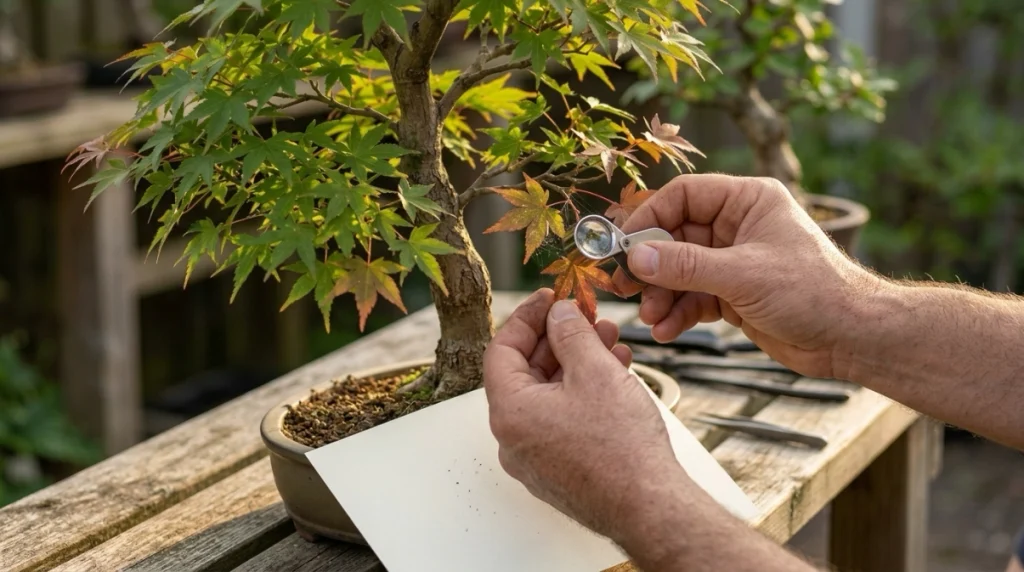
If the red color appeared suddenly, inspect the entire tree before reaching for pesticides.
Step 1: Examine the New Growth
Look closely at young leaves and shoot tips.
Aphids often gather around soft new growth. Distorted leaves, sticky residue, or clusters of tiny insects can be clues.
Step 2: Inspect the Undersides of Leaves
Many pests hide where they are harder to see.
Use a small hand lens if possible. Look for:
- Tiny moving insects
- Eggs
- Fine webbing
- Speckled feeding damage
- Scale-like bumps
- Sticky residue
Step 3: Check the Branches
Scale insects may be easier to spot on twigs than on foliage.
Look for small brown, gray, white, or shell-like structures attached to the bark.
Step 4: Shake a Branch Over White Paper
For very small pests such as spider mites, gently shake an affected branch over a piece of white paper.
Tiny moving dots may become easier to see against the white background. Extension guidance also recommends using a hand lens and white paper when checking for spider mites.
Step 5: Compare Healthy and Affected Leaves
Healthy leaves provide an important reference.
If only certain leaves show stippling, curling, spots, or webbing, compare them with unaffected foliage. This can help distinguish a pest problem from normal seasonal coloration.
What to Do if Pests Are Found
The correct treatment depends on the pest and the bonsai species.
For a minor infestation, start with low-risk measures when appropriate:
- Isolate an affected indoor bonsai from other plants.
- Remove heavily damaged leaves when appropriate.
- Rinse foliage with a gentle stream of water.
- Improve airflow around crowded foliage.
- Monitor the tree frequently.
- Identify the pest before selecting a treatment.
For example, spider mites may become more troublesome during hot, dry conditions, and rinsing foliage can help physically remove them.
If an insecticidal soap, horticultural oil, or other pesticide is necessary, read the product label carefully and confirm that the product is suitable for the plant and pest. Never assume that a stronger concentration will work better.
Do not spray a severely moisture-stressed bonsai. Extension guidance specifically warns against applying pesticides to moisture-stressed plants.
What to Do When Red Leaves Are Caused by Stress
If you cannot find pests, focus on the tree’s growing conditions.
Check the Soil
Insert a finger or appropriate moisture-checking method into the soil where practical.
The goal is not to keep the bonsai permanently wet. You want a healthy balance between moisture and drainage appropriate for the species and soil mix.
Check Drainage
Water should be able to pass through the bonsai pot.
If water pools on the surface for a long time or drainage holes are blocked, investigate the problem.
Do not immediately repot a stressed bonsai simply because its leaves changed color. Repotting is itself a major root disturbance and should be timed according to species, season, tree health, and root condition.
Review Recent Environmental Changes
Think about what changed during the previous few weeks.
Examples include:
- Moving indoors or outdoors
- Changing the tree’s position
- A heat wave
- Several days of heavy rain
- Missing watering
- A major pruning session
- Repotting
- Heavy fertilization
- Applying pesticides
- Sudden exposure to stronger sunlight
This history can be more useful than the leaf color alone.
When Should You Repot a Bonsai With Red Leaves?
Red leaves by themselves are not a reason to repot.
Repotting may be appropriate when the tree has a genuine root-zone problem, such as severely degraded soil, poor drainage, or roots that have filled the container. But timing matters.
A bonsai that is already severely stressed may recover better after its immediate environmental problem is corrected rather than being subjected to additional root disturbance.
Before repotting, consider:
- Species
- Current season
- Root health
- Soil condition
- Tree vigor
- Recent pruning or wiring
- Whether drainage is actually failing
For beginners, it is usually safer to solve one clearly identified problem at a time rather than performing several major interventions simultaneously.
Expert Tip
Expert Tip: When bonsai leaves suddenly turn red, inspect the leaves and soil before adding fertilizer or pesticide. The pattern of the symptoms often tells you more than the color itself.
Should You Remove Red Bonsai Leaves?
Usually, no—not immediately.
If red foliage is part of the tree’s normal seasonal cycle, removing it provides little benefit.
If a leaf is severely damaged, diseased, or covered with pests, selective removal may help in some situations. However, do not strip large amounts of foliage simply because it looks unattractive.
Leaves are still contributing to the tree’s energy production while they remain functional.
If the bonsai is already weak, excessive defoliation or pruning can make recovery harder.
Common Mistakes Bonsai Owners Should Avoid
- Do not assume every red leaf means disease. Species and season matter.
- Do not water automatically when leaves wilt. Check the soil first.
- Do not fertilize heavily to correct an unknown problem.
- Do not spray pesticide without identifying the pest when possible.
- Do not move a bonsai abruptly from low light into intense sun.
- Do not repot a severely stressed tree without a clear reason.
- Do not ignore the underside of leaves when checking for pests.
- Do not prune heavily while the tree is already struggling.
- Do not use household insecticides or garden chemicals unless the label permits their intended use.
- Do not treat red foliage alone. Look for accompanying symptoms.
When to Ask an Experienced Bonsai Grower or Arborist
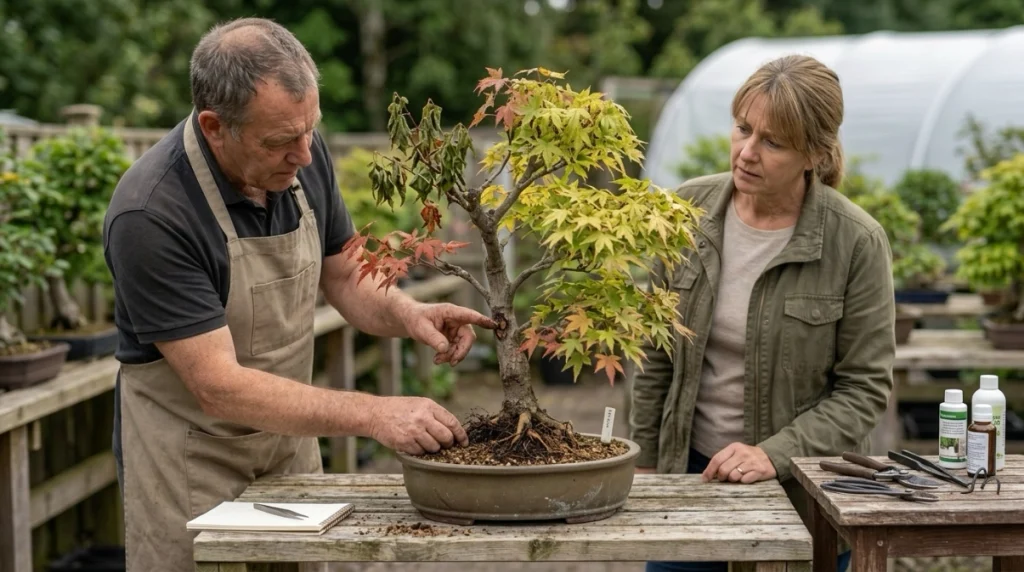
Most minor bonsai problems can be investigated at home, but some situations deserve expert assessment.
Ask an experienced bonsai grower or qualified arborist for help when:
- Multiple branches suddenly wilt or die.
- The entire canopy changes color unexpectedly.
- The trunk or major branches show unusual lesions or decay.
- Roots are badly damaged.
- The bonsai continues declining despite corrected watering and light.
- You suspect a serious disease.
- You are unsure whether major root pruning is appropriate.
- The tree is valuable, old, or especially difficult to replace.
- You need major structural pruning on a weakened tree.
An experienced bonsai grower can also help distinguish normal species behavior from symptoms that are unusual for that particular tree.
Do not perform aggressive root work, heavy structural pruning, or repeated chemical treatments simply because the leaves changed color. When the diagnosis is uncertain, protecting the tree from additional stress is often the smarter choice.
Frequently Asked Questions
Why are my bonsai leaves turning red but not falling off?
The red color may be a normal seasonal or species-specific response. It can also result from environmental stress. Check the season, species, watering, light exposure, and whether the leaves have spots, webbing, or other damage.
Can overwatering cause bonsai leaves to turn red?
It can contribute to abnormal foliage color when prolonged wetness stresses the roots. Other signs may include poor growth, wilting despite wet soil, yellowing, leaf drop, and poor drainage.
Can spider mites make bonsai leaves turn red?
Yes. Heavy spider mite feeding can cause foliage to become bronze or discolored and may eventually lead to leaf drop. Look for fine webbing and tiny speckles, particularly on the undersides of leaves.
Should I fertilize my bonsai when its leaves turn red?
Not unless you have a reasonable basis for suspecting a nutrient problem. Red coloration alone is not enough to diagnose a deficiency. Check the species, season, soil, growth rate, and fertilizer history first.
Why are only some bonsai leaves turning red?
Localized discoloration can result from differences in sunlight, water availability, pest activity, leaf age, or disease. If one branch or section changes while the rest of the tree remains healthy, inspect that area carefully.
Can too much sunlight cause red bonsai leaves?
Strong light can contribute to heat and leaf stress, especially after a sudden change in exposure. However, many bonsai require substantial sunlight, so do not move the tree into deep shade without considering its species and normal light requirements.
Should I remove red leaves from my bonsai?
Not automatically. If the leaves are healthy and changing color naturally, leave them alone. Remove damaged or diseased foliage only when there is a clear horticultural reason and avoid unnecessary defoliation on a stressed tree.
Conclusion
If you are wondering why your bonsai leaves are turning red, resist the temptation to treat the color before identifying the cause.
Red foliage can be completely normal, especially during seasonal changes or on species that naturally produce red new growth. But unexpected redness can also point to heat stress, drought, poor drainage, root problems, nutrient imbalance, pests, or disease.
Start with a simple inspection: identify the species, check the season, examine the leaves and undersides, inspect the soil, and review recent changes in care. Look for additional symptoms such as webbing, leaf spots, curling, wilting, premature leaf drop, or weak growth.
Most importantly, avoid making several major changes at once. A calm, methodical diagnosis is safer than immediately repotting, pruning, fertilizing, and spraying.
If the cause remains unclear or the tree is deteriorating quickly, get advice from an experienced bonsai grower or qualified arborist. With the right diagnosis, you can protect the tree’s health while keeping its foliage and overall appearance on track.
