Can Bonsai Diseases Spread Between Trees?

If one bonsai in your collection suddenly develops yellow leaves, black spots, powdery growth, dieback, or root problems, it is natural to wonder: Can bonsai diseases spread between trees? The answer is yes—some diseases and pests can move from one bonsai to another, especially when trees are kept close together and tools, water, soil, insects, or plant debris carry the problem.
However, not every unhealthy bonsai has a contagious disease. Yellowing leaves, weak growth, leaf drop, and branch dieback can also result from overwatering, underwatering, poor light, root damage, temperature stress, nutrient problems, or unsuitable soil.
Knowing the difference matters. Treating the wrong problem can waste money and may even make a stressed bonsai weaker.
This guide explains how bonsai diseases spread, which pests create similar risks, how to isolate a sick tree, how to sanitize your tools and pots, and when professional help is worth considering.
Quick Answer
Can Bonsai Diseases Spread Between Trees? Yes. Some fungal, bacterial, viral, and pest-related problems can spread between bonsai through contaminated pruning tools, soil, water, insects, plant debris, or close contact. The risk is higher when trees share tools or growing materials. Isolating affected trees and practicing good sanitation can greatly reduce transmission.
How Bonsai Diseases Spread Between Trees
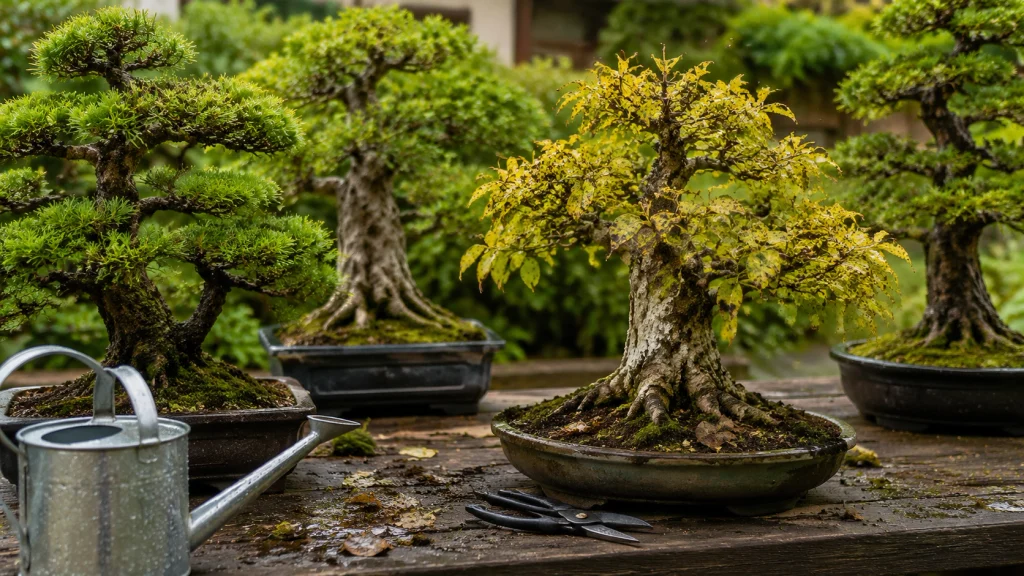
Bonsai are small trees, but they are still vulnerable to many of the same plant pathogens that affect larger landscape trees and nursery plants.
A pathogen is a disease-causing organism. Depending on the problem, it may be a fungus, bacterium, virus, or another organism. Some pathogens remain in plant tissue, while others survive in soil, fallen leaves, dead wood, water, or contaminated equipment.
The way a disease spreads depends on the particular pathogen.
Common ways disease moves between bonsai
Disease can spread through:
- Pruning and cutting tools
- Contaminated soil or potting media
- Shared bonsai pots and trays
- Infected leaves or dead branches
- Splashing water
- Wind-driven rain
- Insects and mites
- Contact between branches or foliage
- Contaminated hands or gardening equipment
- Infected nursery stock or cuttings
Research-based plant-care guidance confirms that dirty tools and containers can transfer pathogens from infected plants to healthy ones. University of Minnesota Extension guidance on cleaning and disinfecting gardening tools and containers
This is especially important in a bonsai collection because several trees may sit on the same bench and receive care one after another.
Which Bonsai Problems Can Spread?
Not all bonsai problems behave the same way. Some are highly contagious under favorable conditions, while others are caused mainly by environmental stress.
Fungal diseases
Fungal pathogens are among the most common concerns for woody plants.
Depending on the species and fungus involved, they may cause:
- Leaf spots
- Powdery growth
- Cankers
- Twig dieback
- Root rot
- Discolored or dying bark
- Fungal growth on dead wood
Some fungi produce spores that can move through air, water, insects, tools, or infected plant material.
For example, certain woody-plant fungi can produce spores that move between branches or plants, while infected dead wood can provide a continuing source of disease.
Bacterial diseases
Bacteria can also infect bonsai, particularly when plants have wounds or conditions that favor infection.
Some bacterial pathogens may spread through:
- Water
- Insects
- Infected nursery material
- Pruning tools
- Damaged plant tissue
Fresh pruning cuts can become an entry point for pathogens, so sanitation is particularly important when working on several trees.
Viral diseases
Viruses are different from many fungal diseases because there is generally no simple spray that cures an infected plant.
Some viruses can be moved by insect vectors, infected propagation material, or contaminated tools. Symptoms may include unusual yellowing, leaf distortion, mottling, curling, or abnormal growth.
The important point is that symptoms alone do not always identify a virus. Other problems, including nutrient deficiencies and insect damage, can look similar.
Root diseases
Root problems deserve special attention in bonsai because the tree is growing in a small container with a limited volume of soil.
Root rot is often associated with excessive moisture and poor root-zone conditions. A tree suffering from root rot may show:
- Yellowing leaves
- Weak or slow growth
- Sudden leaf drop
- Wilt despite wet soil
- Soft, dark, damaged roots
- A sour or unpleasant smell from severely affected soil
Root problems can spread when contaminated soil, water, tools, or reused containers carry pathogens to another tree.
Do not automatically assume that every yellow bonsai has root rot. Check watering habits, drainage, soil condition, light, temperature, and root health before deciding on treatment.
Bonsai Pests Can Spread Even Faster Than Some Diseases
When discussing bonsai diseases, it is easy to overlook insects and mites.
A tree covered with pests can become a source of infestation for nearby bonsai.
Common bonsai pests include:
- Aphids
- Spider mites
- Scale insects
- Mealybugs
- Fungus gnats
- Whiteflies
- Thrips
- Caterpillars
Some pests crawl from plant to plant. Others can be carried by wind, hands, tools, or newly purchased plants.
Spider mites and aphids can be particularly troublesome when several bonsai are kept close together.
A pest problem on one tree should be treated as a collection-management issue, not just an individual-tree problem.
Inspect nearby trees even if they currently look healthy.
Can You Spread a Bonsai Disease With Pruning Shears?
Yes.
This is one of the easiest mistakes for a bonsai owner to make.
Imagine you prune a branch with a visible fungal or bacterial problem. You then move directly to another bonsai using the same uncleaned shears.
If infectious material remains on the blade, the tool can potentially transfer it to a fresh pruning wound.
Penn State Extension recommends disinfecting pruning tools when removing diseased plant material and explains that sanitation helps reduce disease transmission.
How to reduce the risk
After working on a diseased bonsai:
- Remove visible sap, soil, and plant debris from the blade.
- Clean the cutting surfaces thoroughly.
- Apply an appropriate disinfectant.
- Allow the tool to remain wet for the required contact time when the product calls for it.
- Allow the tool to dry as appropriate.
- Continue with the next bonsai only after the tool has been properly sanitized.
For routine bonsai work, it is useful to keep a small sanitation station near your work area.
Do not simply wipe a dirty blade with a cloth and assume it is disinfected. Cleaning and disinfection are separate steps.
What About Bonsai Pots and Soil?
Containers can also contribute to disease transmission.
If a diseased bonsai is removed from a pot and the same container is immediately reused for another tree without proper cleaning, soil particles or plant debris may remain behind.
The same applies to:
- Drainage trays
- Root hooks
- Chopsticks
- Soil scoops
- Watering equipment
- Work benches
- Propagation containers
University extension guidance notes that pathogens can be carried in soil and plant debris and recommends cleaning and disinfecting equipment and containers to reduce contamination.
Should you reuse bonsai soil?
Be cautious.
If soil came from a clearly diseased tree, do not casually reuse it for another bonsai.
Fresh, clean growing media is usually a much safer choice than trying to save a small amount of old soil and potentially exposing a valuable tree to pathogens.
The cost of replacing soil is usually far lower than the cost of losing an established bonsai.
Warning Signs That a Bonsai May Have a Contagious Problem
One symptom rarely tells the entire story. Look for combinations of symptoms and changes over time.
| Warning sign | Possible causes | Spread risk |
|---|---|---|
| Sticky leaves | Aphids, scale, mealybugs | High if pests are present |
| Fine webbing | Spider mites | High |
| White powder on leaves | Powdery mildew or similar fungal issue | Moderate to high |
| Dark leaf spots | Fungal or bacterial disease, environmental stress | Variable |
| Branch cankers | Fungal or bacterial pathogens | Potentially high |
| Sudden branch dieback | Disease, root problems, drought, winter injury | Variable |
| Yellow leaves with wet soil | Root stress, overwatering, root disease | Potentially high if pathogens are involved |
| Distorted new growth | Virus, mites, insects, herbicide or nutrient issues | Variable |
| White insects or cottony clusters | Mealybugs or other pests | High |
| Weak growth without obvious pests | Root damage, poor light, nutrition, stress | Usually not contagious |
These symptoms are clues, not diagnoses. Several unrelated bonsai problems can look surprisingly similar.
What to Do If One Bonsai Looks Sick
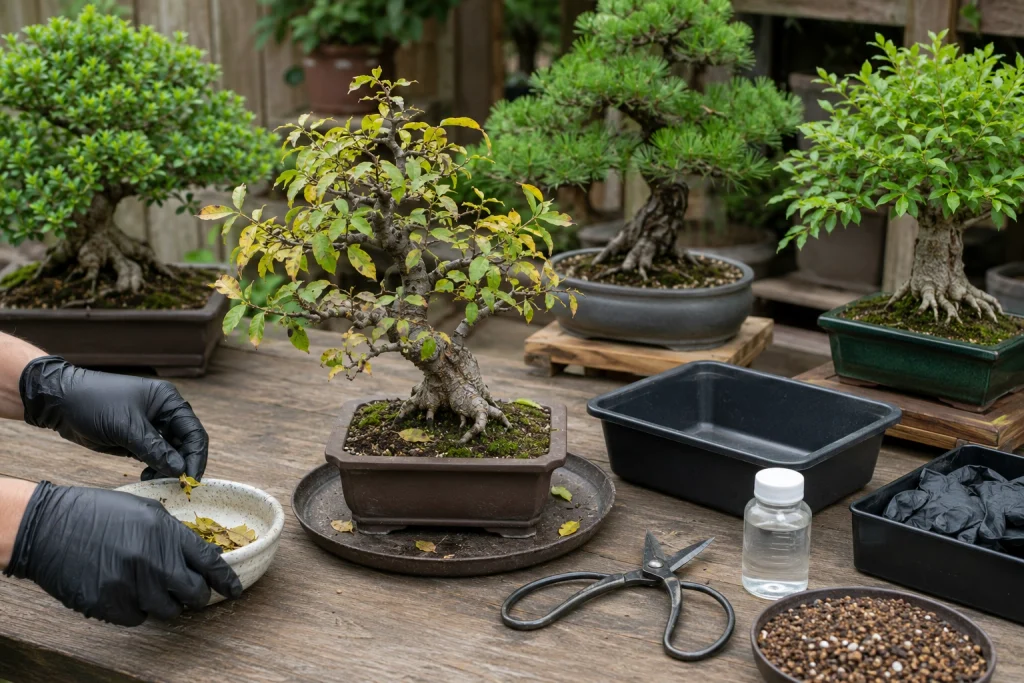
If you suspect disease or a serious pest infestation, act before moving on to other trees.
Step 1: Isolate the bonsai
Move the affected tree away from healthy bonsai when practical.
Do not place it directly beside another tree while you are still trying to identify the problem.
If you have limited space, create as much separation as possible and avoid letting branches touch.
Step 2: Inspect the entire tree
Check:
- Leaves
- New shoots
- Branch junctions
- Bark
- Trunk
- Soil surface
- Drainage holes
- Roots if already exposed
- Undersides of leaves
- Pot and drainage tray
Look for insects, eggs, webbing, fungal growth, lesions, discoloration, and unusual odors.
Step 3: Check the basic care conditions
Before applying treatment, ask:
- Has the bonsai been overwatered?
- Is the soil staying wet too long?
- Has the tree recently been repotted?
- Has it received enough light?
- Was it recently moved indoors or outdoors?
- Has it experienced extreme heat or cold?
- Was it heavily pruned?
- Was fertilizer recently applied?
- Is the tree appropriate for its current environment?
A stressed bonsai is often more vulnerable to secondary problems.
Step 4: Stop unnecessary pruning
Do not start cutting branches simply because they look unhealthy.
Major pruning can add stress, especially when the tree is already weak.
If the problem is clearly infectious, remove affected material only when appropriate and sanitize your tools between cuts.
Step 5: Clean the work area
Remove fallen leaves and obvious infected debris.
Clean tools, trays, benches, and containers that may have contacted the affected tree.
Step 6: Monitor the rest of the collection
Inspect neighboring bonsai regularly for new symptoms.
Early detection is often much easier than trying to control a well-established infestation.
Expert Tip
Expert Tip: When one bonsai becomes seriously diseased, care for your healthy trees first, then the affected tree last. Clean and disinfect your tools before moving back to the healthy collection.
This simple routine can reduce the chance of carrying pests or pathogens from one tree to another.
How to Prevent Bonsai Diseases From Spreading
Prevention is usually easier than treatment.
Keep new bonsai separate
A newly purchased bonsai can look perfectly healthy while carrying pests or an emerging disease.
Whenever possible, quarantine a new tree before placing it directly beside your established collection.
University of Minnesota Extension similarly recommends monitoring newly acquired plants separately for pests before placing them with other plants.
A practical quarantine period gives you time to inspect the tree several times rather than relying on a single examination.
Sanitize tools between trees
This is especially important after:
- Removing diseased branches
- Cutting roots
- Handling visibly infested plants
- Working with suspicious plant material
You do not necessarily need to disinfect your tools after every harmless leaf trim in a healthy collection, but extra sanitation is worthwhile whenever disease is suspected.
Avoid unnecessary leaf wetting
Some diseases are favored by prolonged leaf moisture.
Water the bonsai in a way that suits its species and growing environment rather than keeping foliage continuously wet.
Good airflow also helps foliage dry more quickly.
Keep bonsai healthy
Healthy growing conditions do not make a bonsai immune to disease, but they can reduce stress.
Pay attention to:
- Appropriate light
- Correct watering
- Fast-draining, suitable soil
- Adequate airflow
- Species-appropriate temperatures
- Balanced fertilization
- Proper seasonal care
Avoid trying to make a sick bonsai grow faster with extra fertilizer. Fertilizer cannot replace healthy roots, suitable light, or correct watering.
Should You Use Fungicide or Insecticide?
Sometimes chemical treatment is appropriate, but it should not be the first response to an unidentified symptom.
A fungicide will not solve every problem that looks fungal. Likewise, an insecticide will not fix yellow leaves caused by root damage or poor watering.
Before treating:
- Identify the likely pest or disease.
- Confirm that the product is appropriate for the bonsai species.
- Read the entire product label.
- Follow dilution and application directions.
- Observe required safety precautions.
- Avoid combining products unless the labels specifically allow it.
Never assume that a pesticide safe for one ornamental plant is automatically safe for every bonsai species.
When using pesticides or fungicides, follow the product label exactly. EPA pesticide labeling establishes the directions and restrictions for how registered products are used.
For valuable or unusual bonsai, accurate diagnosis is often more useful than repeatedly applying broad-spectrum products.
When to Ask an Experienced Bonsai Grower or Arborist
Many minor pest problems can be handled by a careful hobbyist. More serious problems deserve additional help.
Consider consulting an experienced bonsai grower, plant disease diagnostic service, horticulturist, or qualified arborist when:
- A valuable bonsai is rapidly declining
- Multiple trees develop similar symptoms
- Branches are dying without an obvious cause
- You suspect a serious canker or vascular disease
- Roots are severely damaged
- The trunk shows unusual lesions or decay
- You cannot distinguish disease from environmental stress
- A treatment has failed
- You are considering major root work on a weak tree
- You need to remove significant structural branches from an established bonsai
Do not perform aggressive root pruning or major structural work on a severely stressed bonsai simply to investigate a suspected disease. Additional injury can make recovery more difficult.
An experienced professional may also help determine whether the tree needs treatment, isolation, repotting, or removal.
Common Mistakes Bonsai Owners Should Avoid
- Using the same dirty pruning shears on every tree
- Reusing soil from a diseased bonsai
- Putting a newly purchased bonsai directly into an established collection
- Treating every yellow leaf as a fungal disease
- Overwatering a tree because it looks unhealthy
- Applying fungicide without identifying the likely problem
- Applying excessive fertilizer to a stressed tree
- Ignoring the undersides of leaves when checking for pests
- Leaving fallen diseased leaves around the collection
- Reusing contaminated pots without cleaning them
- Performing heavy root pruning on an already declining bonsai
- Assuming that one healthy-looking tree cannot carry pests
FAQs
Can a bonsai disease spread to another bonsai?
Yes. Certain fungal, bacterial, viral, and soilborne diseases can move between bonsai through tools, water, soil, insects, plant debris, or infected plant material. The exact risk depends on the disease.
Should I isolate a bonsai with yellow leaves?
It can be a sensible precaution if the cause is unknown and other trees are nearby. Yellow leaves may result from non-contagious problems such as overwatering, underwatering, nutrient issues, poor light, or root stress, but isolation gives you time to investigate safely.
Can pruning shears spread bonsai diseases?
Yes. Sap, plant tissue, soil, and other material on pruning blades can potentially transfer pathogens. Clean and disinfect tools after working on suspicious or diseased material.
Can bonsai pests spread from one tree to another?
Yes. Aphids, spider mites, scale, mealybugs, thrips, and other pests can move between nearby plants. Some may also spread through wind, hands, tools, or newly introduced plants.
Should I throw away a bonsai with a disease?
Not automatically. Some diseases and pest infestations can be managed successfully. However, a severely infected tree may sometimes need to be removed to protect valuable nearby trees, particularly when diagnosis indicates a serious contagious pathogen.
Can I reuse the pot from a diseased bonsai?
You can sometimes reuse the pot after thoroughly cleaning and disinfecting it, but do not immediately move another tree into a contaminated container. Remove all soil and plant debris first.
Will fungicide cure a sick bonsai?
Not necessarily. Fungicides only work against certain fungal diseases and are not a cure for every cause of leaf damage or decline. Correct identification, sanitation, watering, light, airflow, and root health are often equally important.
Conclusion
Can Bonsai Diseases Spread Between Trees? Yes, and the risk is real enough that every bonsai owner should practice basic collection hygiene.
Diseases and pests can move through pruning tools, soil, containers, water, insects, plant debris, and infected plant material. But many bonsai symptoms are caused by environmental stress rather than contagious disease, so accurate diagnosis should come before aggressive treatment.
The best approach is straightforward: isolate suspicious trees, inspect them carefully, sanitize tools and containers, avoid reusing contaminated soil, monitor nearby bonsai, and maintain healthy growing conditions.
If a valuable tree is declining quickly or several bonsai begin showing similar symptoms, seek experienced horticultural or bonsai advice rather than guessing at treatments.
Protect your whole collection by treating every unexplained disease or pest problem seriously—but calmly. Early isolation, good sanitation, and species-appropriate care can make a major difference.
