
Can Bonsai Pests Spread to Other Plants?

Finding tiny insects, sticky leaves, webbing, or unusual leaf damage on a bonsai can be worrying, especially when other plants are growing nearby. You may wonder, can bonsai pests spread to other plants? In many cases, yes. Common bonsai pests such as aphids, spider mites, scale insects, mealybugs, thrips, and whiteflies can move from one plant to another when conditions allow.
The risk is especially important when several bonsai trees or houseplants share the same growing area. Some pests can crawl between touching plants, while others can move through the air, on clothing or tools, or through infested plant material and soil.
The good news is that early action can usually prevent a small infestation from becoming a collection-wide problem. This guide explains which bonsai pests commonly spread, how they move, what warning signs to watch for, and how to isolate and treat an affected bonsai without unnecessarily stressing the tree.
Quick Answer
Yes, bonsai pests can spread to other plants, particularly aphids, spider mites, mealybugs, scale, thrips, and whiteflies. They may move through plant contact, air currents, tools, hands, or infested soil and plant material. Isolate an affected bonsai, inspect nearby plants, and begin appropriate treatment early to reduce the risk of spreading.
How Bonsai Pests Spread to Other Plants
Not every pest spreads in exactly the same way. Understanding the route of movement helps you decide how aggressively to isolate and monitor your bonsai.
Plant-to-Plant Contact
This is one of the simplest ways pests can spread.
If branches or leaves of two plants touch, small insects may crawl from one plant to another. This is particularly important for bonsai arranged closely together on shelves, benches, patios, or windowsills.
A bonsai with a heavy aphid, mealybug, or scale infestation should not be positioned directly beside healthy plants.
Air Movement
Some pests can be carried short distances by air movement.
Aphids, thrips, whiteflies, and other small insects may move between plants when disturbed or when air currents carry them. Spider mites are also capable of spreading beyond the original plant, especially when plants are crowded.
This does not mean every pest will immediately infect every nearby plant. Risk increases when plants are close together and the infestation is left untreated.
Hands, Clothing, and Gardening Tools
You can unintentionally become part of the pest’s transportation system.
For example, you inspect an infested bonsai and then immediately prune a healthy tree without cleaning your hands or tools. Tiny insects or eggs may be transferred during that process.
For this reason, it is sensible to:
- Work on healthy plants before infested plants.
- Wash your hands after handling an affected bonsai.
- Clean pruning tools between plants.
- Avoid moving infested leaves or branches through your plant collection.
- Dispose of heavily infested material carefully.
Soil, Pots, and Plant Debris
Some pests or pest stages can remain around the growing medium, pot, drainage area, or fallen plant material.
Fungus gnats are a good example. Their larvae develop in moist organic material and soil, so constantly wet bonsai soil can create favorable conditions for them.
University of Minnesota Extension recommends keeping plant areas clean, using clean pots and growing media, and inspecting containers as part of pest prevention.
However, do not automatically repot every bonsai simply because you see an insect. Repotting is stressful and should be appropriate for the species, season, root condition, and severity of the problem.
Which Bonsai Pests Are Most Likely to Spread?
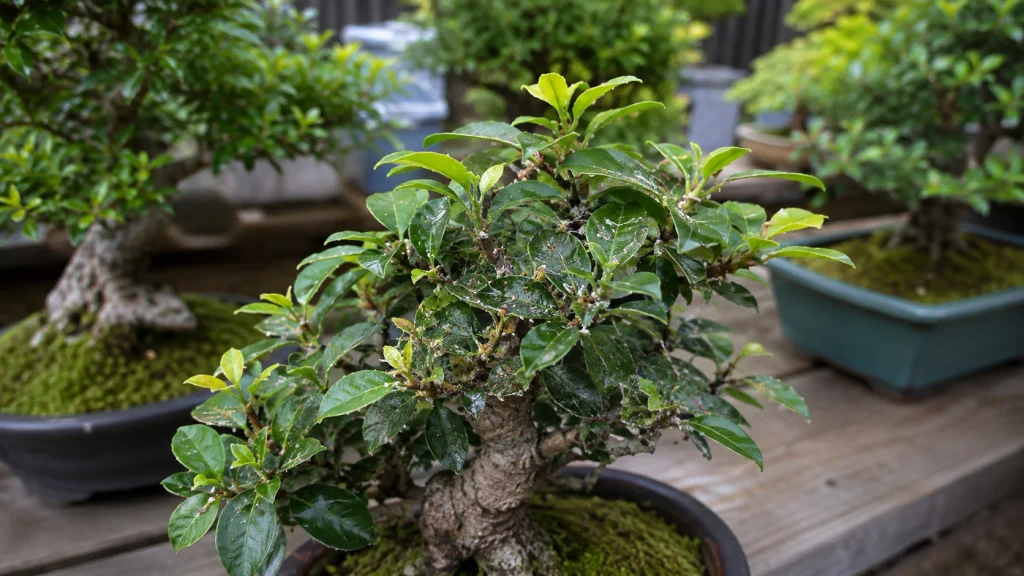
Several common plant pests can move from a bonsai to nearby plants.
| Pest | Common Warning Signs | Spread Risk | What to Check |
|---|---|---|---|
| Aphids | Clusters of small insects, curled new leaves, sticky honeydew | High | New shoots and leaf undersides |
| Spider mites | Fine webbing, stippling, pale or bronzed leaves | High | Leaf undersides and dry foliage |
| Mealybugs | White cottony masses, sticky residue | Moderate to high | Leaf joints, stems, roots |
| Scale | Small brown, gray, or white bumps | Moderate | Stems and leaf undersides |
| Thrips | Silvery or distorted leaves, tiny insects | High | Young leaves and flowers |
| Whiteflies | Small white flying insects | High | Leaf undersides |
| Fungus gnats | Small flies around soil | Moderate | Moist growing medium |
| Caterpillars | Chewed or missing sections of leaves | Usually lower indoors | Leaves and nearby foliage |
The exact risk depends on the pest species, plant species, growing environment, weather, and how long the infestation has been present.
Penn State Extension notes that common houseplant pests include aphids and spider mites and recommends isolating new plants before placing them with an existing collection.
Common Signs That a Bonsai Pest Is Spreading
The first sign is not always the insect itself. A bonsai may show damage before you notice what is causing it.
Watch for:
- Sticky leaves or surfaces: Often associated with honeydew produced by aphids, mealybugs, scale, and whiteflies.
- Fine webbing: A warning sign for spider mites.
- Tiny insects around new growth: Often associated with aphids or other sap-feeding pests.
- White cotton-like material: Commonly associated with mealybugs.
- Small bumps attached to stems: May indicate scale.
- Silvery or distorted leaves: Can occur with thrips.
- Yellowing or stippled leaves: May indicate sap-feeding pests.
- Sudden leaf drop: Can occur when an infestation becomes severe or the tree is otherwise stressed.
- Small flies around wet soil: Often associated with fungus gnats.
University of Minnesota Extension recommends examining both the upper and lower surfaces of leaves, checking containers and saucers, and using a magnifying lens when pests are difficult to see.
Do Not Confuse Pest Damage With Poor Care
Bonsai problems can have several causes.
Yellow leaves do not automatically mean insects. They may result from watering problems, poor drainage, nutrient issues, insufficient light, seasonal changes, or root stress.
Likewise, leaf drop does not automatically mean your bonsai has a pest infestation.
Before treating, identify the pest or at least identify the type of damage as accurately as possible.
This matters because treating the wrong problem can waste money and may put additional stress on the tree.
What to Do If Your Bonsai Has Pests
If you suspect an infestation, avoid moving the bonsai around your collection while deciding what to do.
Follow a simple containment process.
1. Isolate the Bonsai
Move the affected tree away from healthy plants.
Ideally, give it enough space that foliage does not touch neighboring plants. If the bonsai is indoors, place it in a separate, suitable location with adequate light and temperature for its species.
Isolation is one of the simplest ways to reduce the chance of transmission.
University of Minnesota Extension specifically recommends isolating plants when pests are detected and suggests isolating newly acquired plants for one to two weeks so potential pest problems have time to become visible.
2. Inspect the Entire Bonsai
Do not inspect only the damaged leaves.
Check:
- Upper leaf surfaces
- Leaf undersides
- New shoots
- Branch junctions
- Trunk crevices
- Root flare
- Pot rim
- Drainage holes
- Soil surface
- Underside of the pot
- Nearby plant debris
A small flashlight and 10× hand magnifier can make tiny pests much easier to find.
3. Inspect Nearby Plants
Once you discover pests on one bonsai, inspect every plant that was nearby.
Pay particular attention to plants whose leaves touched the affected tree.
You do not necessarily need to treat every plant immediately. Instead, look carefully for evidence and increase monitoring.
4. Remove Visible Pests
For a light infestation, physical removal may be enough.
Depending on the pest and species of bonsai, options may include:
- Wiping insects from leaves.
- Removing individual scale insects.
- Using a cotton swab to remove mealybugs.
- Rinsing foliage with an appropriate stream of water.
- Pruning heavily infested leaves or small shoots.
University of Minnesota Extension recommends physical removal and washing foliage as useful nonchemical approaches for minor indoor plant infestations.
Be gentle with bonsai. Removing a few badly infested leaves is very different from aggressively cutting back a stressed tree.
5. Choose Treatment Based on the Pest
Do not use a pesticide simply because you see an insect.
Different pests respond differently to treatments. Some require repeated applications because eggs or protected life stages survive the first treatment.
For example, insecticidal soaps and horticultural oils can be useful against several soft-bodied pests, but they must contact the pest to work effectively.
Some products can also damage sensitive foliage, especially when applied during excessive heat, strong sunlight, drought stress, or unsuitable environmental conditions.
Always read and follow the product label for the specific plant and pest. The U.S. Environmental Protection Agency emphasizes that pesticide labels provide directions and safety precautions and that using more product than directed does not provide better protection.
Should You Quarantine a New Bonsai?
Yes. Quarantining a new bonsai is one of the easiest ways to protect an established collection.
A tree can look perfectly healthy while carrying a small population of pests that is difficult to notice at first.
When you purchase a bonsai, especially from an unfamiliar source, inspect it before placing it beside your established trees.
A Practical New-Bonsai Quarantine Routine
- Inspect the foliage and branches.
- Check leaf undersides and new growth.
- Inspect the pot, soil surface, drainage holes, and saucer.
- Keep the new tree separated from your collection.
- Monitor it regularly for at least one to two weeks.
- Treat only if a pest problem is identified or a suitable preventive treatment is appropriate.
- Continue watching the plant after treatment.
Penn State Extension recommends isolating new plants and plants returning indoors from outdoor conditions for about three weeks, while University of Minnesota Extension recommends one to two weeks for newly acquired plants. The exact quarantine period can therefore vary with the plant, environment, and level of caution.
Can Bonsai Pests Spread Outdoors?
Yes, and outdoor bonsai collections can present additional opportunities for pest movement.
Wind, insects, plant contact, garden debris, and nearby vegetation can all influence pest movement. Outdoor plants also interact with beneficial insects and natural predators, which can sometimes help suppress pest populations.
This is one reason outdoor bonsai should not automatically be treated with strong pesticides at the first sign of an insect.
Some insects found on a tree may be harmless visitors or beneficial predators rather than pests.
Before spraying, identify what you are looking at whenever possible.
What About Indoor Bonsai?
Indoor bonsai can also develop significant pest problems.
In an indoor environment, plants may have fewer natural predators and pests can spread among closely grouped plants.
Spider mites, mealybugs, scale, aphids, thrips, and fungus gnats are all potential problems.
Humidity, poor air circulation, excessive dryness, weak light, and improper watering can also contribute to plant stress, which may make pest management more difficult.
Should You Repot a Bonsai Because of Pests?
Not always.
Repotting can be useful when the pest is associated with the growing medium or when the soil condition itself is contributing to the problem. However, repotting a bonsai solely because you found aphids or a few scale insects can create unnecessary root disturbance.
Consider repotting when:
- The pest is clearly associated with the soil.
- The growing medium is badly infested.
- Drainage is poor.
- Root health is already compromised.
- The tree is due for scheduled repotting.
- An experienced grower recommends root work.
Do not combine unnecessary repotting with severe pruning on an already stressed bonsai. Multiple major interventions can make recovery harder.
For a valuable, old, or delicate bonsai, pest control should usually be separated from major root work unless there is a clear reason to combine them.
How to Prevent Bonsai Pest Problems From Spreading
Prevention is easier than trying to rescue an entire collection after an infestation becomes established.
Build a Simple Pest-Prevention Routine
- Inspect every new bonsai before adding it to your collection.
- Quarantine new trees.
- Check plants during normal watering.
- Look underneath leaves, not just at the canopy.
- Keep benches and shelves clean.
- Remove dead leaves and plant debris.
- Avoid keeping bonsai foliage tightly packed together.
- Clean pruning tools between plants.
- Avoid excessive watering.
- Provide the light and airflow appropriate for the species.
- Monitor stressed trees more frequently.
- Act quickly when the first signs appear.
Healthy growing conditions do not make a bonsai immune to pests, but they can help the tree maintain better vigor.
University of Minnesota Extension notes that plants struggling with unsuitable light, temperatures, or watering are less able to withstand pest problems effectively.
Expert Tip
Expert Tip: When you find pests on one bonsai, inspect the plants that were closest to it before treating everything. Early isolation and accurate identification usually cause less stress, cost less, and create fewer problems than unnecessary spraying.
When to Ask an Experienced Bonsai Grower or Arborist
Most small pest problems can be managed by a careful hobbyist. However, some situations deserve professional advice.
Ask an experienced bonsai grower, certified horticulture professional, arborist, or appropriate plant-health specialist when:
- The pest cannot be identified.
- The bonsai is old, valuable, or difficult to replace.
- The infestation is severe.
- The tree is rapidly losing foliage.
- The trunk or major branches are affected.
- You suspect a serious disease rather than an insect problem.
- Roots appear damaged or rotten.
- The bonsai is already severely stressed.
- Multiple treatments have failed.
- You are considering major pruning or root work on a weakened tree.
- A regulated or potentially invasive pest is suspected.
For unusual or potentially regulated plant pests, local plant-health authorities can provide identification and guidance. In the United States, USDA APHIS provides contacts for reporting plant pests and obtaining information about quarantine and plant-health issues.
If you are outside the United States, contact the appropriate agricultural extension service or plant-health authority in your country.
Common Mistakes Bonsai Owners Should Avoid
- Ignoring the first few insects. A small population is usually easier to manage than a large infestation.
- Spraying before identifying the pest. Different pests require different approaches.
- Keeping an infested bonsai beside healthy trees. Isolation should be your first response.
- Treating every plant unnecessarily. Monitor healthy plants carefully before deciding they need treatment.
- Using household dish soap as a substitute for insecticidal soap. Homemade mixtures can damage foliage.
- Applying too much pesticide. More is not better and may injure the tree.
- Spraying stressed bonsai without checking the label. Heat, drought, tender foliage, and other conditions can increase the risk of plant injury.
- Ignoring the soil. Fungus gnats and some other problems are associated with moist growing media.
- Overwatering after discovering pests. Watering more does not solve most insect infestations and can create root problems.
- Pruning aggressively. A pest problem does not automatically justify severe structural pruning.
- Failing to clean tools. Tools can transfer plant material and contaminants between trees.
- Stopping monitoring after one treatment. Some pests require repeated management.
When pesticides are necessary, follow the product label exactly. EPA guidance also recommends using nonchemical control methods where practical and keeping people and pets away from treated areas according to the product directions.
FAQs
Can bonsai pests spread to houseplants?
Yes. Many common bonsai pests also attack houseplants. Aphids, spider mites, mealybugs, scale, thrips, and whiteflies can move between susceptible plants when they are kept close together.
Should I isolate a bonsai with pests?
Yes. Isolation is one of the safest first steps. Move the affected bonsai away from healthy plants and inspect nearby trees for early signs of infestation.
How long should I quarantine a new bonsai?
A practical minimum is around one to two weeks for close monitoring, although a longer quarantine can provide additional protection. Penn State Extension recommends about three weeks for new or returning houseplants in some situations.
Can spider mites spread from one bonsai to another?
Yes. Spider mites can spread between nearby plants, especially when conditions favor rapid population growth. Look for fine webbing, stippling, pale leaves, and damage concentrated on leaf undersides.
Can I spray all my bonsai to prevent pests?
Routine blanket spraying is usually unnecessary. It is better to inspect plants regularly, isolate affected trees, identify the pest, and choose an appropriate treatment. Unnecessary pesticide use can harm plants and beneficial organisms.
Should I throw away a bonsai with pests?
Usually not. A bonsai with a manageable infestation can often be treated. Disposal may become reasonable when the infestation is severe, the tree is badly damaged, or continued treatment would put the rest of your collection at greater risk.
Can overwatering cause bonsai pest problems?
Overwatering does not directly cause every pest infestation, but persistently wet soil can encourage problems such as fungus gnats and can weaken roots. Good drainage and species-appropriate watering are important parts of overall pest prevention.
Conclusion
So, can bonsai pests spread to other plants? Yes, and the risk is greatest when infested bonsai are kept close to healthy plants without inspection or isolation. Aphids, spider mites, mealybugs, scale, thrips, whiteflies, and some soil-associated pests can all create problems beyond the original tree.
The best response is not to panic or immediately spray your entire collection. Isolate the affected bonsai, identify the pest, inspect nearby plants, remove visible pests when practical, and choose a treatment that matches the pest and tree.
Prevention is equally important. Quarantine new bonsai, inspect leaves and containers regularly, maintain suitable growing conditions, and keep your tools and growing area clean.
If the infestation is severe or the tree is valuable, old, or already stressed, get advice before attempting major pruning, repotting, or aggressive chemical treatment.
A few minutes of regular inspection can protect an entire bonsai collection. Check your trees today, isolate anything suspicious, and deal with small pest problems before they become collection-wide problems.
