
How Often Should You Check a Bonsai for Pests?

A bonsai can look healthy one day and show signs of a pest problem only a few days later. Because bonsai trees are small and carefully maintained, even a modest infestation can quickly affect leaves, shoots, roots, and overall vigor. This makes regular inspection one of the simplest forms of bonsai care.
So, how often should you check a bonsai for pests? For most bonsai, a quick inspection once or twice a week is a good routine. During warm weather, active growing periods, or after bringing a new tree home, checking every few days is even better. Indoor bonsai should also be monitored regularly because stable indoor conditions can allow certain pests to reproduce throughout the year.
This guide explains how often to inspect your bonsai, what areas to check, which warning signs to look for, and what to do if you find insects, mites, or other pests.
Quick Answer
You should check a bonsai for pests at least once a week, with inspections every few days during warm, humid, or active growing periods. Pay particular attention after buying or repotting a tree, moving it indoors or outdoors, or noticing leaf damage. Frequent early checks help catch small infestations before they become difficult to control.
Why Regular Bonsai Pest Checks Matter
Bonsai trees have limited growing space and relatively little foliage compared with full-sized trees. A pest population that might have little visible effect on a mature landscape tree can cause noticeable damage to a bonsai.
Pests may:
- Suck sap from leaves and young shoots.
- Chew holes in foliage.
- Damage tender new growth.
- Leave sticky honeydew on leaves and branches.
- Cause yellowing, curling, spotting, or premature leaf drop.
- Weaken the tree over time.
- Hide around roots or in the growing medium.
- Create wounds that make other plant-health problems more likely.
A weakened bonsai can also become less tolerant of other stresses such as poor watering, excessive heat, inadequate light, or root problems.
Regular inspection is therefore not just about finding bugs. It is part of maintaining overall tree vigor.
How Often Should You Inspect a Bonsai?
There is no single schedule that works for every species or growing environment. The ideal inspection frequency depends on the tree, season, location, and recent changes in care.
| Situation | Recommended pest check |
|---|---|
| Healthy outdoor bonsai | Once a week |
| Active growing season | 2–3 times per week |
| Hot or humid weather | Every few days |
| Indoor tropical bonsai | Once or twice a week |
| Newly purchased bonsai | Every few days for 2–3 weeks |
| Bonsai recently moved indoors | Every few days initially |
| Bonsai with a known pest problem | Daily or as directed by treatment |
| Recently treated tree | Check according to the product’s directions |
These are practical inspection guidelines rather than strict rules. The more stressful or pest-prone the situation, the more frequently you should look.
During Spring and Summer
Spring and summer often bring vigorous new growth, which can attract sap-feeding insects such as aphids and other pests.
Check your bonsai more frequently when:
- New leaves are appearing.
- Temperatures are consistently warm.
- The tree is growing rapidly.
- You see ants around the pot or trunk.
- Nearby plants have pest problems.
During Fall and Winter
Outdoor deciduous bonsai may lose their leaves in autumn, making branch inspection easier. However, dormant trees can still have pests or overwintering eggs.
Indoor bonsai require particular attention during winter because moving them into a warm indoor environment can change humidity, temperature, airflow, and pest pressure.
Where Should You Look for Bonsai Pests?
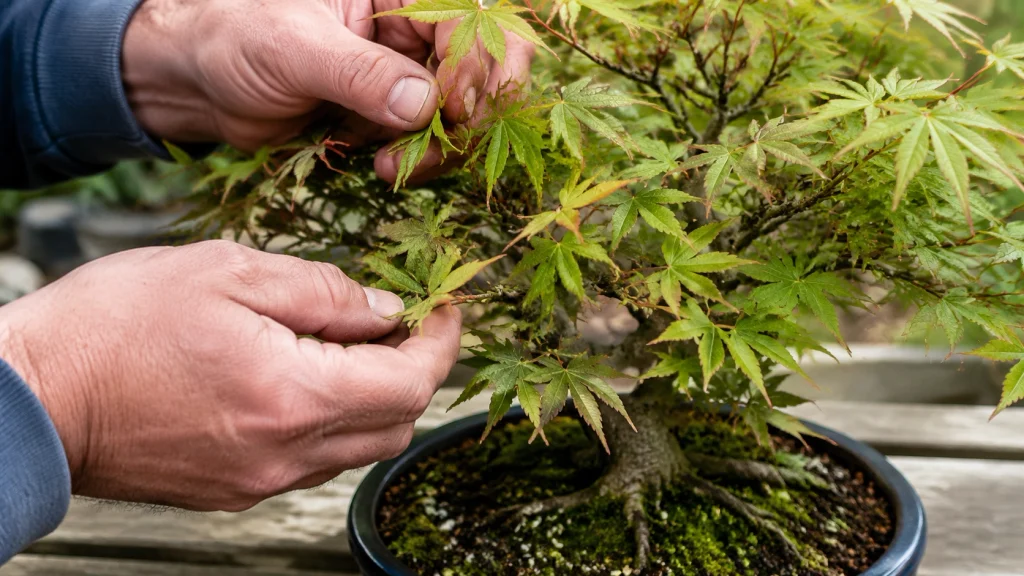
A quick glance at the top of the foliage is not enough. Many pests hide in places that are easy to overlook.
Check the Undersides of Leaves
Turn leaves over gently and inspect the undersides.
Look for:
- Tiny insects.
- Fine webbing.
- Eggs.
- White or cottony material.
- Brown or black spots.
- Clusters of small insects.
- Sticky residue.
Spider mites, for example, can be difficult to notice until their feeding causes visible stippling or webbing.
Inspect New Growth
Young shoots and developing leaves are especially important.
Look closely at:
- Growing tips.
- Leaf stems.
- Newly emerging leaves.
- Tender branches.
- Areas where leaves meet stems.
Aphids and other sap-feeding insects often gather around soft new growth.
Examine Branches and Trunk
Some pests are easier to spot on woody parts of the tree.
Look for:
- Scale-like bumps.
- Cottony deposits.
- Small holes.
- Cracks or unusual wounds.
- Sticky residue.
- Ant activity.
Do not assume every bump is an insect. Bonsai branches can naturally have buds, bark irregularities, lenticels, or old pruning scars. If you are uncertain, identify the object before treating the tree.
Check the Soil Surface and Pot
Some problems are associated with the growing medium rather than the foliage.
Watch for:
- Small flies around the soil.
- Unusual larvae.
- Persistent algae or excessive moisture.
- Foul smells.
- Soil that remains wet for unusually long periods.
Remember that not every small insect is harmful. Some insects are harmless decomposers, while others may be beneficial predators. Proper identification should come before treatment. The USDA’s plant pest and disease resources are useful for understanding the wide range of insects, mites, and other organisms that can affect plants.
Common Warning Signs of Bonsai Pests
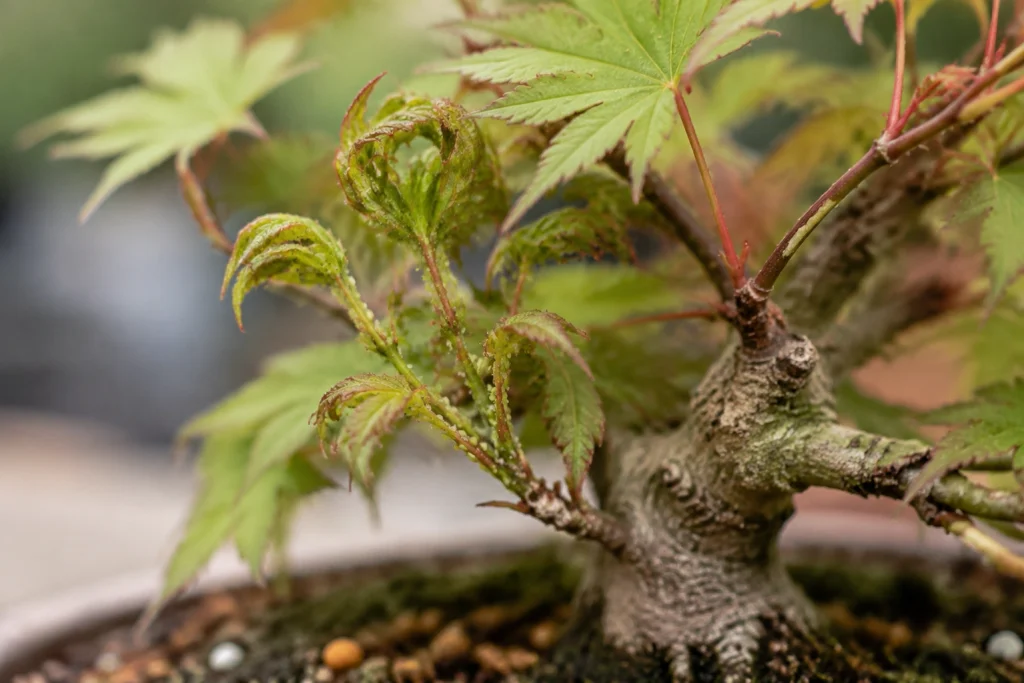
Sometimes you will notice the damage before you see the pest.
Pay attention to changes such as:
- Yellow or pale leaves without an obvious watering or nutrition explanation.
- Curling or distorted new leaves.
- Tiny holes or chewed edges.
- Fine stippling or speckling.
- Sticky leaves or branches.
- White cotton-like patches.
- Fine webbing.
- Sudden leaf drop.
- Black sooty-looking growth on leaves.
- Reduced vigor or weak new growth.
- Ants repeatedly climbing the trunk.
These symptoms do not automatically mean pests are responsible.
For example, yellow leaves may result from overwatering, poor drainage, nutrient problems, insufficient light, seasonal changes, or root damage. Likewise, leaf drop can occur naturally in deciduous species.
Treat the cause, not just the symptom.
Bonsai Pests You May Encounter
Different bonsai species attract different pests, but several groups commonly appear on container-grown trees.
Aphids
Aphids are small, soft-bodied insects that commonly gather on young shoots and leaves.
They may cause:
- Curled leaves.
- Distorted new growth.
- Sticky honeydew.
- Weak-looking shoots.
They can multiply quickly, so early detection is useful.
Scale Insects
Scale insects can look like small bumps attached to branches or leaves.
They may be brown, gray, white, or other colors depending on the species. Because they can blend into bark, they are easy to miss during a casual inspection.
Spider Mites
Spider mites are particularly troublesome in some warm, dry conditions.
Possible signs include:
- Fine webbing.
- Tiny pale spots across leaves.
- Dull or bronzed foliage.
- Gradual leaf decline.
A magnifying glass can be extremely useful when inspecting for tiny pests.
Fungus Gnats
Fungus gnats are small flying insects often noticed around moist potting media.
Seeing an occasional adult does not necessarily mean your bonsai has a serious infestation. However, repeated activity can indicate consistently damp growing media, which may also point to watering or drainage issues.
Caterpillars and Chewing Insects
Chewing pests may leave obvious holes or missing sections of leaves.
If damage appears overnight, inspect the foliage, branches, pot rim, and nearby plants carefully. Some caterpillars are surprisingly difficult to spot because they blend into stems and leaves.
What Should You Do If You Find a Pest?
Do not immediately reach for the strongest pesticide.
A better approach is to identify the problem and assess how serious it is.
Step 1: Isolate the Bonsai if Necessary
If the bonsai is kept indoors or near other valuable plants, move it away from healthy plants when practical.
This is particularly important when you do not yet know what the pest is.
Step 2: Identify the Pest
Take a clear photograph and inspect the affected area closely.
Note:
- Pest size.
- Color.
- Shape.
- Location on the tree.
- Type of damage.
- Presence of eggs, webbing, or honeydew.
Correct identification makes treatment much more effective.
Step 3: Assess the Severity
A few pests are very different from a heavily infested tree.
Ask:
- Is the tree still producing healthy growth?
- Are only a few leaves affected?
- Is the pest spreading?
- Is the infestation present on branches and foliage?
- Is the tree already weak or stressed?
A small population may sometimes be managed with physical removal and improved growing conditions.
Step 4: Start With the Least Disruptive Effective Method
Depending on the pest and species, options may include:
- Removing pests by hand.
- Washing foliage with an appropriate stream of water.
- Pruning heavily infested individual shoots.
- Improving airflow.
- Correcting chronic overwatering or underwatering.
- Using an appropriate horticultural treatment.
Integrated Pest Management, or IPM, means combining monitoring, prevention, physical controls, biological controls, and chemical treatments when appropriate. The USDA describes IPM as a science-based process for identifying and managing pests while reducing unnecessary risks.
Step 5: Monitor After Treatment
One treatment does not always solve a pest problem.
Continue checking the bonsai regularly. Look for:
- New pest activity.
- Fresh leaf damage.
- Newly emerging insects.
- Eggs or immature pests.
- Improvement in the tree’s vigor.
Never assume that the absence of visible adult insects means the problem is completely gone.
When Should You Increase Your Inspection Schedule?
A weekly inspection is a good baseline, but some circumstances justify checking much more often.
After Buying a New Bonsai
Newly purchased trees deserve special attention.
The tree may have been grown in a different environment, surrounded by many other plants, or exposed to conditions different from your home.
For the first couple of weeks, inspect it every few days.
If possible, keep it separated from your established bonsai collection while you monitor its health.
After Moving an Outdoor Bonsai Indoors
Moving an outdoor bonsai inside changes its environment considerably.
Indoor air may be warmer and less ventilated, while natural predators that normally help suppress pests may no longer be present.
Check the tree every few days after the move, particularly around leaves, branch joints, and the soil surface.
When a Tree Is Stressed
A stressed bonsai deserves closer observation.
Potential stress factors include:
- Recent repotting.
- Root damage.
- Major pruning.
- Extreme heat.
- Sudden temperature changes.
- Poor drainage.
- Prolonged drought.
- Excessively wet soil.
Avoid performing major pruning or aggressive root work on a severely stressed tree simply because you suspect pests. First determine what is actually wrong.
How Long Does a Pest Inspection Take?
A routine inspection does not need to become a long gardening session.
For one or two bonsai, five minutes can be enough for a useful weekly check.
Use a consistent routine:
- Look over the entire tree from a short distance.
- Examine new growth.
- Check the undersides of several leaves.
- Inspect branch joints and the trunk.
- Look at the soil surface.
- Check the pot rim and nearby area.
- Note any unusual changes.
- Investigate suspicious symptoms before treating.
As you become familiar with your tree, you will quickly recognize what is normal.
Expert Tip
Inspect your bonsai at the same time you check its watering needs. Combining the two routines makes pest monitoring easier to remember and helps you notice changes in leaf color, vigor, and soil condition before they become serious.
Pest Monitoring and Bonsai Health
Good pest prevention starts with good general care.
A bonsai that receives appropriate light, water, nutrition, airflow, and seasonal conditions is generally better positioned to recover from minor problems.
However, good care does not make a tree immune to pests.
Even a healthy bonsai can develop an infestation after:
- Contact with an affected plant.
- Introduction of a new tree.
- Seasonal pest activity.
- Wind-blown insects.
- Movement between indoor and outdoor environments.
This is why prevention and monitoring are more reliable than assuming healthy trees cannot get pests.
Be Careful With Pesticides
Pesticides can be useful when properly selected and applied, but they should not be the first response to an unidentified problem.
Different products target different pests, and some plants may be sensitive to particular ingredients or concentrations.
Before using any pesticide:
- Identify the pest as accurately as possible.
- Confirm the product is appropriate for the intended plant and pest.
- Read the entire label.
- Follow the stated dilution and application rate.
- Follow protective equipment instructions.
- Keep children and pets away as directed.
- Avoid applying products during unsuitable weather or conditions.
- Do not assume a stronger concentration will work better.
The EPA emphasizes that pesticide labels provide instructions for safe and effective use, including where, how, how much, and how often a product should be applied.
Over-application can injure the bonsai as well as create unnecessary exposure risks.
For additional consumer guidance, the EPA’s pesticide safety guide for home gardeners explains how to choose, use, store, and dispose of pest-control products safely.
DIY Pest Control vs. Expert Help
Most small bonsai pest problems can be monitored and addressed by a careful hobbyist.
However, there are situations where professional advice is worthwhile.
| Situation | DIY approach | Expert help |
|---|---|---|
| A few visible aphids | Usually reasonable | Usually unnecessary |
| Mild chewing damage | Inspect and monitor | Useful if damage continues |
| Unknown pest | Photograph and identify | Recommended if uncertain |
| Severe infestation | Possible treatment | Strongly recommended |
| Declining tree with multiple symptoms | Diagnose cautiously | Recommended |
| Suspected root pest or serious root damage | Avoid aggressive work | Recommended |
| Valuable old specimen | Minimal intervention | Consider experienced advice |
| Tree declining after repeated treatments | Stop guessing | Seek diagnosis |
Cost is also a consideration. Spending a modest amount on an experienced diagnosis can be cheaper than repeatedly buying treatments that do not address the actual problem or accidentally damaging a valuable bonsai.
When to Ask an Experienced Bonsai Grower or Arborist
Ask for experienced help when you cannot confidently determine whether the problem is caused by pests, disease, watering, roots, nutrition, or environmental stress.
Professional guidance is especially useful when:
- The tree is rapidly declining.
- A large percentage of foliage is damaged.
- The trunk or major branches show unusual damage.
- You suspect a serious root problem.
- A pest infestation keeps returning.
- Several treatments have failed.
- You own a valuable or old specimen.
- You are considering major structural pruning while the tree is already stressed.
An experienced bonsai grower can often identify patterns that are difficult for beginners to recognize. An arborist may be appropriate when the issue involves a larger woody plant, significant structural damage, or a diagnosis beyond routine bonsai care.
Common Mistakes Bonsai Owners Should Avoid
- Only checking the top of the leaves. Many pests hide underneath foliage.
- Waiting until damage becomes obvious. Small infestations are generally easier to manage.
- Treating insects before identifying them. Not every insect is harmful.
- Assuming yellow leaves always mean pests. Watering, light, roots, and nutrition can cause similar symptoms.
- Using excessive pesticide. More product does not necessarily mean better control.
- Ignoring newly purchased trees. New plants can introduce pests to an existing collection.
- Keeping stressed bonsai constantly wet. Poor watering can create additional health problems.
- Making major cuts while the cause is unknown. Severe pruning can add stress to an already weakened tree.
- Stopping inspections immediately after treatment. Eggs or immature pests may remain.
- Ignoring the surrounding plants. A nearby infested plant can continually reintroduce pests.
FAQs
How often should you check a bonsai for pests?
For most bonsai, inspect the tree once a week. During warm weather, active growth, or periods of high pest activity, checking every few days is better.
Can bonsai get pests indoors?
Yes. Indoor bonsai can develop aphids, spider mites, scale, fungus gnats, and other pests. Warm indoor conditions may allow some pests to remain active for longer periods.
Should I check my bonsai every day?
Daily inspection is usually unnecessary for a healthy tree. However, daily or very frequent monitoring can make sense when a bonsai has an active infestation, has recently been treated, or has been exposed to a known pest problem.
What is the first sign of pests on a bonsai?
There is no single first sign. Depending on the pest, you may notice distorted new growth, stippled leaves, sticky residue, holes, webbing, white deposits, or visible insects.
Should I isolate a bonsai with pests?
If practical, yes. Isolating a newly infested bonsai can reduce the chance of pests spreading to nearby plants, particularly when you do not yet know what you are dealing with.
Can overwatering make bonsai more vulnerable to pests?
Overwatering does not automatically cause an insect infestation, but chronically poor watering and root conditions can weaken a tree. Weak or stressed bonsai may have a harder time recovering from pest damage.
Should I spray a bonsai as soon as I see an insect?
Not necessarily. First determine whether the insect is harmful and whether treatment is actually needed. Some insects are harmless or beneficial. Correct identification helps you choose a more targeted response.
Conclusion
Knowing how often you should check a bonsai for pests is one of the simplest ways to protect a tree’s long-term health. For most bonsai, a careful weekly inspection is a good starting point. During warm growing periods, after buying a new tree, or when an infestation is already present, increase the frequency to every few days or as needed.
Focus on the undersides of leaves, new growth, branch joints, bark, soil surface, and pot area. Look for insects as well as symptoms such as curling leaves, sticky residue, webbing, holes, discoloration, and declining vigor.
Most importantly, identify the problem before treating it. Good watering, appropriate light, proper nutrition, cleanliness, and regular monitoring all support healthier bonsai, but no tree is completely protected from pests.
Make a short pest inspection part of your normal bonsai-care routine. A few minutes each week can help you catch problems early, protect your investment, and give your tree a much better chance of staying healthy and attractive.
