How to Prune Cherry Blossom Bonsai: Step-by-Step Guide

This post contains affiliate links. As an Amazon Associate, OurBonsai earns from qualifying purchases at no extra cost to you. Read our disclosure.
In this guide
- When to prune a cherry blossom bonsai
- Understanding how cherries flower
- Tools you will need
- How to prune cherry blossom bonsai: step by step
- Pruning a young cherry for structure
- Root pruning and flowering
- Larger structural cuts
- Wiring cherry bonsai
- Aftercare
- Common pruning mistakes with cherry bonsai
- FAQ: how to prune cherry blossom bonsai
- Final thoughts
Knowing how to prune cherry blossom bonsai is mostly about timing. Do your main pruning right after the flowers fade in spring, trim new shoots back to two or three leaves through early summer, and stop by midsummer so the tree can form next year’s flower buds. Make any larger cuts in dry summer weather, never in winter or during wet spells, to reduce the risk of fungal and bacterial infections that cherries are prone to.
Cherry blossom bonsai are usually Japanese flowering cherry (Prunus serrulata) or related Prunus species. They flower on short spur shoots and on the previous year’s wood, so careless pruning can remove the entire display. This guide explains when to prune, how to trim, how to protect the flowers and how to avoid disease.
When to prune a cherry blossom bonsai
| Type of pruning | Best time | Notes |
|---|---|---|
| Main shaping | Right after flowering | Tree has the whole season to recover and set buds |
| Shoot trimming | Late spring to early summer | When shoots have 5 to 6 leaves |
| Larger branch cuts | Dry weather in early to mid summer | Wounds heal fastest, lower infection risk |
| Light tidy only | Late summer | Remove only dead or broken twigs |
| Avoid | Autumn and winter | Slow healing, high disease risk, buds already formed |
The main reason to avoid winter pruning is disease. Cherries and plums are susceptible to silver leaf, a fungal infection that enters fresh wounds in damp weather, and to bacterial canker. The RHS guide to silver leaf explains why stone fruit trees are best pruned in summer. For general timing principles on other species, see our guide on when to prune deciduous bonsai.
Understanding how cherries flower
To prune without losing flowers, you need to know where the flowers come from:
- Flower buds form in summer for the following spring.
- They sit on short spurs (stubby twigs a few centimeters long) and along last year’s shoots.
- Flower buds are plump and round. Leaf buds are slimmer and pointed.
Cutting off spurs or trimming shoots after midsummer removes those buds. So the golden rules are: prune early in the season, and leave the spurs alone.
Tools you will need
- Sharp, clean bonsai scissors
- A concave cutter for branch removal
- Cut paste to seal every cut larger than a matchstick
- Rubbing alcohol to sterilize blades between trees
A good pair of bonsai pruning shears and a concave cutter cover almost every job. Always clean your tools, because cherry diseases spread easily on dirty blades.
How to prune cherry blossom bonsai: step by step
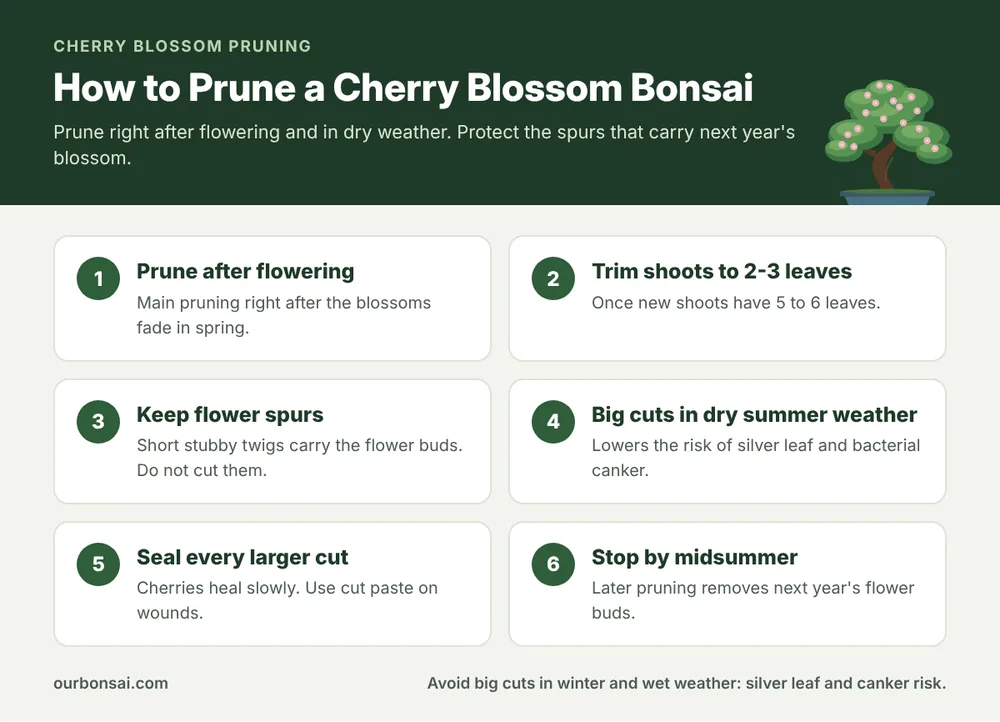
1. Clean up after flowering
As soon as the blossoms fade, remove spent flowers and any developing fruit. Fruit takes a lot of energy that the tree needs for new growth.
2. Shape the branches
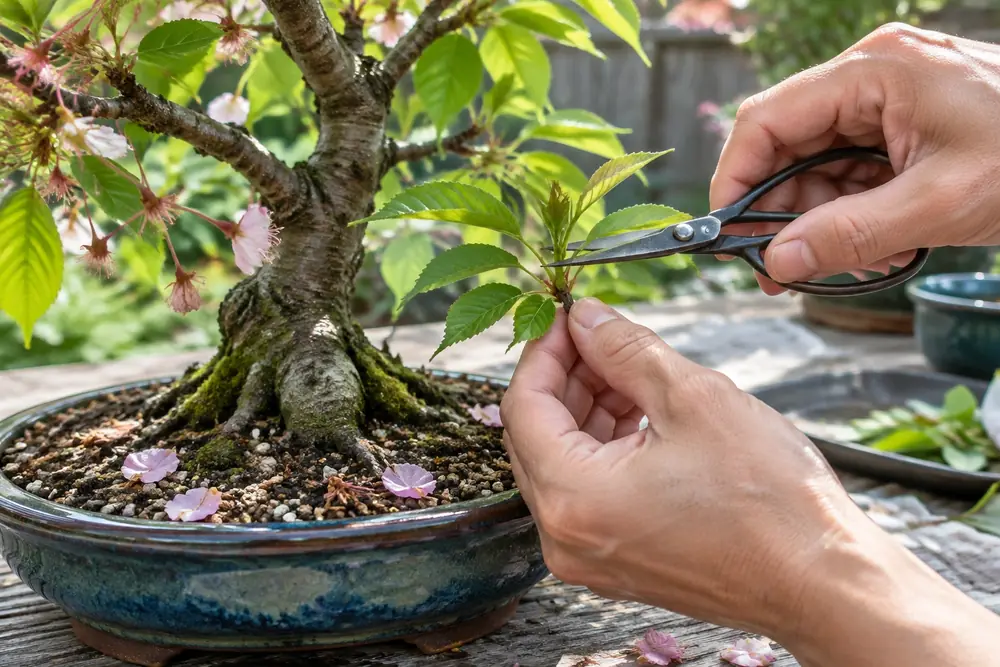
Step back and look at the tree. Remove branches that cross, grow straight up or down, grow back toward the trunk, or spoil the outline. Cut back to a side branch or bud facing the direction you want new growth to go. Use a concave cutter for clean, flat wounds.
3. Seal the cuts
Cherries heal more slowly than many species, and open wounds are entry points for disease. Seal every cut larger than a matchstick with cut paste. Our guide to bonsai cut paste alternatives explains options.
4. Trim new shoots
As new shoots grow, let them reach five or six leaves, then cut them back to two or three. This keeps the tree compact and encourages more spurs, which means more flowers in future years.
5. Leave the spurs
Short, stubby twigs with clustered buds are flowering spurs. Leave them on, even if they look untidy.
6. Stop by midsummer
After midsummer, stop all routine trimming. The tree is now forming its flower buds for next spring.
Pruning a young cherry for structure
If you are starting with a young nursery cherry rather than a developed bonsai, focus on building a good trunk and main branches before worrying about flowers.
- Let it grow. For the first one or two seasons, let the tree grow fairly freely in a larger pot, in full sun, with regular feeding. This thickens the trunk.
- Choose the main branches. Right after flowering (or in early summer if it did not flower), select three to five well placed branches that spiral around the trunk, and remove the rest gradually.
- Reduce the height in stages. Cherries do not respond as well to hard trunk chops as elms or maples. Reduce height over two or three seasons rather than in one big cut, and seal every wound.
- Start shoot trimming once the main structure is set, to build the fine branching that carries flower spurs.
Patience pays off with cherries. A tree built slowly with fewer, smaller wounds stays healthier and flowers better than one cut back hard.
Root pruning and flowering
Root work affects flowering too. Cherries are repotted every two to three years, in early spring as buds swell or just after flowering. Remove no more than about a quarter of the roots, and avoid heavy branch pruning in the same season. A tree that loses a lot of roots and branches in the same year often skips flowering the following spring while it recovers.
Larger structural cuts
If you need to remove a large branch or reduce the trunk, do it in dry weather in early to mid summer, when the tree heals fastest. Check the weather forecast for several dry days. Make the cut cleanly with a concave cutter or saw, smooth the edges with a sharp knife and seal immediately. Never make big cuts during rainy periods.
Wiring cherry bonsai
Cherry branches are fairly brittle and the bark marks easily. If you wire, do it in late spring or early summer, use aluminum wire wrapped with care, make gentle bends only and check every two weeks. Remove the wire as soon as it starts to press in. Many growers shape cherries mainly by pruning, using the “clip and grow” method, to avoid wire damage.
Aftercare
- Keep the tree outdoors in full sun.
- Water evenly so the soil never dries out completely or stays soggy.
- Feed after flowering with a balanced fertilizer, switching to a lower nitrogen feed in mid to late summer to encourage flower buds. Our guide to the best liquid fertilizer for bonsai trees covers good options.
- Watch pruned areas for oozing gum, which can signal canker. Our guide to bacterial diseases in bonsai trees explains what to look for.
Common pruning mistakes with cherry bonsai
- Pruning in winter. High risk of silver leaf and canker, and you cut off flower buds.
- Pruning in late summer. Removes next spring’s flowers.
- Cutting off spurs. They carry the blossom.
- Leaving cuts unsealed. Cherries heal slowly and are prone to infection.
- Heavy pruning and repotting in the same spring. Do one, let the tree recover, then the other.
- Using dirty tools. Spreads disease between trees.
FAQ: how to prune cherry blossom bonsai
When is the best time to prune a cherry blossom bonsai?
Right after flowering in spring for shaping, with shoot trimming until early summer. Make large cuts in dry summer weather.
Why did my cherry bonsai not flower after pruning?
Most likely the flower buds were cut off, either by pruning in late summer, autumn or winter, or by removing the short flowering spurs.
Can I prune a cherry blossom bonsai in winter?
It is best avoided. Wounds heal slowly in the cold and wet, and the risk of silver leaf and canker is highest.
How much can I prune at once?
Avoid removing more than about a third of the foliage in one season. Cherries are less vigorous than species like elms and recover more slowly.
Final thoughts
Learning how to prune cherry blossom bonsai comes down to working with its flowering cycle. Prune right after flowering, trim shoots through early summer, keep the spurs, seal every cut and stop by midsummer. Do that, and you get both a well-shaped tree and a full show of blossom every spring. For more on keeping flowering species healthy, see our guide to flowering indoor bonsai tree care.