Trident Maple Bonsai Yellow Leaves: Causes and Fixes

This post contains affiliate links. As an Amazon Associate, OurBonsai earns from qualifying purchases at no extra cost to you. Read our disclosure.
In this guide
- First: is it just autumn?
- How to read the yellowing pattern
- 6 causes of trident maple bonsai yellow leaves
- How to fix yellow leaves step by step
- Yellow leaves after repotting or leaf pruning
- Preventing yellow leaves on trident maples
- Sun, shade and leaf color
- Feeding a trident maple the right way
- FAQ: trident maple bonsai yellow leaves
- Final thoughts
Seeing trident maple bonsai yellow leaves can be worrying, especially in the middle of summer. Trident maples (Acer buergerianum) are vigorous trees with bright green, three-lobed leaves, so any yellowing stands out. The good news is that yellow leaves are a symptom you can read. Which leaves turn yellow, when, and what the veins look like tells you most of what you need to know.
This guide explains the six most common causes, how to tell them apart, and how to fix each one.
First: is it just autumn?
Trident maples are deciduous. From mid-autumn they turn yellow, orange and red before dropping their leaves. If the whole tree changes color evenly after the first cool nights, that is completely normal. Many growers consider trident autumn color one of the highlights of the year.
Yellowing in spring or summer, on just part of the tree, or with other symptoms, is different and needs a closer look.
How to read the yellowing pattern
| Pattern | Most likely cause |
|---|---|
| Soft yellow leaves, soil wet for days | Overwatering or root rot |
| Yellow then brown and crispy edges | Drought or heat stress |
| Older, lower leaves pale first, evenly | Nitrogen deficiency |
| Yellow leaves with green veins, new leaves worst | Iron or manganese chlorosis |
| Whole tree pale, dries out fast | Root-bound pot |
| Fine speckling, then yellow | Spider mites |
6 causes of trident maple bonsai yellow leaves
1. Overwatering
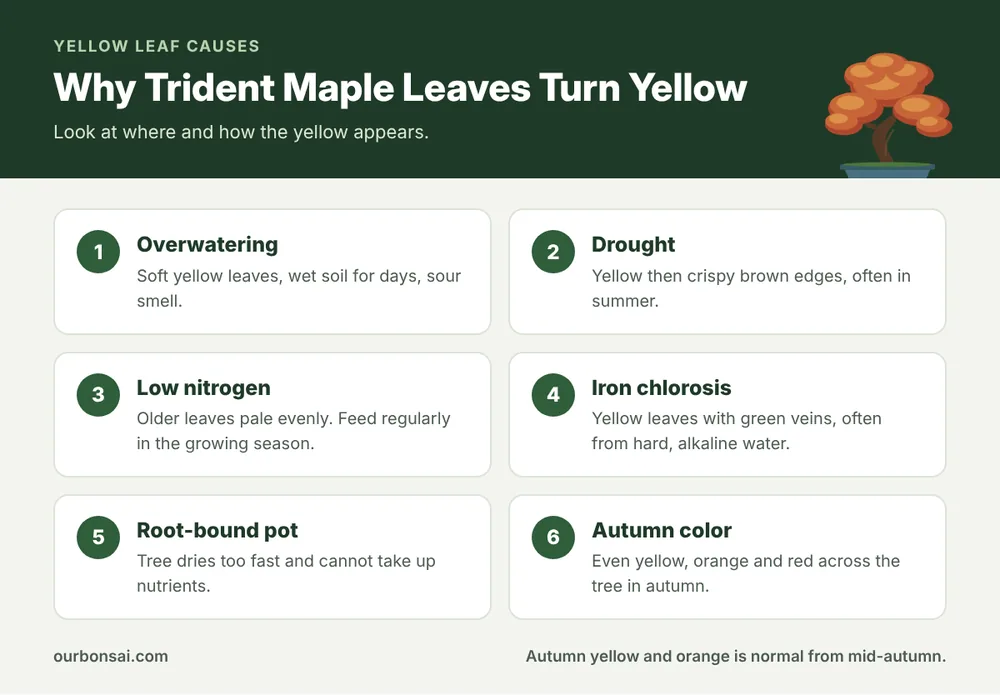
Soil that stays wet suffocates the roots. They stop taking up nutrients, and leaves turn a soft, even yellow. This is common when trees are in old, broken-down soil or ordinary potting compost. Check the roots for black, mushy tips and a sour smell, and read our guide on bonsai root rot if you find them.
2. Underwatering
Trident maples are thirsty. If the soil dries out, leaves yellow and then turn brown and crispy at the edges, often on the sunniest side. This usually happens in summer. Our guide to watering bonsai in summer has tips for hot weather.
3. Nitrogen deficiency
Bonsai soil holds few nutrients, and fast-growing tridents use them quickly. When nitrogen runs low, the tree moves it from old leaves to new ones, so older leaves pale evenly first. The fix is regular feeding from spring to late summer. See our guide to liquid bonsai fertilizers or fertilizer pellets vs liquid.
4. Iron chlorosis
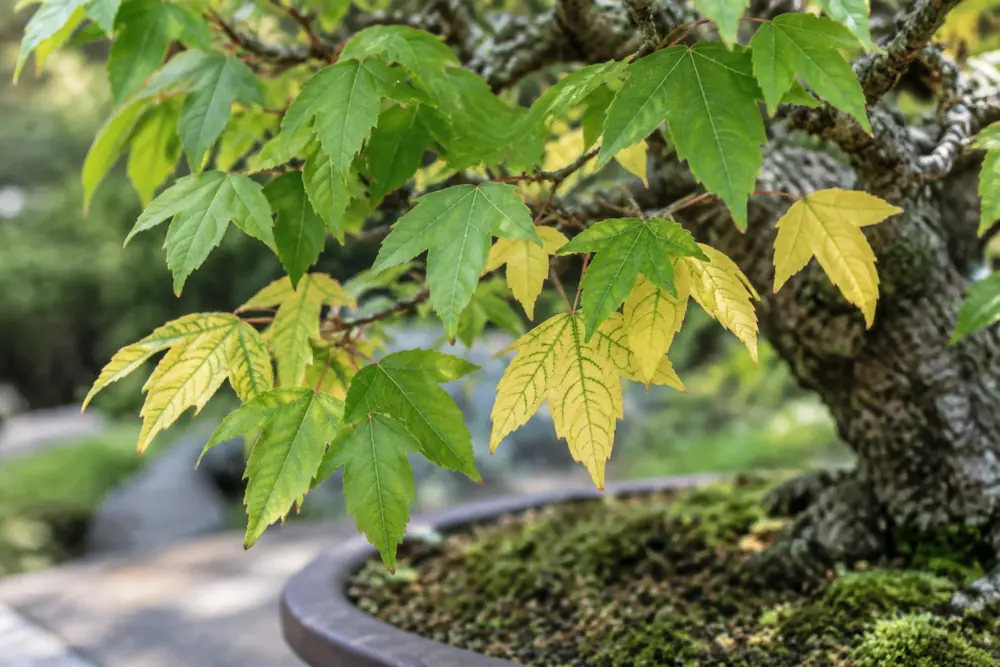
If leaves turn yellow while the veins stay green, and new leaves are worst affected, the tree probably cannot take up enough iron. This chlorosis is often caused by hard, alkaline tap water slowly raising the soil pH. Trident maples prefer slightly acidic soil. Fixes:
- Water with rainwater when you can.
- Use a fertilizer that contains trace elements, or a chelated iron supplement.
- Repot into fresh akadama-based soil, which is slightly acidic.
5. Root-bound pot
Tridents fill their pots with roots quickly. A root-bound tree dries out within hours and struggles to take up nutrients. Leaves pale and growth slows. If water runs off the surface and roots circle the pot, it is time to repot in early spring.
6. Pests
Spider mites suck sap from the underside of leaves, leaving fine speckles that turn into yellowing. Aphids on new shoots can also cause yellow, curled leaves. Check under the leaves with a magnifier. Our guide to spider mites on bonsai trees explains treatment.
How to fix yellow leaves step by step
- Check the soil moisture. Wet for days? Water less and check drainage. Bone dry? Water thoroughly, then check daily.
- Check the roots if the problem persists. Look for rot or a solid mass of circling roots.
- Look at the veins. Green veins on yellow leaves suggest iron chlorosis; switch to rainwater and a trace-element fertilizer.
- Feed regularly during the growing season if you have not been.
- Inspect for pests under the leaves.
- Be patient. Leaves that have turned fully yellow rarely green up again. Judge success by the color of new leaves.
Yellow leaves after repotting or leaf pruning
After heavy root pruning in spring, some yellowing of older leaves is common while the roots regrow. Likewise, after partial leaf pruning, a few remaining leaves may yellow. As long as new growth is green and healthy, this is normal. Wait about a month before feeding after repotting.
Preventing yellow leaves on trident maples
- Use a free-draining, slightly acidic soil, such as an akadama-based mix. Our guide to bonsai soil mix ratios gives good starting points.
- Water thoroughly when the surface starts to dry; never on a fixed schedule.
- Feed every one to two weeks from spring to late summer.
- Repot every one to three years before the pot fills solid with roots.
- Collect rainwater if your tap water is hard. A simple rain barrel makes this easy.
For a broader look at discolored leaves on all species, see our guide to bonsai leaves turning yellow or brown.
Sun, shade and leaf color
Light also plays a part in leaf color. A trident maple kept in deep shade grows larger, softer and paler leaves than one in sun, and inner leaves that get very little light yellow and drop. On the other hand, a tree moved suddenly from shade to full sun can show yellow and bleached patches before the leaves scorch. Most tridents do best in full morning sun with some protection from the hottest afternoon sun in hot climates. If you change a tree’s position, do it gradually over a week or two so the leaves can adapt.
Feeding a trident maple the right way
Because nutrient problems are such a common cause of pale or yellow leaves, it is worth getting the feeding routine right:
- Start in spring once the first leaves have fully opened, not while buds are still breaking.
- Feed every one to two weeks with liquid fertilizer, or place solid organic pellets on the soil surface every four to six weeks.
- Use a balanced fertilizer with trace elements. Higher nitrogen early in the season supports growth on developing trees; refined trees do better with a lower-nitrogen feed to keep internodes short.
- Reduce feeding in midsummer heat if the tree struggles, and stop by early autumn so it can harden off.
- Never feed a dry tree. Water first, then feed, to avoid burning the roots.
A trusted general-purpose option is covered in our guide to Miracle-Gro and other bonsai fertilizers.
FAQ: trident maple bonsai yellow leaves
Will yellow trident maple leaves turn green again?
Leaves that are only slightly pale may recover once the cause is fixed. Fully yellow leaves usually drop and are replaced by new growth.
Should I remove yellow leaves?
You can remove fully yellow or dead leaves to keep the tree tidy. Leave pale but green leaves; they still help the tree.
Can too much fertilizer cause yellow leaves?
Yes. Overfeeding can burn roots, causing yellow and brown leaves. Follow the label and never feed a dry tree.
Why do only the inner leaves turn yellow?
Inner leaves that get little light naturally yellow and drop. Thinning the outer canopy lets more light in.
Final thoughts
Trident maple bonsai yellow leaves almost always point to one of six causes: too much water, too little water, low nitrogen, iron chlorosis, a root-bound pot or pests. Read the pattern, check the soil and roots, adjust watering and feeding, and judge your progress by the new leaves. And remember, yellow in autumn is just the tree getting ready for its winter rest. For more general advice, see our bonsai care guide.