
How to Quarantine a Bonsai With Pests

Finding pests on a bonsai can be worrying, especially when you have other trees nearby. A few aphids, scale insects, mealybugs, spider mites, or fungus gnats can quickly become a larger collection-wide problem if the affected tree stays beside healthy plants.
Knowing how to quarantine a bonsai with pests gives you time to identify the problem, reduce the chance of spreading it, and treat the affected tree without putting your other bonsai at unnecessary risk. The process is usually simple: isolate the tree, inspect it carefully, clean the growing area and tools, identify the pest, begin an appropriate treatment, and continue monitoring before returning the bonsai to your collection.
This guide explains how to quarantine a bonsai properly, how long isolation should last, what to look for during inspections, which treatment mistakes to avoid, and when professional help is worthwhile.
Quick Answer
To quarantine a bonsai with pests, move it away from all other plants and place it in a clean, well-lit area with suitable temperature and airflow. Inspect the leaves, branches, trunk, soil, pot, and drainage area, identify the pest, remove visible pests, and begin an appropriate treatment. Continue regular inspections until there are no signs of active infestation.
Why Should You Quarantine a Bonsai With Pests?
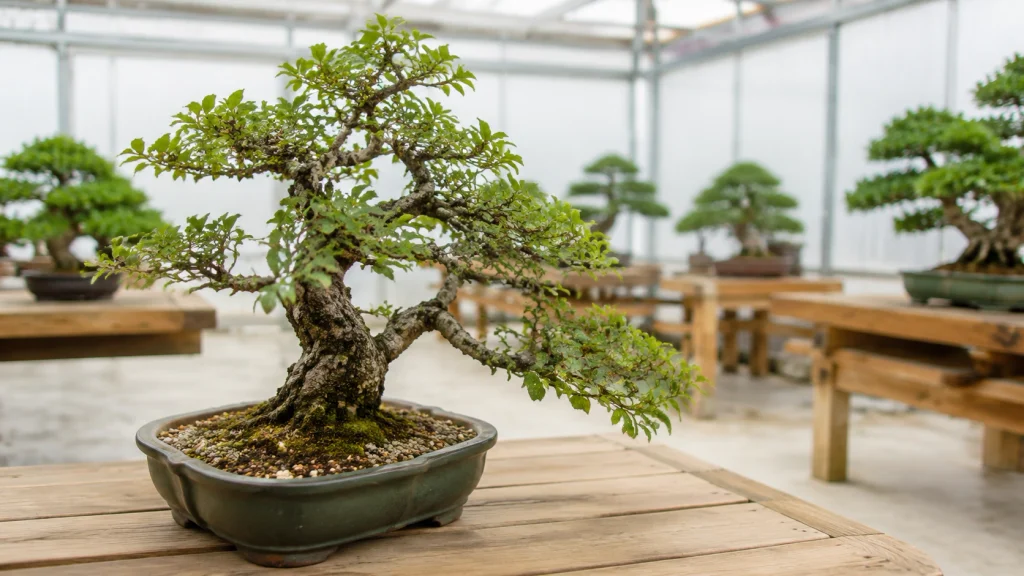
Quarantine is simply temporary isolation. It prevents an infested bonsai from sharing the same environment with healthy plants while you determine what is wrong and treat it.
Pests can spread through direct contact, wind movement, crawling insects, contaminated tools, hands, pots, plant debris, and even nearby surfaces. Some pests are also small enough to escape notice during a quick visual inspection.
The University of Minnesota Extension guidance on indoor plant insects recommends isolating plants when pests are detected and inspecting plants regularly for insects and signs of infestation.
This is particularly important for bonsai because a collection often contains many trees in a relatively small space. One infested tree sitting among ten healthy bonsai can turn a small problem into a collection-wide problem.
Quarantine is not punishment for the tree. It is protection for the entire collection.
Which Bonsai Pests Require Quarantine?
Almost any confirmed insect or mite infestation is a good reason to isolate a bonsai.
Common pests include:
| Pest | Typical signs | Spread risk | Important consideration |
|---|---|---|---|
| Aphids | Clusters of small insects, curled or distorted new growth, sticky honeydew | High | Often gather on tender shoots |
| Mealybugs | White cotton-like clusters | High | Hide in leaf joints and protected areas |
| Scale | Brown, gray, white, or shell-like bumps | High | Can be difficult to eliminate completely |
| Spider mites | Fine webbing, stippled leaves, leaf drop | High | Thrive under warm, dry conditions |
| Thrips | Silvery or damaged leaves, distorted growth | High | Small and difficult to detect |
| Whiteflies | Tiny white flying insects beneath leaves | High | Adults move easily between plants |
| Fungus gnats | Small flying insects around soil | Moderate | Often associated with persistently wet soil |
| Root pests | Weak growth, poor vigor, root damage | Variable | May be difficult to detect without inspecting roots |
Not every insect around a bonsai is harmful. Some insects are harmless or even beneficial.
Do not automatically spray an unknown insect. Identify the problem first whenever possible.
Correct identification matters because different pests have different life cycles and respond to different treatments. UC IPM also recommends correctly identifying the pest or disease before selecting a management method.
Where Should You Quarantine a Bonsai?
The ideal quarantine area is separate from your main bonsai collection, not simply a few inches away.
For an indoor bonsai, this could be a separate room. For outdoor trees, use a location that is physically separated from other bonsai and does not allow branches or foliage to touch.
The quarantine area should provide:
- Appropriate light for the bonsai species
- Suitable temperature
- Good air circulation
- Protection from extreme weather
- Easy access for inspection
- A clean surface that can be wiped down
- Enough space to work around the tree without touching other plants
Avoid placing the affected bonsai in a dark closet or poorly ventilated corner simply because it is isolated. Quarantine should not create additional stress.
A tree already dealing with pests still needs appropriate light, watering, temperature, and airflow.
Keep the Bonsai’s Normal Care Routine
Quarantine does not mean neglect.
Continue to monitor:
- Soil moisture
- Leaf condition
- New growth
- Temperature
- Light exposure
- Humidity where relevant
- Drainage
- Overall vigor
Avoid the temptation to compensate for pest damage by heavily fertilizing or watering the tree.
If the soil is already wet, adding more water will not help the bonsai recover. In fact, persistently wet soil can create additional root problems.
How to Quarantine a Bonsai With Pests: Step-by-Step
1. Move the Bonsai Away From Other Plants
As soon as you suspect an infestation, isolate the tree.
Move it carefully so that leaves, branches, soil, or insects do not brush against neighboring plants.
If several bonsai are already close together, inspect the surrounding trees as well. You may discover that the problem is not limited to one plant.
USDA APHIS notes that moving plants or plant material can spread pests and diseases and recommends keeping plants separate for a period of observation when necessary.
2. Inspect the Entire Bonsai
Do not inspect only the leaves.
Check:
- Tops of leaves
- Undersides of leaves
- New shoots
- Branch junctions
- Trunk crevices
- Bark
- Buds
- Flowers or fruit, if present
- Soil surface
- Pot rim
- Drainage holes
- Saucer or tray
- Nearby plant debris
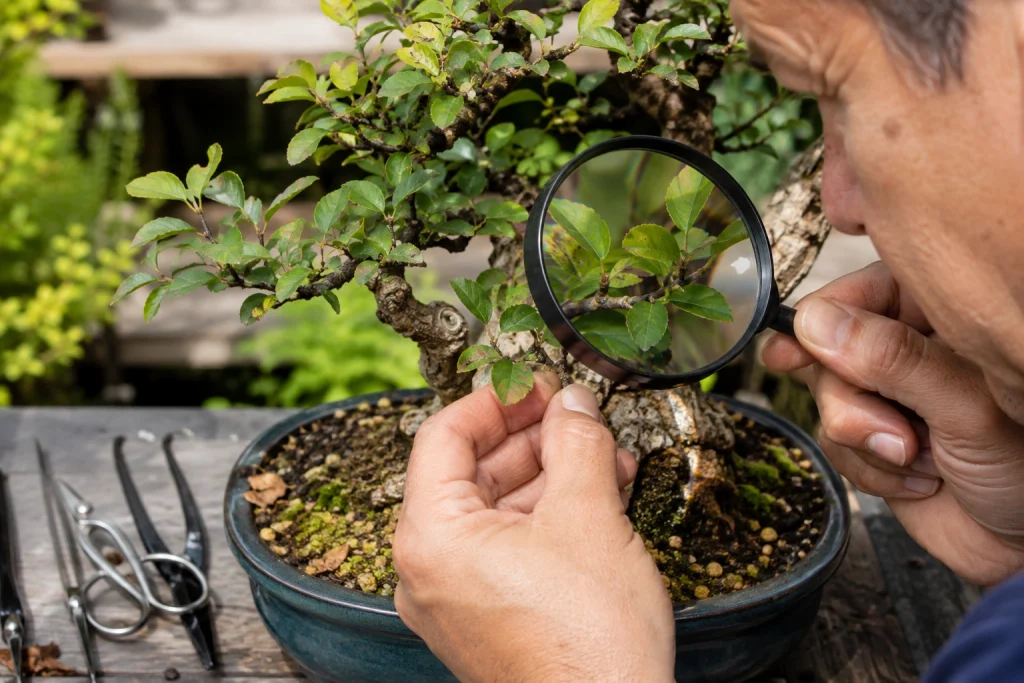
Use a 10× hand lens if possible. Some mites and young insects are extremely difficult to see with the naked eye.
Look for:
- Webbing
- Sticky honeydew
- White cottony material
- Small bumps attached to stems
- Eggs
- Tiny moving insects
- Distorted leaves
- Yellow stippling
- Silver-colored damage
- Premature leaf drop
- Weak or distorted new growth
3. Take a Few Clear Photos
Before treatment, photograph the pest and the damage.
Take close-up photographs of:
- The insect or suspected pest
- The damaged leaf
- The affected branch
- The whole bonsai
These photographs can be useful when asking an experienced grower, extension specialist, plant clinic, or arborist for help.
They also give you a reference for comparing the infestation over time.
4. Identify the Pest Before Choosing Treatment
This is one of the most important steps.
Aphids, scale, mealybugs, spider mites, thrips, and soil-dwelling pests do not behave exactly the same way.
For example, spider mites may produce fine webbing and stippled foliage, while scale insects appear as stationary bumps attached to plant surfaces.
A hand lens can make identification much easier. University extension resources such as UC IPM’s houseplant pest management guidance provide useful information about identifying and managing common insect and mite problems.
Do not assume that every white spot is mealybug or every tiny moving insect is a harmful pest.
5. Remove Heavily Infested Plant Parts When Appropriate
If the infestation is limited to a few leaves or small shoots, removing those heavily affected parts can reduce the pest population.
However, be careful with pruning.
A bonsai that is already stressed by pests may not respond well to aggressive pruning. Removing large branches simply to eliminate a few insects can create more stress than necessary.
Use clean, sharp tools and remove only what is reasonably justified.
Place heavily infested material into a sealed bag before disposal so insects do not crawl or fly onto nearby plants.
6. Physically Remove Visible Pests
For light infestations, physical removal can be surprisingly effective.
Depending on the pest and species, you may:
- Wipe leaves gently
- Wash foliage with an appropriate stream of water
- Remove individual scale insects
- Remove mealybugs with a suitable cotton swab method
- Remove badly infested leaves
- Clean the pot and surrounding surface
Be gentle with delicate foliage and young shoots.
A bonsai is a miniature tree, not a miniature plastic plant. Its foliage and bark can be damaged by excessive pressure, repeated scrubbing, or inappropriate chemicals.
7. Clean Your Tools and Work Area
Pests can move on tools, hands, gloves, containers, and plant debris.
After working on the infested bonsai:
- Remove fallen leaves
- Clean the work surface
- Clean pruning tools
- Wash your hands
- Avoid touching healthy bonsai immediately afterward
- Keep quarantine tools separate when practical
For certain pests, sanitation is especially important. UC IPM notes that contaminated containers, equipment, hands, and tools can contribute to pest movement.
8. Choose Treatment Based on the Pest
Treatment should match the pest, bonsai species, growing conditions, and severity of the infestation.
For minor infestations, nonchemical methods may be enough.
For persistent problems, a labeled insecticidal soap, horticultural oil, insecticide, or miticide may be appropriate.
Never assume that a product safe for one plant is automatically safe for every bonsai species.
Before using any pesticide:
- Identify the pest.
- Check that the product is labeled for the intended use.
- Follow the label directions exactly.
- Check whether the bonsai species has known sensitivity.
- Test cautiously when the label permits.
- Avoid spraying during unsuitable heat or intense sunlight.
- Wear the protective equipment specified on the label.
The EPA’s pesticide safety information emphasizes following pesticide label directions and using appropriate safety practices.
9. Monitor the Bonsai Regularly
Treatment is rarely the end of the process.
Some pests have eggs or life stages that survive an initial treatment. You may see new insects later even when the first treatment appeared successful.
Inspect the tree regularly and record:
- Number of visible pests
- New damage
- New growth condition
- Leaf drop
- Webbing
- Sticky residue
- Pest activity after treatment
Look for a declining pest population, not simply a temporarily clean-looking tree.
10. Return the Bonsai Only After the Problem Is Under Control
Do not rush to return the tree to the collection because you cannot see insects for one day.
Continue monitoring until the infestation is clearly inactive and the tree is showing healthy progress.
The appropriate quarantine period varies with the pest, species, environment, and treatment program. A short observation period may be sufficient for some minor issues, while persistent pests may require considerably longer monitoring.
For new plants, the University of Minnesota Extension recommends isolation for roughly one to two weeks as an initial monitoring period, while established infestations may require a longer period based on the pest and treatment response.
How Far Away Should a Quarantined Bonsai Be?
There is no universal distance that guarantees protection.
Physical separation is more important than choosing a magic number of feet or meters.
The goal is to prevent:
- Leaves touching
- Branches touching
- Insects crawling between plants
- Wind carrying pests directly to nearby foliage
- Shared tools transferring pests
- Water movement carrying contaminated debris
- People accidentally spreading pests between plants
For pests that can move through air currents or on clothing and tools, greater separation is helpful.
If you can quarantine the tree in a separate room or clearly separated growing area, that is generally safer than simply moving it to the opposite side of the same bonsai bench.
Should You Repot a Bonsai During Pest Quarantine?
Usually, not immediately.
Repotting is a major intervention. It can disturb roots and add stress to a tree that is already dealing with an infestation.
If the pest is clearly associated with the soil or roots, repotting may eventually become part of the treatment strategy. However, timing depends heavily on the bonsai species, season, root condition, pest, and severity of the infestation.
For example, fungus gnats are strongly associated with persistently moist growing media, so correcting watering practices may be more useful than immediately performing a major root operation.
Do not automatically repot every bonsai with insects.
If the tree is weak, avoid stacking multiple stressful procedures together unless there is a clear reason to do so.
Signs the Bonsai Is Becoming Seriously Stressed
Pests are only one part of the problem. An infestation can expose underlying care issues.
Watch for:
- Rapid leaf yellowing
- Sudden leaf drop
- Wilting despite moist soil
- Dry, brittle foliage
- Blackened or soft roots
- Weak new growth
- Persistent lack of vigor
- Severe branch dieback
- Extensive discoloration
- Mold or fungal growth
- Soil that stays saturated for too long
If the bonsai is declining rapidly, stop and reassess the entire growing environment.
Do not assume every symptom is caused by the pest.
Overwatering, poor drainage, insufficient light, temperature stress, root damage, and inappropriate fertilizer can produce symptoms that resemble pest damage.
Expert Tip
Treat the pest population, not just the visible insects. Check hidden areas such as leaf undersides, branch junctions, pot rims, and new growth, then continue monitoring after treatment so surviving eggs or immature pests do not restart the infestation.
Quarantine Checklist for a Pest-Infested Bonsai
| Task | What to do | Why it matters |
|---|---|---|
| Isolate | Move the tree away from healthy bonsai | Reduces spread |
| Inspect | Check leaves, branches, trunk, soil, and pot | Finds hidden pests |
| Identify | Use a hand lens if necessary | Prevents incorrect treatment |
| Clean | Remove debris and clean work surfaces | Reduces pest transfer |
| Prune | Remove only severely affected parts when appropriate | Lowers pest pressure |
| Treat | Use a pest-specific method | Improves treatment effectiveness |
| Monitor | Inspect repeatedly after treatment | Detects surviving pests |
| Reassess | Check light, watering, drainage, and vigor | Prevents secondary stress |
| Reintroduce | Return only when the infestation is controlled | Protects the collection |
Common Mistakes Bonsai Owners Should Avoid
- Keeping the affected bonsai beside healthy trees. A small gap may not provide meaningful isolation.
- Spraying before identifying the pest. Incorrect treatment can waste time or damage foliage.
- Using homemade soap mixtures without understanding plant sensitivity. Some mixtures can injure foliage.
- Overwatering a stressed bonsai. More water does not automatically improve recovery.
- Heavy pruning immediately after discovering pests. Excessive pruning can add unnecessary stress.
- Repotting automatically. Root disturbance should have a clear purpose.
- Stopping treatment after one application. Some pest life stages can survive the first treatment.
- Ignoring the pot and surrounding area. Pests can hide around pot rims, trays, and debris.
- Using dirty pruning tools between trees. Tools can contribute to pest or disease spread.
- Returning the tree too quickly. A temporary absence of visible insects does not always mean the infestation is gone.
- Treating every insect as harmful. Correct identification matters.
- Ignoring the tree’s growing conditions. Poor light, bad watering, or weak roots can make recovery more difficult.
When to Ask an Experienced Bonsai Grower or Arborist
Most minor pest problems can be managed by careful bonsai owners. However, professional or experienced help is worthwhile when the situation becomes uncertain or severe.
Consider asking for help when:
- You cannot identify the pest.
- The bonsai is rapidly losing foliage.
- The trunk or major branches are declining.
- You suspect a serious root problem.
- The infestation keeps returning despite treatment.
- Multiple valuable bonsai have become affected.
- You are considering major structural pruning.
- You are considering significant root work on a weak tree.
- You are unsure whether a pesticide is appropriate.
- The bonsai is rare, old, or especially valuable.
An experienced bonsai grower can often recognize species-specific symptoms that are difficult for beginners to interpret.
For severe tree-health problems, an arborist or qualified plant-health professional may also be appropriate. Do not perform major root pruning or structural work on a severely stressed bonsai simply because you want to remove every possible source of the problem.
FAQs
How long should I quarantine a bonsai with pests?
There is no single quarantine period for every pest. Continue isolation while the infestation is active and monitor the tree after treatment. Minor problems may resolve relatively quickly, while persistent pests require longer observation.
Can I quarantine a bonsai outdoors?
Yes, provided the location is suitable for the species and genuinely separated from healthy plants. Avoid placing the infested bonsai where wind, branches, or people can easily transfer pests to nearby trees.
Should I quarantine a new bonsai even if it looks healthy?
Yes. New plants can carry pests that are difficult to notice during a quick inspection. A short isolation period allows you to observe new growth and detect hidden problems before introducing the tree to your collection.
Can I use neem oil on a pest-infested bonsai?
Neem-based products may be useful for some pest problems, but they are not universally appropriate for every bonsai species or every pest. Follow the specific product label and avoid assuming that a natural product is automatically risk-free.
Should I spray pesticides immediately after finding pests?
Not necessarily. First identify the pest and determine whether physical removal or cultural control may be sufficient. If a pesticide is needed, use a product labeled for the plant and pest and follow the label directions.
Can pests spread from one bonsai to another?
Yes. Some pests can move through direct contact, air currents, tools, hands, containers, plant debris, or other nearby surfaces. This is why prompt isolation is one of the first steps after discovering an infestation.
Should I throw away a bonsai with a severe pest infestation?
Not always. Many infestations can be treated. However, if a tree is severely damaged and unlikely to recover, disposal may sometimes be the most practical way to protect the rest of a collection. The decision depends on the species, value, pest, tree condition, and likelihood of successful treatment.
Conclusion
Learning how to quarantine a bonsai with pests is one of the simplest ways to protect an entire bonsai collection. The key is to act early rather than waiting for an infestation to become severe.
Move the affected tree away from healthy plants, inspect every part of the bonsai, identify the pest, clean your tools and growing area, remove visible pests where appropriate, and select a treatment suited to the actual problem. Continue monitoring after treatment rather than assuming one application has solved everything.
Most importantly, remember that pest control and bonsai care work together. A healthy tree with suitable light, watering, drainage, temperature, and nutrition is generally better prepared to recover from pest pressure.
If you discover pests on your bonsai, quarantine first and investigate second. A calm, methodical response is usually much safer than aggressive pruning, unnecessary repotting, or repeated pesticide applications.
Protect your collection by making isolation part of your normal bonsai-care routine, especially whenever you bring home a new tree.
