How to Treat Aphids on Bonsai Naturally
Quick Answer
To treat aphids on bonsai naturally, isolate the tree, rinse aphids from sturdy foliage with water, and remove remaining clusters by hand. If they return, use a labeled insecticidal soap or horticultural oil such as neem, following the product directions carefully; the University of Minnesota Extension aphid guidance also recommends low-risk controls such as soaps and oils when treatment is needed.
Natural Aphid Treatment Steps
- Isolate the bonsai: Keep the affected tree away from other bonsai and houseplants while aphids are active.
- Inspect new growth: Check tender shoots, buds, stems, and leaf undersides where aphids commonly gather.
- Rinse them away: Use a controlled stream of water on foliage sturdy enough to tolerate it.
- Remove survivors: Wipe or pick off visible colonies without damaging tender shoots.
- Use low-impact treatment: Apply labeled insecticidal soap or neem/horticultural oil if physical removal is not enough.
- Recheck frequently: Inspect the tree every few days until no new aphids or honeydew appear.
One Important Precaution
- Avoid guessing homemade soap or oil concentrations on valuable bonsai. Tender foliage can react badly to mixtures that seem harmless on tougher garden plants.
Aphids look harmless at first, but a crowded colony can distort the delicate new growth that gives a bonsai its shape. Learning how to treat aphids on bonsai naturally lets you control them without immediately reaching for broad-spectrum insecticides.
I prefer a simple progression: identify the pest, remove as many as possible physically, and escalate only when the population keeps returning. That approach protects the tree while giving beneficial insects a better chance to help.
In This Guide
- How Can You Tell If Your Bonsai Has Aphids?
- What Is the Safest Natural Way to Treat Bonsai Aphids?
- Water vs. Insecticidal Soap vs. Neem Oil: Which Works Best?
- How Often Should You Treat and Recheck the Bonsai?
- Why Do Aphids Keep Coming Back to a Bonsai?
- How Can You Prevent Aphids Naturally?
- Frequently Asked Questions
How Can You Tell If Your Bonsai Has Aphids?
Aphids are small, soft-bodied, sap-feeding insects that commonly cluster around tender shoots and young leaves. They may be green, black, yellow, brown, gray, pink, or other colors depending on the species.
Aphid definition: Aphids are piercing-sucking insects that feed on plant sap, often concentrating on soft new growth and producing a sugary waste liquid called honeydew.
What are the clearest signs?
Do not rely on insect color alone. The location of the insects and the damage they leave often make identification easier.
- Clusters on new shoots: Tender stems, buds, and unfolding leaves are common feeding areas.
- Curled leaves: Feeding can distort young foliage as it develops.
- Sticky surfaces: Honeydew may coat leaves, branches, pots, benches, or windowsills.
- White skins: Pale shed skins can remain beside active aphid colonies.
- Ant activity: Ants may visit aphids because they feed on honeydew.
- Black surface growth: Sooty mold can develop where honeydew accumulates.
The Bonsai Empire pest and disease guide also lists aphids among insects commonly found on bonsai. Correct identification matters because scale, mealybugs, whiteflies, and mites require somewhat different management.
Where should you inspect?
Start with the newest growth and work inward. A small hand lens can help when the insects are tiny.
- Check growing tips and unopened buds.
- Turn over young leaves.
- Inspect petioles and branch junctions.
- Look along tender green stems.
- Check lower leaves for dripping honeydew.
- Look for ants moving repeatedly into the canopy.
Spider mites are particularly easy to confuse with other problems. Fine webbing and pale stippling point more toward mites than aphids.
What Is the Safest Natural Way to Treat Bonsai Aphids?
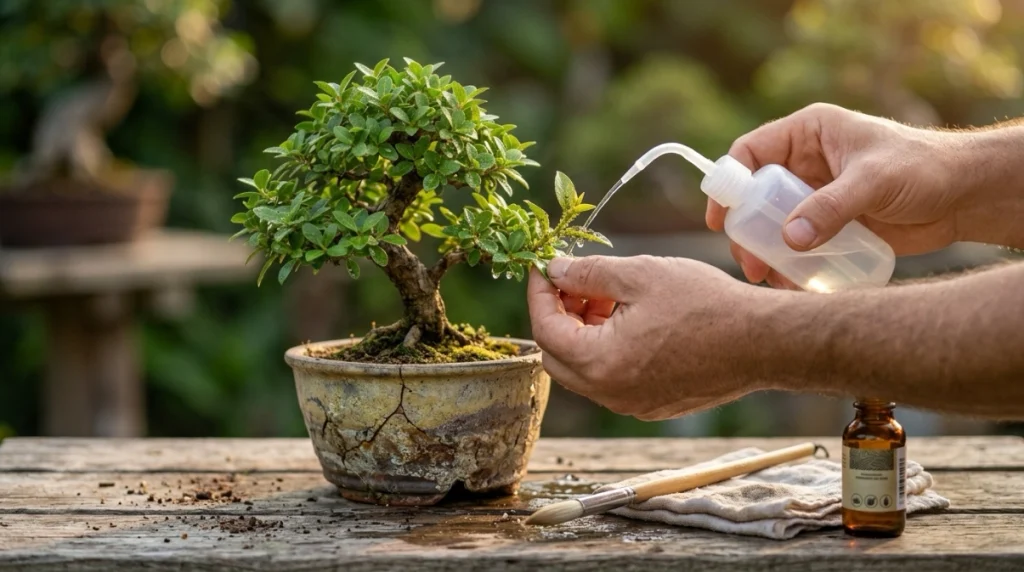
The safest starting point is usually mechanical control. Remove aphids without adding another stressor to the tree.
Step 1: Isolate the bonsai
Move the affected bonsai away from neighboring trees and houseplants. Keep its leaves and branches from touching healthy plants.
Isolation is especially useful indoors or in a tightly spaced bonsai collection. Winged aphids can also appear when colonies become crowded.
Step 2: Remove aphids with water
For sturdy broadleaf foliage, a controlled stream of water can knock many aphids from shoots and leaf undersides. Support delicate branches with your free hand while rinsing.
- Avoid blasting fragile new growth.
- Keep excessive water from flooding the bonsai soil.
- Direct the rinse away from neighboring plants.
- Check leaf undersides afterward for survivors.
Water works best when you catch the infestation early. Large colonies hidden inside tightly curled foliage may need additional treatment.
Step 3: Remove remaining clusters manually
Small colonies can often be wiped away carefully with fingers or a damp soft cloth. A soft artist’s brush can help around delicate shoots.
If only one or two shoot tips are badly infested, removing those tips may sometimes be reasonable. Do not sacrifice important styling branches simply to eliminate a few aphids.
Pro tip: Any pruning of live bonsai wood is irreversible. If the affected shoot is important to the design, ask an experienced grower or local bonsai club before cutting it.
Step 4: Use a labeled low-impact treatment if needed
If aphids remain after physical removal, commercial insecticidal soap or horticultural oil can provide another option. Plant-derived neem oil is included in many horticultural oil products.
UC Integrated Pest Management’s aphid guidance recommends nonchemical controls first and identifies insecticidal soaps and oils as lower-impact choices when treatment becomes necessary.
- Read the product label completely.
- Confirm the product is suitable for the plant.
- Test sensitive foliage when the label recommends it.
- Cover aphids directly, including leaf undersides.
- Avoid treating a drought-stressed bonsai.
- Follow temperature and sunlight precautions on the label.
I avoid treating a stressed tree with several products at once. One controlled method followed by careful observation is easier on the bonsai and easier to evaluate.
Water vs. Insecticidal Soap vs. Neem Oil: Which Works Best?
No single treatment is automatically best for every bonsai. Your choice should depend on infestation size, leaf sensitivity, tree health, and whether beneficial insects are already active.
| Method | Best Use | Main Advantage | Main Limitation |
|---|---|---|---|
| Water spray | Light, exposed colonies | No pesticide residue | May miss hidden aphids |
| Manual removal | Small infestations | Highly targeted | Slow on large colonies |
| Insecticidal soap | Persistent exposed aphids | Contact control of soft-bodied insects | Coverage is essential |
| Neem/horticultural oil | Recurring colonies when label permits | Low-residual contact approach | Some foliage may be sensitive |
| Natural enemies | Outdoor growing areas | Ongoing biological pressure | Not an instant cure |
What about ordinary dishwashing liquid?
Commercial insecticidal soap is not the same thing as household detergent. Dishwashing products can contain degreasers, fragrances, dyes, or other ingredients not designed for plant foliage.
For a valuable bonsai, I would choose a labeled insecticidal soap instead of guessing a homemade concentration. The predictable formulation makes careful application much easier.
Is neem oil completely harmless?
No pest-control spray should be treated as harmless simply because it comes from a plant source. Oils can injure sensitive or stressed foliage under unsuitable conditions.
The UC IPM guide to less-toxic insecticides stresses reading labels and matching the treatment to the plant and pest. Complete coverage is also important for contact treatments.
How Often Should You Treat and Recheck the Bonsai?
Reinspection is more important than automatically spraying on a fixed calendar. Aphids can remain hidden or reappear after the first treatment.
During an active infestation, I recommend checking the affected bonsai every two or three days. Look closely at the same shoots where the original colony appeared.
What should you look for after treatment?
- Living aphids on young shoots.
- New clusters on leaf undersides.
- Fresh sticky honeydew.
- Newly curled or distorted foliage.
- Ants returning to the canopy.
- Healthy new growth without fresh feeding damage.
Do not assume dead aphids or old damage mean treatment failed. Existing curled leaves may stay distorted after the insects are gone.
Repeat insecticidal soap, neem, or horticultural oil only as the product label directs. Contact treatments may require another application because they mainly affect insects reached by the spray.
When is the infestation under control?
You want repeated inspections with no living colonies and no fresh honeydew. New shoots should also emerge without new aphid clusters.
Keep the bonsai separated until you are confident the active infestation has stopped. A few extra inspections are easier than treating several neighboring trees.
Why Do Aphids Keep Coming Back to a Bonsai?
Recurring aphids usually mean the original population was not completely removed, new aphids arrived, or growing conditions continue to provide attractive soft growth. Ants can also interfere with natural aphid control.
Are ants causing the problem?
Ants are attracted to the sugary honeydew produced by aphids. Their repeated presence is an excellent reason to inspect the newest bonsai growth again.
Some ants protect honeydew-producing insects from predators. Controlling ant access can therefore support natural enemies already present outdoors.
Can too much fertilizer encourage aphids?
Heavy nitrogen feeding can produce abundant soft growth that sap-feeding insects favor. Do not respond to aphid damage by automatically adding extra fertilizer.
Keep feeding appropriate for the bonsai species, season, and development stage. Healthy growth matters, but forced tender growth is not the goal.
Could nearby plants be the source?
Yes. Check houseplants, garden plants, weeds, and other bonsai near the affected tree.
Look especially closely when branches touch or several plants share a crowded growing space. Treating one bonsai while ignoring an infested neighbor can lead to repeated outbreaks.
How Can You Prevent Aphids Naturally?
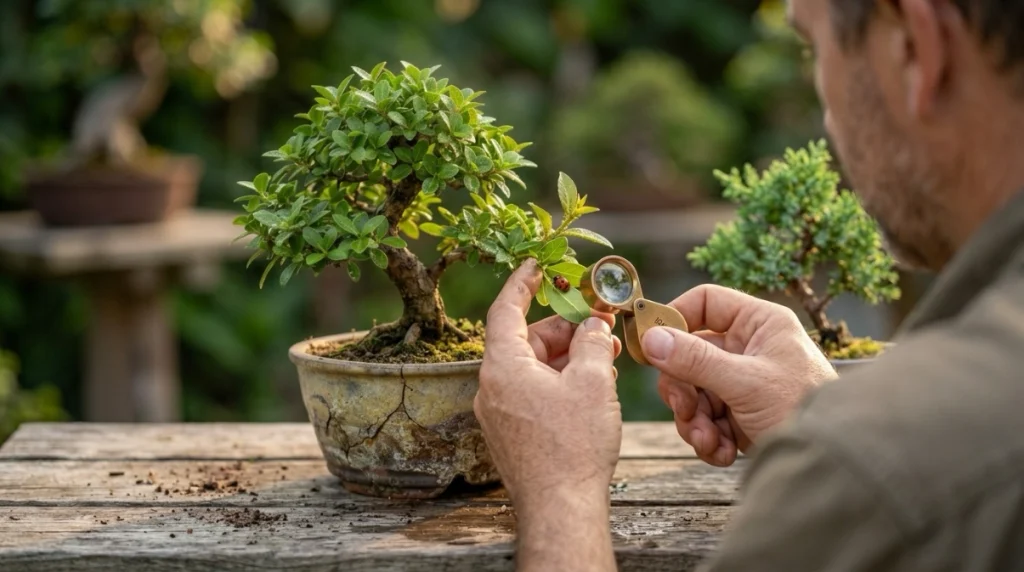
Prevention depends on regular inspection more than constant spraying. Catching a colony while it occupies one growing tip gives you far more control.
Use a simple inspection routine
- Inspect new growth whenever you water.
- Turn over several leaves each week.
- Check immediately when leaves begin curling.
- Investigate sticky residue instead of wiping it away and forgetting it.
- Inspect new bonsai before placing them in your collection.
- Watch for ants repeatedly climbing trunks or benches.
Beneficial insects such as lady beetles, lacewing larvae, syrphid fly larvae, and parasitoid wasps naturally attack aphids outdoors. Avoid unnecessary broad-spectrum insecticides that can kill these helpers along with the pests.
As of 2026, this integrated approach remains one of the most sensible ways to manage aphids. Monitor first, use physical control early, protect beneficial organisms, and choose targeted treatments only when necessary.
Keep the bonsai healthy without overcorrecting
Aphids do not automatically mean your watering, soil, or lighting routine is wrong. Avoid making several major care changes simply because you discovered insects.
Maintain species-appropriate sunlight, drainage, watering, and fertilization. A stable tree can focus its resources on healthy growth after the infestation is controlled.
Section Takeaway: The best natural aphid prevention strategy is frequent inspection combined with early physical removal. Preserve beneficial insects and avoid unnecessary treatments that disrupt the wider growing environment.
Frequently Asked Questions
Can aphids kill a bonsai tree?
A small aphid population rarely kills an otherwise healthy bonsai immediately. Heavy or prolonged feeding can weaken young growth, distort foliage, reduce vigor, and create additional stress, so early control is worthwhile.
Can I spray aphids off a bonsai with water?
Yes, if the foliage and branches are sturdy enough. Use a controlled stream that removes aphids without breaking tender shoots or washing excessive water into the bonsai pot.
Is neem oil good for aphids on bonsai?
Neem-containing horticultural oils can help suppress aphids when the product is labeled for your plant and situation. Follow the label carefully because foliage sensitivity, heat, drought stress, and poor application timing can increase injury risk.
Does insecticidal soap kill aphids?
Commercial insecticidal soaps can control exposed soft-bodied insects such as aphids through direct contact. Thorough coverage matters, especially around leaf undersides and tender shoots where colonies commonly hide.
Why are my bonsai leaves sticky after aphids appear?
Aphids excrete a sugar-rich liquid called honeydew while feeding. It can make foliage, branches, pots, shelves, and surfaces beneath the bonsai feel sticky and may support black sooty mold.
Should I repot a bonsai because it has aphids?
Usually not. Aphids normally feed above the soil on shoots and foliage, so unnecessary repotting adds root stress without solving the main problem.
Are ladybugs useful for bonsai aphid control?
Lady beetles and their larvae eat aphids and can contribute to biological control outdoors. Natural predator populations usually work best as part of a wider pest-management approach rather than as an instant cure for a severe infestation.
Aphids are frustrating, but they are much easier to manage when you catch them early. Start with isolation, identification, water, and careful physical removal before moving to a labeled low-impact treatment.
Keep checking the new growth afterward. If identification remains uncertain or a valuable bonsai continues declining, ask a local bonsai club, experienced grower, or horticulture extension service for help before escalating treatment.