
Why Are My Bonsai Leaves Turning Black?

Seeing black leaves on a bonsai can be alarming. One day the foliage looks healthy, and the next you notice dark spots, blackened edges, or entire leaves turning brown-black and dropping. If you are wondering, “Why are my bonsai leaves turning black?”, the important thing is not to treat the color alone. Black foliage is a symptom, and several different problems can cause it.
Overwatering, poor drainage, root damage, fungal or bacterial disease, pests, cold or heat stress, and fertilizer or chemical damage can all play a role. The pattern of the damage usually provides important clues.
This guide explains the most common causes of black bonsai leaves, how to distinguish them, what to do immediately, and when the problem requires more than simple care adjustments.
Quick Answer
Why are my bonsai leaves turning black? The most common causes are excess moisture, root problems, fungal or bacterial disease, pests, temperature stress, and chemical or fertilizer damage. Check the soil, roots, leaves, branches, and recent care changes before treating the tree. Avoid adding pesticides or fertilizer until you have identified the likely cause.
What Black Bonsai Leaves Can Tell You
Black leaves do not automatically mean your bonsai has a pest infestation. In fact, the first question should be whether the damage is affecting individual leaves or the entire tree.
Look closely at:
- Where the blackening starts
- Whether spots have defined edges
- Whether leaves feel dry and crispy or soft and water-soaked
- Whether new growth is affected
- Whether branches are also darkening
- Whether leaves are dropping
- How wet the soil stays after watering
- Whether you recently changed fertilizer, pesticide, location, or watering habits
Plant-health problems often have overlapping symptoms. For example, university plant-diagnostic guidance lists fungal and bacterial infections, root rot, overwatering, pesticide injury, and environmental stress among possible causes of abnormal leaf color and dead tissue. Penn State Extension’s guide to diagnosing poor plant health is a useful reference when several possibilities look similar.
1. Overwatering and Poor Drainage
Overwatering is one of the first things to investigate when bonsai leaves become dark, soft, or black.
The problem is not simply that you gave the tree too much water once. The bigger issue is soil that remains wet for too long. Bonsai roots need both moisture and oxygen. When the growing medium stays saturated, roots can become stressed or damaged.
This can eventually lead to:
- Yellowing followed by black or brown leaves
- Soft or limp foliage
- Leaf drop
- Weak new growth
- A sour or stagnant smell from the soil
- Poor response to watering
- Dark or unhealthy roots
A bonsai in a shallow pot can look deceptively dry on top while remaining wet deeper in the root zone.
What to do
Do not automatically stop watering for a fixed number of days. Instead, check the actual moisture level.
If the soil is still wet, allow the appropriate drying period for your species and growing conditions before watering again. Make sure drainage holes are open and that the pot is not sitting in standing water.
Do not repot a severely stressed tree simply because a few leaves have turned black. Repotting is another major stress and should be based on the condition of the roots, soil, species, and season.
2. Root Rot Can Cause Black Leaves
Root problems are more serious than a few damaged leaves because the roots support the entire canopy.
Root rot can develop when roots remain excessively wet and poorly aerated. Affected roots may become dark, soft, weak, or foul-smelling rather than firm and healthy.
The foliage may then deteriorate because damaged roots cannot supply water and nutrients effectively.
Signs that roots may be involved
Watch for a combination of symptoms:
- Leaves turning yellow, brown, or black
- Sudden or progressive leaf drop
- Weak shoots
- Soil staying wet unusually long
- A sour smell from the pot
- Poor recovery after watering
- Dark, mushy roots if the tree is carefully inspected
Do not perform aggressive root pruning on a tree that is already severely weakened unless you understand the species and timing. Removing a large amount of living root tissue can make an already stressed bonsai harder to recover.
3. Fungal or Bacterial Leaf Disease
Black spots can also result from plant disease.
Disease is more likely when the black areas begin as small spots that gradually enlarge, especially if they have yellow or brown margins. Leaves may eventually develop large dead areas and fall.
Some bacterial diseases can produce leaf spots, blights, and darkened tissue. They are often favored by warm, wet conditions and can spread through water splashing, insects, plant debris, or wounds. Penn State Extension’s plant disease guide explains how fungal and bacterial pathogens can cause leaf spots and other plant symptoms.
University of Minnesota Extension also documents bacterial blight in which leaf spots enlarge and merge, eventually causing leaves to turn black and die.
Disease is more suspicious when you see:
- Multiple leaves with similar spots
- Spots increasing in size
- Yellow halos around dark lesions
- Blackened young shoots
- Branch dieback
- Symptoms spreading from one part of the tree to another
- Persistent wet foliage or poor air circulation
Do not assume every black spot is fungal disease. Environmental damage can look very similar.
4. Poor Airflow and Constantly Wet Foliage
Bonsai kept in humid, poorly ventilated areas can be more vulnerable to leaf disease.
This is especially relevant when leaves remain wet for long periods. Dense foliage, crowded plants, sheltered corners, and frequent overhead watering can create conditions that favor disease development.
Good airflow does not mean exposing a bonsai to harsh wind. The goal is gentle air movement that helps foliage dry naturally.
If your bonsai is indoors, avoid placing it directly beside a constantly running heater or air conditioner. If it is outdoors, avoid tightly crowding several plants together.
5. Pests Can Contribute to Black Leaves
Pests do not always cause black leaves directly, but they can weaken foliage and create conditions for secondary problems.
Common bonsai pests include:
- Aphids
- Scale insects
- Spider mites
- Thrips
- Mealybugs
- Whiteflies
Look underneath leaves and around new shoots, branch junctions, and protected areas of the canopy.
Some sap-feeding insects also produce honeydew, a sticky substance that can encourage the growth of sooty mold. This can make leaves appear dark, dirty, or almost black.
If you see a black coating that looks more like a surface film than dead leaf tissue, inspect the tree carefully for insects.
A simple pest inspection
- Check both sides of several leaves.
- Examine young shoots and leaf joints.
- Look for tiny insects, webbing, scale-like bumps, or cottony material.
- Check whether the black material wipes away.
- Inspect nearby plants for the same problem.
If you identify a pest, start with the least disruptive effective control method whenever possible.
6. Temperature Stress Can Blacken Bonsai Foliage
A sudden temperature change can damage leaves, particularly on species that are not suited to the conditions where they are being kept.
Cold injury may cause foliage to become dark, limp, brown, or black. Sudden exposure to freezing temperatures can be especially damaging to tender new growth.
Heat stress can also injure leaves, particularly when intense sunlight, high temperatures, dry roots, and poor hydration occur together.
Species suitability matters here. A temperate outdoor bonsai should not automatically be treated like a tropical houseplant, and a tropical species may struggle if exposed to cold conditions.
The U.S. National Arboretum’s bonsai programs emphasize that bonsai are living trees requiring appropriate seasonal care rather than simply being miniature indoor decorations.
7. Fertilizer Burn or Chemical Damage
Too much fertilizer can damage roots and foliage.
If black or brown leaf margins appeared shortly after heavy fertilization, especially alongside crispy tips and edges, fertilizer injury is worth considering.
Chemical damage can also result from incorrectly applied pesticides, fungicides, oils, or other treatments.
Never assume that a stronger concentration will work better. Always use a product according to its label, including the listed plant, pest, concentration, timing, and safety precautions. The EPA’s pesticide safety guidance specifically recommends following pesticide-label directions and avoiding unnecessary chemical use.
If chemical injury is suspected, stop applying additional products until you understand what caused the damage.
How to Identify the Most Likely Cause
Use the pattern below as a starting point rather than a definitive diagnosis.
| What you notice | More likely causes | What to check first |
|---|---|---|
| Entire leaves become soft and dark | Root stress, excess moisture, cold injury | Soil moisture and recent temperatures |
| Black spots spread across leaves | Leaf disease, environmental injury | Spot pattern and humidity |
| Black coating wipes from the leaf | Sooty mold associated with pests | Undersides of leaves and shoots |
| Leaf edges turn crispy black/brown | Fertilizer burn, underwatering, heat stress | Feeding and watering history |
| New shoots turn black | Disease, cold injury, severe stress | Branches, temperature, and recent weather |
| Leaves drop after prolonged wet soil | Root damage | Drainage and root condition |
| Damage appeared after spraying | Chemical injury | Product, concentration, and application timing |
The most useful diagnostic clue is often what happened immediately before the symptoms appeared.
What to Do When Your Bonsai Leaves Turn Black
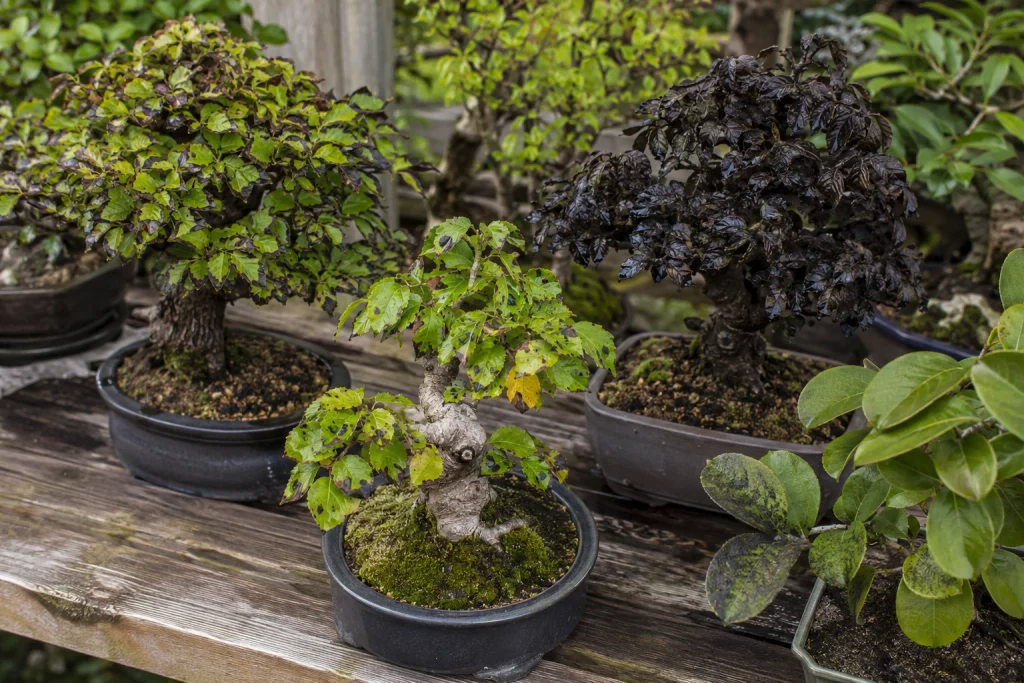
Do not immediately prune every damaged leaf or reach for a fungicide.
Use this simple process instead.
Step 1: Isolate the affected tree if disease or pests are suspected
If your bonsai sits among several plants and you suspect an infectious disease or pest infestation, move it away from healthy plants when practical.
This reduces the chance of spreading pests or pathogens while you investigate.
Step 2: Check the soil
Push a wooden chopstick or similar tool gently into the growing medium and assess moisture deeper in the pot.
If the soil remains saturated for an unusually long time, investigate drainage before simply adding more water.
Step 3: Inspect the foliage carefully
Look at both sides of affected leaves.
Determine whether the damage is:
- Spotty
- Edge-based
- Surface-based
- Whole-leaf
- Soft and water-soaked
- Dry and crispy
Also inspect young shoots and branches.
Step 4: Review recent care changes
Ask yourself:
- Did I water more frequently?
- Did I move the bonsai?
- Did temperatures suddenly change?
- Did I fertilize recently?
- Did I spray anything?
- Did I recently repot?
- Did another plant show similar symptoms?
This history can be more useful than guessing from leaf color alone.
Step 5: Remove severely damaged material carefully
Dead leaves can be removed to improve cleanliness and appearance.
However, avoid heavy pruning simply because the foliage looks unattractive. If the tree is already stressed, excessive pruning can reduce its remaining ability to recover.
Step 6: Correct the underlying problem
If the soil is staying too wet, improve watering and drainage.
If pests are present, identify the pest before selecting treatment.
If disease appears likely, improve airflow, remove severely infected material, avoid unnecessary leaf wetting, and consider species-appropriate treatment.
If the cause is uncertain and the tree is declining rapidly, seek experienced advice rather than applying several products at once.
Should You Cut Off Black Bonsai Leaves?
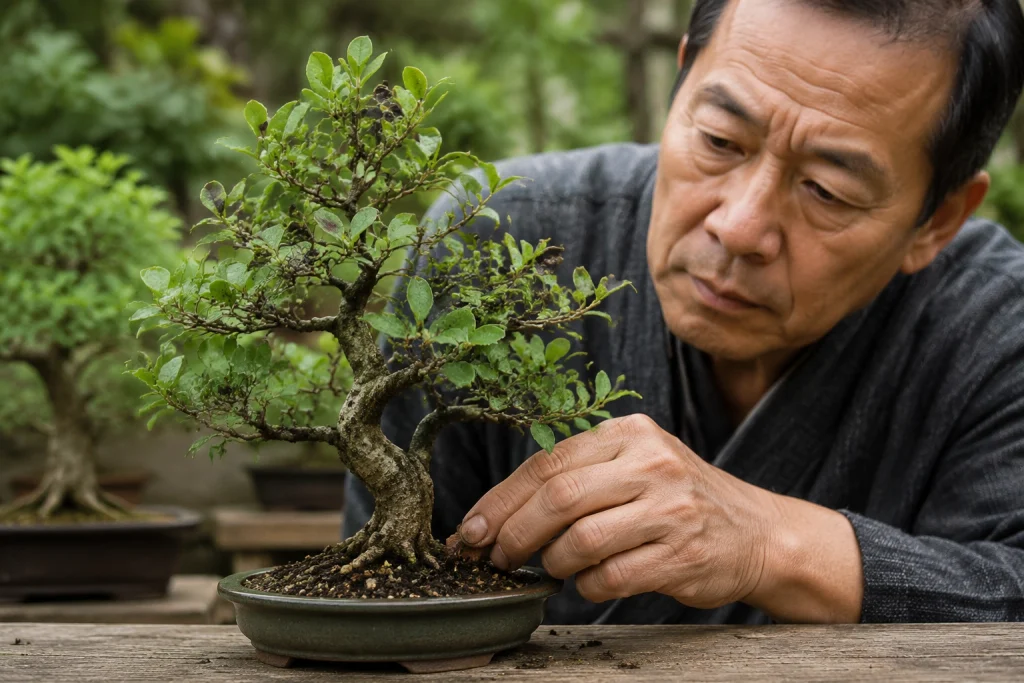
Usually, severely damaged leaves can be removed, but pruning the leaves does not solve the underlying problem.
If the blackening is caused by root damage, poor watering, disease, pests, or temperature stress, new leaves may develop the same symptoms unless the cause is corrected.
Remove leaves that are:
- Completely dead
- Heavily diseased
- Infested and unlikely to recover
- Creating a clear sanitation concern
Do not remove large amounts of healthy foliage unnecessarily.
For valuable or weak bonsai, conservative pruning is generally safer than trying to make the tree look perfect immediately.
Expert Tip: When diagnosing black leaves, fix the growing conditions before adding another treatment. A healthy root zone and suitable environment often determine whether a bonsai can recover.
Can Black Bonsai Leaves Turn Green Again?
Usually, completely black and dead leaf tissue will not turn green again.
Once a section of leaf has died, the priority is to protect the living tissue and encourage healthy future growth.
The good news is that many bonsai can recover if the damage is limited and the underlying cause is corrected early.
Watch the new growth rather than expecting old black leaves to repair themselves.
Healthy new shoots, normal leaf color, and improved vigor are much better indicators of recovery.
When to Ask an Experienced Bonsai Grower or Arborist
Some problems are reasonable for a beginner to troubleshoot. Others deserve professional or experienced help.
Ask for assistance when:
- Multiple branches are dying rapidly
- The trunk or major branches develop dark, sunken, cracked areas
- A large portion of the root system may be damaged
- The tree is valuable or old
- You cannot identify whether the problem is disease, pests, or environmental stress
- A serious infection appears to be spreading
- The tree requires major root work while already severely stressed
- Several plants are showing similar symptoms
An experienced bonsai grower can often diagnose problems from the combination of species, season, soil, watering pattern, foliage symptoms, and recent work.
For serious structural or tree-health problems involving larger specimens, an arborist or qualified plant-health professional may be more appropriate.
Using Fungicides and Pesticides Safely
Avoid treating black leaves with a random fungicide simply because the foliage looks diseased.
Different diseases require different approaches, and some black leaf symptoms are not caused by pathogens at all.
If a pesticide or fungicide is appropriate, read the complete label before application. The EPA’s guidance on reading pesticide labels explains why correct product selection, application instructions, and safety precautions matter.
Also consider non-chemical methods first, such as removing infected material, improving airflow, correcting watering, isolating affected plants, and controlling pest sources. Integrated pest management uses multiple approaches to reduce pest problems while minimizing unnecessary pesticide exposure.
Never increase the recommended concentration because you think it will work faster.
Common Mistakes Bonsai Owners Should Avoid
- Watering on a fixed schedule: Bonsai watering needs change with species, weather, pot size, soil, and season.
- Treating every black spot as fungus: Blackening can have many causes.
- Adding fertilizer to a stressed tree: More nutrients do not automatically mean faster recovery.
- Using several pesticides at once: This can make diagnosis harder and may damage foliage.
- Keeping diseased plants next to healthy ones: Pests and pathogens can spread.
- Removing too much foliage: Severe pruning can add stress to an already weak tree.
- Ignoring drainage: A bonsai pot needs reliable drainage, not just frequent watering.
- Repotting immediately: Root work is not always the correct first response.
- Ignoring species requirements: Tropical, deciduous, and evergreen bonsai have different environmental needs.
- Focusing only on the leaves: The roots, soil, branches, location, and recent care history are equally important.
FAQs
Why are my bonsai leaves turning black after watering?
If leaves turn black after the tree has been kept consistently wet, investigate poor drainage and root stress. Check whether the growing medium remains wet for too long rather than judging moisture only from the surface.
Are black bonsai leaves always a sign of disease?
No. Black leaves can result from overwatering, root damage, cold injury, heat stress, pests, fertilizer burn, chemical injury, or fungal and bacterial diseases.
Should I remove black leaves from my bonsai?
Severely dead or heavily damaged leaves can usually be removed, but removing them will not correct the underlying cause. First determine why the foliage is turning black.
Can overwatering make bonsai leaves black?
Yes. Prolonged excess moisture can stress roots and contribute to root problems, which may eventually cause foliage to discolor, wilt, or die.
Why do bonsai leaves turn black at the edges?
Black or brown leaf margins can be associated with several forms of stress, including excessive fertilizer, underwatering, heat, chemical injury, or root problems. Look at the entire pattern rather than the leaf edge alone.
What does black coating on bonsai leaves mean?
A black coating that looks like soot may be sooty mold associated with honeydew-producing insects such as scale or aphids. Check the undersides of leaves and young shoots for pests.
Should I use fungicide when bonsai leaves turn black?
Not automatically. First determine whether disease is actually likely. If you use a fungicide, select one labeled for the relevant problem and follow all application and safety instructions.
Conclusion
If you are asking, “Why are my bonsai leaves turning black?”, resist the temptation to treat the symptom before identifying the cause. Start by examining the soil, roots, leaves, branches, pests, recent weather, watering, fertilizer, and any products you have applied.
Overwatering and root problems are important possibilities, but fungal or bacterial disease, pests, temperature stress, and chemical damage can produce similar symptoms.
The best next step is a careful diagnosis followed by a targeted correction. Do not overwater, overfertilize, aggressively prune, or spray multiple products simply because the leaves look unhealthy.
A bonsai does not need perfect leaves to recover. Give the tree the right conditions, protect healthy roots and foliage, and monitor new growth closely. With early, sensible care, many bonsai can recover from leaf damage and return to healthy growth.
For more practical bonsai care guidance, continue building your knowledge around watering, soil, pruning, repotting, pests, disease prevention, and species-specific growing requirements before making major changes to your tree.