
Why Are My Bonsai Leaves Turning Brown?

Seeing brown leaves on a bonsai can be worrying, especially when the tree looked healthy a few days earlier. If you are asking, “Why are my bonsai leaves turning brown?”, the cause could be something as simple as inconsistent watering or harsh sunlight—or something more serious, such as damaged roots, disease, or a pest infestation.
Brown leaves are a symptom, not a diagnosis. The important thing is to look at where the browning starts, how quickly it spreads, whether the leaves are dry or soft, and what is happening around the roots and branches.
This guide explains the most common reasons bonsai leaves turn brown, including watering problems, poor drainage, environmental stress, pests, disease, fertilizer damage, and seasonal changes. It also explains how to inspect your tree and decide what action to take without making the problem worse.
Quick Answer
Why are my bonsai leaves turning brown? Common causes include underwatering, overwatering, root problems, excessive sunlight or heat, low humidity, fertilizer buildup, pests, and disease. Check the soil moisture, drainage, roots, leaf undersides, and recent changes in light or temperature before treating the tree.
What Brown Bonsai Leaves Can Tell You
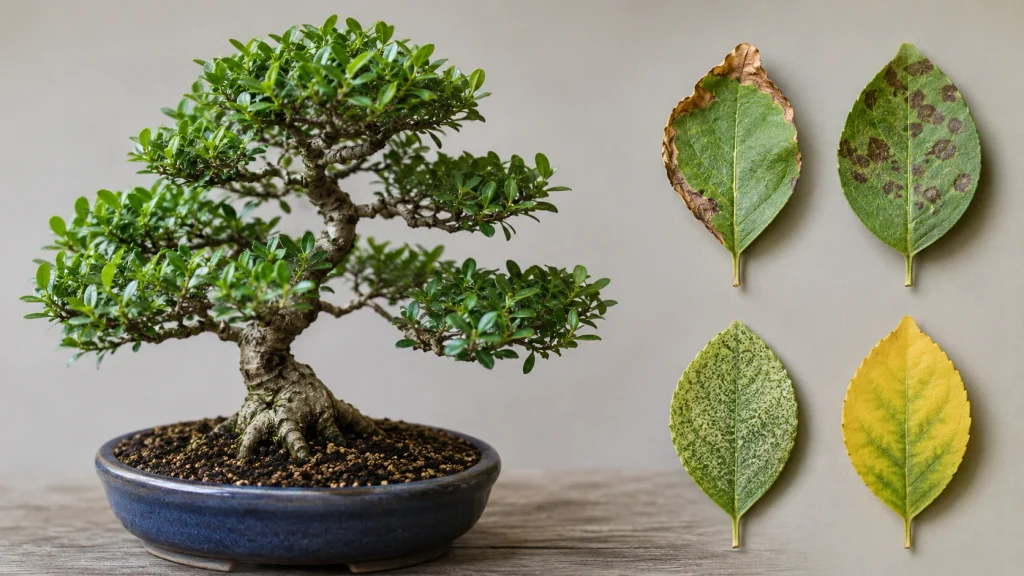
Brown leaves do not always mean the same thing. The pattern can provide useful clues.
| What you notice | Possible cause | What to check first |
|---|---|---|
| Crispy brown leaf edges | Dry soil, heat, low humidity, salt buildup | Soil moisture and recent weather |
| Entire leaves turning brown and dropping | Severe water stress or root problems | Root-zone moisture and drainage |
| Brown spots or patches | Leaf disease, sunburn, chemical injury | Location and shape of spots |
| Yellowing followed by browning | Root stress, pests, watering problems | Roots and underside of leaves |
| Fine pale speckles with browning | Spider mites or other sap-feeding pests | Underside of leaves |
| Sticky leaves with dark mold | Scale, aphids, or mealybugs | Stems, leaf joints, and branches |
| Soft brown leaves and wet soil | Overwatering or root disease | Drainage and root condition |
| Browning after moving outdoors | Sun or environmental shock | Light exposure and temperature |
Do not assume that every brown leaf needs pesticide or fertilizer. Correctly identifying the underlying stress is usually more important than treating the visible symptom.
UC IPM’s plant problem guide lists excessive dryness, overwatering, fertilizer or salt injury, low humidity, excessive light, root problems, and pests among the possible causes of brown or damaged foliage. UC IPM’s guide to diagnosing plant problems is a useful reference when several symptoms appear at the same time.
1. Underwatering Is a Common Cause of Brown Bonsai Leaves
A bonsai can dry out much faster than a tree growing in the ground because it lives in a small container with a limited amount of soil.
When the root zone becomes too dry, the tree may not be able to replace the water lost through its leaves. Leaf edges often become brown and crispy first. If the stress continues, entire leaves may dry, curl, and fall.
Underwatering is particularly common when:
- The tree is in a very small pot.
- The bonsai is exposed to hot afternoon sun.
- Wind increases evaporation.
- The growing medium drains extremely quickly.
- The owner follows a fixed watering schedule instead of checking the soil.
- The tree has recently been moved to a hotter location.
How to check
Do not judge moisture only by the surface of the soil. Push a finger or wooden stick slightly into the growing medium where appropriate, or learn how the pot feels before and after watering.
If the soil is genuinely dry, water the bonsai thoroughly until water flows freely from the drainage holes.
Do not compensate for several days of dryness by keeping the soil constantly saturated afterward. The goal is to restore appropriate moisture, not swing from drought to waterlogging.
2. Overwatering Can Also Turn Bonsai Leaves Brown
Overwatering is one of the most misunderstood bonsai problems.
The issue is not simply that the tree received “too much water.” The bigger problem is soil that remains wet for too long. Roots need both water and oxygen. Poorly draining soil can reduce the oxygen available around the roots and eventually weaken them.
A bonsai with unhealthy roots may show:
- Yellowing leaves followed by browning.
- Sudden leaf drop.
- Weak or stunted new growth.
- A constantly wet soil surface.
- Soft or dark roots.
- A sour or unpleasant smell from the root zone.
UC IPM notes that overwatering, poor drainage, compacted soil, and root disease can all contribute to poor root health and leaf symptoms. Its plant problem diagnosis guide can help you compare symptoms.
Important: Do not automatically repot a stressed bonsai just because its leaves are brown. Repotting is additional stress. First determine whether the tree is actually suffering from a root-zone problem and whether the species and season make repotting appropriate.
3. Poor Drainage Can Damage the Roots
A bonsai pot should drain efficiently. Drainage holes are not decorative—they are essential for removing excess water.
Problems can develop when:
- Drainage holes are blocked.
- The soil has broken down into fine particles.
- The container is too deep or poorly suited to the tree.
- The growing medium has become compacted.
- Water collects underneath the pot.
- The tree is sitting in a tray of standing water.
A tree may look thirsty even when the soil is wet because damaged roots cannot function normally.
This creates a frustrating situation: the owner sees wilted or brown leaves and waters again, which can make the root problem worse.
What to do
Check whether water exits the drainage holes freely. If it does not, investigate the drainage system rather than simply increasing watering frequency.
Major root work should be avoided on a severely stressed tree unless you understand the species, season, and extent of the problem. When root rot is suspected, an experienced bonsai grower can often help determine whether the tree needs immediate intervention.
4. Too Much Sun or Sudden Sun Exposure
Light is essential for bonsai health, but a sudden increase in light intensity can damage foliage.
This commonly happens when an indoor bonsai is moved directly into strong outdoor sunlight. Leaves that developed under lower light may not tolerate intense exposure immediately.
Sun-related injury can appear as:
- Brown or tan patches.
- Scorched leaf margins.
- Pale areas that later become brown.
- Damage concentrated on the side facing intense sunlight.
The same principle applies after moving a bonsai from shade to full sun.
How to prevent sun stress
Increase light exposure gradually when possible. Give recently relocated trees time to adjust, particularly during hot weather.
Species matters. A sun-loving outdoor species and a tropical bonsai grown indoors may have very different light requirements.
5. Heat, Wind, and Low Humidity
Bonsai leaves lose water through a natural process called transpiration. Hot temperatures, strong wind, and dry air can increase water loss.
A bonsai may therefore develop brown edges even when you are watering correctly.
This is especially noticeable when:
- The pot is exposed to hot surfaces.
- Strong wind hits the foliage.
- Temperatures suddenly rise.
- The tree is positioned beside heating or cooling equipment.
- A tropical bonsai is kept in unusually dry indoor air.
Instead of immediately watering more frequently, look at the entire environment.
A bonsai’s watering needs are influenced by temperature, light, wind, species, pot size, soil composition, and root health.
6. Fertilizer or Salt Buildup Can Burn the Leaves
Fertilizer helps bonsai produce healthy growth, but more fertilizer is not necessarily better.
Excess fertilizer can increase soluble salts around the roots. This can damage roots and produce brown or scorched leaf margins.
Possible warning signs include:
- Brown leaf tips.
- Browning along leaf margins.
- White crust or residue on the soil surface.
- Symptoms appearing after heavy fertilization.
- Poor growth despite apparently adequate watering.
If you suspect fertilizer injury, stop adding fertilizer until you understand what happened.
A heavily fertilized or salt-affected tree may require careful flushing or, in serious cases, a growing-medium change. However, do not perform major root work on a weak tree without considering species and timing.
7. Bonsai Pests Can Cause Brown or Dying Leaves
Pests are especially important to investigate when browning is accompanied by unusual marks, sticky residue, distorted growth, webbing, or tiny insects.
Common bonsai pests include:
- Spider mites
- Aphids
- Scale insects
- Mealybugs
- Thrips
- Whiteflies
- Fungus gnats and other soil-associated pests
Spider mites
Spider mites are tiny and can be difficult to see without magnification. They feed by removing cell contents from leaves.
Early damage may appear as tiny pale speckles or stippling. As feeding becomes more severe, foliage may become bronze, yellow, dry, and eventually drop. Fine webbing may also appear.
UC IPM’s spider mite guidance notes that mite damage is often worse under hot, dusty, water-stressed conditions.
Check the undersides of leaves, especially around young growth.
Scale insects
Scale insects can look like small bumps attached to stems, leaves, or branches. They feed on plant juices and can weaken a bonsai over time.
Possible signs include:
- Yellowing leaves.
- Premature leaf drop.
- Sticky honeydew.
- Black sooty mold.
- Weak or dying twigs.
UC IPM’s scale insect information explains that scale feeding can cause leaf discoloration, premature dropping, and branch damage.
Aphids and mealybugs
Aphids often cluster around soft new growth. Mealybugs may look like small cottony patches around leaf joints and stems.
Both can weaken new growth and may produce honeydew, a sticky substance that can encourage black sooty mold.
How to Check a Bonsai for Pests
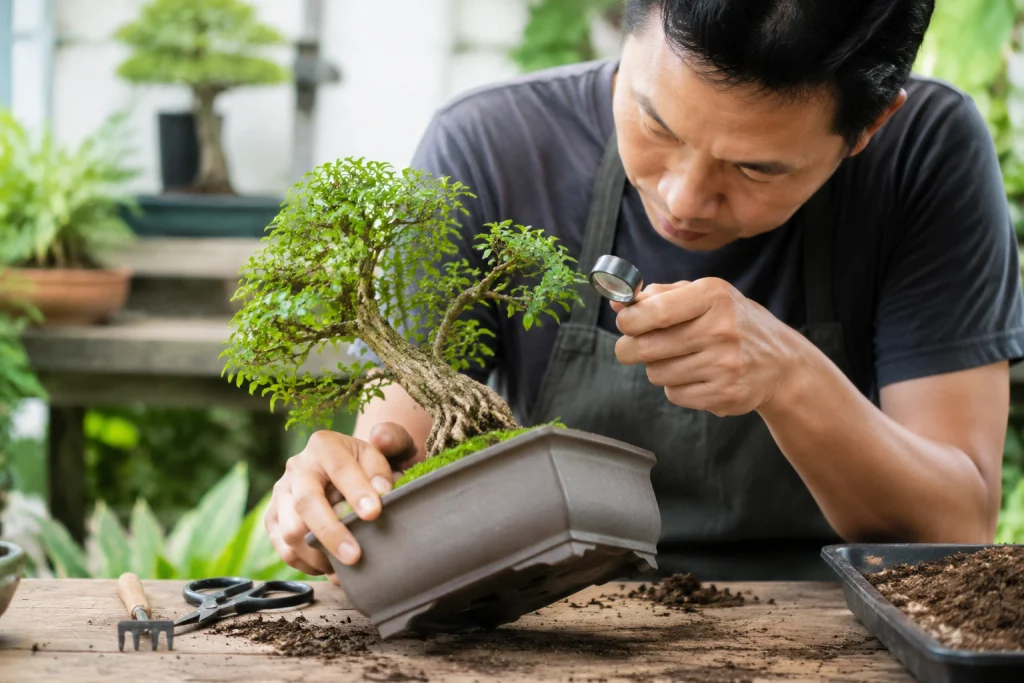
Before spraying anything, inspect the entire tree.
- Look closely at the newest leaves.
- Check both sides of the foliage.
- Inspect branch joints and leaf axils.
- Look along the trunk and smaller branches.
- Check for webbing, sticky residue, cottony material, or scale-like bumps.
- Examine nearby plants for similar symptoms.
- Use a 10× hand lens if pests are difficult to see.
Isolate a visibly infested bonsai from other plants when practical. This can reduce the chance of pests spreading while you identify and manage the problem.
8. Leaf Disease Can Cause Brown Spots
Not all brown marks are caused by watering or insects.
Fungal and bacterial problems can produce:
- Circular or irregular brown spots.
- Dark lesions.
- Expanding patches.
- Premature leaf drop.
- Damaged new growth.
Disease is more likely to become troublesome when foliage stays wet for long periods, airflow is poor, or the tree is already stressed.
Avoid repeatedly misting diseased foliage simply because the leaves look dry.
Instead, improve airflow, remove severely affected material when appropriate, keep tools clean, and identify the disease before choosing a treatment.
Do not apply fungicide simply because a leaf is brown. A brown leaf caused by drought will not become healthy again after a fungicide application.
9. Seasonal Leaf Browning May Be Normal
Some bonsai naturally change color or shed leaves as part of their seasonal cycle.
Deciduous species may lose leaves in autumn or enter winter dormancy. Evergreen species can also shed older foliage, although the pattern is different.
The important question is whether the browning matches the tree’s expected seasonal behavior.
Signs of normal seasonal change
- Browning happens at the expected time of year.
- Older leaves change first.
- New growth remains healthy.
- The tree’s buds and branches appear normal.
- There are no obvious pest or disease symptoms.
Signs of a problem
- Browning happens suddenly outside the normal seasonal pattern.
- New leaves are affected first.
- Large sections of the tree decline.
- The soil remains excessively wet or completely dry.
- Pests are visible.
- Branches begin dying back.
A Simple Bonsai Brown-Leaf Diagnosis Process
When you notice brown leaves, avoid changing five things at once.
Use this simple process:
Step 1: Check the soil
Is it extremely dry, appropriately moist, or staying wet for too long?
Step 2: Check drainage
Confirm that water can leave the pot freely.
Step 3: Examine the leaves
Look at both surfaces. Search for spots, stippling, webbing, insects, sticky residue, and distorted growth.
Step 4: Look at the branches
Check for dying tips, scale insects, lesions, unusual swelling, or dieback.
Step 5: Review recent changes
Ask yourself:
- Did I move the tree?
- Did temperatures change?
- Did I recently repot?
- Did I fertilize?
- Did I increase sunlight?
- Did I forget to water?
- Did I spray a chemical?
Step 6: Correct the most likely cause
Make one sensible change at a time and observe the tree.
Healthy new growth is often more useful than trying to make already-brown leaves green again.
What to Do About Brown Leaves
Once you have identified the likely cause, focus on correcting the underlying problem.
If the soil is too dry
Water thoroughly and then monitor moisture more closely.
If the soil stays wet
Improve drainage and review the soil structure. Avoid repeatedly adding water simply because the leaves appear wilted.
If the tree has sun damage
Move it to a more appropriate light level or gradually acclimate it to stronger sunlight.
If pests are present
Physically remove pests where practical and use a treatment appropriate for the pest and bonsai species.
If disease is suspected
Remove severely affected material when appropriate, improve airflow, and avoid spreading contamination with dirty tools.
If fertilizer injury is suspected
Stop fertilizing temporarily and reassess the root-zone conditions.
When pesticides are necessary, use only a product labeled for the intended use and follow its directions exactly. The EPA’s pesticide safety guidance emphasizes using nonchemical controls when practical and following pesticide labels carefully.
Never assume that a stronger concentration will work better. Over-application can damage the tree and create unnecessary risks for people, pets, and the environment.
Expert Tip
Expert Tip: Before treating brown leaves, inspect the roots, soil, leaf undersides, and recent environmental changes. Diagnosis first, treatment second prevents many bonsai owners from making a manageable problem worse.
When to Ask an Experienced Bonsai Grower or Arborist
Most minor leaf problems can be investigated at home, but some situations deserve experienced help.
Ask a knowledgeable bonsai grower or qualified arborist for advice when:
- Several major branches are dying.
- The trunk shows serious decay or structural damage.
- Roots are extensively rotten.
- The tree is valuable or historically important.
- You are unsure whether major root pruning is necessary.
- A pest infestation continues despite appropriate treatment.
- The diagnosis is unclear after inspection.
- The bonsai is declining rapidly.
A healthy-looking tree can sometimes recover from limited foliage damage, but extensive root or structural problems are more serious.
Do not perform aggressive pruning, root reduction, or repotting simply because the leaves are brown. A stressed tree has fewer resources available for recovery.
Indoor and Outdoor Bonsai Need Different Care
One reason brown leaves can be difficult to diagnose is that bonsai species have different environmental requirements.
An outdoor temperate bonsai generally needs seasonal changes and appropriate outdoor conditions. A tropical species may be better suited to warmer conditions and bright indoor growing when outdoor temperatures are unsuitable.
| Situation | Main risk | What to monitor |
|---|---|---|
| Indoor tropical bonsai | Low light, dry air, pests | Light, humidity, mites, watering |
| Outdoor bonsai in summer | Heat and rapid drying | Soil moisture, wind, sunlight |
| Outdoor bonsai in rainy weather | Excess moisture | Drainage and root health |
| Newly moved bonsai | Environmental shock | Light and temperature changes |
| Recently repotted bonsai | Root stress | Moisture, protection, new growth |
Species-specific care always takes priority over generic bonsai rules.
Common Mistakes Bonsai Owners Should Avoid
- Watering on a fixed calendar instead of checking the tree and soil.
- Keeping the soil constantly wet because brown leaves look thirsty.
- Applying fertilizer to a stressed tree without identifying the cause.
- Spraying pesticides before identifying the pest.
- Moving an indoor bonsai directly into intense sunlight.
- Ignoring the undersides of leaves.
- Repotting every time foliage changes color.
- Removing large amounts of healthy foliage from a weakened tree.
- Using garden chemicals without checking whether they are appropriate for the plant.
- Assuming brown leaves will recover. Damaged tissue generally does not turn green again; focus on protecting healthy and future growth.
How Cost and Product Quality Affect Bonsai Recovery
Sometimes the problem is related to the equipment or growing setup rather than the owner’s effort.
A very inexpensive bonsai pot may work perfectly well if it has suitable drainage and appropriate dimensions. A more expensive pot is not automatically better for tree health.
The same principle applies to soil.
A premium bonsai mix may offer excellent drainage and particle consistency, but the best soil is the one appropriate for the species, climate, watering habits, and stage of development.
For tools, sharp and durable bonsai scissors or concave cutters can make clean work easier. However, buying expensive tools will not solve brown leaves caused by poor watering or root problems.
Spend money where it improves the tree’s growing conditions rather than assuming the most expensive product is always the best choice.
FAQs
Why are my bonsai leaves turning brown and crispy?
Crispy brown leaves commonly indicate water stress, excessive heat, low humidity, strong wind, or root problems. Check the soil and growing conditions before changing your watering routine.
Can overwatering cause brown bonsai leaves?
Yes. Soil that stays wet for too long can damage roots and reduce their ability to supply water to the foliage. The result can be yellowing, browning, wilting, and leaf drop.
Should I remove brown leaves from my bonsai?
You can remove completely dead leaves if they come away easily, but do not remove large amounts of foliage unnecessarily. Brown tissue will not become healthy again, so focus on correcting the cause.
Can pests make bonsai leaves turn brown?
Yes. Spider mites, scale, aphids, mealybugs, and other pests can weaken foliage. Look for stippling, webbing, sticky residue, cottony material, distorted growth, or insects.
Should I fertilize a bonsai with brown leaves?
Not automatically. Fertilizer can help a nutritionally deficient tree, but it can also worsen problems caused by root stress or salt buildup. Identify the cause before feeding heavily.
Should I repot a bonsai if its leaves are turning brown?
Not necessarily. Repotting can add stress. Consider repotting when there is a genuine root, drainage, or soil-structure problem and the timing is appropriate for the species and condition of the tree.
Can brown bonsai leaves turn green again?
Usually, completely brown or dead leaf tissue will not return to healthy green tissue. The goal is to stop the underlying stress and encourage healthy new growth.
Conclusion
If you are wondering why are my bonsai leaves turning brown, start with the basics: inspect the soil, check drainage, examine the leaves and branches for pests, and think about recent changes in light, temperature, watering, fertilizing, or location.
Brown leaves can result from underwatering, overwatering, root damage, sun stress, fertilizer buildup, pests, disease, or normal seasonal changes. The pattern of symptoms is often the best clue.
Most importantly, do not treat the symptom before identifying the cause. Avoid unnecessary fertilizer, pesticides, aggressive pruning, or emergency repotting when the tree is already stressed.
Give your bonsai the conditions its species actually needs, monitor it regularly, and respond to problems early. With careful observation and patient correction, many bonsai trees can recover and produce healthy new growth.
Save this guide for your next bonsai health check, and use the symptom checklist before making a major change to your tree’s care.
