Why Are My Bonsai Leaves Turning Yellow?

Seeing yellow leaves on a bonsai can be worrying, especially when the tree looked healthy a few days earlier. If you are asking, “Why are my bonsai leaves turning yellow?”, the answer is usually related to watering, light, roots, nutrition, seasonal change, or pest damage.
Yellow leaves are a symptom, not a diagnosis. A few older leaves turning yellow may be normal, while widespread yellowing combined with leaf drop, weak growth, sticky residue, webbing, or soft roots can signal a more serious problem.
This guide explains how to identify the most likely cause, with special attention to bonsai pests, because sap-sucking insects and mites can quietly weaken a small tree. You will also learn what to check before changing your watering, fertilizer, soil, or pest-control routine.
Quick Answer
Why are my bonsai leaves turning yellow? Common causes include overwatering, poor drainage, underwatering, insufficient light, nutrient problems, natural aging, root damage, and pests such as spider mites, scale, aphids, and mealybugs. Check the soil, roots, light, leaves, and stems before treating the tree so you correct the actual cause rather than making the problem worse.
What Yellow Bonsai Leaves Can Tell You
Yellowing does not always mean your bonsai is dying. The pattern of yellowing is often more useful than the color itself.
For example, a few old interior leaves may naturally yellow and drop as the tree replaces older foliage. By contrast, many leaves turning yellow at once usually deserves investigation.
University extension plant-diagnostic guides list overwatering, poor root health, inadequate light, nutrient deficiencies, pests, and disease among common causes of yellow foliage.
Before making a major change, ask:
- Are the yellow leaves old or newly formed?
- Is the entire tree yellowing or only one area?
- Is the soil constantly wet?
- Does water drain freely from the pot?
- Are there insects, webbing, or sticky deposits?
- Has the bonsai recently been moved?
- Has the light level changed?
- Does the tree have healthy new growth?
- Is the species deciduous and entering its normal seasonal dormancy?
These observations can narrow the problem considerably.
The Most Common Reasons Bonsai Leaves Turn Yellow
1. Overwatering
Overwatering is one of the first things to investigate when bonsai leaves turn yellow.
The problem is not simply “too much water.” The deeper issue is that roots need both moisture and oxygen. When the soil stays saturated for too long, roots can become stressed or begin to rot.
Warning signs include:
- Yellow leaves throughout the tree
- Leaves dropping even though the soil is wet
- Slow or weak growth
- A sour or unpleasant smell from the soil
- Soft, dark, damaged roots
- A trunk or lower stem that feels unusually soft
A bonsai should generally be watered according to the condition of its soil and species requirements, not according to a rigid calendar.
Do not water again simply because the leaves are yellow. First check whether the soil is already wet.
For example, a Ficus bonsai can develop yellowing and leaf drop from overwatering and root problems, while insufficient water can also cause brittle leaves and leaf drop.
2. Poor Drainage or Compacted Soil
Even if you are watering correctly, a poorly draining bonsai can develop similar symptoms.
Fine, compacted soil can hold too much water around the roots. A blocked drainage hole can create the same problem.
Check the pot:
- Does water come out of the drainage holes?
- Does the soil remain wet for unusually long periods?
- Is the drainage hole blocked by roots or debris?
- Has the soil become compacted?
- Is the tree sitting in a saucer of standing water?
If drainage is poor, simply watering less may not solve the underlying problem.
Do not immediately repot a severely stressed bonsai just because some leaves are yellow. Repotting is another form of stress. First determine whether the tree actually needs root work and whether the species and season make repotting appropriate.
3. Underwatering
Yellow leaves can also occur when a bonsai repeatedly becomes too dry.
An underwatered tree may show:
- Dry, crispy leaves
- Curling foliage
- Sudden leaf drop
- Very dry soil pulling away from the pot
- Weak or drooping new growth
Some trees recover quickly after a missed watering, while others can suffer serious root damage if they repeatedly dry out.
The important distinction is that yellow leaves with wet soil point you toward one set of problems, while yellow leaves with extremely dry soil suggest another.
4. Not Enough Light
Light affects photosynthesis, growth, and leaf color.
A bonsai kept in a location that is too dark may develop pale or yellow-green foliage and weak, stretched growth.
This is particularly important for indoor bonsai. Moving an outdoor tree indoors simply because it is convenient can drastically reduce its available light.
However, more light is not always the answer. A sudden move from shade to intense direct sunlight can scorch foliage.
Change light gradually when possible, especially after a tree has been growing in a protected location.
5. Natural Leaf Aging or Seasonal Change
Not every yellow leaf indicates a care mistake.
Deciduous bonsai naturally lose their leaves as part of their seasonal cycle. Older leaves may also yellow and fall as the tree reallocates resources.
If only a small number of older leaves are yellow while:
- New growth looks healthy
- The tree has normal vigor
- Soil moisture is appropriate
- No pests are visible
- There are no unusual leaf spots
then the yellowing may be completely normal.
The species matters. A deciduous bonsai preparing for dormancy should not be treated like an evergreen that is unexpectedly losing foliage in midsummer.
Could Bonsai Pests Be Causing Yellow Leaves?
Yes. Bonsai pests are an important possibility when yellowing appears alongside unusual marks, sticky leaves, webbing, distorted growth, or reduced vigor.
Small bonsai pots and limited root systems mean a pest infestation can become noticeable quickly.
Common culprits include:
| Pest | What You May Notice | Possible Effect |
|---|---|---|
| Spider mites | Fine webbing, tiny pale speckles | Yellowing, bronzing, leaf drop |
| Scale insects | Brown or pale bumps on stems/leaves | Weak growth and yellow foliage |
| Aphids | Small soft-bodied insects around new growth | Curling, distorted or yellow leaves |
| Mealybugs | White cotton-like clusters | Weakness and yellowing |
| Thrips | Silvery or scarred leaf surfaces, tiny black specks | Distorted and discolored foliage |
| Whiteflies | Tiny white insects flying when disturbed | Yellowing and reduced vigor |
University of Alaska Extension notes that yellow or pale leaves can be associated with insect or mite feeding, while spider mites may produce pale, speckled foliage and webbing.
Spider Mites
Spider mites are particularly easy to miss because they are extremely small.
Look closely at:
- The undersides of leaves
- New growth
- Leaf axils
- Fine webbing between leaves and shoots
A bonsai with spider mites may develop tiny pale dots across the leaves before the foliage becomes yellow or bronze.
If you suspect mites, gently shake a branch over a sheet of white paper and watch for tiny moving specks.
Hot, dry conditions can favor spider mite problems, making regular inspection especially useful during stressful weather.
Scale Insects
Scale can look like small bumps attached to stems or leaves.
They are often overlooked because they do not look like typical insects. Heavy infestations can weaken a bonsai by continuously removing plant sap.
Watch for:
- Brown, black, white, or tan bumps
- Sticky leaves or surfaces beneath the tree
- Black sooty mold
- Yellowing foliage
- Reduced new growth
- Branch dieback in severe cases
Scale insects can be difficult to control because their protective coverings make them less vulnerable to some treatments. Early detection is therefore much easier than dealing with a large infestation.
Aphids and Mealybugs
Aphids often gather around tender shoots and new leaves.
Mealybugs are easier to recognize because they can appear as small white, cottony clusters.
Both can weaken a bonsai by feeding on plant sap.
Inspect new growth carefully rather than looking only at the largest leaves. Pests often establish themselves where the newest, softest tissue is available.
How to Check Your Bonsai for Pests
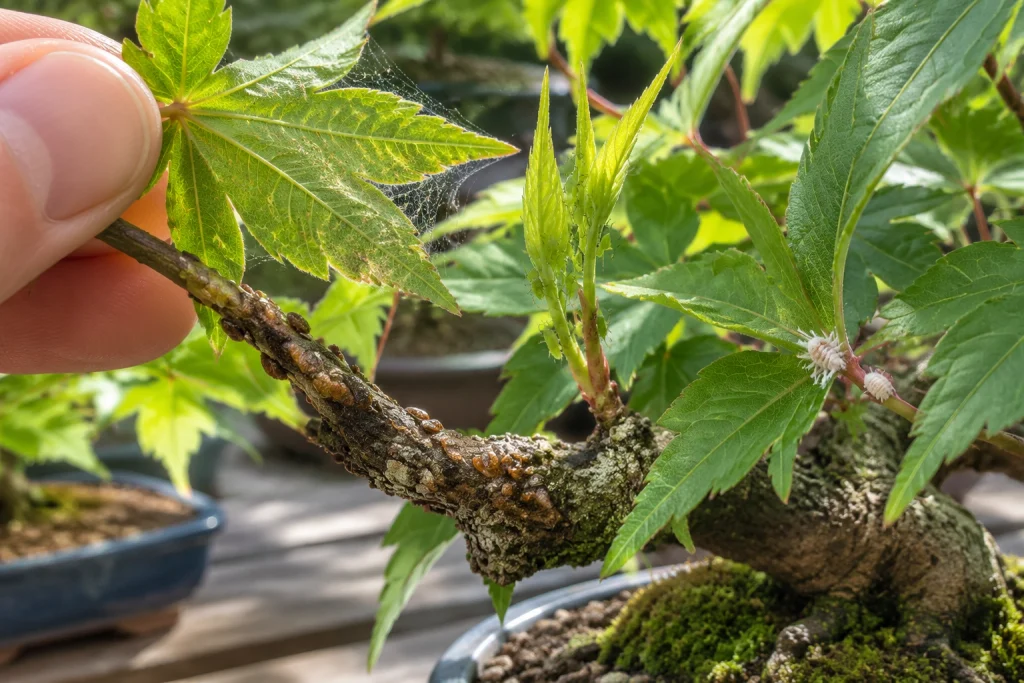
If yellowing is unexplained, spend a few minutes inspecting the whole tree.
Step 1: Examine the upper leaves
Look for:
- Spots
- Speckling
- Curling
- Distortion
- Unusual discoloration
- Fine webbing
Step 2: Check underneath the leaves
This is one of the most important steps.
Many mites and insects remain hidden on the underside rather than sitting on top of the foliage.
Step 3: Inspect stems and branch junctions
Look for scale, mealybugs, aphids, eggs, or unusual deposits.
Pay particular attention to areas where branches meet the trunk.
Step 4: Check for sticky residue
Sticky leaves or surfaces underneath the bonsai can indicate honeydew produced by certain sap-sucking insects.
Black sooty mold may develop on the sticky residue.
Step 5: Inspect the soil and pot
Do not assume every yellow-leaf problem is caused by an insect.
Check soil moisture and drainage at the same time. A pest infestation and root problem can also occur together.
Yellow Leaves From Pests vs. Watering Problems
When several causes seem possible, compare the symptoms rather than guessing.
| Symptom | More Likely Cause |
|---|---|
| Yellow leaves + constantly wet soil | Overwatering or root problems |
| Yellow leaves + dry, brittle foliage | Underwatering |
| Yellow leaves + fine webbing | Spider mites |
| Yellow leaves + sticky residue | Aphids, scale, or other sap-feeding pests |
| Yellow leaves + white cottony insects | Mealybugs |
| Yellow leaves + bumps on stems | Scale |
| Yellow leaves + poor, stretched growth | Insufficient light |
| Yellow leaves + dark leaf spots | Disease, water stress, or chemical injury |
| Older leaves yellow while new growth is healthy | Natural aging or nutrient issue |
This is only a diagnostic starting point. Several problems can produce similar symptoms, so look for multiple clues before choosing a treatment.
What to Do When You Find Bonsai Pests
If the infestation is small, start with the least disruptive approach.
- Isolate the bonsai from other plants when practical.
- Remove heavily infested leaves or small affected sections if doing so will not damage the tree’s structure.
- Rinse the foliage gently when appropriate for the species and pest.
- Inspect the tree again after treatment.
- Repeat monitoring regularly because one treatment may not eliminate every life stage.
- Use an appropriate pest-control product only when identification and product labeling support its use.
The goal of integrated pest management is not simply to spray everything. It is to identify the pest, monitor the problem, and use the least disruptive effective control.
The EPA’s guidance on choosing and using garden pesticides emphasizes identifying the pest first and following the product label because incorrect use can harm plants, people, pets, and the environment.
Never assume that a stronger concentration will work better. More pesticide can injure foliage and roots rather than solve the problem.
When Yellow Leaves May Mean Root Problems
Pests are not the only serious concern.
If yellowing is accompanied by persistent wet soil, wilting, poor growth, or leaf drop, inspect the roots when appropriate.
Healthy roots are generally firm and lighter in color, while rotted roots can become dark and soft.
Root problems deserve extra caution because bonsai have limited soil volume.
If you discover substantial root rot, do not simply add fertilizer to “strengthen” the tree. Damaged roots may be unable to support normal growth.
Avoid heavy pruning, aggressive root pruning, wiring, and unnecessary repotting on a severely stressed tree. Stabilizing the growing conditions should come first unless the root problem itself requires immediate intervention.
Could Fertilizer Be Causing Yellow Leaves?
Yes, but fertilizer should not be the first explanation you choose.
Nutrient deficiencies can cause pale or yellow foliage, particularly when the tree is growing actively and the soil has inadequate available nutrients.
However, yellowing can also result from poor root health, which means the tree may have nutrients in the soil but be unable to absorb them properly.
Excess fertilizer can create another problem: high concentrations of soluble salts can damage roots and contribute to leaf symptoms.
Do not automatically fertilize a yellow bonsai. First determine whether the tree is actively growing, whether its roots are healthy, and whether watering and light are appropriate.
What About Disease?
Some fungal and bacterial diseases can produce yellow areas around leaf spots.
Disease becomes more suspicious when you see:
- Distinct brown, black, or water-soaked spots
- Yellow halos around lesions
- Rapidly expanding spots
- Distorted new leaves
- Repeated leaf drop
- Symptoms affecting several plants in similar conditions
Poor air circulation and prolonged leaf wetness can increase the risk of some foliar diseases. University extension guidance recommends improving air circulation and avoiding unnecessary prolonged moisture on foliage when leaf-spot diseases are suspected.
Do not diagnose a fungal disease solely because a leaf is yellow. Yellowing alone is too general.
Practical Recovery Plan for a Yellow Bonsai
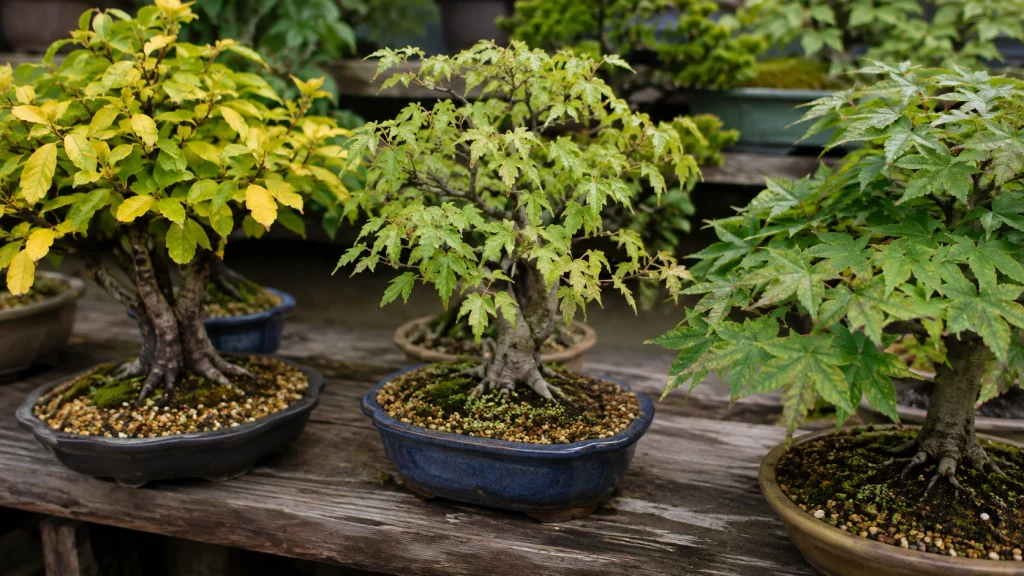
Once you have inspected the tree, avoid changing everything at once.
A simple recovery approach is:
1. Stabilize watering
Check the soil before watering.
If it is saturated, improve drainage and allow the tree’s normal moisture cycle to resume. If it is extremely dry, water thoroughly according to the species and growing conditions.
2. Correct the light
Make sure the tree is receiving the amount of light appropriate for its species.
Avoid sudden exposure to intense sunlight if the tree has been growing in shade.
3. Inspect for pests
Check leaves, stems, branch junctions, and new growth.
Use a magnifying glass if necessary.
4. Check root health if symptoms are severe
If the tree continues to decline despite appropriate watering and light, root problems become more important to investigate.
5. Delay unnecessary styling
Do not combine major pruning, repotting, heavy wiring, and pest treatment simply because the tree looks unhealthy.
A stressed tree needs a measured response.
6. Monitor new growth
Old yellow leaves may not turn green again.
Instead, watch the new foliage.
Healthy new growth is often a better indicator that your care adjustments are working.
Expert Tip: When diagnosing yellow bonsai leaves, change one major variable at a time whenever possible. This makes it much easier to identify what actually helped the tree.
Cost, Treatment, and Skill-Level Considerations
Not every yellow bonsai needs an expensive treatment.
For a beginner, the first diagnostic tools can be very simple:
- A finger or moisture check
- A magnifying glass
- A clean pair of pruning scissors
- Good drainage
- Appropriate light
- Regular inspection
Spending money on pesticides before identifying the pest can waste both money and time.
Likewise, buying premium fertilizer will not repair roots damaged by chronic overwatering.
For larger infestations, serious root rot, or valuable older bonsai, professional advice can be more cost-effective than repeatedly experimenting with treatments.
The value of the tree matters too. A common beginner Ficus and a mature specimen that has been trained for decades may justify very different levels of professional care.
When to Ask an Experienced Bonsai Grower or Arborist
Most minor yellowing can be investigated at home, but professional help is sensible when:
- The entire canopy is rapidly declining.
- Large branches are dying back.
- The trunk or base becomes soft or discolored.
- Roots are extensively rotted.
- A pest infestation is severe.
- You cannot identify the pest or disease.
- The tree is valuable or historically important.
- Major root work or structural pruning is needed.
- The bonsai remains unhealthy after basic environmental problems have been corrected.
An experienced bonsai grower can help distinguish species-specific seasonal behavior from genuine decline.
For trees that have become large or present structural or safety concerns, an appropriately qualified arborist may also be useful. Do not perform major root or structural work simply because a few leaves have turned yellow.
Common Mistakes Bonsai Owners Should Avoid
- Watering on a fixed schedule without checking soil moisture.
- Adding fertilizer immediately when leaves turn yellow.
- Spraying pesticides without identifying the pest.
- Using excessive pesticide concentrations.
- Keeping a bonsai constantly wet because it looks thirsty.
- Moving an outdoor bonsai into poor indoor light.
- Giving a shade-grown tree intense sun suddenly.
- Ignoring the undersides of leaves.
- Repotting a severely stressed tree without a clear reason.
- Pruning heavily while the tree is already weak.
- Treating every yellow leaf as a disease.
- Ignoring seasonal leaf color changes in deciduous species.
How to Prevent Yellow Leaves in the Future
Prevention starts with consistent observation rather than a complicated care schedule.
Inspect your bonsai regularly, especially during periods of hot, dry weather or when bringing plants indoors or outdoors.
Check:
- Soil moisture
- Drainage
- Leaf color
- New growth
- Undersides of leaves
- Stems and branch junctions
- Pest activity
- Light exposure
- Seasonal changes
Early detection is particularly valuable for pests. Regular monitoring is a core part of integrated pest management because small pest populations are generally easier to manage than established infestations.
Keep new bonsai separate from an established collection for an appropriate observation period when practical. This reduces the chance of introducing pests to otherwise healthy trees.
FAQs
Why are my bonsai leaves turning yellow and falling off?
Yellow leaves followed by leaf drop can result from overwatering, underwatering, poor light, root problems, pests, or normal seasonal changes. Check the soil and inspect the foliage before changing your care routine.
Can overwatering make bonsai leaves yellow?
Yes. Constantly wet soil can damage roots and reduce their ability to function properly. Yellow leaves combined with wet soil, poor growth, or soft roots are warning signs that overwatering or poor drainage may be involved.
Can spider mites cause yellow bonsai leaves?
Yes. Spider mites feed on leaf tissue and can create fine yellow or pale speckling. Fine webbing, especially around new growth or leaf undersides, is another useful clue.
Should I remove yellow leaves from my bonsai?
You can remove leaves that are completely dead or badly damaged, but removing every yellow leaf will not fix the underlying problem. First determine why the foliage is yellowing.
Should I fertilize a bonsai with yellow leaves?
Not automatically. Yellowing may come from root damage, overwatering, poor light, pests, or natural aging. Fertilizer is appropriate only when the tree’s species, season, growth stage, and nutritional needs support it.
Can a bonsai recover after severe yellowing?
Many bonsai can recover if the underlying problem is corrected before the roots or branches suffer severe damage. Focus on stable watering, suitable light, pest control when needed, and avoiding unnecessary stress.
Are yellow leaves always a sign of bonsai disease?
No. Yellow leaves are a general stress symptom and can occur for many reasons. Disease is more likely when yellowing occurs with distinctive spots, lesions, unusual growth, or rapid deterioration.
Conclusion
If you are wondering why your bonsai leaves are turning yellow, do not assume the tree needs more water or fertilizer immediately. Yellow foliage can result from overwatering, underwatering, poor drainage, inadequate light, nutrient problems, seasonal change, root damage, pests, or disease.
Start with the basics: check the soil, inspect the roots when appropriate, examine the leaves and stems for pests, and review the tree’s light and recent environmental changes.
Pay particular attention to spider mites, scale, aphids, and mealybugs when yellowing appears alongside webbing, sticky residue, bumps, distorted growth, or reduced vigor.
The best bonsai care decisions come from diagnosing the cause before treating the symptom. Inspect your tree carefully today, make the smallest necessary correction, and monitor its new growth before taking further action.
