
Why Are New Bonsai Leaves Curling? Causes and Fixes

Quick Answer
New bonsai leaves usually curl because tender growth is reacting to watering stress, heat, low humidity, excessive fertilizer, root problems, or sap-feeding pests. Start by checking moisture, leaf undersides, new shoots, and recent care changes before treating anything; good bonsai care fundamentals make diagnosis much easier.
Common causes and clues
- Dry root zone: New leaves may curl, wilt, or develop dry edges when the pot dries too far.
- Wet roots: Persistent moisture can reduce root function and cause weak, distorted growth.
- Heat or sun: Tender leaves can curl when water loss exceeds what the roots can replace.
- Aphids or mites: Inspect curled leaves for insects, sticky residue, pale stippling, or fine webbing.
- Fertilizer stress: Excess salts can damage roots and leaf margins, especially in a small bonsai pot.
- Normal expansion: Some fresh leaves emerge folded or slightly curled, then flatten as they mature.
Best first move
- Compare the newest damaged leaves with older healthy foliage, then change only the factor supported by the evidence.
New bonsai leaves are delicate, so curling often appears before the rest of the tree looks unhealthy. The important question isn’t simply why the leaf curled, but what changed around the tree just before the distortion appeared.
I use the newest growth as an early-warning system. Its shape, texture, color, and location often tell me where to investigate first.
In This Guide
- Why do new bonsai leaves curl?
- Is watering causing your new bonsai leaves to curl?
- Can light, heat, humidity, or fertilizer curl new leaves?
- Which pests make new bonsai leaves curl?
- Can root problems or disease cause curled growth?
- How do you fix curled new bonsai leaves?
- FAQs about new bonsai leaves curling
Why Do New Bonsai Leaves Curl?
New bonsai leaves curl when developing tissue grows unevenly or loses normal water balance. The trigger can be environmental, root-related, nutritional, or caused by an organism feeding on the leaf.
Definition: Leaf curling is a distortion in which the leaf blade bends, cups, rolls, puckers, or twists instead of expanding normally. It is a symptom rather than a diagnosis.
Fresh leaves deserve extra attention because their cells are still expanding. Damage during this stage can remain visible even after the underlying problem has been corrected.
First decide whether the curling is abnormal
Some bonsai species naturally produce folded, pleated, or slightly rolled leaves as buds open. Healthy new leaves should gradually expand, gain normal color, and become firmer.
Persistent distortion is more suspicious. Look closely when several new leaves remain twisted or when curling appears with other symptoms.
- Dry, crisp margins: Investigate drought, heat, wind, or salt buildup.
- Soft or limp leaves: Check moisture and root condition.
- Sticky foliage: Look for aphids, soft scale, mealybugs, or whiteflies.
- Pale speckles: Inspect for spider mites.
- White coating: Consider mildew or residue rather than assuming insects.
- Black or soft roots: Investigate excessive moisture and root deterioration.
The distribution also matters. Damage only on the sun-facing side suggests a different problem from curled leaves throughout the canopy.
| Curling pattern | Clues to check | Likely direction |
|---|---|---|
| Wilted, inward curl | Dry substrate, light pot, hot weather | Water stress |
| Twisted tender shoots | Aphid clusters, honeydew | Sap-feeding pests |
| Curling with stippling | Tiny pale dots, webbing underneath | Mites |
| Curled, scorched margins | Heat, intense sun, dry soil, salts | Abiotic stress |
| Weak distorted growth | Long-wet soil, poor drainage, declining roots | Root stress |
Is Watering Causing Your New Bonsai Leaves to Curl?
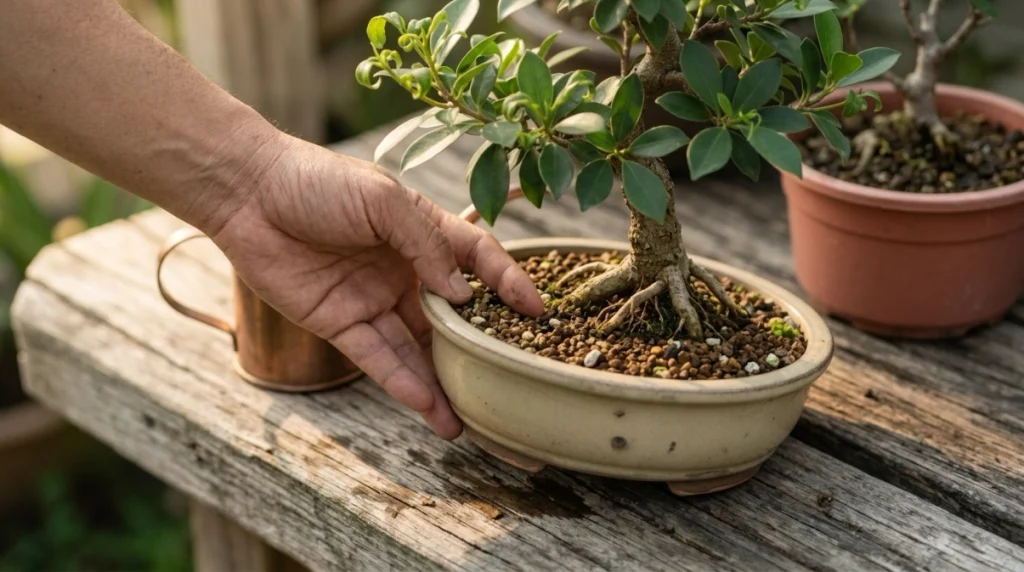
Yes. Both insufficient water and chronically wet soil can produce curled or weak new foliage because roots must supply the water needed for expanding leaves.
Underwatering and rapid drying
A bonsai pot holds far less moisture than the ground around a landscape tree. Hot sun, wind, a small pot, and a fast-draining substrate can therefore dry the root zone quickly.
Don’t diagnose underwatering from leaf shape alone. Check the growing medium and the weight of the pot.
- The substrate feels dry below the surface.
- The pot feels noticeably lighter.
- Leaves wilt during the hottest part of the day.
- Edges become dry or crispy.
- Water runs through soil that has become extremely dry.
If the root ball is genuinely dry, water thoroughly until water exits the drainage holes. Then observe how quickly the pot dries before watering again.
Overwatering and poor drainage
Frequent watering is not automatically overwatering. The real problem is a root zone that stays poorly aerated for too long.
A constantly wet substrate can interfere with healthy root function. University of Maryland Extension also lists overwatering, poor drainage, and root rot among common causes of indoor plant decline in its plant problem diagnosis guidance.
- Water remains on the surface before draining.
- The substrate stays wet much longer than expected.
- Growth becomes weak despite adequate light.
- Leaves yellow, wilt, or curl while the soil is still moist.
- A sour smell or dark, soft roots appear during a justified root inspection.
Avoid reacting by watering on a fixed schedule. Check the tree each day, but water according to its actual moisture needs.
Can Light, Heat, Humidity, or Fertilizer Curl New Leaves?
Yes. Young bonsai foliage can curl when environmental demand changes faster than the roots and leaves can adapt.
Sudden sun and heat exposure
A tree moved abruptly from filtered light into intense afternoon sun can lose water faster than its roots replace it. Tender foliage may cup, wilt, bleach, or develop scorched edges.
This doesn’t mean outdoor bonsai should automatically be kept in shade. Light requirements vary greatly between junipers, maples, elms, ficus, azaleas, pines, and other species.
Low humidity and drying airflow
Indoor tropical bonsai can react to hot heating vents or air-conditioning drafts. Outdoor trees can also lose moisture quickly during hot, dry, windy weather.
Humidity trays are often misunderstood. A shallow tray may protect furniture and provide a little local evaporation, but it cannot compensate for incorrect watering or unsuitable placement.
Too much fertilizer
Bonsai roots occupy a confined soil volume, so excess fertilizer salts can become more troublesome than they might in open ground. Root stress can then appear as scorched margins, weak growth, discoloration, or curling.
- Stop adding fertilizer while the cause is uncertain.
- Check whether the product was applied at the label rate.
- Consider recent fertilizer changes before assuming disease.
- Make sure drainage holes are working normally.
As of 2026, the safest principle remains simple: match light, watering, feeding, and seasonal care to the actual species rather than treating every bonsai alike.
Which Pests Make New Bonsai Leaves Curl?
Aphids and certain plant-feeding mites are important suspects when new growth becomes twisted, puckered, or curled. New shoots are especially useful places to inspect because several pests prefer tender tissue.
Aphids
Aphids are small, soft-bodied insects that often gather around shoots and leaf undersides. University of Minnesota Extension notes that heavy aphid feeding can produce twisted or curled leaves, yellowing, and poor growth in susceptible plants.
Adult aphids are commonly around 2–4 mm long. You may notice the damage before you notice the insects.
- Clusters on tender shoots
- Sticky honeydew
- Ant activity around the tree
- Distorted new leaves
- Yellowed or weakened shoots
See the University of Minnesota Extension’s aphid identification guidance when you need to compare these signs.
Spider mites and other mites
Spider mites are much smaller and usually feed on leaf undersides. Their feeding often creates pale stippling before severe foliage damage develops.
Fine webbing is a strong clue when populations become larger. The University of Minnesota Extension recommends checking discolored leaves closely and provides practical spider mite identification guidance.
- Fine pale or yellow speckles
- Dull or bronzed foliage
- Tiny moving dots under magnification
- Webbing on leaves or shoots
- Distorted tender foliage on susceptible plants
A hand lens is one of the most useful tools for this diagnosis. Inspect several leaves rather than relying on one damaged sample.
Don’t spray before identifying the pest
Curled leaves do not prove that insects are responsible. Unnecessary pesticide use can add another source of stress.
If you find a pest, start with accurate identification and the least disruptive effective control. The American Bonsai Society can also help you locate bonsai learning resources and clubs when a valuable tree needs experienced eyes.
Section Takeaway: Curling plus insects, honeydew, stippling, or webbing makes pests much more likely. Curling alone does not.
Can Root Problems or Disease Cause Curled Growth?
Yes, but they usually produce additional symptoms. Root trouble can limit water and nutrient uptake, while some diseases can distort expanding tissue.
Look at the root zone before blaming the leaves
A bonsai with compromised roots can behave as though it is thirsty even while the substrate remains wet. The leaves only show the consequence of what is happening below.
- Water drains unusually slowly.
- Growth has weakened across the tree.
- Yellowing accompanies the curling.
- The substrate has broken down or compacted.
- The tree has recently suffered root disturbance.
Do not pull a stressed bonsai from its pot repeatedly just to inspect the roots. That can disturb fine feeder roots and make diagnosis harder.
Pro tip: If fixing the problem would require root pruning, emergency repotting, or removing significant live wood, get advice from an experienced grower or local bonsai club before making an irreversible cut.
Could it be disease?
Disease becomes more plausible when curling appears with spreading spots, lesions, unusual coatings, shoot dieback, or progressive tissue discoloration. The exact risk depends heavily on species and growing conditions.
Powdery fungal growth, for example, is different from mite stippling. Diagnosis should focus on the complete symptom pattern rather than the curl itself.
How Do You Fix Curled New Bonsai Leaves?
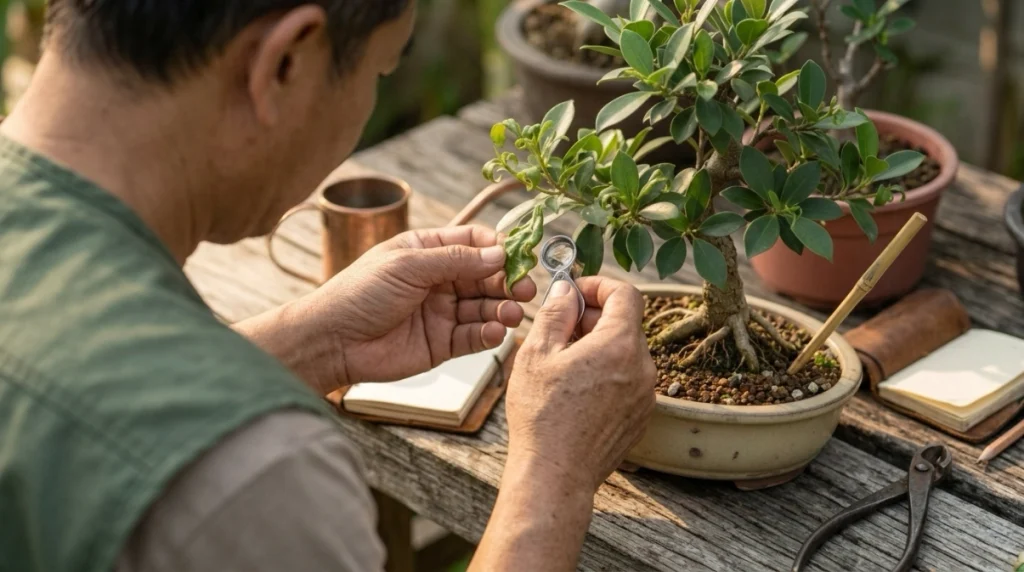
Fix the confirmed cause rather than trying to flatten damaged leaves. Existing distorted foliage may never become perfectly shaped again, so judge recovery by the next flush of growth.
- Identify the species. A juniper, ficus, Japanese maple, Chinese elm, and azalea do not share identical light, temperature, watering, or seasonal requirements.
- Check soil moisture. Determine whether the root zone is dry, appropriately moist, or remaining wet for too long.
- Inspect every side of the new growth. Turn leaves over and check shoots, petioles, branch junctions, and nearby foliage.
- Use magnification. Look for mites, eggs, tiny insects, scale-like bumps, webbing, or feeding marks.
- Review recent changes. Consider relocation, heat waves, indoor heating, fertilizer, repotting, pruning, spraying, and watering changes.
- Correct one likely cause. Avoid simultaneously changing soil, fertilizer, light, watering, and pest treatments unless an emergency clearly requires it.
- Monitor new leaves. Healthy replacement growth is a better recovery indicator than old damaged foliage.
What not to do
The urge to rescue a bonsai can lead to over-treatment. A stressed tree often benefits more from accurate diagnosis and stable care than repeated interventions.
- Don’t water solely because leaves are curled.
- Don’t fertilize a weak tree just because growth looks poor.
- Don’t spray pesticide without identifying a likely pest.
- Don’t move a sun-loving species permanently indoors to treat heat stress.
- Don’t repot outside the appropriate window without a compelling reason.
- Don’t remove large amounts of foliage from an already weak tree.
When should you expect improvement?
Recovery speed depends on the species, season, and cause. The damaged leaf may remain curled even after conditions improve.
Instead, watch developing buds and the next leaves. Better color, normal expansion, stronger shoots, and stable moisture use are more meaningful signs.
If new growth continues to deform despite corrected care, revisit the diagnosis. Look again for mites, aphids, root problems, disease signs, and environmental exposure you may have missed.
Section Takeaway: Diagnose first, make the smallest justified correction, and judge success by healthy new growth rather than expecting damaged leaves to straighten.
FAQs About New Bonsai Leaves Curling
Why are only the newest leaves on my bonsai curling?
New leaves are softer and still expanding, so they show stress sooner than mature foliage. Water imbalance, heat, aphids, mites, fertilizer stress, or root problems may therefore affect new growth first.
Can curled bonsai leaves become normal again?
Slightly curled leaves may improve if they were still unfolding normally. Leaves permanently distorted by feeding damage or stress often remain misshapen, so monitor the next flush instead.
Do curled leaves mean my bonsai needs more water?
No. Both dry roots and unhealthy, persistently wet roots can cause wilted or distorted foliage. Check the actual substrate moisture and drainage before adding water.
Should I remove curled leaves from my bonsai?
Usually not just for appearance. Green leaves can still contribute energy to the tree, and removing healthy tissue adds stress. Remove foliage only when there is a sound horticultural reason, such as managing confirmed disease or severe pest damage.
Can aphids make bonsai leaves curl?
Yes. Heavy aphid feeding can distort tender growth and cause curling, especially around developing shoots. Look for soft-bodied insects, sticky honeydew, shed skins, yellowing, or ants before deciding aphids are responsible.
Can spider mites cause curled bonsai leaves?
They can contribute to distorted foliage on susceptible plants, although pale stippling, bronzing, and fine webbing are often more useful clues. Examine leaf undersides with magnification.
When should I get expert help?
Ask an experienced grower when curling spreads rapidly, major branches decline, roots appear severely damaged, repeated treatments fail, or an old and valuable bonsai may require emergency repotting or substantial pruning.
Final Takeaway: New bonsai leaves curling is a warning sign, not a diagnosis. Check watering, roots, light, temperature, fertilizer, and pests in a logical order, then let the next growth show whether your correction worked.
A few minutes of careful observation can prevent weeks of guesswork. When you know what normal growth looks like on your own tree, small changes become much easier to catch early.
