
Why Are My Bonsai Leaves Curling?

Curling leaves on a bonsai can be worrying, especially when a tree that looked healthy a few days ago suddenly develops twisted, cupped, or tightly folded foliage. Because a bonsai grows in a small container with limited soil and root space, changes in watering, temperature, pests, or root health can affect it quickly.
So, why are my bonsai leaves curling? The most common causes include underwatering, overwatering, heat or low humidity, aphids, spider mites, root problems, excessive fertilizer, disease, and environmental shock.
The shape, color, and location of the curled leaves can provide important clues. This guide explains what to inspect, how to narrow down the cause, when treatment is appropriate, and when a struggling bonsai needs experienced help.
Quick Answer
Bonsai leaves usually curl because the tree is experiencing water stress, pest damage, root problems, excessive heat, low humidity, fertilizer stress, or disease. Check the soil moisture, leaf undersides, roots, recent environmental changes, and new growth before treating the tree. Correcting the underlying cause early usually gives the bonsai the best chance of recovery.
What Does Curling Bonsai Foliage Mean?
Leaf curling is a symptom rather than a diagnosis.
A bonsai may curl its leaves when it cannot move enough water to its foliage, when insects are feeding on tender tissue, or when environmental conditions are damaging new growth.
The direction of the curling is sometimes useful.
- Leaves curling inward: Often associated with dehydration, heat, pests, or damaged roots.
- Leaves curling downward: Can occur with excessive moisture or root stress.
- Twisted new leaves: Frequently worth checking for aphids, mites, chemical damage, or disease.
- Curled leaves with brown edges: Often point toward drought, heat, fertilizer burn, or root damage.
- Curled leaves with yellowing: May indicate overwatering, poor roots, pests, or nutrient problems.
- Curled leaves with webbing: Strongly suggests spider mites.
- Sticky curled leaves: Often indicate sap-feeding pests such as aphids or scale insects.
Do not diagnose a bonsai from curling alone. Look at the entire tree, including its soil, branches, roots, and recent care history.
Common Reasons Bonsai Leaves Curl
| What You Notice | Possible Cause | What to Check Next |
|---|---|---|
| Dry soil and limp curled leaves | Underwatering | Soil below the surface |
| Wet soil with yellowing foliage | Overwatering/root stress | Drainage and roots |
| Fine webbing and pale speckles | Spider mites | Leaf undersides |
| Sticky foliage and clusters of insects | Aphids | New shoots and leaf undersides |
| Brown, crispy curled margins | Heat/dry air/water stress | Sun exposure and moisture |
| Curling after fertilizing | Fertilizer stress | Application strength and timing |
| White or gray coating | Fungal disease | Both leaf surfaces |
| Curling after relocation | Environmental shock | Light, temperature, wind |
| Weak tree with dark soft roots | Root rot | Root condition and drainage |
1. Underwatering Can Make Bonsai Leaves Curl
A bonsai pot contains much less growing medium than a garden bed. That means it can dry much faster, particularly in warm weather.
When the roots cannot absorb enough water, the tree loses moisture through its leaves faster than it can replace it. Leaves may become limp, curl inward, develop dry edges, or eventually fall.
Do not assume that a dry-looking surface means the entire root ball is dry. Likewise, do not rely on a rigid schedule such as watering every two days.
Push a finger or wooden chopstick slightly below the surface and check the actual moisture level.
What to Do
If the growing medium is genuinely dry:
- Water the bonsai thoroughly.
- Continue until water drains freely from the drainage holes.
- Allow excess water to escape.
- Recheck the soil later rather than immediately watering again.
- Protect a severely dehydrated tree from intense afternoon sun while it recovers.
Do not repeatedly flood a stressed tree. One thorough watering is better than constantly keeping the soil saturated.
Species also matter. A Japanese maple may react to drying differently from a juniper, ficus, or jade-type bonsai.
2. Overwatering and Poor Drainage Can Cause Curling
Giving a bonsai extra water does not necessarily protect it from dehydration.
Roots need oxygen as well as moisture. When the growing medium remains saturated for extended periods, oxygen levels around the roots can fall. Damaged roots then become less effective at supplying the foliage with water.
That means an overwatered tree can sometimes look strangely similar to a dry one.
Watch for:
- Persistent wetness
- Yellow leaves
- Curling or wilting despite moist soil
- Weak new growth
- Sour-smelling growing medium
- Dark or soft roots
- Unusual leaf drop
Penn State Extension explains that excess soil moisture can contribute to root problems in woody ornamental plants, particularly when poor drainage deprives roots of oxygen.
Do not automatically repot a weak bonsai simply because you suspect overwatering. Major root work can add significant stress.
Instead, first correct obvious watering and drainage problems unless the root system is clearly failing.
3. Aphids Are a Common Cause of Twisted New Leaves
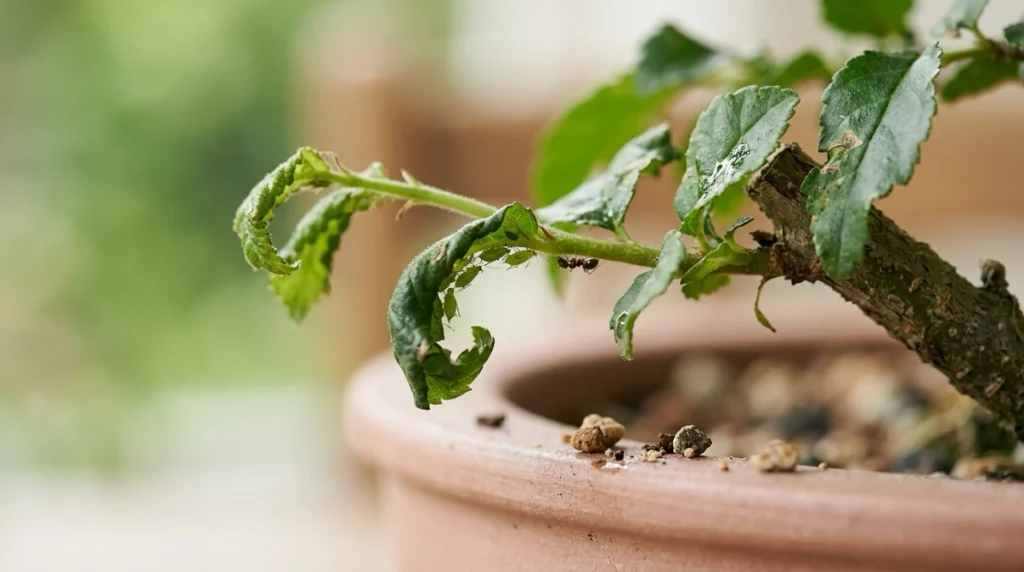
If the newest leaves are curling, inspect them closely for aphids.
Aphids are small, soft-bodied insects that feed by removing plant sap. They often gather on tender shoots and underneath young leaves.
According to the University of Minnesota Extension’s aphid identification and management guidance, heavy aphid feeding can cause twisted or curled leaves, yellowing, poor growth, and damaged shoots.
Signs may include:
- Clusters of tiny green, black, yellow, brown, or gray insects
- Curled tender leaves
- Distorted new shoots
- Sticky residue called honeydew
- Ant activity around foliage
- Black sooty growth developing on sticky surfaces
How to Manage Aphids
For a light infestation, physical removal may be enough.
A gentle spray of water can dislodge many aphids. On a small bonsai, you may also be able to remove individual insects while inspecting the foliage.
If a pesticide product is needed, verify that it is labeled for the plant, pest, and intended location.
Never assume that a stronger concentration works better.
The EPA recommends reading and following pesticide label instructions, which provide information about correct use, precautions, storage, and protection of people and pets.
4. Spider Mites Can Curl and Damage Bonsai Leaves
Spider mites can be particularly troublesome on bonsai kept in warm, dry conditions.
They are extremely small and may be difficult to see without magnification. Instead, growers often notice the feeding damage first.
Look for:
- Fine pale dots or stippling
- Faded or bronzed leaves
- Distorted foliage
- Fine webbing
- Premature leaf drop
- Tiny moving dots beneath leaves
The University of Minnesota Extension notes that spider mites feed primarily on leaf undersides and may cause discoloration, distortion, webbing, and leaf loss.
Try the White-Paper Test
Hold a sheet of white paper beneath a suspicious branch and gently tap the foliage.
If tiny moving specks fall onto the paper, inspect them with a magnifying glass. This simple test can reveal mites that were almost invisible while on the tree.
Expert Tip: When bonsai leaves start curling, inspect the undersides before changing your watering or fertilizer routine. Tiny pest colonies can hide there while the upper leaf surface still looks relatively normal.
5. Heat, Strong Sun, and Low Humidity
Not every curled bonsai leaf means insects or disease.
Environmental stress is extremely common.
A tree moved suddenly from partial shade into intense afternoon sunlight may lose water faster than its roots can replace it. Hot wind can make the problem worse.
Indoor tropical bonsai can also struggle next to:
- Heating vents
- Air conditioners
- Radiators
- Very hot windows
- Extremely dry indoor air
The leaves may curl, develop crispy edges, or wilt during the hottest part of the day.
Move a stressed tree to a more suitable location gradually rather than dramatically changing every part of its care routine.
Remember that species suitability matters. Most temperate trees, including many maples, pines, and junipers, are fundamentally outdoor trees. Tropical species such as many ficus varieties are better suited to protected indoor conditions when adequate light is available.
6. Root Problems and Root Rot
A bonsai depends on a comparatively small root system. When those roots are damaged, foliage symptoms can appear quickly.
Root problems may develop from:
- Constantly wet growing medium
- Poor drainage
- Compacted soil
- Severe drought
- Excess fertilizer
- Recent aggressive root pruning
- Disease
- Temperature extremes
Healthy fine roots are generally firm rather than mushy.
Penn State’s guidance on pest and disease problems of indoor plants notes that root rot can be associated with overwatering or damaged roots and may produce wilting along with darkened, soft roots.
If your bonsai was recently repotted, mild temporary stress can occur. However, worsening leaf curl, widespread yellowing, dieback, or continuously wet soil deserves closer attention.
Avoid aggressive pruning, wiring, fertilizing, and root work at the same time on an already weak tree.
7. Too Much Fertilizer Can Damage Foliage
More fertilizer does not automatically produce faster bonsai growth.
Excess dissolved fertilizer salts can damage roots, especially in a small container. A stressed root system may then struggle to supply the foliage properly.
Possible symptoms include:
- Brown leaf tips
- Scorched margins
- Curling
- Weak foliage
- Sudden decline after feeding
If symptoms appeared shortly after a strong fertilizer application, stop adding fertilizer until you better understand the cause.
Do not try to “feed a sick tree back to health.” Fertilizer is most useful when roots are functioning and the tree is actively growing.
8. Diseases Can Sometimes Distort Bonsai Leaves
Fungal or other plant diseases are less common than simple watering problems, but they should not be ignored.
Possible warning signs include:
- White powdery growth
- Expanding brown or black lesions
- Yellow halos around spots
- Stem discoloration
- Repeated dieback
- Curled leaves with unusual surface growth
Avoid automatically spraying fungicide because leaves are curled. A fungicide will not correct underwatering, spider mites, fertilizer burn, or damaged roots.
Correct diagnosis matters.
How to Diagnose Curling Bonsai Leaves Step by Step
Avoid treating symptoms at random. Work through the tree systematically.
1. Check the Soil
Feel below the surface.
Ask whether it is:
- Very dry
- Evenly moist
- Constantly saturated
- Compacted and slow to drain
2. Inspect Leaf Undersides
Use a hand lens if available.
Look for:
- Aphids
- Mites
- Scale insects
- Eggs
- Webbing
- Sticky residue
A basic hand lens is inexpensive and often more useful for pest diagnosis than immediately buying multiple treatment products.
3. Look at New Growth
New leaves are often the first to show problems.
Compare healthy older foliage with the newest shoots. Distortion concentrated in fresh growth can point toward pests, chemical injury, or a recent environmental problem.
4. Review Recent Changes
Think back over the previous one to three weeks.
Did you recently:
- Move the tree?
- Repot it?
- Prune the roots?
- Apply fertilizer?
- Spray a pesticide?
- Change its light exposure?
- Experience a heat wave?
- Bring an outdoor bonsai indoors?
Timing can be one of the best diagnostic tools.
5. Inspect the Roots Only When Necessary
Do not repeatedly remove a bonsai from its pot.
Root inspection is more appropriate when the tree shows significant decline and there are strong reasons to suspect drainage or root disease.
Should You Remove Curled Bonsai Leaves?
Not automatically.
A curled but still-green leaf may continue producing energy through photosynthesis. Removing every imperfect leaf can reduce the tree’s ability to recover.
Remove leaves when they are:
- Completely dead
- Severely diseased
- Supporting a confirmed pest problem that requires sanitation
- At risk of spreading infection
For severely stressed trees, prioritize recovery rather than appearance.
How Long Does It Take Curled Bonsai Leaves to Recover?
Some leaves straighten after mild water stress, but permanently damaged leaves may never return to normal.
Judge recovery mainly by new growth.
If fresh leaves emerge healthy after you correct the problem, the tree is probably moving in the right direction even if older damaged foliage remains curled.
Recovery time depends on the species, season, root health, and severity of the original stress.
Treatment Cost, Quality, and Skill-Level Considerations
Leaf curling does not usually require expensive equipment.
For a beginner, the most useful items are often:
- A basic hand lens
- A wooden chopstick for checking soil moisture
- Quality free-draining bonsai soil when repotting is genuinely needed
- Clean pruning tools
- A correctly labeled pest treatment when necessary
Cheap diagnostic tools can provide excellent value. By comparison, buying several pesticides without identifying the pest wastes money and may further stress the tree.
Higher-quality bonsai soil can also be worthwhile because durable particles maintain drainage and air spaces better than poorly structured mixes that quickly compact.
However, good materials cannot compensate for inappropriate watering or incorrect species placement.
Common Mistakes Bonsai Owners Should Avoid
- Watering on a fixed calendar. Check the tree and soil instead.
- Assuming every curled leaf means underwatering. Overwatering can also damage roots.
- Spraying pesticides before finding a pest. Diagnose first.
- Using stronger pesticide concentrations than directed. This can harm the tree and create safety risks.
- Fertilizing a severely stressed bonsai. Fix the underlying problem first.
- Repotting immediately after seeing curled leaves. Repotting itself is stressful.
- Keeping outdoor bonsai indoors permanently. Species requirements matter.
- Ignoring leaf undersides. Many pests feed where they are difficult to notice.
- Treating only once and never checking again. Pest populations may require continued monitoring.
- Performing pruning, wiring, repotting, and pest treatment simultaneously. A weak tree needs fewer stresses, not more.
When to Ask an Experienced Bonsai Grower or Arborist

Many cases of curling leaves can be handled at home, but professional or experienced help is appropriate when the cause remains unclear.
Seek assistance when:
- A valuable or mature bonsai is declining quickly.
- Major branches are dying.
- The root system appears extensively rotten.
- Curling continues despite correcting obvious care problems.
- You suspect a serious infectious disease.
- A pest infestation continues despite appropriate treatment.
- You are considering major root work on a weak tree.
- The trunk or major roots show unusual lesions, decay, or structural damage.
- Several nearby plants develop similar symptoms.
A local bonsai club, plant diagnostic laboratory, extension service, experienced bonsai grower, or certified arborist may be able to identify problems that cannot reliably be diagnosed from foliage alone.
Avoid major structural pruning or aggressive root work on a seriously stressed tree unless you understand the cause of the decline.
FAQs
Why are my bonsai leaves curling inward?
Inward curling commonly occurs with dehydration, heat stress, low humidity, spider mites, aphids, or root problems. Check the soil moisture and leaf undersides before deciding on treatment.
Why are my bonsai leaves curling and turning brown?
Brown, curled foliage often indicates water stress, excessive heat, fertilizer damage, root problems, or severe pest injury. Crispy margins are particularly common when foliage is losing moisture too quickly.
Can overwatering cause bonsai leaves to curl?
Yes. Constantly wet soil can deprive roots of oxygen and contribute to root damage. Affected foliage may curl, wilt, yellow, or fall even though the soil is still wet.
Why are my bonsai’s new leaves curling?
Distorted new leaves are worth checking carefully for aphids, mites, environmental stress, chemical injury, and problems affecting the roots. Tender new growth is often more sensitive than mature foliage.
Should I cut off curled bonsai leaves?
Usually not if the leaves are still green and functional. Remove dead or badly diseased foliage when necessary, but avoid unnecessary defoliation while the tree is stressed.
Can spider mites make bonsai leaves curl?
Yes. Spider mite feeding can cause pale stippling, discoloration, distortion, webbing, and eventual leaf loss. Inspect the undersides of leaves with a magnifying lens and try the white-paper test.
Will curled bonsai leaves become normal again?
Sometimes, but not always. Mildly wilted leaves may recover, while physically damaged leaves often remain distorted. Healthy new growth is a better sign of recovery than the appearance of old leaves.
Conclusion
If you have been asking “Why are my bonsai leaves curling?”, start with diagnosis rather than treatment. Check soil moisture, drainage, leaf undersides, new growth, recent fertilizer use, environmental changes, and overall root health.
Underwatering and heat can curl foliage, but so can overwatering and damaged roots. Aphids and spider mites are particularly important to rule out because they often hide beneath leaves and attack tender growth.
Correct one confirmed problem at a time, then watch how the tree responds. Avoid adding fertilizer, pesticides, repotting stress, and heavy pruning all at once.
Most importantly, judge improvement by the quality of the next flush of growth. Healthy new leaves are one of the clearest signs that your bonsai is recovering. Continue monitoring your tree closely, adjust its care to the needs of its species, and seek experienced help when symptoms continue or the tree’s health declines.
