
Why Are My Bonsai Leaves Drooping? Causes, Diagnosis, and What to Do

When a bonsai that looked healthy yesterday suddenly has limp, hanging, or soft leaves, it is easy to assume it simply needs water. Sometimes that is true. But drooping can also happen when the roots are too wet, damaged, overheated, stressed by a sudden environmental change, or attacked by pests.
If you are asking “Why are my bonsai leaves drooping?”, the safest approach is to diagnose the cause before changing your care routine. Automatically watering a drooping tree can make an overwatering problem much worse.
This guide explains the most common causes of drooping bonsai leaves, how to distinguish watering problems from pest damage, what signs to check on the roots and foliage, and when your tree needs more advanced help.
Quick Answer
Bonsai leaves usually droop because the tree cannot move enough water from its roots to its foliage. The cause may be dry soil, waterlogged or damaged roots, excessive heat, environmental stress, or sap-sucking pests. Check the soil moisture, drainage, roots, leaf undersides, light, and temperature before watering or treating the tree.
What Drooping Leaves Actually Tell You
Drooping is a symptom rather than a diagnosis.
Leaves remain firm because water inside their cells creates pressure that keeps the tissue supported. When the tree loses water faster than its roots can replace it, the leaves become soft and begin to hang.
The confusing part is that this can happen both when a bonsai is too dry and when its soil is too wet.
Healthy roots need water, but they also need oxygen. Prolonged waterlogging can damage fine feeder roots and prevent them from supplying the foliage properly. Penn State Extension explains that excessive soil moisture reduces oxygen around roots and can also encourage root-rotting organisms. Penn State Extension guidance on root rot in ornamental plants
That is why you should never diagnose drooping from the leaves alone.
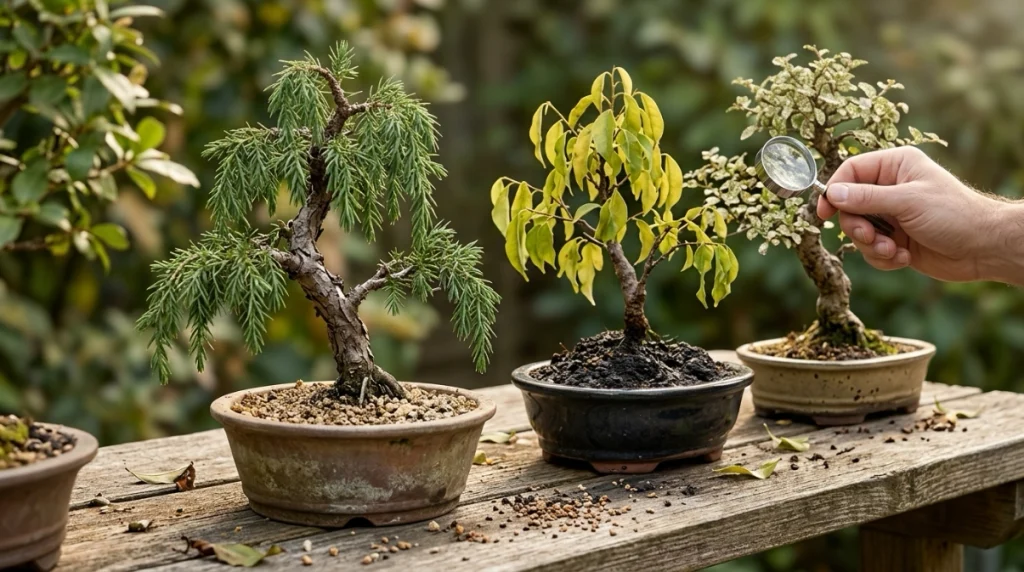
Most Common Reasons Bonsai Leaves Droop
| What You Notice | Likely Cause | What to Check Next |
|---|---|---|
| Drooping with dry soil | Underwatering | Soil depth, root ball, recent heat |
| Drooping with constantly wet soil | Overwatering/root trouble | Drainage, smell, root condition |
| Drooping in afternoon heat | Heat or sun stress | Pot temperature, recent weather |
| Sticky leaves or distorted shoots | Aphids, scale, mealybugs | Leaf undersides and new growth |
| Speckled or bronzed leaves with webbing | Spider mites | Undersides with a hand lens |
| Drooping after moving the tree | Environmental shock | Light, temperature, humidity |
| Drooping plus black or mushy roots | Root rot | Root system and drainage |
| Weak growth plus drooping | Multiple stresses | Roots, light, pests, fertilizer |
1. Underwatering
Underwatering is one of the simplest causes of drooping.
Because bonsai trees grow in relatively small containers, their soil can dry much faster than soil around a full-sized landscape tree. Hot weather, wind, strong sunlight, and vigorous growth can shorten the time between waterings dramatically.
Signs of underwatering include:
- Dry soil below the surface
- A noticeably lightweight pot
- Soil pulling away from the edge of the container
- Limp but otherwise normally colored leaves
- Dry, crispy leaf edges if the stress has continued
- Rapid improvement after thorough watering
If the soil is genuinely dry, water the bonsai thoroughly until water drains freely from the drainage holes.
Do not give it just a small splash. You want the entire root mass to become evenly moist.
Avoid watering according to a fixed calendar. A tree that needs water every day during a hot week may need it far less frequently during cool, cloudy weather.
2. Overwatering and Poor Drainage
A frequently watered bonsai can look surprisingly similar to a dehydrated one.
When soil remains saturated, air spaces fill with water. Fine roots may weaken or die, reducing the tree’s ability to take up water. The foliage then droops even though plenty of moisture is present around the roots.
UC Integrated Pest Management lists both underwatering and poor root health associated with overwatering among causes of wilting in container plants. UC IPM’s guide to diagnosing houseplant problems
Look for:
- Soil that remains wet for several days
- A sour or unpleasant smell
- Soft or yellowing leaves
- Algae on the soil surface
- Very slow growth
- Blackened shoots in advanced cases
- Dark, soft, or mushy roots
Do not respond to wet-soil drooping by adding more water.
Instead, allow the soil to approach the appropriate moisture level for that species while improving airflow and checking whether the drainage holes are blocked.
3. Root Rot or Damaged Roots
Root problems deserve special attention because a badly compromised root system can threaten the entire tree.
Root rot is often associated with prolonged wetness and poor aeration. Penn State notes that root-rot symptoms can include wilting, slowed growth, yellowing leaves, and dark, limp roots. Penn State Extension’s root-rot diagnosis guidance
Healthy root appearance varies among species, but actively growing fine roots are generally firm rather than slimy.
Possible warning signs include:
- Persistent drooping despite reasonable soil moisture
- Black or soft roots
- Sections of roots whose outer tissue slips away easily
- Foul-smelling soil
- Branch dieback
- Progressive yellowing
- Very little new growth
Should You Repot a Drooping Bonsai?
Not automatically.
Repotting involves disturbing and often pruning roots. Performing heavy root work on a severely stressed tree can reduce its ability to recover.
If the soil is simply staying wet because you watered too frequently, correcting the watering routine may be enough.
If the soil has broken down into a dense mass, drainage has failed, or substantial root rot is present, repotting may eventually be necessary. However, the correct timing depends on the species, season, and severity of the problem.
Major emergency root work on a weak or valuable bonsai is one situation where experienced help is worthwhile.
4. Heat and Intense Sun
A bonsai can temporarily droop during very hot conditions even when its roots are healthy.
Leaves lose water through tiny pores in a process called transpiration. When leaves lose moisture faster than roots can replace it, they may become limp.
The shallow container makes bonsai particularly vulnerable because the root zone can heat quickly.
Watch for drooping that:
- Appears during the hottest part of the afternoon
- Improves later in the evening
- Follows an abrupt heat wave
- Occurs after moving a tree into stronger sunlight
- Is accompanied by dry soil
Protecting the root ball from extreme pot temperatures can be as important as protecting the foliage.
However, do not permanently move a sun-loving outdoor species into deep shade simply because it wilted during one hot afternoon. Correct the underlying heat and watering issue while still providing the light the species requires.
5. Sudden Environmental Changes
Bonsai trees often respond poorly to abrupt changes.
Drooping may follow:
- Moving an indoor bonsai outdoors
- Bringing a tropical bonsai indoors for winter
- A sudden temperature drop
- Strong wind
- Relocation beside a heater or air conditioner
- A major change in light intensity
- A sudden decrease in humidity
Ficus and other tropical bonsai are especially well known for reacting to environmental changes with drooping or leaf loss.
Give the tree stable conditions rather than repeatedly moving it from place to place.
Can Pests Cause Bonsai Leaves to Droop?
Yes. Pest infestations can weaken foliage and young shoots enough to cause drooping, distortion, yellowing, or premature leaf drop.
However, drooping alone does not prove that pests are present.
Inspect the entire tree, especially:
- Undersides of leaves
- New shoots
- Branch junctions
- Leaf stems
- Bark crevices
- Soil surface
A 10× hand lens is inexpensive and useful for checking very small pests. Beginners do not need an expensive microscope for routine inspections.
Aphids
Aphids are small sap-sucking insects that commonly gather around tender new shoots and underneath young leaves.
Possible symptoms include:
- Drooping or distorted new growth
- Curled leaves
- Sticky honeydew
- Ant activity
- White shed insect skins
- Groups of small green, black, brown, or pale insects
UC IPM notes that aphids can cause leaf curling and distortion and recommends nonchemical controls such as washing insects from plants where practical before escalating treatment.
Spider Mites
Spider mites are extremely small and can become serious problems, particularly during warm, dry conditions.
Look for:
- Tiny pale speckles on foliage
- A dull or gray appearance
- Bronzing
- Fine webbing
- Drying leaves
- Premature leaf drop
Colorado State University Extension describes speckling, bronzing, webbing, and premature leaf drop as common signs of spider-mite feeding. Colorado State University Extension’s spider-mite guidance
Junipers and other conifers can also be affected by mite species, so do not assume mites are only an indoor tropical-bonsai problem.
Scale and Mealybugs
Scale insects may look like tiny brown, tan, or white bumps attached to stems or leaves.
Mealybugs are easier to recognize because many have a white, cotton-like appearance.
Both feed on plant sap and can cause:
- Weak growth
- Yellowing
- Sticky honeydew
- Leaf drop
- General loss of vigor
A heavily infested bonsai may droop because the pests are adding stress to an already weakened tree.
Expert Tip: When investigating drooping leaves, inspect the soil before watering and the leaf undersides before spraying. Those two checks prevent many unnecessary treatments.
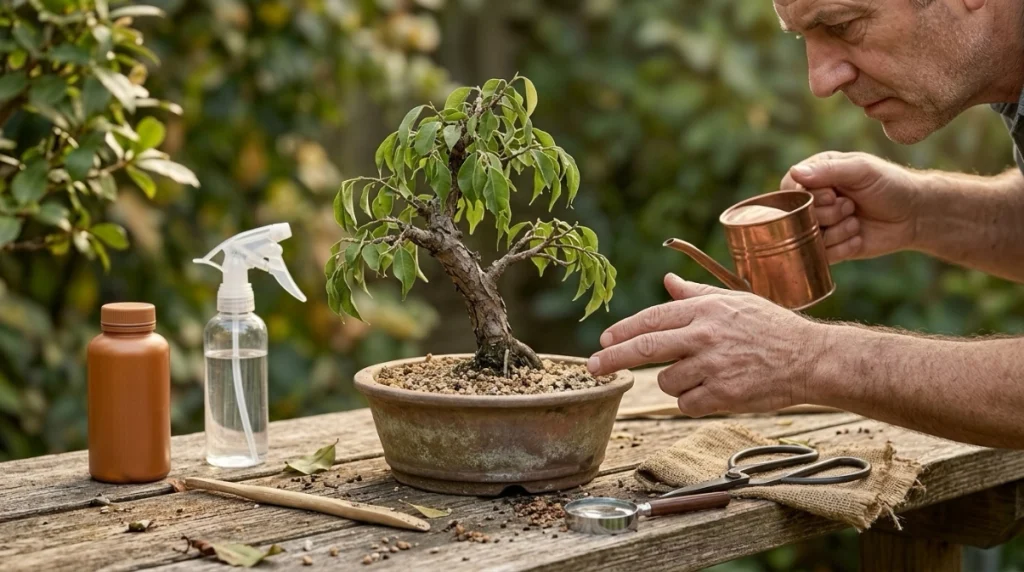
How to Diagnose a Drooping Bonsai Step by Step
Avoid changing several things at the same time. A systematic check makes the real cause much easier to identify.
1. Check the Soil
Push a finger, wooden chopstick, or moisture-checking tool slightly below the surface.
Surface appearance can be misleading. The top layer may look dry while the deeper root zone remains wet.
2. Check Drainage
Water should be able to move through the soil and leave through the drainage holes.
If water pools on top for a long time or the pot stays saturated for days, the soil structure may be too compact.
3. Inspect the Leaves
Check both surfaces.
Look for:
- Speckles
- Webbing
- Sticky residue
- Insects
- Scale-like bumps
- Brown margins
- Yellowing
- Black spots
- Distorted new growth
4. Inspect Stems and Branches
Healthy live twigs are usually flexible, although this varies by species.
Check for unusual discoloration, soft tissue, dieback, or pests hiding in branch junctions.
5. Review Recent Changes
Ask yourself:
- Did temperatures suddenly rise?
- Did I move the tree?
- Did I recently repot it?
- Did I apply fertilizer?
- Did I spray a pesticide?
- Has it been exposed to strong wind?
- Did I bring home another plant recently?
The timing of symptoms can reveal the cause.
6. Check Roots Only When Necessary
Avoid repeatedly pulling a bonsai from its pot just to investigate.
If persistent wetness, foul odor, declining vigor, or other symptoms strongly suggest root trouble, a careful root inspection may be justified.
What to Do When Your Bonsai Leaves Are Drooping
Treatment depends on the diagnosis.
If the Soil Is Too Dry
Water thoroughly.
If extremely dry bonsai soil initially repels water, apply water gradually until the root mass becomes evenly moist.
Then adjust your inspection routine rather than assuming the tree always needs watering at the same interval.
If the Soil Is Too Wet
Stop adding water simply because the foliage is drooping.
Make sure drainage holes are open, give the tree appropriate airflow, and allow moisture levels to normalize according to the species.
Do not attempt to “dry” an outdoor bonsai by putting a shade-loving or recently stressed tree into extreme midday sun.
If Pests Are Present
Isolate the affected tree from other susceptible plants when practical.
For some pests, a gentle stream of water and removal of heavily infested foliage can reduce populations.
If you use insecticidal soap, horticultural oil, or another pesticide, confirm that the product is labeled for the intended plant and pest. The U.S. Environmental Protection Agency emphasizes reading and following garden-product label directions, including application rates and safety precautions. EPA guidance on reading pesticide labels before garden use
Do not assume a stronger concentration will work better. Excessive pesticide rates can damage foliage and add stress to an already weakened bonsai.
If Heat Is the Problem
Move the tree to a location appropriate for the species where it is protected from exceptional afternoon stress while it stabilizes.
Monitor soil more frequently during hot, windy weather.
Remember that small bonsai pots can dry much faster than larger nursery containers.
Indoor vs Outdoor Bonsai Considerations
The correct diagnosis also depends on the species.
Tropical Bonsai
Ficus, Schefflera, Fukien tea, and many other tropical trees are sensitive to cold and abrupt environmental changes.
Indoor drooping may be associated with:
- Low light
- Heating vents
- Dry air
- Excessive watering
- Spider mites
- Sudden relocation
Temperate Deciduous Bonsai
Maples, elms, hornbeams, and similar temperate trees generally belong outdoors and require normal seasonal cycles.
Persistent indoor growing conditions can weaken them.
Some leaf drooping or eventual leaf loss may also be related to seasonal changes rather than disease.
Conifer Bonsai
Junipers, pines, and many other conifers should generally be grown outdoors.
Their foliage may not visibly wilt in the same dramatic way as broadleaf species. By the time widespread foliage discoloration appears, the underlying problem may already be serious.
Correct species identification therefore matters before you make major care changes.
Should You Fertilize a Drooping Bonsai?
Usually not immediately.
Fertilizer does not fix dehydration, root rot, pest infestation, or heat stress. Adding fertilizer to damaged roots can increase soluble salts around the root system and create additional stress.
First restore:
- Appropriate moisture
- Healthy drainage
- Suitable light
- Appropriate temperature
- Pest control where needed
Once the tree resumes healthy growth, return gradually to a fertilizer program appropriate for the species and season.
A stressed bonsai needs correct growing conditions before it needs extra fertilizer.
Common Mistakes Bonsai Owners Should Avoid
- Watering automatically whenever leaves droop. Wet roots can produce the same symptom as dry roots.
- Following a rigid watering calendar. Weather, pot size, soil, species, and growth rate change water demand.
- Repotting immediately. Root disturbance can further weaken a stressed tree.
- Fertilizing a sick tree heavily. Fertilizer cannot repair damaged roots or kill pests.
- Spraying before identifying the pest. Different pests require different management.
- Using household detergents as improvised pesticides. Some products can damage plant tissue.
- Applying stronger-than-labeled pesticide mixtures. More product does not necessarily produce better control and may harm the bonsai.
- Moving an outdoor species indoors because it looks stressed. This may introduce an additional light and environmental problem.
- Changing watering, light, soil, fertilizer, and location simultaneously. Too many changes make it difficult to determine what helped or hurt.
- Ignoring nearby plants. Aphids, mites, scale, and mealybugs can spread between susceptible plants.
When to Ask an Experienced Bonsai Grower or Arborist
Most mild watering or environmental problems can be corrected by a careful hobbyist.
Ask an experienced bonsai grower for help when:
- A valuable or old bonsai is declining rapidly
- Large sections of the canopy are dying
- Roots appear severely rotted
- Emergency repotting may be necessary outside the normal season
- You cannot identify the species
- You cannot distinguish a pest problem from disease or chemical injury
- The tree continues declining after basic care problems are corrected
- Major root pruning would be required
For large trees being developed as bonsai, collected landscape trees, or trees with structural hazards, a qualified arborist may also be appropriate.
Avoid major pruning, extensive root work, or aggressive styling while a tree is severely stressed. Recovery comes before aesthetics.
FAQs
Why are my bonsai leaves drooping even though the soil is wet?
The roots may be receiving too much water and too little oxygen. Poor drainage or root damage can prevent the tree from absorbing water properly, producing wilted leaves even in wet soil.
Should I water my bonsai immediately when its leaves droop?
Only if the root zone is actually becoming dry. Check below the soil surface first. Watering an already saturated bonsai can worsen root problems.
Can spider mites make bonsai leaves droop?
Yes. Heavy spider-mite feeding can weaken foliage and cause speckling, bronzing, drying, drooping, and leaf loss. Fine webbing is another important warning sign.
How long does it take a drooping bonsai to recover after watering?
A mildly dehydrated tree with healthy roots may begin improving within hours. A severely dehydrated or root-damaged tree may take considerably longer, and some damaged leaves may not recover fully.
Why did my bonsai start drooping after repotting?
Repotting temporarily reduces the root system’s ability to supply water, especially when roots were pruned. Protect the freshly repotted tree according to species-specific aftercare and avoid excessive fertilizer or additional stress while it recovers.
Can too much sunlight cause bonsai leaves to droop?
Yes. Strong heat and sunlight can increase water loss faster than roots can replace it. This is especially common during sudden heat waves or after moving a tree into stronger sun without gradual acclimation.
Should I repot a bonsai with drooping leaves?
Not simply because it is drooping. Repot only when there is a clear reason, such as severely degraded soil, failed drainage, or significant root trouble. Unnecessary root disturbance can make a stressed tree worse.
Conclusion
If you are wondering “Why are my bonsai leaves drooping?”, start with diagnosis rather than treatment. Check the soil moisture, drainage, roots, recent weather, growing environment, and leaf undersides before deciding what the tree needs.
Underwatering may require a thorough watering. Constantly wet soil may point toward poor drainage or unhealthy roots. Speckling, sticky residue, webbing, or visible insects can indicate a pest problem, while sudden heat or environmental changes can temporarily overwhelm an otherwise healthy tree.
Most importantly, do not respond to every drooping bonsai with more water, fertilizer, pesticide, or an immediate repot. Correct the actual cause and give the tree time to stabilize.
Inspect your bonsai carefully today, identify the most likely source of stress, and make one appropriate change at a time. That measured approach gives your tree the best chance of returning to healthy, firm growth.
