
Why Are My Bonsai Leaves Falling Off?

Seeing leaves suddenly collecting around your bonsai can be alarming. A tree that looked healthy a week ago may begin yellowing, wilting, or dropping foliage with no obvious explanation. Naturally, the first question is: Why are my bonsai leaves falling off?
Leaf loss can happen because of overwatering, underwatering, poor light, temperature stress, root problems, pests, disease, or simply the tree’s normal seasonal cycle. Because bonsai grow in small containers with limited soil, changes in moisture and root health can affect them faster than full-sized landscape trees.
The key is not to react by immediately watering, fertilizing, spraying, or repotting. Instead, look at how the leaves are falling and check the tree systematically. This guide explains the most common causes, warning signs, pest symptoms, and practical steps you can take to help your bonsai recover.
Quick Answer
Why are my bonsai leaves falling off? The most common causes are incorrect watering, sudden environmental changes, insufficient light, root problems, pests, disease, or normal seasonal leaf drop. Check the soil moisture, leaf color, roots, temperature, light, and undersides of leaves before changing your care routine or applying treatments.
Is Leaf Drop Always a Sign That a Bonsai Is Dying?
No. Leaf drop does not automatically mean your bonsai is dying.
Deciduous bonsai such as Japanese maple, Chinese elm, hornbeam, and zelkova naturally lose leaves as they enter dormancy. Dormancy is the tree’s seasonal resting period when growth slows significantly.
Evergreen and tropical bonsai can also shed a small number of older leaves during normal growth.
The situation becomes more concerning when you notice:
- Large numbers of leaves dropping within a few days
- Yellow or brown leaves falling throughout the canopy
- New growth dying
- Branch tips becoming brittle
- Soft or blackened roots
- Persistent wilting even though the soil is wet
- Webbing, sticky residue, insects, or unusual spots
- An unpleasant smell coming from the soil
- No new growth during the tree’s normal growing season
Sudden or widespread leaf loss usually means the tree is experiencing stress and deserves closer inspection.
The Most Common Reasons Bonsai Leaves Fall Off
Leaf drop is a symptom rather than a diagnosis. Several completely different problems can produce almost identical-looking foliage.
The UC Statewide Integrated Pest Management Program’s guidance on houseplant problems notes that sudden leaf drop can be associated with poor root health, excessive or insufficient moisture, root disease, compacted soil, excessive salts, or sudden changes in light, temperature, and humidity.
1. Overwatering
Overwatering is one of the first problems to investigate.
Bonsai roots need both moisture and oxygen. If the growing medium remains saturated for too long, air spaces fill with water. Roots can become stressed and eventually begin deteriorating.
Possible signs include:
- Yellowing leaves
- Soft foliage
- Leaves dropping while still yellow or green
- Soil that remains wet for many days
- Algae or persistent moss growth on overly wet soil
- Reduced growth
- Dark, soft, or foul-smelling roots
Do not assume a bonsai needs water simply because leaves are falling.
If the soil is already wet, adding more water can make the problem worse.
2. Underwatering
The opposite problem can cause leaf loss just as quickly.
A bonsai pot contains relatively little growing medium. On hot, sunny, or windy days, it can dry much faster than an ordinary houseplant container.
Signs of insufficient water may include:
- Dry or crispy leaf edges
- Limp leaves
- Leaves becoming pale or brown
- Soil pulling away from the sides of the pot
- Extremely lightweight pot
- Sudden leaf drop during hot weather
Species also differ greatly in their water needs. A water-loving deciduous bonsai may suffer drought stress much sooner than a jade-style succulent bonsai.
Check the growing medium rather than following a rigid schedule such as “water every three days.”
3. Sudden Changes in Light
Moving a bonsai can trigger leaf loss.
A tropical bonsai brought indoors for winter may suddenly receive much less light. Similarly, moving an indoor tree directly into strong outdoor sunlight can scorch foliage that has not gradually adapted.
Stress can occur after moving a tree:
- From outdoors to indoors
- From indoors to full sun
- Away from a bright window
- Into a darker room
- From a greenhouse into a home
- From a protected area into strong wind
Whenever possible, make major environmental transitions gradually.
4. Temperature Shock
Bonsai foliage can react strongly to sudden temperature changes.
Cold-sensitive tropical species such as ficus should not be treated like hardy outdoor junipers or maples. Conversely, many temperate bonsai need a genuine winter dormancy and should not be maintained like tropical houseplants all year.
Watch for:
- Cold drafts
- Heating vents
- Air-conditioner airflow
- Unexpected frost
- Hot windows
- Rapid indoor-outdoor temperature changes
Species identification is essential. Care advice that works for one bonsai may seriously stress another.
Root Problems and Poor Drainage
Healthy foliage depends on healthy roots.
When roots cannot absorb water and oxygen properly, the canopy often responds with yellowing, wilting, weak growth, and leaf loss.
Compacted Bonsai Soil
Old organic soil can break down into fine particles. Eventually, drainage and air movement around the roots may decrease.
Look for:
- Water sitting on the surface
- Water taking unusually long to drain
- Dense, muddy soil
- Poor growth despite appropriate light
- Roots circling tightly around the pot
Good bonsai soil should balance moisture retention with drainage and aeration.
Root Rot
Root rot becomes a concern when roots remain wet and oxygen-starved for extended periods or when disease organisms attack already weakened roots.
Healthy roots are generally firm. Unhealthy roots may become:
- Dark
- Mushy
- Easily broken
- Foul-smelling
Do not perform aggressive root pruning simply because leaves are falling. Root work places additional stress on the tree and may be dangerous when the bonsai is already weak.
If the soil is draining adequately, stabilizing watering and environmental conditions may be safer than immediately repotting.
Can Pests Make Bonsai Leaves Fall Off?
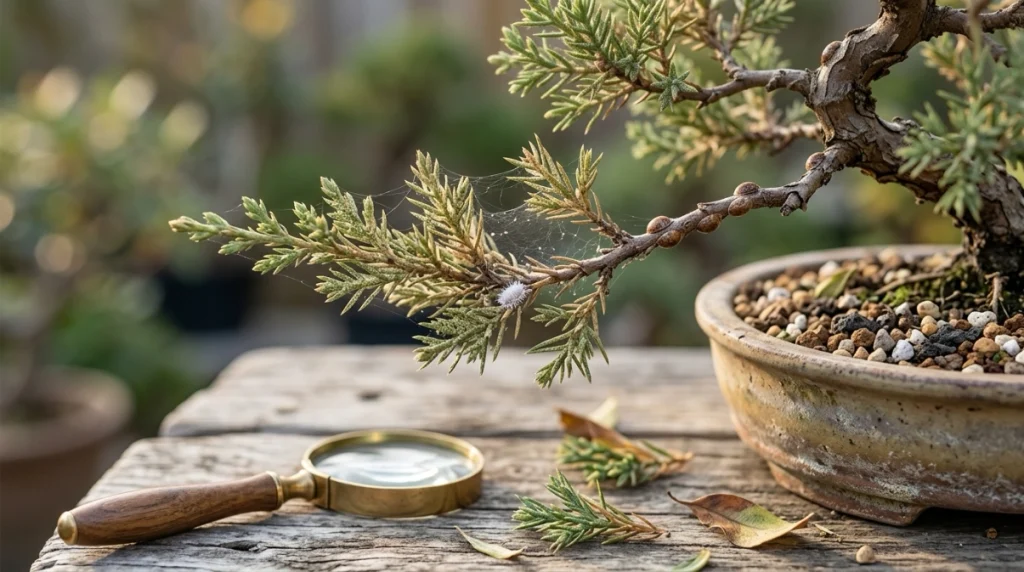
Yes. Several sap-feeding pests can weaken bonsai enough to cause premature leaf drop.
Penn State Extension’s guide to pest and disease problems of indoor plants identifies spider mites, mealybugs, scale insects, whiteflies, and other pests as causes of yellowing, reduced vigor, and premature foliage loss.
Spider Mites
Spider mites are extremely small and often feed underneath leaves.
Watch for:
- Tiny pale speckles
- Bronzed foliage
- Fine webbing
- Dry-looking leaves
- Premature leaf drop
A hand lens can make inspection much easier.
Scale Insects
Scale can resemble tiny brown, tan, or gray bumps attached to stems and leaves.
Possible symptoms include:
- Yellow leaves
- Weak growth
- Leaf drop
- Sticky honeydew
- Black sooty mold
The UC IPM guidance on scale insects explains that scale feeding can cause premature leaf drop, discoloration, distortion, and branch decline.
Aphids
Aphids commonly gather around tender shoots and new leaves.
Look for:
- Clusters of tiny insects
- Curling new growth
- Sticky leaves
- Ant activity
- Weak or distorted shoots
Mealybugs
Mealybugs look like small white cottony patches.
Check:
- Leaf joints
- Branch crotches
- Under leaves
- Around tender shoots
- Occasionally around roots
Heavy infestations can weaken a small bonsai surprisingly quickly.
Expert Tip
Expert Tip: Hold a sheet of white paper beneath a suspicious branch and gently tap the foliage. Tiny moving dots on the paper can reveal spider mites or other small pests that are difficult to see directly on the tree.
Warning Signs: What Your Bonsai May Be Telling You
| What You See | Possible Cause | What to Check First |
|---|---|---|
| Yellow leaves + wet soil | Overwatering/root stress | Drainage and soil moisture |
| Crispy brown leaves | Drought, heat, root damage | Soil moisture and sun exposure |
| Green leaves suddenly falling | Environmental shock | Recent moves or temperature changes |
| Speckled leaves + webbing | Spider mites | Undersides of leaves |
| Sticky foliage | Aphids, scale, mealybugs | Stems and leaf joints |
| Black roots + bad smell | Root deterioration | Root and soil condition |
| Older leaves dropping gradually | Natural aging | New growth and overall vigor |
| Autumn leaf loss on deciduous bonsai | Normal dormancy | Species and season |
| Leaf drop after fertilizing | Excess fertilizer/salt stress | Fertilizer concentration |
| Dropping leaves after repotting | Root disturbance | Recent root work and aftercare |
This table should be used as a starting point, not as a final diagnosis. Several problems can occur at the same time.
How to Diagnose Bonsai Leaf Drop Step by Step
Avoid changing five things at once. A systematic inspection is much more useful.
1. Identify Your Bonsai Species
Determine whether the tree is:
- Tropical
- Subtropical
- Deciduous
- Evergreen
- Coniferous
This immediately helps you judge whether seasonal leaf loss is expected.
2. Check Soil Moisture
Feel below the surface rather than judging by appearance alone.
If the growing medium is soaked, do not automatically water again.
If it is completely dry and the tree shows drought symptoms, watering may be urgently needed.
3. Examine the Drainage Holes
Water should be able to move through the pot freely.
Blocked holes, compacted soil, or a poorly draining decorative container can keep roots wet for too long.
4. Inspect the Leaves Closely
Look at both sides.
Search for:
- Webbing
- Sticky residue
- Small insects
- Scale-like bumps
- Cottony material
- Spots
- Chewed areas
- Powdery growth
5. Check Stems and Branches
Healthy living twigs are usually flexible rather than dry and brittle.
You can gently inspect a questionable twig, but avoid repeatedly scratching bark all over the tree.
6. Review Recent Changes
Ask yourself:
- Did I move the bonsai?
- Did temperatures suddenly change?
- Did I recently repot it?
- Did I fertilize heavily?
- Has watering changed?
- Was it exposed to frost or intense heat?
- Did I recently apply a spray?
The timing often reveals the cause.
What to Do When Your Bonsai Is Losing Leaves
Once you have identified the most likely cause, make the smallest sensible correction.
Correct Watering Problems
For overly dry soil, water thoroughly until water drains from the drainage holes.
For excessively wet soil, allow appropriate drying while maintaining suitable conditions for the species. Improve airflow and confirm that drainage holes are functioning.
Do not intentionally let a moisture-loving bonsai become bone-dry simply to “fix” overwatering.
Give the Tree Appropriate Light
Research the needs of the specific species.
Many tropical bonsai require bright light indoors. Outdoor temperate bonsai usually perform poorly when permanently kept inside.
Gradually acclimate trees when changing light intensity.
Isolate Pest-Infested Bonsai
If you discover pests, move the affected bonsai away from nearby plants when practical.
For small infestations, physical control may be enough. Depending on the pest and species, this may include:
- Washing pests away with water
- Manually removing scale
- Removing badly infested foliage
- Improving plant hygiene
- Using properly labeled horticultural oil or insecticidal soap
Never assume stronger pesticide concentrations provide better control.
If you use any pesticide, follow the EPA guidance on pesticide labels and confirm that the product is labeled for the plant, location, and pest you intend to treat. EPA guidance emphasizes following label directions because they specify safe application rates, precautions, and permitted uses.
Keep treated plants and products safely away from children and pets according to label requirements.
Should You Repot a Bonsai That Is Losing Leaves?
Sometimes—but not automatically.
Repotting is appropriate when there is a genuine root or soil problem that cannot reasonably be corrected otherwise. However, unnecessary repotting can add another major stress.
Consider the tree’s:
- Species
- Season
- Current vigor
- Root condition
- Soil breakdown
- Drainage
- Recent repotting history
A healthy tree that is simply reacting to a change in light does not normally need emergency repotting.
A severely stressed bonsai with failing roots may require intervention, but aggressive root pruning can also reduce its chance of recovery.
For beginners, major emergency root work is one of the situations where experienced help is valuable.
Should You Fertilize a Bonsai That Is Dropping Leaves?
Usually, fertilizer is not the first solution.
Fertilizer supplies nutrients. It does not repair rotten roots, correct inadequate light, eliminate spider mites, or reverse severe dehydration.
Too much fertilizer can also increase soluble salts around the roots and worsen stress.
If the tree is weak or rapidly losing foliage, first stabilize:
- Watering
- Light
- Temperature
- Drainage
- Pest or disease problems
Resume appropriate feeding once the tree is actively recovering, based on the requirements of the species.
Cost, Quality, and Skill-Level Considerations
Diagnosing leaf loss usually does not require expensive equipment.
A beginner can handle many problems with basic items such as:
- A simple hand lens
- Clean pruning scissors
- A watering can or hose attachment
- Appropriate bonsai soil
- Basic pest-control products when genuinely needed
Better-quality bonsai tools are often more durable and make precise work easier, but premium tools will not compensate for incorrect diagnosis.
Likewise, expensive pesticides are unnecessary when a small pest infestation can be physically removed.
For beginners, good observation is usually more valuable than buying more products.
Experienced growers may be better equipped to handle root rot, severe pest infestations, valuable mature bonsai, difficult species, or major emergency repotting.
When to Ask an Experienced Bonsai Grower or Arborist
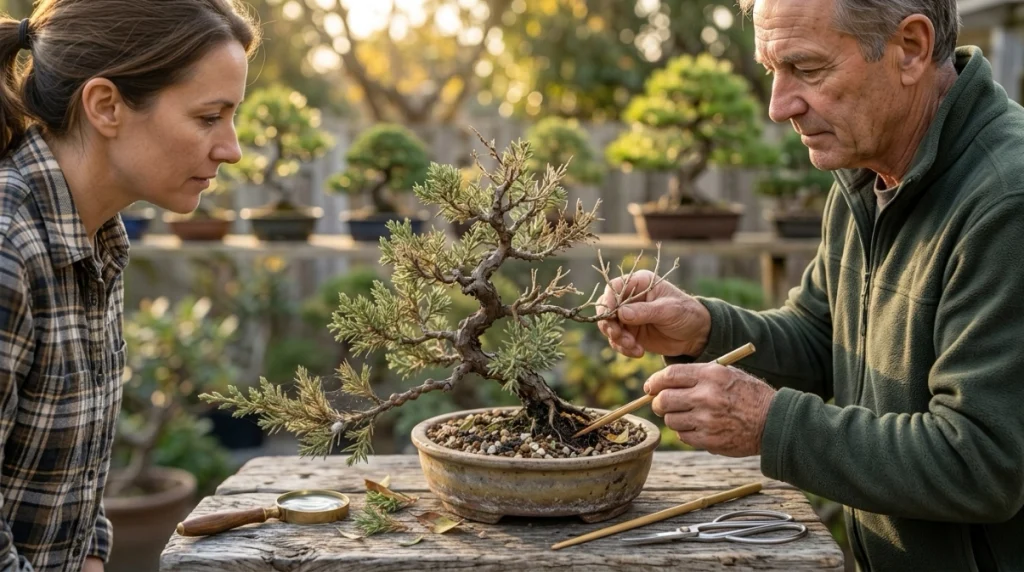
Seek experienced help when:
- More than half the canopy drops rapidly
- Branches are dying as well as leaves
- The roots are extensively black or rotten
- The trunk becomes soft
- You cannot identify a serious pest or disease
- The tree continues declining after basic conditions are corrected
- A valuable or old specimen requires emergency repotting
- You are considering major root removal on an already weak tree
- Several bonsai develop the same symptoms
A bonsai club or experienced bonsai grower may be especially helpful because container-grown miniature trees require different management from ordinary landscape trees.
For a large tree with structural, safety, or significant disease concerns outside normal bonsai container care, a qualified arborist or plant-health professional may be the better choice.
Common Mistakes Bonsai Owners Should Avoid
- Watering automatically every day. Water according to the tree’s needs and actual soil condition.
- Assuming every leaf drop problem is caused by pests. Water, roots, light, and temperature are often responsible.
- Spraying pesticides without identifying a pest. Unnecessary treatment can damage foliage and does not correct cultural problems.
- Fertilizing a severely stressed tree heavily. More fertilizer does not automatically create faster recovery.
- Moving an outdoor bonsai indoors permanently. Many temperate species require outdoor conditions and seasonal dormancy.
- Emergency repotting too quickly. Disturbing roots can worsen stress if poor soil is not actually the problem.
- Changing several care factors simultaneously. You may never discover what caused the problem.
- Ignoring leaf undersides. Spider mites, scale, aphids, and other pests can remain hidden.
- Treating every yellow leaf as an emergency. Older foliage sometimes drops naturally.
- Using generic bonsai advice without identifying the species. Different bonsai can have very different requirements.
FAQs
Why is my indoor bonsai suddenly losing all its leaves?
Sudden indoor leaf loss is commonly associated with changes in light, watering, temperature, humidity, or root health. Consider whether the tree was recently moved, brought indoors, placed near heating or cooling equipment, or watered differently.
Can overwatering make bonsai leaves fall off?
Yes. Constantly saturated soil can reduce oxygen around the roots and damage root function. Yellowing, weak growth, wet soil, and persistent leaf drop are common warning signs.
Will bonsai leaves grow back after falling off?
Often, yes, if the branches and roots remain alive and the underlying problem is corrected. Recovery speed depends on the species, season, severity of stress, and overall vigor of the tree.
Why are my bonsai leaves falling off but still green?
Green leaves can drop after sudden environmental changes, root disturbance, temperature shock, watering problems, or other stress. Review anything that changed shortly before the leaf loss began.
Can spider mites cause a bonsai to lose leaves?
Yes. Spider mites feed on leaf tissue and can cause pale stippling, bronzing, drying, webbing, and premature leaf drop. Inspect leaf undersides carefully with a hand lens.
Should I remove yellow leaves from my bonsai?
Loose or dead leaves can usually be removed gently, but removing leaves does not solve the underlying cause. Diagnose watering, light, roots, pests, and seasonal behavior first.
Is my bonsai dead if it loses every leaf?
Not necessarily. Many deciduous bonsai naturally become completely leafless during dormancy, while stressed tropical trees may also defoliate and later recover. Check the species, season, branch condition, and root health before assuming the tree is dead.
Conclusion
If you are wondering why are my bonsai leaves falling off, start with observation rather than treatment. Check the species, season, soil moisture, drainage, light, temperature, roots, and leaves before deciding what to change.
Watering mistakes and environmental stress are common causes, but spider mites, scale, aphids, mealybugs, root problems, and disease can also lead to leaf loss. At the same time, normal seasonal shedding should not be mistaken for a crisis.
Make one careful correction at a time, avoid unnecessary fertilizer or pesticide treatments, and do not perform aggressive root work on an already stressed tree without good reason.
Inspect your bonsai closely today, identify the most likely cause, and give the tree the stable conditions it needs to recover.
