
Why Does My Bonsai Have Scale? Causes, Signs, and Treatment

Quick Answer
Your bonsai has scale because scale insects reached the tree and established themselves on its leaves, stems, or bark. They often arrive on a newly purchased plant or spread from nearby infested plants, and their tiny crawler stage can move before settling. The UC IPM scale guide explains that heavy infestations can cause yellowing, leaf drop, honeydew, sooty mold, and branch decline.
Common clues to check
- Fixed bumps: Look for brown, tan, gray, white, or waxy bumps attached to leaves and branches.
- Sticky residue: Soft scale often produces sugary honeydew on leaves, pots, or surfaces below the bonsai.
- Black coating: Sooty mold can grow on honeydew and make foliage look dirty or blackened.
- Weak growth: Larger infestations may contribute to yellow leaves, premature leaf drop, and declining shoots.
- Tiny crawlers: Newly hatched scale insects can move before attaching themselves to the plant.
How to confirm it
- Inspect several suspicious bumps with a 10× hand lens and compare them with normal bark, buds, and pruning scars before treating the tree.
Finding scale on a bonsai can be confusing because these pests rarely look like normal insects. Adult scale often resembles a tiny shell, scab, or bump stuck to the plant.
I approach bonsai scale insects by answering three questions first: where did they come from, how widespread are they, and which life stage is present. That prevents unnecessary spraying and helps protect an already stressed tree.
In This Guide
Why Does My Bonsai Have Scale in the First Place?
Your bonsai has scale because the insects were introduced to the tree or moved onto it from another host plant. Poor care may weaken a tree, but stress itself does not create scale insects.
A scale infestation can begin quietly. The earliest mobile stage is so small that you may never notice it arriving.
Definition: Scale insects are plant-feeding insects whose settled stages often live beneath waxy, leathery, or shield-like coverings attached to leaves, twigs, branches, or bark.
New plants can introduce scale
A newly purchased bonsai, houseplant, nursery plant, or cutting can carry scale without obvious symptoms. Adults may hide along branch joints, leaf veins, rough bark, and undersides of foliage.
The infestation becomes easier to notice after the population increases. This is one reason I inspect a new tree from several angles before placing it beside an established collection.
- Check branch forks: Protected joints can conceal small colonies.
- Inspect leaf undersides: Scale may be much harder to see from above.
- Look at the trunk: Brown or gray coverings can blend into mature bark.
- Inspect the pot: Check rims, crevices, drainage areas, and fallen debris.
Crawlers can spread to nearby plants
Newly hatched scale insects are called crawlers. Unlike most settled adults, crawlers have legs and can move to a new feeding location.
Nearby plants are therefore at greater risk when an infestation is active. Keeping foliage from touching also makes monitoring easier.
Indoor conditions can hide an infestation
Indoor bonsai do not automatically get scale because of low humidity, warm rooms, or weak airflow. Those conditions may instead make inspection harder or reduce the natural checks found outdoors.
As of 2026, the practical lesson remains simple: scale must come from scale. Your first job is to identify and contain the infestation rather than blame fertilizer, soil, or watering alone.
Section Takeaway: Scale reaches a bonsai from an existing population. New plants, nearby infested plants, and unnoticed crawler activity are more useful explanations than assuming poor care created the insects.
How Can I Confirm That My Bonsai Really Has Scale?
Scale usually appears as small, firmly attached bumps on leaves, stems, twigs, or bark. Confirmation matters because normal bark features, buds, mineral residue, mealybugs, and other pests can look similar.
I prefer bright side lighting and a 10× hand lens for this job. Rotating the pot slowly often reveals insects that disappear visually against textured bark.
Look for the characteristic signs
- Firm attachment: Mature scale usually stays in one feeding position.
- Repeated shapes: Several similar oval, round, or shell-like bumps are more suspicious than one irregular mark.
- Honeydew: Soft scale commonly leaves shiny, sticky residue.
- Sooty mold: Black fungal growth may develop on accumulated honeydew.
- Crawlers: Tiny yellowish or orange moving specks can indicate a new generation.
- Declining foliage: Yellowing or weak shoots may accompany a larger infestation.
The general Bonsai Empire pest and disease guide also lists scale among insects commonly found on bonsai and emphasizes correct pest identification.
Soft scale vs. armored scale
Soft scale and armored scale can look similar at first glance, but their biology differs. Honeydew is one of the fastest practical clues.
| Feature | Soft Scale | Armored Scale |
|---|---|---|
| Typical size | Often about 1/8–1/4 inch | Often about 1/16–1/8 inch |
| Honeydew | Common | Usually absent |
| Appearance | Often rounded or dome-shaped | Often flatter with a protective covering |
| Young stage | Mobile crawlers | Mobile crawlers |
| Useful clue | Sticky leaves or nearby surfaces | Dry, firmly attached shell-like coverings |
Section Takeaway: Firm attached bumps strongly suggest scale, but honeydew helps separate many soft scales from armored scales. Use several clues rather than color alone.
What Damage Can Scale Cause to a Bonsai?
Scale insects feed on plant tissues and can weaken a bonsai when populations become large. The amount of damage depends on the scale species, tree species, infestation level, growing conditions, and overall tree health.
A handful of scale insects does not always mean a tree is close to dying. A spreading colony deserves attention because bonsai have limited foliage and branch structure to lose.
Common scale damage includes
- Yellow foliage: Feeding can contribute to discoloration and reduced vigor.
- Premature leaf drop: Heavily affected foliage may fall earlier than expected.
- Slow growth: An infested tree may produce weaker shoots.
- Branch decline: Severe populations can contribute to twig or branch dieback.
- Sticky surfaces: Soft scale honeydew can coat leaves, pots, benches, and windowsills.
- Sooty mold: Dark fungal growth can develop on honeydew deposits.
Sooty mold is an indirect problem. The fungus grows on sugary honeydew rather than feeding directly from the bonsai like the scale insect does.
Ants are another useful clue outdoors. They may visit honeydew-producing scale and can interfere with predators that would otherwise feed on the pests.
Section Takeaway: Scale damage ranges from cosmetic residue to yellowing, leaf loss, reduced growth, and branch decline. The population size and type of scale matter more than the presence of one isolated insect.
How Do I Get Rid of Scale on My Bonsai?
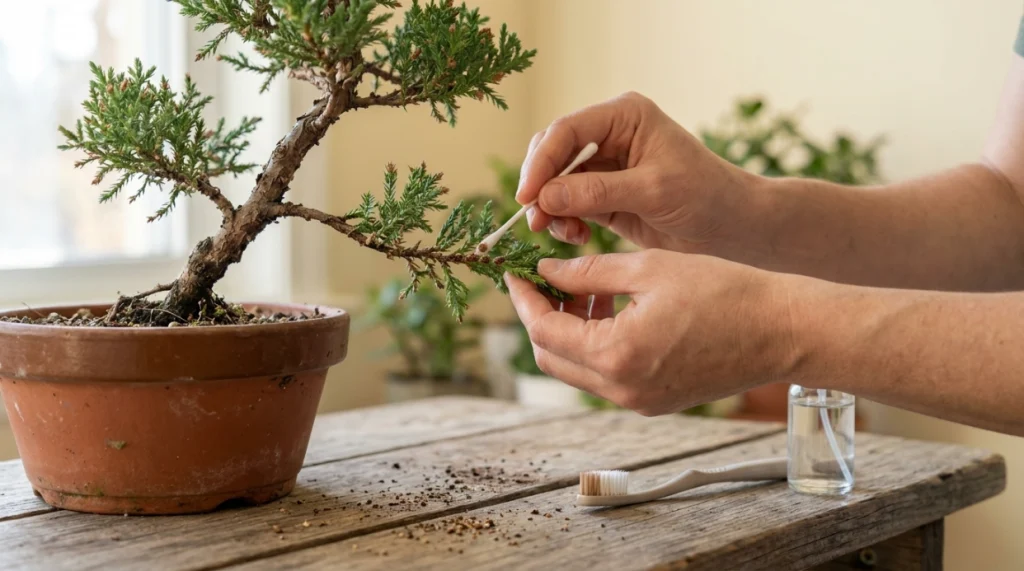
Start by isolating the bonsai, removing manageable insects, and monitoring for crawlers. Use a labeled horticultural oil, insecticidal soap, or other appropriate treatment only when needed and suitable for your bonsai species.
1. Isolate the affected tree
Move the bonsai away from healthy plants while keeping its normal light and temperature needs in mind. Isolation gives you space to inspect without exposing nearby trees unnecessarily.
2. Remove visible scale carefully
A small infestation can often be reduced mechanically. Use a soft swab, soft toothbrush, fingernail, or similarly gentle tool without scraping living bark.
Work slowly around buds and thin branches. Dead scale coverings may remain attached after treatment, so physical inspection is still useful.
3. Remove badly infested minor growth when appropriate
A heavily infested leaf or expendable twig may sometimes be easier to remove than clean individually. Do not remove major branches simply because you see scale.
Pro tip: Pruning live bonsai wood is irreversible. If the affected branch is important to the design, ask an experienced grower or local bonsai club before cutting it.
4. Target vulnerable crawlers
Crawlers lack the stronger protection associated with settled scale. That makes crawler timing especially important when a spray treatment is necessary.
Horticultural oils and insecticidal soaps require good coverage and must be suitable for the plant being treated. Some bonsai species can react poorly to certain products or application conditions.
5. Follow the pesticide label exactly
If you use a pesticide in the United States, follow the product directions rather than increasing the concentration or application frequency. The EPA pesticide-label guidance explains that registered pesticide labels contain legally enforceable use directions.
- Confirm the plant: Make sure the product is labeled for the type of plant and use site.
- Check the pest: Verify that scale insects are included when required by the label.
- Follow the rate: Never make a stronger mixture hoping for faster control.
- Watch conditions: Avoid applying products under conditions prohibited by the label.
- Reinspect later: One treatment may not eliminate every life stage.
Section Takeaway: Isolation, careful physical removal, crawler monitoring, and correctly labeled treatments form a safer approach than immediately applying a strong pesticide.
How Can I Stop Scale From Coming Back?
Preventing scale depends on regular inspection and early isolation. You cannot guarantee a bonsai will never encounter a pest, but you can stop many infestations before they become established.
Quarantine new plants
Keep newly acquired bonsai and houseplants separate before adding them to your main collection. The University of Minnesota Extension recommends inspecting new indoor plants carefully and isolating newly acquired plants for about one to two weeks in its indoor plant insect guidance.
Inspect whenever you water
Watering gives you a natural opportunity to look closely. I pay particular attention to areas that stay hidden from the normal viewing angle.
- Undersides of leaves
- Leaf stems and veins
- New shoots and buds
- Branch junctions
- Rough bark crevices
- Trunk base
- Pot rim and drainage areas
Keep the bonsai healthy
Correct species-specific watering, light, soil drainage, nutrition, and airflow help the bonsai maintain strong growth. Healthy care does not make a tree immune to scale, but it reduces avoidable stress while you manage pests.
Do not overwater in an attempt to “wash out” scale. These insects live primarily on plant tissue, not as a soil infestation that extra watering will cure.
Keep monitoring after the visible scale disappears
The most frustrating part of scale control is seeing a tree look clean and then finding new insects later. Hidden individuals, eggs, or newly emerged crawlers can restart the problem.
Continue checking the bonsai during regular care. Early detection is far easier than cleaning a colony spread across fine ramification and mature bark.
Section Takeaway: Quarantine new plants, inspect hidden areas regularly, maintain appropriate growing conditions, and keep checking after treatment. Prevention is mostly about finding scale early.
Frequently Asked Questions
Can scale insects kill a bonsai tree?
Yes, a severe or prolonged scale infestation can contribute to serious decline and may eventually kill a weakened bonsai. Small populations are usually easier to manage, so early identification and treatment matter.
Why does scale keep coming back on my bonsai?
Scale can return because hidden insects or protected life stages survived the first treatment. New crawlers may then appear later, which is why repeated inspection is essential even after visible adults are removed.
Does sticky foliage always mean my bonsai has scale?
No. Soft scale can produce honeydew, but aphids, mealybugs, and some other sap-feeding insects can also leave sticky residue. Inspect the leaves and branches before deciding which pest is responsible.
Can I scrape scale off my bonsai?
Small numbers of scale can often be removed carefully with a soft tool or swab. Avoid gouging bark, damaging buds, or scraping delicate young branches while removing the insects.
Should I use neem oil for scale on bonsai?
Some horticultural products containing neem or other oils are labeled for scale insects, but suitability varies by product and plant. Check the exact label and your bonsai species before applying any treatment.
Are the brown bumps on my bonsai definitely scale?
Not necessarily. Bark texture, buds, scars, dried residue, and other plant features can resemble scale. Look for repeated attached bumps, honeydew, crawlers, or other pest evidence before treating the tree.
Should I repot a bonsai because it has scale?
Usually not. Scale commonly feeds on leaves, stems, branches, and bark, so repotting alone does not solve the infestation and may add unnecessary stress unless there is a separate root or soil problem.
The main takeaway is simple: if your bonsai has scale, identify the pest first, isolate the tree, remove manageable insects, and watch closely for crawlers. Catching the infestation early gives you the best chance of controlling it without putting the tree through unnecessary stress.
Make pest inspection part of your normal watering routine. A few minutes with good light and a hand lens can reveal scale long before a small colony becomes a major bonsai problem.