How Long Does It Take a Bonsai Tree to Grow?

Quick answer: most bonsai take 2–5 years from purchase or propagation to a first presentable shape, and 10–20+ years to look truly mature. Nursery stock and air layers are fastest; trees grown from seed are slowest. Fast species such as Chinese elm and ficus show progress within 1–3 seasons, while pines and junipers need a decade or more of refinement.
In this guide
- Understanding growth time for bonsai
- Starting methods and average timelines
- Species growth rates with examples
- Key factors that affect growth speed
- Realistic milestones: a year-by-year roadmap
- How to speed up healthy growth
- Indoor vs outdoor bonsai timelines
- Common mistakes that slow growth
- Frequently asked questions
- Conclusion
Bonsai is slow art, but the timeline is more predictable than most beginners expect. Below you will find realistic timelines by starting method and by species, the factors that speed growth up, and a year-by-year roadmap you can plan around.
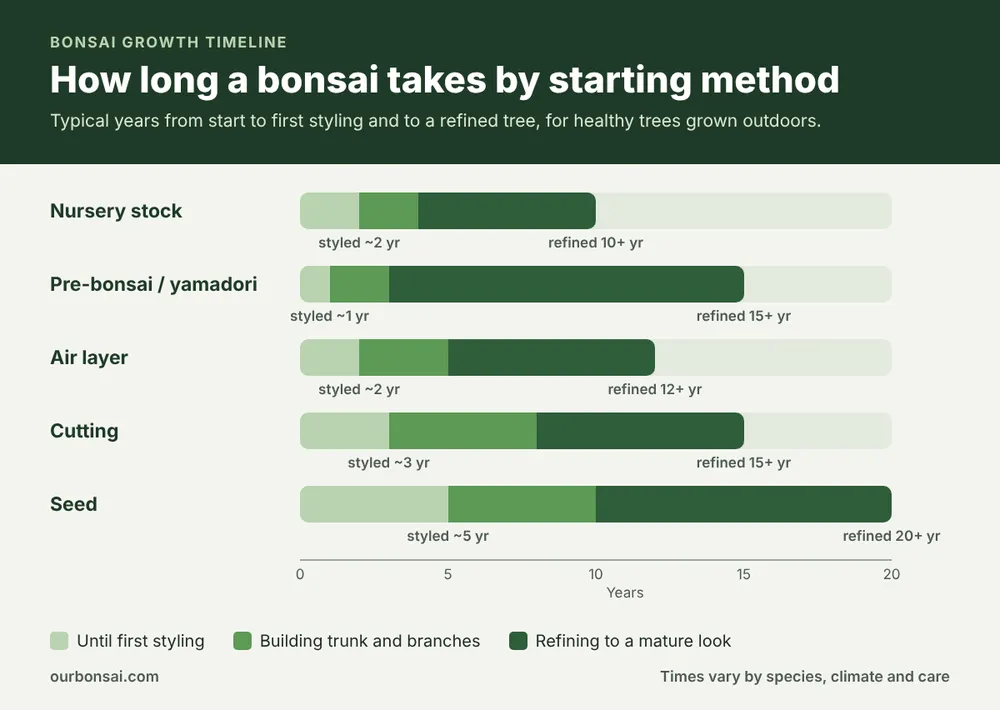
| Starting point | First styling | Good trunk | Refined bonsai |
|---|---|---|---|
| Nursery stock | 0–2 years | Present or 2–4 years | 5–10+ years |
| Pre-bonsai or yamadori | 0–1 year | Usually present | 5–15+ years |
| Air layer | 1–2 years | 3–5 years | 6–12+ years |
| Cutting | 2–3 years | 4–8 years | 8–15+ years |
| Seed | 3–5 years | 5–10 years | 10–20+ years |
Understanding growth time for bonsai
How long a bonsai takes depends on three things: the species, the starting method, and how well the tree is cared for. A styled tree can appear in a few years. A refined, old-looking bonsai takes far longer.
Think in stages. First comes trunk building and roots. Then branch structure. Last is ramification and fine detail. Each stage has its own clock, and heavy work at one stage can set the next one back a season.
Your goal also shapes the timeline. A shohin (small) bonsai needs less trunk time, so it can look mature sooner. A larger tree needs a thick trunk and a flared root base (nebari), which take more years to build.
Starting methods and average timelines
Your starting point matters more than any other choice. Pick the path that fits your patience and budget.
From seed
- Time to first styling: 3–5 years
- Time to good trunk: 5–10 years
- Time to refined bonsai: 10–20+ years
Seeds teach you everything, and you control the roots from day one, which makes it easier to build a perfect root base. It is also the slowest route. Germination itself takes weeks to months; see our guide to bonsai seed germination time.
From cuttings
- Time to first styling: 2–3 years
- Time to good trunk: 4–8 years
- Time to refined bonsai: 8–15+ years
Cuttings clone a known tree. You skip the seedling phase and can root the cutting flat on a tile for a better base.
From air layers
- Time to first styling: 1–2 years
- Time to good trunk: 3–5 years
- Time to refined bonsai: 6–12+ years
Air layering roots a thick branch while it is still attached to the parent tree, so you get a mature trunk fast. It works especially well on maples and elms.
From nursery stock or garden center trees
- Time to first styling: 0–2 years
- Time to good trunk: already present or 2–4 years
- Time to refined bonsai: 5–10+ years
This is the fastest way to start. Choose trees with good trunk movement, taper and low branches. Our list of the best trees to make bonsai covers species that are easy to find in nurseries.
From pre-bonsai or collected yamadori
- Time to first styling: 0–1 year
- Time to refined bonsai: 5–15+ years
Pre-bonsai and collected trees cost more, but you are buying years of trunk growth. Give collected trees at least a full season to recover before styling.
Species growth rates with examples
Species speed is the next big driver. Some trees sprint; others stroll.
Fast growers
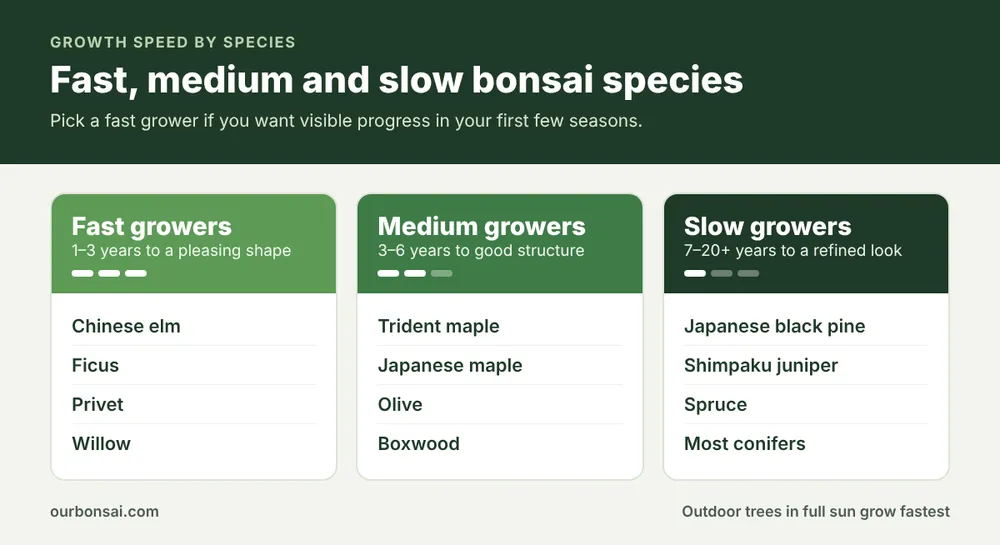
- Chinese elm (Ulmus parvifolia): fast ramification and forgiving of mistakes, which makes it great for beginners.
- Ficus (Ficus microcarpa and Ficus benjamina): strong growth in warm, bright conditions and one of the best choices indoors.
- Willow, privet and many tropicals: quick trunk gain with regular feeding.
Typical timeline to a first pleasing shape: 1–3 years.
Medium growers
- Japanese maple (Acer palmatum): graceful, steady growth that needs careful pruning.
- Trident maple (Acer buergerianum): faster than Japanese maple and excellent for air layering.
- Olive (Olea europaea): moderate growth that loves heat and full sun.
Typical timeline to good structure: 3–6 years.
Slow growers
- Japanese black pine (Pinus thunbergii): slow trunk development and detailed seasonal work over many years.
- Shimpaku juniper (Juniperus chinensis): foliage pads take time to refine. See our juniper bonsai care guide.
- Spruce and most conifers: short growing windows and slower thickening.
Typical timeline to a refined look: 7–20+ years.
A note on size: shohin trees look mature sooner because they need less trunk. For small trees, think in single-digit years; for large bonsai, think in decades.
Key factors that affect growth speed
These factors push the timeline up or down for any species:
- Light. Full sun outdoors or bright grow lights indoors drive photosynthesis. More light means faster growth.
- Water. Even moisture is key. Fast-draining soil prevents root rot and keeps roots active.
- Soil mix. Use large, airy particles such as akadama, pumice and lava; our bonsai soil mix ratio guide gives starting blends.
- Fertilizer. Feed little and often in the growing season. A balanced bonsai fertilizer works well for most trees.
- Pot size. Larger training pots or grow boxes build trunks faster than small display pots.
- Pruning and wiring. Prune to direct energy, and use sacrifice branches to thicken the trunk.
- Climate and dormancy. Hardy outdoor trees need a proper winter rest. Indoor tropicals need steady warmth.
- Health and pests. Stress slows growth. Treat pests quickly and avoid heavy work during heat waves.
In short: maximize light, air and food, and minimize stress and extremes.
Realistic milestones: a year-by-year roadmap
This map fits most deciduous and tropical trees grown in training pots.
Years 0–2: Establishment
- Build roots and health with minimal styling.
- Move the tree into a roomy container for speed.
- Start choosing primary branches late in this phase.
Years 3–5: Structure
- Thicken the trunk with sacrifice branches.
- Carve or correct scars while the wood is young.
- Set major branches with wire.
Years 5–10: Refinement
- Reduce pot size and improve the root base with root work.
- Build secondary and tertiary branching for ramification.
- Detail wiring and clip-and-grow cycles.
Years 10+: Character and finish
- Bark texture deepens.
- Silhouette and seasonal interest improve.
- Show preparation, fine wiring and light maintenance.
For pines and junipers, slow the pace. Use candle pinching, decandling (for black pines) and long recovery windows. The roadmap is the same idea, just stretched out.
How to speed up healthy growth
You can shorten the timeline without cutting corners:
- Use training containers. Training pots, mica pots, colanders or wood boxes speed root growth.
- Give more sun. Outdoors, aim for 6–8 hours for most species.
- Feed often. Use organic cakes plus a light liquid feed in peak season.
- Water deeply. Let water run through the pot to flush salts and pull in oxygen.
- Grow out, then cut back. Let a branch run to thicken, then prune to shape.
- Air layer smartly. Create new bonsai with instant trunks from maples and elms.
- Time work to the tree’s cycle. Repot as buds swell, and do major pruning after the first flush of growth. Our guide on when to start pruning bonsai has the details.
Grower’s tip: trident maples grown in colanders in full sun with weekly feeding can build a thick, tapered trunk in about four seasons. The same tree kept indoors would take roughly twice as long.
Indoor vs outdoor bonsai timelines
Indoor bonsai usually grow more slowly. Light is lower, the air is still, and growth slows.
- Indoor-friendly species. Ficus, jade, schefflera and Chinese elm adapt well.
- Use bright LEDs. Aim for 10,000–20,000 lux for 10–12 hours a day.
- Boost airflow and humidity. A small fan and a humidity tray help leaves work harder.
Outdoor trees get real sun and seasons, and they often grow twice as much in a year as the same species kept indoors. If you can, move tropical bonsai outside into bright shade for the summer.
Common mistakes that slow growth
- A shallow pot too soon. Build the trunk first, then downsize.
- Overwatering in dense soil. Roots drown and growth stalls. Use an airy mix.
- Heavy pruning every month. Trees need leaves to make energy.
- Wiring during heat waves or drought. Stress leads to dieback.
- Skipping fertilizer. Hungry trees grow weak and slow.
- No winter rest for hardy trees. Outdoor species need dormancy to reset.
Styling a juniper every few weeks is a classic example: the tree sulks for a year. Spacing work out with long recovery periods lets growth bounce back and foliage pads form much faster.
Frequently asked questions
Can I get a bonsai look in one year?
Yes, you can style nursery stock to look bonsai-like in a single season. It will not look mature, but it can be presentable.
What is the fastest bonsai species to train?
Chinese elm and trident maple are fast outdoors. Ficus is fastest indoors with strong light and warm temperatures. For more options, see our list of low-maintenance bonsai trees for beginners.
How many years until my first showable bonsai?
With good nursery stock, 3–5 years is common for a showable tree. True refinement usually takes 7–15 years.
Is growing from seed worth the time?
Yes, if you enjoy the process and want perfect roots. Expect 5–10+ years to reach a pleasing small bonsai.
Does repotting slow growth?
For a few weeks, yes. In the long run, fresh soil and root pruning speed growth by restoring vigor.
Will bigger pots make my bonsai grow faster?
Yes. Training pots and grow boxes speed trunk thickening. Move to a smaller display pot only when you shift to refinement.
Can I keep a juniper bonsai indoors to speed growth?
No. Junipers need full sun and outdoor seasons. Indoors they weaken and often die.
How long does it take if I buy pre-bonsai?
Often 2–5 years to reach a refined look. Choose material with a strong trunk and good movement.
Conclusion
Bonsai time is elastic: the first look can come fast, but true age takes years. Plan your route by species, starting method and final size, then speed things up with plenty of light, airy soil, regular feeding and well-timed work. For more background, the bonsai cultivation and care overview is a useful reference.
Pick one tree and one action today: move it into a training container, give it more light, or set a feeding plan.