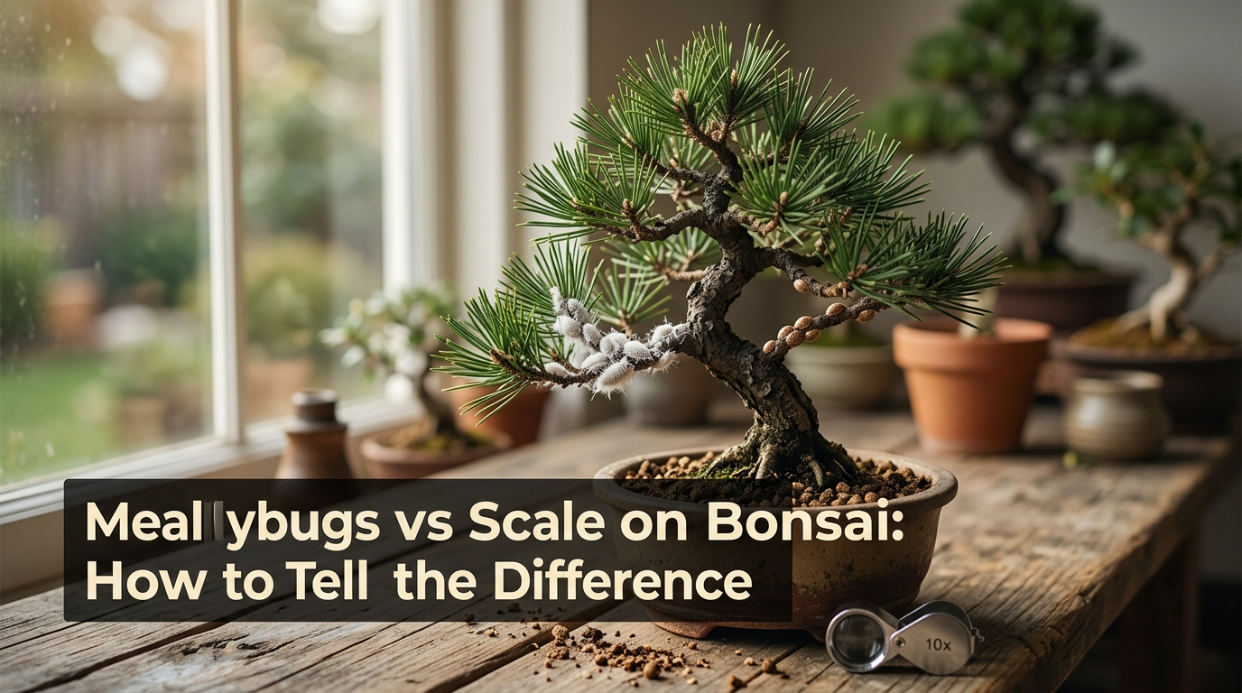
Mealybugs vs Scale on Bonsai: How to Tell the Difference
Quick Answer
Mealybugs usually look like soft, white, cottony insects with visible segmented bodies, while scale insects usually look like firm bumps, shells, or waxy spots attached to leaves and branches. Movement, body shape, honeydew, and how firmly the pest is attached are the best clues; UC IPM’s mealybug identification guidance can help confirm a doubtful case.
Fastest Ways to Tell Them Apart
- Body texture: Mealybugs look soft and segmented; scale usually forms a defined bump or protective covering.
- White wax: Mealybugs often produce loose, floury, or cotton-like wax around their bodies.
- Movement: Female mealybugs can crawl slowly, while settled adult scale often appears immobile.
- Honeydew: Mealybugs and many soft scales produce sticky honeydew, but armored scales generally do not.
- Attachment: Scale usually sits tightly against the plant, while a mealybug looks more like a recognizable insect beneath its wax.
Best Confirmation Test
- Use a 10× hand lens and gently disturb one pest with a toothpick or cotton swab. Look for a segmented crawling insect beneath fluffy wax versus a fixed scale-like covering.
Mealybugs and scale on bonsai can look confusingly similar, especially when wax covers the insects. Both are sap-feeding pests, and both can weaken a small tree when populations build.
I never identify either pest from color alone. Shape, movement, location, wax, and honeydew together give a much more reliable diagnosis.
In This Guide
What Is the Difference Between Mealybugs and Scale on Bonsai?
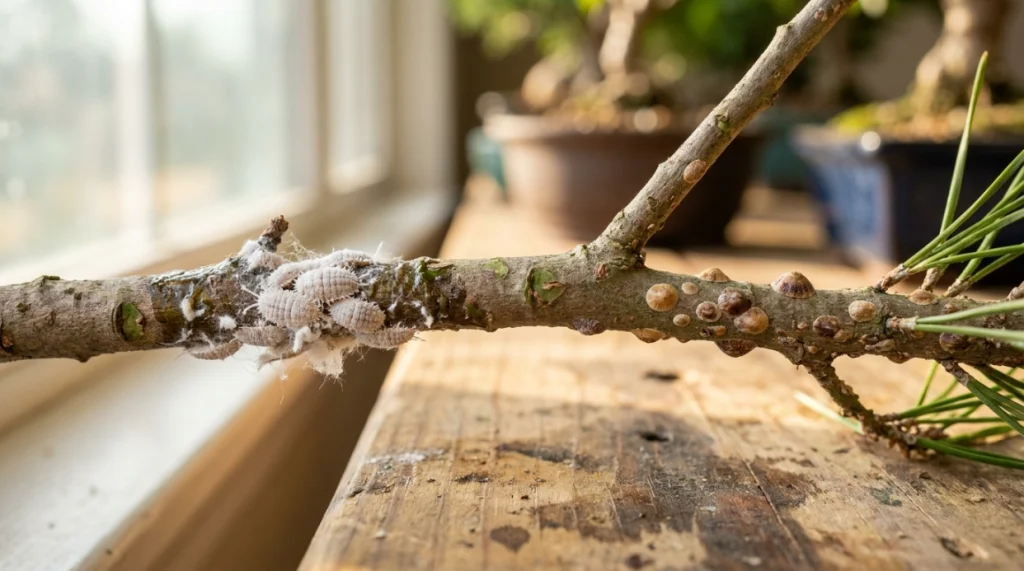
The clearest difference is body structure. Mealybugs remain visibly insect-like beneath their wax, while many scale insects develop coverings that make them resemble bumps on the bonsai.
Definition: Mealybugs and scale insects are related piercing-sucking pests that remove sap from plant tissue. Mealybugs normally retain visible segmented bodies, while settled scale often develops a waxy, leathery, or shield-like appearance.
The comparison gets harder because not every scale is brown and hard. Some soft scales are pale or waxy, and certain species produce cottony egg masses.
| Feature | Mealybugs | Scale Insects |
|---|---|---|
| Typical appearance | Soft, oval, segmented, white or grayish insects covered with powdery wax | Round, oval, elongated, dome-shaped, or shell-like bumps |
| Typical size | Often about 1/20–1/5 inch, depending on species | Covers commonly about 1/25–1/4 inch, depending on species |
| Adult movement | Females can usually crawl slowly | Many settled females appear stationary |
| Honeydew | Common | Common with soft scale; generally absent with armored scale |
| Main clue | Visible insect body beneath loose wax | Defined covering or bump closely attached to plant tissue |
Both pests have mobile young stages called crawlers. That means movement alone cannot identify a tiny immature insect.
As of 2026, established horticultural guidance still recommends examining several characteristics instead of diagnosing from one symptom.
Section Takeaway: Mealybugs usually look like wax-covered insects; scale usually looks like something attached to the plant. Honeydew helps, but it cannot distinguish mealybugs from soft scale by itself.
What Do Mealybugs Look Like on a Bonsai?
Mealybugs usually appear as small, soft insects dusted with white powder or surrounded by cotton-like wax. Their oval bodies remain visibly segmented when viewed closely.
Adult females can have waxy filaments around their edges. Some species have longer tail filaments, which makes them look even less like scale.
Where should you look for mealybugs?
Mealybugs prefer protected places where their bodies stay sheltered. On a bonsai, I inspect tight junctions before exposed leaf surfaces.
- Leaf axils: Check where a leaf or petiole meets the shoot.
- Branch forks: Look deep inside narrow branch junctions.
- New growth: Inspect buds and tender shoots carefully.
- Leaf undersides: Follow the veins and inspect folded areas.
- Bark crevices: Rough bark can conceal small colonies.
- Trunk base: Examine the transition between trunk and soil.
- Roots: Some mealybug species live below the soil surface.
Sticky honeydew is another useful clue. Mealybugs feed with piercing-sucking mouthparts and may leave shiny deposits on leaves, pots, benches, or windowsills.
Black sooty mold can later grow on that sugary material. The mold is secondary evidence, not proof that mealybugs caused it.
The University of Minnesota Extension’s indoor plant pest guidance also recommends checking leaf undersides, joints, containers, and other protected locations when searching for sap-feeding pests.
Does white cotton always mean mealybugs?
No. Cottony scale, woolly aphids, fungal material, mineral residue, and other wax-producing insects can create similar-looking patches.
Expose the organism rather than judging the cotton alone. A mealybug should reveal a soft, recognizable insect body beneath its wax.
What Does Scale Look Like on a Bonsai?
Scale usually looks like a small bump attached tightly to a leaf, twig, branch, needle, or trunk. Mature insects often lack the obvious insect shape beginners expect to see.
Colors vary widely. Scale can appear brown, tan, gray, cream, white, yellowish, or nearly black.
What is the difference between soft scale and armored scale?
Soft scale and armored scale are important to separate because their appearance and honeydew production differ. The distinction can also affect treatment choices.
- Soft scale: Usually more rounded or convex and commonly produces sticky honeydew.
- Armored scale: Usually flatter beneath a protective cover and generally does not produce honeydew.
With armored scale, the protective cover can often be separated from the insect beneath it. Soft scale has a covering that is more closely part of the insect’s body.
UC IPM’s scale insect guide describes adult scales as circular, oval, or elongated spots and bumps that often lack an obvious head or legs.
Why is scale easy to miss on bonsai?
Bonsai bark already contains texture, scars, lenticels, buds, and natural color changes. A few scale insects can blend into that surface surprisingly well.
Dense ramification also creates hiding places. Ramification means the increasingly fine branching that produces a mature bonsai canopy.
- Inspect along leaf veins.
- Check both sides of leaves.
- Follow twigs toward the trunk.
- Examine branch crotches and pruning scars.
- Look closely at rough bark.
My practical rule is simple: if a suspicious bump repeats across several leaves or twigs, I inspect it with magnification rather than assuming it is bark.
Section Takeaway: Scale is defined more by its attached, bump-like appearance than by one color. Remember that soft scale may be sticky, while armored scale can infest a bonsai without producing honeydew.
How Can You Confirm Whether It Is Mealybug or Scale?
Use bright light, a 10× hand lens, and a small wooden toothpick or cotton swab. Then inspect the pest itself rather than relying on the damage around it.
- Look at the outline. A soft segmented body favors mealybug; a defined dome, shield, or shell favors scale.
- Check the wax. Loose powdery or cotton-like wax is typical of mealybugs.
- Gently disturb it. An adult female mealybug may crawl slowly when exposed.
- Check attachment. Settled scale commonly stays firmly against the leaf, twig, or bark.
- Look for honeydew. Its presence supports mealybugs or soft scale but not armored scale.
- Inspect nearby pests. Several individuals at different stages often make identification easier.
Can you identify the pest from sticky leaves?
No. Honeydew tells you that a honeydew-producing sap feeder may be present, but it doesn’t identify the species.
Mealybugs, aphids, whiteflies, and many soft scales can all create sticky surfaces. Armored scales generally do not.
What if the white material is in the soil?
Consider root mealybugs if white wax appears around fine roots, drainage holes, or the outer root ball. Do not assume every white soil deposit is a pest.
Mineral deposits, fungal growth, fertilizer residue, and perlite can also look pale. Positive identification matters before disturbing a bonsai’s root system.
Pro tip: Avoid unnecessary root pruning or emergency repotting just to investigate a suspected pest. If major root work seems necessary, consult an experienced grower or local bonsai club before making irreversible cuts.
What Should You Do After Identifying the Pest?
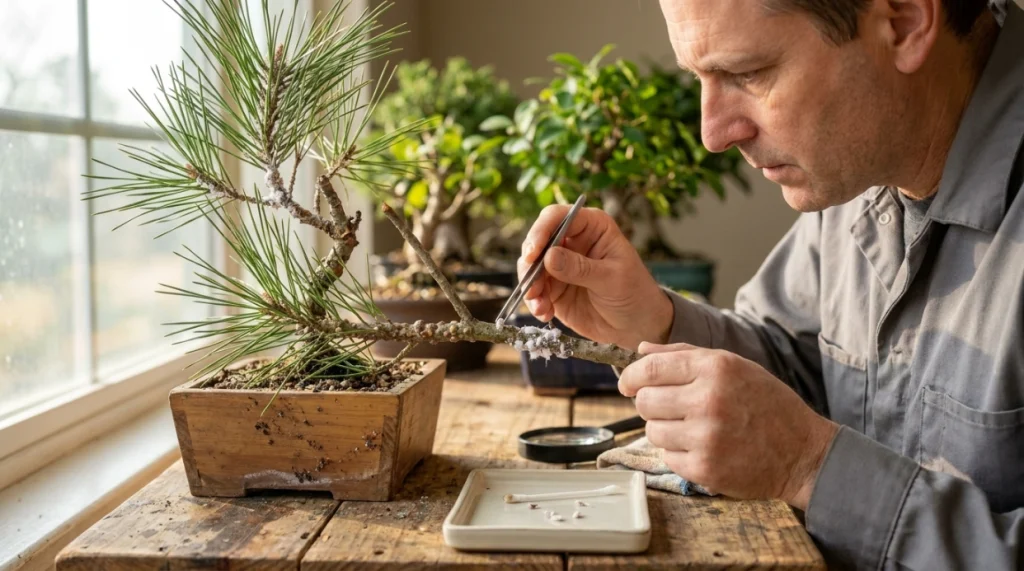
Start by isolating the bonsai from other plants. Then reduce the visible population and choose treatment based on the pest, tree species, infestation level, and product label.
First steps for mealybugs
- Move the bonsai away from healthy plants.
- Remove accessible insects with tweezers or cotton swabs.
- Clean the pot, tray, bench, and nearby surfaces.
- Inspect hidden joints and the trunk base.
- Check repeatedly for newly visible insects.
Small populations may respond to physical removal. Larger infestations can require an insecticidal soap, horticultural oil, or another pesticide specifically labeled for the plant and pest.
First steps for scale
- Isolate the bonsai.
- Confirm that suspicious bumps are living scale.
- Carefully remove manageable individuals where practical.
- Watch for tiny mobile crawler stages.
- Use only a treatment labeled for the plant and target pest.
Young crawlers lack much of the protection found on mature scale. That often makes crawler timing an important part of scale management.
Bonsai Empire’s pest and disease overview also emphasizes correct pest identification and regular inspection of bonsai foliage and branches.
Should you spray a bonsai immediately?
Not automatically. A stressed bonsai can react badly to unnecessary treatment, and different species do not tolerate every oil, soap, or pesticide equally.
Read the product label completely and make sure the plant is listed or otherwise permitted by the label. Testing unfamiliar contact treatments on a small area first is a sensible precaution.
Avoid treating a severely moisture-stressed tree until its basic care problem is understood. Pest control works better when watering, drainage, light, and overall vigor are also appropriate.
Section Takeaway: Identification comes before treatment. Isolate first, reduce the pest population carefully, and use labeled treatments only when the infestation requires them.
Frequently Asked Questions
Are mealybugs a type of scale insect?
Mealybugs are closely related to scale insects and belong to the same broader group of sap-feeding insects. However, growers usually distinguish mealybugs from the insects commonly called soft or armored scale because mealybugs retain a visibly segmented, mobile body beneath their wax.
Can scale insects be white like mealybugs?
Yes. Some scale insects are white, cream, gray, or covered with wax, so color alone cannot confirm mealybugs. Check whether you can see a segmented insect body and loose cottony wax or a more defined covering attached closely to the plant.
Do both mealybugs and scale produce sticky honeydew?
Mealybugs commonly produce honeydew, as do many soft scale species. Armored scales generally do not produce it, so a scale-infested bonsai can lack sticky leaves. Aphids and whiteflies can also produce honeydew, making it supporting evidence rather than a diagnosis.
Do mealybugs move while scale insects stay still?
Adult female mealybugs can usually crawl slowly, while many settled scale insects remain almost stationary. However, young scale insects have a mobile crawler stage. Movement is therefore useful when examining mature insects but cannot identify every immature pest.
Can mealybugs or scale kill a bonsai?
Heavy, prolonged infestations can weaken a bonsai, causing yellowing, poor growth, leaf drop, or branch decline. Risk increases when the tree is already stressed by root problems, poor light, incorrect watering, heat, or other unfavorable growing conditions.
How often should I inspect a bonsai after finding either pest?
Inspect it frequently during treatment and continue monitoring after visible pests disappear. Check leaf undersides, branch junctions, bark crevices, new growth, the pot rim, and nearby surfaces because crawlers or hidden individuals can make an infestation appear to return.
What is the easiest way for a beginner to distinguish them?
Use a hand lens and focus on the insect’s structure. A soft, segmented, slowly crawling insect under fluffy white wax strongly suggests mealybug, while a firm, defined bump attached closely to a leaf or branch strongly suggests scale.
The main takeaway is simple: don’t diagnose mealybugs or scale from whiteness, stickiness, or leaf damage alone. Look directly at the pest and combine body shape, wax, movement, attachment, and honeydew before deciding what treatment your bonsai needs.