How Often to Water Juniper Bonsai (Indoor & Outdoor Guide)


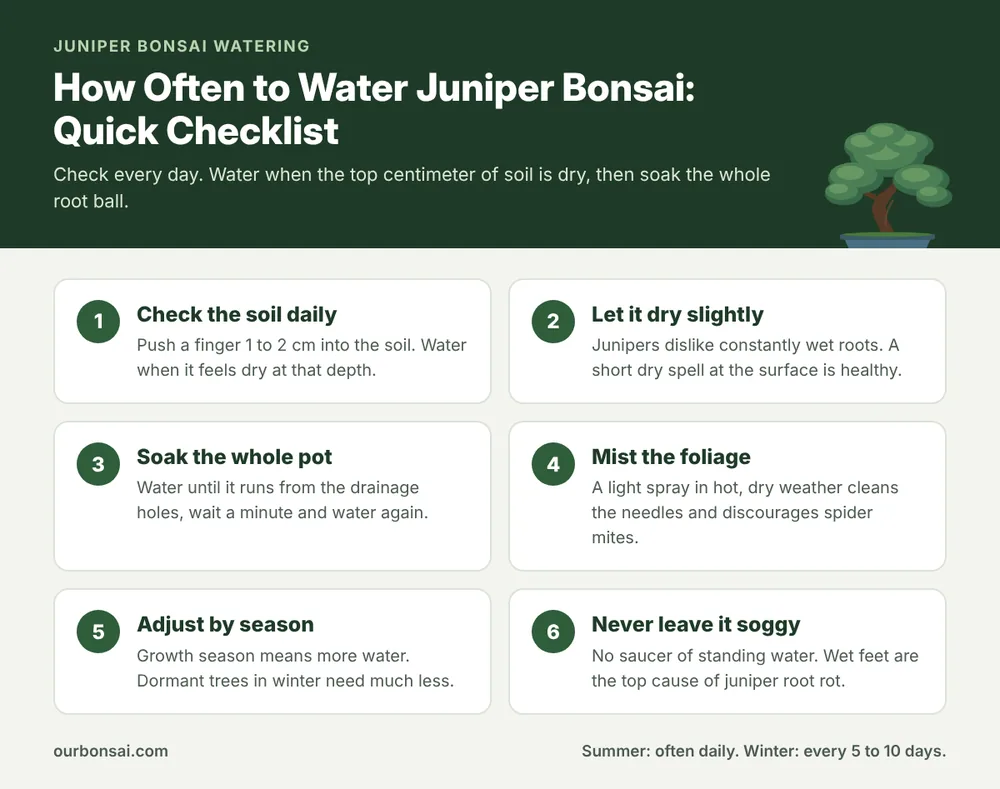
If you are asking how often to water juniper bonsai, the honest answer is: check it every day and water when the top centimeter or so of soil has dried. For an outdoor juniper in summer that often means once a day. In spring and autumn it may be every two or three days, and in winter, when the tree is dormant, it can be once a week or even less. Pot size, soil mix, sun and wind all change the timing, so a fixed calendar will let you down sooner or later.
In this guide
- Why junipers need a different watering rhythm
- How often to water juniper bonsai by season
- How to tell when your juniper needs water
- How to water a juniper bonsai properly
- Watering juniper bonsai indoors vs outdoors
- Signs of overwatering and underwatering
- Common juniper watering mistakes
- FAQ: how often to water juniper bonsai
- Final thoughts
Junipers are one of the most popular bonsai trees, and most problems with them come back to water. They handle a slightly dry spell better than many species, but they hate sitting in wet soil. This guide shows you how to read your tree and your soil so you water at the right moment, season by season, indoors and outdoors.
Why junipers need a different watering rhythm
Most junipers used for bonsai, such as the Japanese garden juniper (Juniperus procumbens ‘Nana’) and the Chinese juniper (Juniperus chinensis), come from open, sunny and often rocky places. Their roots are adapted to soil that drains fast and gets plenty of air. The Wikipedia entry on Juniperus procumbens notes it grows naturally on coastal slopes, which tells you a lot: lots of light, free drainage and no standing water.
That is why the right soil matters as much as the watering schedule. A gritty mix of akadama, pumice and lava rock lets you water thoroughly without drowning the roots. If your juniper is in dense potting soil, it will stay wet for days and you will struggle no matter how carefully you water. Our juniper bonsai soil recipe explains the mix most growers use, and our main juniper bonsai care guide covers light, feeding and placement.
How often to water juniper bonsai by season
Use this table as a starting point. It tells you how often to look closely, not when to water without checking.
| Season | Typical outdoor watering | What is happening |
|---|---|---|
| Spring | Every 1 to 3 days | New growth starts, water use rises week by week |
| Summer | Daily, sometimes twice | Heat, sun and wind dry small pots fast |
| Autumn | Every 2 to 4 days | Growth slows, cooler nights |
| Winter (dormant) | Every 5 to 10 days | Very little water use, roots must not freeze dry |
In a heat wave, a small juniper in a shallow pot can dry out by mid afternoon. Water early in the morning and check again in late afternoon. Our guide to watering bonsai in summer has extra tips like shade cloth and grouping pots together.
How to tell when your juniper needs water
Counting days is not reliable. Instead, use one or more of these quick checks.
1. The finger test
Push a finger 1 to 2 cm (about half an inch) into the soil near the edge of the pot. If it feels dry at that depth, water. If it feels cool and damp, wait and check again tomorrow. Junipers prefer you to err slightly on the dry side, but not to the point where the whole root ball is dusty.
2. Soil color and pot weight
Akadama and most bonsai soils turn lighter in color as they dry. You will also notice the pot feels much lighter when it needs water. Lift it right after watering and again a day later to learn the difference.
3. A moisture meter or chopstick
Push a wooden chopstick into the soil and leave it for ten minutes. If it comes out dark and damp, there is still water down there. A soil moisture meter does the same job, as long as the probe reaches the root zone.
How to water a juniper bonsai properly
A quick splash wets the surface and leaves dry pockets underneath. Water slowly and fully instead.
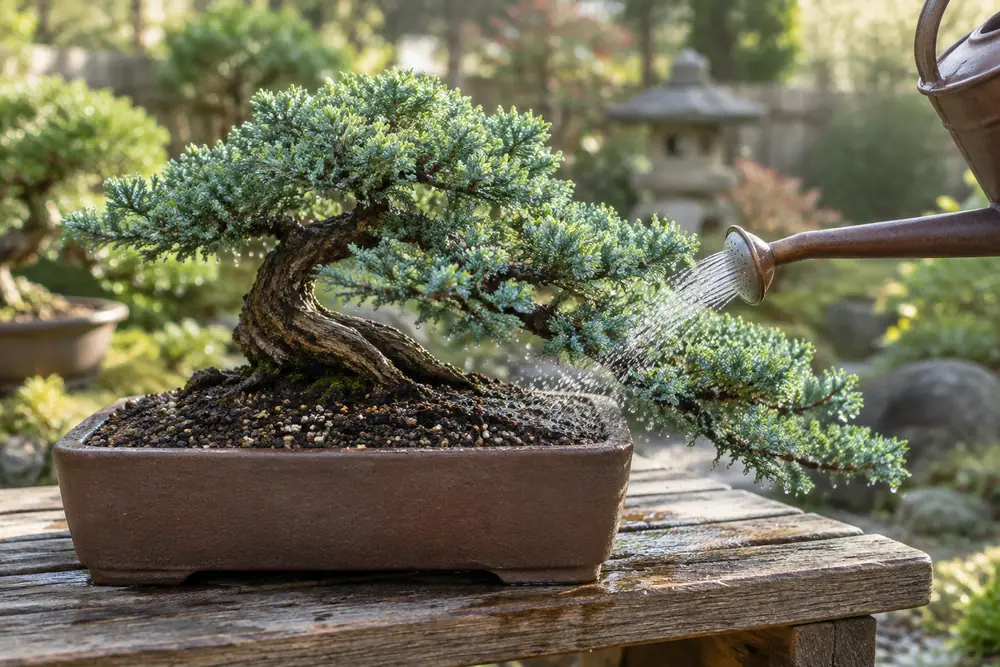
- Use a watering can with a fine rose so you do not wash soil out of the pot. A Japanese bonsai watering can is designed for exactly this.
- Water the whole soil surface until water flows from the drainage holes.
- Wait one or two minutes, then water again. The second pass soaks into any dry pockets.
- In hot, dry weather, give the foliage a light spray as well. It cools the tree and makes life harder for spider mites.
- Let the pot drain completely. Never leave a juniper standing in a saucer of water.
Rain water or tap water?
Junipers are not fussy about water quality. Rain water is ideal, but normal tap water is fine for most people. If your tap water is very hard, you may see white crust on the soil and pot over time. Flushing the pot with rain water once in a while helps.
Watering juniper bonsai indoors vs outdoors
Junipers are outdoor trees. They need full sun, fresh air and a cold winter rest. Indoors, they slowly weaken even when the watering is perfect, which is why so many “indoor juniper” gifts die within a year. If you have to keep one inside for a while, read our guide to Japanese juniper bonsai indoors first.
- Outdoors: sun and wind dry the soil quickly. Check daily from spring to autumn.
- Indoors: the soil dries much more slowly, so overwatering is the big risk. Check daily but water only when the top soil is dry. Place the tree in the brightest window you have.
- Winter: keep the tree outside in a sheltered spot. Water on mild days when the soil starts to dry. A frozen pot that is bone dry can kill roots, so do not ignore it entirely.
Signs of overwatering and underwatering
| Sign | Likely cause | What to do |
|---|---|---|
| Soft, drooping tips that recover after watering | Underwatering | Check more often, water in two passes |
| Crispy, brown foliage tips all over the tree | Soil dried out completely | Soak the pot, keep watering consistently |
| Yellowing inner foliage, soil always wet | Overwatering or poor drainage | Water less often, check soil and drainage holes |
| Brown foliage spreading from the base, sour smell | Root rot | Repot into gritty soil, cut away dead roots |
| Fine webbing and speckled needles | Spider mites in dry conditions | Spray foliage, treat the mites |
Brown foliage on a juniper can have several causes besides water. Our guide to Japanese juniper bonsai turning brown helps you narrow it down, and if the soil smells sour, read up on root rot in bonsai.
Common juniper watering mistakes
- Watering on a fixed day. Weather changes, so the tree’s needs change. Check instead of counting.
- Keeping it in regular potting soil. It holds water far too long for a juniper.
- Using a saucer that stays full. Standing water keeps the bottom of the root ball soggy.
- Ignoring it in winter. Dormant does not mean dry. Check every few days.
- Only misting. Misting is a bonus for the foliage. It never replaces watering the soil.
FAQ: how often to water juniper bonsai
Should I water my juniper bonsai every day?
In summer, an outdoor juniper often needs water every day. In spring, autumn and especially winter, it needs much less. Always check the soil first rather than watering out of habit.
Can you overwater a juniper bonsai?
Yes, and it is one of the most common ways they die. Junipers want the soil to dry slightly between waterings. Constant wetness leads to yellowing, then root rot.
Should I mist my juniper bonsai?
A light misting on hot, dry days is helpful. It cools the foliage and discourages spider mites. Do it in the morning so the foliage dries before night.
How long can a juniper bonsai go without water?
In summer, a small juniper can be damaged after a single dry day. In winter it may be fine for a week. If you are going away, ask someone to check it or set up a simple watering system.
Final thoughts
So, how often to water juniper bonsai? Check every day, water when the top of the soil is dry, and soak the whole root ball when you do. Expect daily watering in summer and much less in winter. Combine that with a gritty, free-draining soil and a sunny outdoor spot, and your juniper will stay green, dense and healthy for many years.